The latest on the peas – do they lack metals?
It’s sometimes difficult to know which papers will excite other scientists and get them to follow-up what you’ve done. Our peas paper already has seven references to it, so I wasn’t entirely surprised to find a whole paper discussing the peas on astro-ph today. Astro-ph is required reading for all astrophysicists and contains pre-prints of papers that are updated every day. Some papers are posted when they’re submitted to a journal, others only once they’ve been accepted. A wonderful thing about the field of astronomy is the free access to data and the wide sharing of ideas through forums such as astro-ph. This creates new and exciting scientific results at an amazing pace.
This paper, written by Ricardo O. Amorín, E. Pérez-Montero and J.M. Vílchez (all at the IAA-CISC), follows up on one of the aspects of the peas: the metallicity (amount of elements other than hydrogen and helium) that are polluting the gas in the peas. These elements (or metals, as astronomers confusingly say) are generated in supernovae, so the metallicity,and the ratios of specific elements, can give astronomers some idea of how “evolved” a galaxy is. The more metals, the more supernovae must have gone off and polluted the gas.
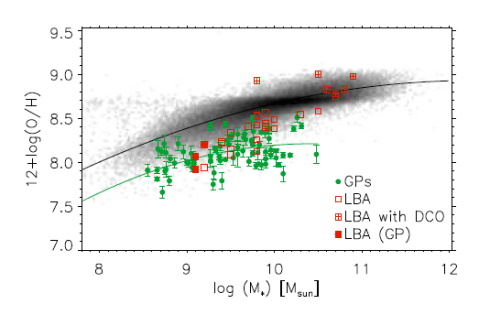 From: Amorin et al. (2010), arXiv:1004.4910. Horizontal axis: galaxy mass; Vertical axis: “metallicity”
What they find is different from our paper. Using a different method to measure the metallicity of the peas, they include the abundance of Nitrogen. This turns out to be anomalous in the peas, and suggests that the peas are less metal-enriched than we concluded. They then look at whether the peas have the amount of metals that other galaxies of similar mass have, and conclude that the peas are off the “mass-metallicity relation” (see plot above – green points are the peas,which are below the grey shaded area representing normal star forming galaxies). This is definitely different from what we concluded – we deduced that the peas are actually on the mass-metallicity relation.
They discuss what this means – if they are right, this makes the peas even more exceptional, since they don’t fit in with normal galaxies in our old, evolved Universe, and underscores their role as “living fossils” since the peas are more like primordial galaxies than evolved ones. The differences in this nitrogen abundance tells us something about the way the peas convert gas into stars that is quite different from what occurs in galaxies like our own Milky Way. Amorin et al. further suggest that the “pea” phase is likely short-lived as the intense star formation in the peas will quickly enrich the gas to make them appear more like their normal cousins. The differences in this nitrogen abundance can imply
So who is right? We don’t know yet. The Amorin et al. paper is appearing in the Astrophysical Journal as a Letter and hopefully starts off a debate on the topic. Stay tuned!
Kevin & Carie
101: The Great Debate
This is the first in a new series of blog posts under the title of ‘Galaxies 101’. These posts aim to explore the history and basics of the science of galaxies. I’ll be covering some of people who helped us understand these ‘Island Universes’ as well as some of the basics that would be taught during a first year undergraduate galaxies course at university.
It is fortunate that these posts are beginning in the week of the 90th anniversary of The Great Debate which occurred on April 26th, 1920. The Great Debate – or the Shapely-Curtis Debate – took place at the Smithsonian Museum of Natural History between two eminent astronomers, Harlow Shapley and Heber Curtis. Shapely was arguing that the ‘spiral nebulae’, that were observed at the time, were within our own Galaxy – and that our Galaxy was the Universe. He also argued that the Sun was not at its centre. Conversely, Curtis argued that the Sun was at the centre of our Galaxy but that the ‘spiral nebulae’ were not inside our Galaxy at all. He suggested instead that the Universe was much larger than our Galaxy and that these nebulae were in fact other, ‘island’ universes.
Below is a drawing of the ‘spiral nebula’ M51. This is an observation by Lord Rosse, drawn in 1845 using the 72-inch Birr Telescope at Armagh Observatory in the UK.

With 90 years of hindsight we can now say that Shapely and Curtis were both right and wrong. The Sun is not at the centre of the Galaxy and the Galaxy is only one of hundreds of billions of galaxies in the Universe. But how was the argument resolved? The answer, in part, comes from a very famous name in astronomy: Hubble.
Less a decade after the Great Debate took place, Edwin Hubble used the largest telescope in the world – the 100-inch Hooker Telescope on Mount Wilson – to observe Cepheid variable stars in the Andromeda Nebula/Galaxy. Cepheid variables are a type of pulsating stars whose pulsation periods are precisely proportional to their luminosities. This makes Cepheid variable stars a ‘standard candle’ – an object where the brightness is a known quantity. If you can observe the apparent brightness of a standard candle, then you can determine its distance by a simple inverse square law. Since Cepheid variable stars have pulse rates proportional to their luminosity, if you can measure the pulse rate of a Cepheid variable anywhere in the Universe, then you can determine how far away it is. This is what Edwin Hubble did in 1925 and he calculated the distance to Andromeda as 1.5 million light years.

At the time, Shapely thought that our Galaxy was around 300,000 light years across and Curtis believed it was around 30,000 light years. Hubble’s measurement placed Andromeda well outside our galaxy and showed that Curtis was correct in thinking that the ‘spiral nebulae’ could indeed be other galaxies. Today we think the Milky Way is about 100,000 light years across and that Andromeda is 2.5 million light years away.
The discoveries of the 1920s started a whole new adventure for astronomy. The Universe had gotten a lot bigger and was about to expand much, much more. It is important to remember that Shapely, although wrong about the nature of the nebulae, did correctly assert that the Sun was not at the centre of the Galaxy. This is the kind of Copernican shift that makes people think about things differently and it is important to realise that the issues discussed during the Great Debate were complex. For our benefit though, the Great Debate is a starting point for exploring the relatively new study of galaxies. Humanity’s view of the Universe, and our place within it, has changed an awful lot since 1920. The study of galaxies has had a lot to do with that.
If you want to read more about the Great Debate, and what else helped to resolve the arguments I can recommend this excellent NASA site. You can also read the published text of the debate online.
[Andromeda image credit: Robert Gendler]
Galaxy Zoo: Hubble

The Galaxy Zoo project has evolved once again – now we are classifying galaxies from the incredible Hubble Space Telescope! Galaxy Zoo: Hubble is the new incarnation of the Galaxy Zoo project and it continues to allow you to help astronomers with real scientific research by asking you to to visually classify galaxies online.
The original Galaxy Zoo and Galaxy Zoo 2 both used data from the Sloan Digital Sky Survey and recently, after reaching 60,000,000 classifications those projects began to wind down. The timing is excellent though and it allows Galaxy Zoo: Hubble to launch today, for the 20th anniversary of the space telescope. Images of galaxies taken using the legendary space telescope are there for everyone to classify and I recommend that you go and do just that.

A lot of the fainter galaxies look like those seen in the Sloan catalogue from Galaxy Zoo 2 (this is a good sign, since we don’t want galaxies to change wildly depending on what telescopes we use!) however in amongst these there are some real gems to be discovered in the Galaxy zoo: Hubble data. I just found a couple in my first tentative classifications, I’ve shown them here to whet your appetites.
Hubble has now been in orbit for 20 years. In that time it has helped us to understand the age of the Universe, to see more distant galaxies than ever before, to detect the presence of black holes in the centre of galaxies, to witness a comet collide with Jupiter, and much more!
Hubble has captured the imagination of people all around the world and it has given us some of the most iconic images of space that exists in the public consciousness. The image at the top of this post was taken during Servicing Mission 4, just after the Space Shuttle Atlantis captured Hubble with its robotic arm in May 2009, beginning the mission to upgrade and repair the telescope. Thanks to that upgrade, Hubble will continue to provide amazing images and science for many years.
So that’s enough chat from me – go and classify some Hubble galaxies!
XMM-Newton is observing Hanny's Voorwerp TODAY!
Hi all,
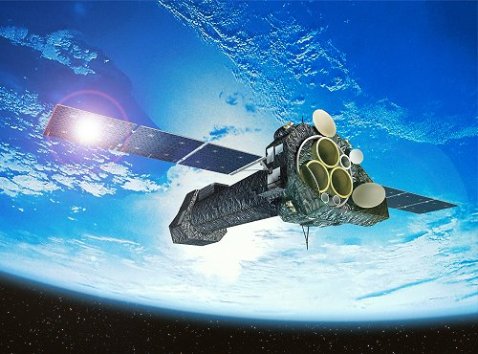
Just a quick note – our observations of IC 2497 and the Voorwerp have been scheduled for today and are taking place now. Since we’re observing in the X-rays, our “quick snapshot” to see what is going on actually takes almost a whole day. XMM-Newton‘s eye isn’t very sharp, so we won’t get a pretty picture. What we will get however is a really great spectrum of the X-ray emission of the black hole in IC 2497 (if it’s munching on stars and gas) and perhaps also the hot gas in the Voorwerp.
We won’t get the data right away though. First, the folks at the European Space Agency (esa) who are controlling XMM need to check out whether the data is OK and do some basic processing on it. Only then can they send it to us to have a look and that may take a few weeks.
Stay tuned!
Kevin
60 Million Classifications
Well, you’ve done it, more quickly than we would ever have thought possible. We have now reached a critical point – 60 million classifications means an incredibly robust, well-defined and scientifically valid catalogue of Sloan Digital Sky Survey galaxies. Congratulations to those who won prizes, and thanks to everyone who took part.
So what happens now? The site is still here, as you can see, and every classification you make will still improve our results, and will be saved in our database. To encourage you to keep clicking, we’re still giving away individual prizes to one person at random for each collection of 250,000 classifications. To take part, all you have to do is what you do best – classify galaxies – and it will help if you make sure your Zooniverse email address is up to date so we can contact you if you’re a winner.
What 60 million really means is that we can move on to the next phase of the project – and you won’t have long to wait…
How to handle Hubble images
While we’re squirreling away processing the Hubble data on IC 2497 and Hanny’s Voorwerp, and starting to get some science out of them, here’s a guide to the kinds of things needed to get science from Hubble images and make them presentable. To demonstrate, I’ll use a galaxy that shows up in the opposite corner of the field in exposures with the Wide-Field Camera 3 (WFC3). Read More…
Zoonometer Approaches 60 million

Having only announced the race to 60 million, only ten days ago, the Zoonometer is showing that we are now making the final 500,000 classifications! The response has been quite incredible and you can now start to see the winners going up on the Zoonometer page. We are still contacting winners as the classifications are made.
There is still one more prize draw to be made, at the 59,750,000 mark – when one classification from the previous 250,000 will be selected at random. Beyond that we await our 60,000,000th galaxy classification. The lucky person that makes that fateful classification will win a cool bundle of prizes:
- An original Sloan Digital Sky Survey plate
- A Galaxy Zoo mug and mousepad
- A Zooniverse t-shirt
Those of you that are wondering what will happen to Galaxy Zoo after the 60 million mark need not worry. We have a nice surprise in store for everyone very soon, but classifications will continue beyond 60,000,000 in the meantime. 60 million marks our minimum, best database. Every galaxy classified afterwards is still just as valid and useful as the 60,000,000 that preceded it and thus Galaxy Zoo will continue.
So if you want to be in with a chance of winning our prize for the 60,000,000th classification then go forth and classify! Watch this blog for more news and updates on the future of the Galaxy Zoo project.
[Image credit: NASA, ESA, K. Sheth (Spitzer Science Center, California Institute of Technology), and P. Capak and N. Scoville (California Institute of Technology)]
Machine Learning Paper Accepted!
Exciting News from Manda Banerji on the Machine Learning paper:
Hi Everyone!
This is to let you all know that the Galaxy Zoo machine learning paper has now been accepted for publication in the Monthly Notices of the Royal Astronomical Society journal. The final version of the paper is at http://arxiv.org/abs/0908.2033. You can read all about the paper in my previous blog post at http://blogs.zooniverse.org/galaxyzoo/2009/08/05/latest-galaxy-zoo-paper-submitted/.
The paper has already attracted a lot of interest from the computer science community demonstrating that your classifications are proving useful and interesting to non astronomers as well!
 Galaxy Zoo