Classification tree tweaks
Some of you may have noticed that on Thursday we made a couple of small changes to the flow of questions that are asked for each object in Galaxy Zoo: Hubble. Both of these changes relate to the set of additional questions which we introduced during the switch from Galaxy Zoo 2 to Galaxy Zoo: Hubble. As you will have certainly noticed, the new Hubble Space Telescope images contain many more galaxies with a clumpy appearance. This type of galaxy was very rare in the Sloan Digital Sky Survey images and doesn’t really fit into the classification tree we used for Galaxy Zoo 2. To obtain useful classifications for these objects in Galaxy Zoo: Hubble we therefore decided to add another branch of questions to the “classification tree”.
 During the first month or so of Galaxy Zoo: Hubble we have received a great deal of very useful feedback, particularly on the forum. In particular, two features of the new classification tree appeared to cause a fair bit of consternation amongst some of the Zooites. After considering your comments, and much deliberation, we decided to make a few changes.
Both points of contention related to the question asked after an answer had been clicked for ‘How many clumps are there?’. If the answer was anything except ‘one’, then we then asked ‘Do the clumps appear in a straight line, a chain, a cluster or a spiral pattern?’. Now, that’s a hard enough question to answer when there is only three clumps, but doesn’t make much sense at all when there are just two. We were trying to keep things simple but, to be perfectly honest, this wasn’t very sensible on our part. We have now changed the tree so that if the answer given is ‘two’, the question about how they are arranged is skipped.
The second issue was more interesting, because the frustration it caused told us something about the appearance of the clumpy galaxies which we hadn’t properly appreciated when planning the questions. New astrophysical insight before we’ve even collected enough clicks to start analysing! If the answer to ‘How many clumps are there?’ was ‘one’, the classification tree went back to the branch for ‘Smooth’ galaxies and asked ‘How rounded is it?’. Our thinking here was that a galaxy that was mostly just one clump would probably be an elliptical or maybe a bulge within a smooth disk galaxy.
It seems we both underestimated the discriminatory power of the Galaxy Zoo participants and how clearly different clumpy galaxies are from other types, even when there is only one clump. After having seen a few clumpy galaxies, it seems that many Zooites come to recognise that there are subtle features that set them apart from other types of galaxies. This suggests that single-clump galaxies really are a clearly different type of galaxy to the ellipticals and disks that are more common nearby. For single clump galaxies we now carry on asking the usual clumpy galaxy questions, skipping those that don’t make sense for only one clump.
Don’t worry – all your previous classifications of one (and two) clump galaxies are still safely stored away and will be very useful in helping us catalogue the subtle differences between the appearances of all these objects. Thank you, and keep clicking!
Voorwerp Web-Comic: Authors meeting at CONvergence

It came from the SDSS: The Voorwerp
Have you ever looked at the Voorwerp and said to yourself, “Doesn’t that look like the Swamp Thing?” Or maybe you’ve seen Kermit the Frog dancing, or a maybe you see foliage run amok. There is just something about the Voorwerp that make me, for one, want to anthropomorphize it as a monster, and I’m betting some of you have had the same moment of Pareidolia.
The neat thing about the Voorwerp is it not only looks like the character from a bad monster movie, but it is a real-life monster of a problem that has played a starring role in an intellectual adventure. While astronomy doesn’t normally get turned into summer block buster movies, this story just might make it with a rating of “S: Judged appropriate for people who contribute to science in their spare time.”
Image with me – you go into a movie theatre and hear booming from the speakers: “It came on the 13th; Monday the 13th. And one woman dared to ask ‘What is that stuff?'” Suddenly the camera zooms in on the Voorwerp. Then this imaginary movie trailer has us cutting between action adventure shots of astronomers racing for telescopes (you see a car racing across the desert with domes in the distance), the Swift space telescope repointing, and Zoo Keepers conferring in solemn tones as they gather around a computer. Bill Keel (played by Martin Sheen?) asks, “Can we get Hubble time?” and someone played by the Hollywood hunk of your choice responds in an overly dramatic tone, “I don’t know, but we have to try – I want answers – and we can handle the truth.”
Ok, so maybe the idea is pure cheese, and no Hollywood director (or college film major) is likely to shoot this flick, but there is still a story here that is worth sharing with the world.
And the STScI agrees with us. They’ve funded the creation of a digitized comic book (a web comic) to tell the story of Hanny’s discovery of the Voorwerp and the scientific adventure all of us have gone on as the truth has been sought in all sorts of wavelengths using a myriad of telescopes.
This comic is being written under the guidance of Kelly McCullough (author of the Ravirn series) by a team of volunteer writers at the CONvergence Con outside of Minneapolis, Minnesota, USA. The writers will work in close collaboration with Bill Keel and many other Zoo Keepers to make sure they get the story completely right.
Want to watch? Want to hang out with Zoo Keepers (list of attendees to come) at a cool event? Then join us in Bloomington, Minnesota, July 1-4, 2010. The event does cost money, unfortunately, and you have to register (My turn to bring the cookies). The cost of registration goes up May 15, so if you’re interested, please register ASAP for lowest prices.
We’ll be releasing the comic at Dragon*Con in the fall. We’d love it if you’d consider coming and being part of the celebration.
We’re going to work to keep you informed about everything that is going on. You can follow along at http://hannysvoorwerp.zooniverse.org, and in the webcomic thread on the forums.
Types of Galaxies
Last time I talked about the Great Debate of 1920, and about Edwin Hubble’s discovery that Galaxies lie beyond the Milky Way. The 1920s changed over view of the Universe – they made it much larger! This time I’m going to quickly outline the basic types of galaxies and the kind of sizes and distances we are dealing with.
Galaxies are usually grouped by their appearance. You may be familiar with spiral galaxies, for example. In fact there are two types of spiral galaxy: those with bars through their middle, and those without. You also have elliptical galaxies, which are basically big blobs of stars. Finally there are irregular galaxies, i.e. galaxies that don’t seem to be one shape or another really. There are examples of each of these types shown below – taken from the Galaxy Zoo data, of course!

Spirals

Barred Spirals

Ellipticals

Irregulars
The different shapes of galaxies tell us something about their properties, and we’ll deal with each type of galaxy in the next few blog posts. For now I thought I’d end with another of Hubble’s ideas. When he saw these different types of galaxies he tried to understand the different shapes as an overall evolution. He thought that elliptical galaxies might evolve into spirals as time went by. The Hubble ‘tuning fork’ diagram is shown below.

Hubble called the elliptical galaxies ‘early’ galaxies and the spirals ‘late’ galaxies. Galaxies do not move left across the diagram as they evolve, but still the diagram is a nice way to visualise the varying shapes of galaxies relative to one another. Understanding the shapes – or morphologies – of galaxies are a huge part of the motivation behind the Galaxy Zoo project. you can learn more about it on our science pages.
[UPDATE: This post has been modified from its original form to correct some errors on my part.]
Dust in the Zoo – chapters opening, continuing, and closing
Anna Manning and I are back at Kitt Peak, using the 3.5m WIYN telescope for
more observations of overlapping-galaxy systems from the Galaxy Zoo sample.
This trip started with an unexpected dust encounter. Indulging my fascination with some of the technological excesses of the Cold War, I dragged Anna (and my mother-in-law as well) to Tucson’s Pima Air and Space Museum. I particularly wanted to see their newly-restored B-36 aircraft, one of only 4 of these vintage giants left. The wind had been high already, but really whipped up and caught us in a dust storm (with added rain so it was like tiny mud droplets stinging the skin). Anna pointed out the irony, especially since I had announced on Twitter that “dust will be revealed, in detail”. Maybe next time it is I who should be more detailed.
Read More…
The latest on the peas – do they lack metals?
It’s sometimes difficult to know which papers will excite other scientists and get them to follow-up what you’ve done. Our peas paper already has seven references to it, so I wasn’t entirely surprised to find a whole paper discussing the peas on astro-ph today. Astro-ph is required reading for all astrophysicists and contains pre-prints of papers that are updated every day. Some papers are posted when they’re submitted to a journal, others only once they’ve been accepted. A wonderful thing about the field of astronomy is the free access to data and the wide sharing of ideas through forums such as astro-ph. This creates new and exciting scientific results at an amazing pace.
This paper, written by Ricardo O. Amorín, E. Pérez-Montero and J.M. Vílchez (all at the IAA-CISC), follows up on one of the aspects of the peas: the metallicity (amount of elements other than hydrogen and helium) that are polluting the gas in the peas. These elements (or metals, as astronomers confusingly say) are generated in supernovae, so the metallicity,and the ratios of specific elements, can give astronomers some idea of how “evolved” a galaxy is. The more metals, the more supernovae must have gone off and polluted the gas.
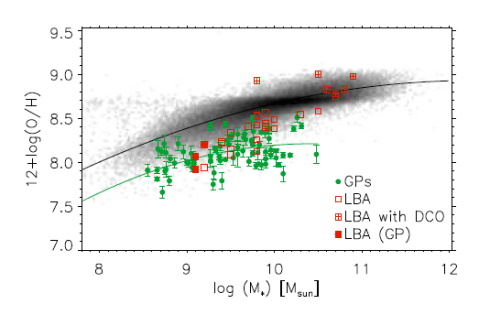 From: Amorin et al. (2010), arXiv:1004.4910. Horizontal axis: galaxy mass; Vertical axis: “metallicity”
What they find is different from our paper. Using a different method to measure the metallicity of the peas, they include the abundance of Nitrogen. This turns out to be anomalous in the peas, and suggests that the peas are less metal-enriched than we concluded. They then look at whether the peas have the amount of metals that other galaxies of similar mass have, and conclude that the peas are off the “mass-metallicity relation” (see plot above – green points are the peas,which are below the grey shaded area representing normal star forming galaxies). This is definitely different from what we concluded – we deduced that the peas are actually on the mass-metallicity relation.
They discuss what this means – if they are right, this makes the peas even more exceptional, since they don’t fit in with normal galaxies in our old, evolved Universe, and underscores their role as “living fossils” since the peas are more like primordial galaxies than evolved ones. The differences in this nitrogen abundance tells us something about the way the peas convert gas into stars that is quite different from what occurs in galaxies like our own Milky Way. Amorin et al. further suggest that the “pea” phase is likely short-lived as the intense star formation in the peas will quickly enrich the gas to make them appear more like their normal cousins. The differences in this nitrogen abundance can imply
So who is right? We don’t know yet. The Amorin et al. paper is appearing in the Astrophysical Journal as a Letter and hopefully starts off a debate on the topic. Stay tuned!
Kevin & Carie
101: The Great Debate
This is the first in a new series of blog posts under the title of ‘Galaxies 101’. These posts aim to explore the history and basics of the science of galaxies. I’ll be covering some of people who helped us understand these ‘Island Universes’ as well as some of the basics that would be taught during a first year undergraduate galaxies course at university.
It is fortunate that these posts are beginning in the week of the 90th anniversary of The Great Debate which occurred on April 26th, 1920. The Great Debate – or the Shapely-Curtis Debate – took place at the Smithsonian Museum of Natural History between two eminent astronomers, Harlow Shapley and Heber Curtis. Shapely was arguing that the ‘spiral nebulae’, that were observed at the time, were within our own Galaxy – and that our Galaxy was the Universe. He also argued that the Sun was not at its centre. Conversely, Curtis argued that the Sun was at the centre of our Galaxy but that the ‘spiral nebulae’ were not inside our Galaxy at all. He suggested instead that the Universe was much larger than our Galaxy and that these nebulae were in fact other, ‘island’ universes.
Below is a drawing of the ‘spiral nebula’ M51. This is an observation by Lord Rosse, drawn in 1845 using the 72-inch Birr Telescope at Armagh Observatory in the UK.

With 90 years of hindsight we can now say that Shapely and Curtis were both right and wrong. The Sun is not at the centre of the Galaxy and the Galaxy is only one of hundreds of billions of galaxies in the Universe. But how was the argument resolved? The answer, in part, comes from a very famous name in astronomy: Hubble.
Less a decade after the Great Debate took place, Edwin Hubble used the largest telescope in the world – the 100-inch Hooker Telescope on Mount Wilson – to observe Cepheid variable stars in the Andromeda Nebula/Galaxy. Cepheid variables are a type of pulsating stars whose pulsation periods are precisely proportional to their luminosities. This makes Cepheid variable stars a ‘standard candle’ – an object where the brightness is a known quantity. If you can observe the apparent brightness of a standard candle, then you can determine its distance by a simple inverse square law. Since Cepheid variable stars have pulse rates proportional to their luminosity, if you can measure the pulse rate of a Cepheid variable anywhere in the Universe, then you can determine how far away it is. This is what Edwin Hubble did in 1925 and he calculated the distance to Andromeda as 1.5 million light years.

At the time, Shapely thought that our Galaxy was around 300,000 light years across and Curtis believed it was around 30,000 light years. Hubble’s measurement placed Andromeda well outside our galaxy and showed that Curtis was correct in thinking that the ‘spiral nebulae’ could indeed be other galaxies. Today we think the Milky Way is about 100,000 light years across and that Andromeda is 2.5 million light years away.
The discoveries of the 1920s started a whole new adventure for astronomy. The Universe had gotten a lot bigger and was about to expand much, much more. It is important to remember that Shapely, although wrong about the nature of the nebulae, did correctly assert that the Sun was not at the centre of the Galaxy. This is the kind of Copernican shift that makes people think about things differently and it is important to realise that the issues discussed during the Great Debate were complex. For our benefit though, the Great Debate is a starting point for exploring the relatively new study of galaxies. Humanity’s view of the Universe, and our place within it, has changed an awful lot since 1920. The study of galaxies has had a lot to do with that.
If you want to read more about the Great Debate, and what else helped to resolve the arguments I can recommend this excellent NASA site. You can also read the published text of the debate online.
[Andromeda image credit: Robert Gendler]
Galaxy Zoo: Hubble

The Galaxy Zoo project has evolved once again – now we are classifying galaxies from the incredible Hubble Space Telescope! Galaxy Zoo: Hubble is the new incarnation of the Galaxy Zoo project and it continues to allow you to help astronomers with real scientific research by asking you to to visually classify galaxies online.
The original Galaxy Zoo and Galaxy Zoo 2 both used data from the Sloan Digital Sky Survey and recently, after reaching 60,000,000 classifications those projects began to wind down. The timing is excellent though and it allows Galaxy Zoo: Hubble to launch today, for the 20th anniversary of the space telescope. Images of galaxies taken using the legendary space telescope are there for everyone to classify and I recommend that you go and do just that.

A lot of the fainter galaxies look like those seen in the Sloan catalogue from Galaxy Zoo 2 (this is a good sign, since we don’t want galaxies to change wildly depending on what telescopes we use!) however in amongst these there are some real gems to be discovered in the Galaxy zoo: Hubble data. I just found a couple in my first tentative classifications, I’ve shown them here to whet your appetites.
Hubble has now been in orbit for 20 years. In that time it has helped us to understand the age of the Universe, to see more distant galaxies than ever before, to detect the presence of black holes in the centre of galaxies, to witness a comet collide with Jupiter, and much more!
Hubble has captured the imagination of people all around the world and it has given us some of the most iconic images of space that exists in the public consciousness. The image at the top of this post was taken during Servicing Mission 4, just after the Space Shuttle Atlantis captured Hubble with its robotic arm in May 2009, beginning the mission to upgrade and repair the telescope. Thanks to that upgrade, Hubble will continue to provide amazing images and science for many years.
So that’s enough chat from me – go and classify some Hubble galaxies!
XMM-Newton is observing Hanny's Voorwerp TODAY!

Hi all,
Just a quick note – our observations of IC 2497 and the Voorwerp have been scheduled for today and are taking place now. Since we’re observing in the X-rays, our “quick snapshot” to see what is going on actually takes almost a whole day. XMM-Newton‘s eye isn’t very sharp, so we won’t get a pretty picture. What we will get however is a really great spectrum of the X-ray emission of the black hole in IC 2497 (if it’s munching on stars and gas) and perhaps also the hot gas in the Voorwerp.
We won’t get the data right away though. First, the folks at the European Space Agency (esa) who are controlling XMM need to check out whether the data is OK and do some basic processing on it. Only then can they send it to us to have a look and that may take a few weeks.
Stay tuned!
Kevin
60 Million Classifications
Well, you’ve done it, more quickly than we would ever have thought possible. We have now reached a critical point – 60 million classifications means an incredibly robust, well-defined and scientifically valid catalogue of Sloan Digital Sky Survey galaxies. Congratulations to those who won prizes, and thanks to everyone who took part.
So what happens now? The site is still here, as you can see, and every classification you make will still improve our results, and will be saved in our database. To encourage you to keep clicking, we’re still giving away individual prizes to one person at random for each collection of 250,000 classifications. To take part, all you have to do is what you do best – classify galaxies – and it will help if you make sure your Zooniverse email address is up to date so we can contact you if you’re a winner.
What 60 million really means is that we can move on to the next phase of the project – and you won’t have long to wait…
How to handle Hubble images
While we’re squirreling away processing the Hubble data on IC 2497 and Hanny’s Voorwerp, and starting to get some science out of them, here’s a guide to the kinds of things needed to get science from Hubble images and make them presentable. To demonstrate, I’ll use a galaxy that shows up in the opposite corner of the field in exposures with the Wide-Field Camera 3 (WFC3). Read More…
 Galaxy Zoo

