Dust in the Zoo – chapters opening, continuing, and closing
Anna Manning and I are back at Kitt Peak, using the 3.5m WIYN telescope for
more observations of overlapping-galaxy systems from the Galaxy Zoo sample.
This trip started with an unexpected dust encounter. Indulging my fascination with some of the technological excesses of the Cold War, I dragged Anna (and my mother-in-law as well) to Tucson’s Pima Air and Space Museum. I particularly wanted to see their newly-restored B-36 aircraft, one of only 4 of these vintage giants left. The wind had been high already, but really whipped up and caught us in a dust storm (with added rain so it was like tiny mud droplets stinging the skin). Anna pointed out the irony, especially since I had announced on Twitter that “dust will be revealed, in detail”. Maybe next time it is I who should be more detailed.
Read More…
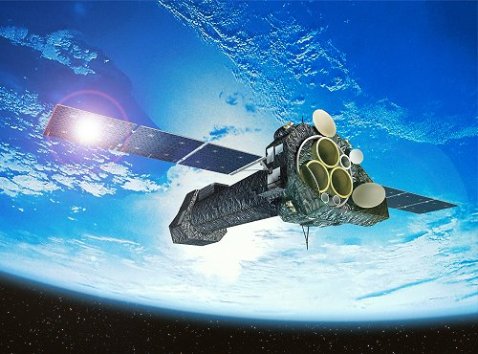
XMM-Newton is observing Hanny's Voorwerp TODAY!
Hi all,
Just a quick note – our observations of IC 2497 and the Voorwerp have been scheduled for today and are taking place now. Since we’re observing in the X-rays, our “quick snapshot” to see what is going on actually takes almost a whole day. XMM-Newton‘s eye isn’t very sharp, so we won’t get a pretty picture. What we will get however is a really great spectrum of the X-ray emission of the black hole in IC 2497 (if it’s munching on stars and gas) and perhaps also the hot gas in the Voorwerp.
We won’t get the data right away though. First, the folks at the European Space Agency (esa) who are controlling XMM need to check out whether the data is OK and do some basic processing on it. Only then can they send it to us to have a look and that may take a few weeks.
Stay tuned!
Kevin
How to handle Hubble images
While we’re squirreling away processing the Hubble data on IC 2497 and Hanny’s Voorwerp, and starting to get some science out of them, here’s a guide to the kinds of things needed to get science from Hubble images and make them presentable. To demonstrate, I’ll use a galaxy that shows up in the opposite corner of the field in exposures with the Wide-Field Camera 3 (WFC3). Read More…
Who's looking at the Voorwerp?
I just got a notification from the XMM-Newton Science Operations Centre that our observations of IC 2497 and the Voorwerp have now been scheduled for April 19th. XMM-Newton is esa’s flagship X-ray satellite and can observe photons from 0.2-10 keV. We’ve already got our hard X-ray observations from Suzaku last year, so XMM will have a second, detailed look at the softer X-rays. Also, if there’s anything there, then XMM will give us a very rough image; Suzaku can’t take images, only spectra. After the data are taken, it may take a few weeks for esa to process the raw data before they send it to us. Stay tuned…
Hubble observations – any week now!
Speaking of the long-awaited Hubble observations of Hanny’s Voorwerp – where are they? We know certain windows when each can be done, and is supposed to be carried out. One such week-long window has already gone by without getting data, so things are narrowed down a bit. Read More…
UV(oorwerp) from Space
We have some new results to show off, Hanny’s Voorwerp observed using a space telescope. No, not that space telescope, that’s still coming up (shortly, we hope).
Soon after the initial results showed what a fascinating object Hanny’s
Voorwerp was proving to be, it was entered in the observing schedule for NASA’S GALEX satellite (GALaxy Evolution EXplorer). Alex Szalay, who belongs to both the GALEX and Galaxy Zoo science teams, played a key role in making this happen). Alex has interesting career parallels with Brian May, but that’s another story.
GALEX was designed to make the first sensitive ultraviolet survey of most of the whole sky (skipping only areas where there are such bright stars that they would damage the detector array), with a major goal of tracing the recent evolution of galaxies. Read More…
Bars side project
Dear Zooniverse users,
We’d like to re-draw [no pun intended!] your attention to the GalaxyZoo Google-powered Bar drawing website: http://www.icg.port.ac.uk/~hoyleb/bars/ simply log in with your Zooninverse username and password. Please note, this site works best using FireFox.

GZ2 Galaxy as seen in Google Maps
In this project, we ask for more specific observations and even drawing to be performed on a selection of galaxies. The sample size is relatively small, and 8000 [of the 8400] galaxies have been classified 5 times. The remaining 400 have been examined 6+ times.
We are starting to collate votes, for example we see some excellent agreement between users, e.g. See the picture below, which shows the bars as drawn on the above galaxy by different users, but we still need a few more classifications for each galaxy, to really be able to produce science.
One such science question we’d like to answer is, “How does the presence of a bar, affect the galaxies properties?”. GZoo allows us to study this question with 20- times more data than previously possible.

GZ2 Galaxy with Bars drawn by users.
We’d also like to thank the GZ users for the hard work they have put into the site since it’s launch in October.
Regards,
Ben Hoyle, on behalf of the GZ-bar drawing team
Hello From Palomar
I’m Robert, an astronomer at the California Institute of Technology working on thePalomar Transient Factory (PTF). I have arrived at the Palomar Observatory in anticipation of my two night run on the 5.1 meter Hale Telescope. The plan is to take spectra of new PTF discoveries to find out what they are, and maybe follow-up on some of the more interesting sources we’ve already identified.

The dome of the Palomar 5.1m Hale Telescope
As you can see from the photo, the mountain was dusted with snow a couple days ago, but it was quite nice out at my arrival. Hopefully the wet stuff will help clear up our ash problem left over from this summer’s wild fires. More rain and/or snow may fall in the next few days, but I’m hoping the skies will clear up enough at night so that I can get some observing in.
Our survey telescope, which is just a short walk from the Hale Telescope, has gathered some new images over the last few nights. These likely contain a few new supernovae which you can help us identify. If all goes well, I will make spectroscopic observations the next two nights of the best candidates found. These data will reveal what the candidates are. There’s always the chance of discovering something new, which makes this all very exciting!
So happy hunting, and look for updates throughout my observing run.
Galaxy Zoo: Supernova is back
After a couple of trial runs in August and October, the hunt for supernovae is now back – and we need your help again! As before, we’re supporting the Palomar Transient Factory in their search for supernovae, and we have an upcoming observing run, this time at the Palomar 200in telescope.
We are hoping to keep the supernova hunt website up for good now – no more trials! – and so no danger of you being cut off in a few days time.
A few pieces of news from the supernova hunt.
The first is that we would have been back sooner, but Palomar, the observatory at which PTF operates, has suffered unusual atmospheric conditions following the forest fires in Southern California over the summer. A build-up of ash and dust in the atmosphere has meant the number of nights on which the observatory has been open has been greatly reduced, and so the supernova search has been offline for much of the Autumn. Even now, the conditions are still unstable, so please bear with us if the number of candidates is very small!
The second is that in the near future we will have a website containing feedback on the classifications that you’ve all been doing. We’re also in the process of writing a scientific paper on the trial runs from earlier in the year.
Finally, we are planning to add other supernova searches to the hunt – so watch this space for more data.
That’s all for now. Good luck with the supernova hunting, and don’t forget to post questions or comments over in the forum!
Voorwerping, Part 2
We’ve been working hard at making sense of the X-ray data from Suzaku and it turns out we (that is, Shanil) will have to do a very, very careful analysis of the data beyond what is described in the handbook to be sure we understand what the data mean. In the meantime, I’ve started the paper and generated some new, very beautiful composite images of IC 2497 and the Voorwerp…
 Galaxy Zoo