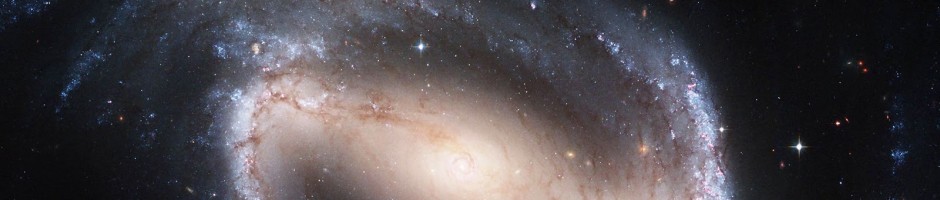
A brief history of clumpy galaxies
The vast majority of galaxies we see around us today can be grouped into just a few categories of visual appearance, or morphology. There are spirals and lenticulars (barred and not), ellipticals and irregulars. These are described in this recent post and will be looked at more closely in the Galaxies 101 series. Things get a bit more complicated when one goes to faint and small “dwarf” galaxies, but we won’t go into that here. There are also a small fraction of galaxies that are in the process of merging, often creating unusual and spectacular morphologies, but again they will have to wait for a future post.

Studying the morphologies of galaxies was quickly recognised as an interesting thing to do, as it gives us lots of clues as to how galaxies originally formed and how they have interacted with one another and their surroundings over the history of the Universe. However, because of the blurring effect of the atmosphere, and the fact that galaxies, like everything else, appear smaller the further away they are, for a long time it was not possible to see the morphologies of distant galaxies. With big telescopes, though, we could still determine their brightnesses, colours and numbers. From these measurements we knew that far-away galaxies were generally different from those nearby. Remember that the finite speed of light means that we see distant galaxies as they were in the past, when the Universe was younger. This useful fact means that we can directly see how the galaxy population has evolved just by looking further and further away. But while our telescopes were stuck on the ground we couldn’t see what galaxies in the early Universe actually look like.
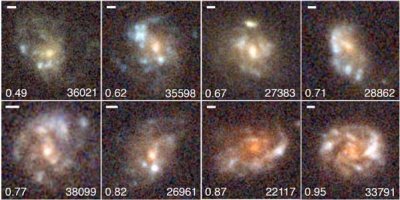
Example clumpy spiral galaxies in GOODS imaging, from Elmegreen et al. 2009. Each panel includes a bar of length 2 kpc, the object’s redshift and COMBO-17 ID number.
The Hubble Space Telescope (HST), together with its camera WFPC2, solved the problem. Free from the atmosphere, it could see details ten times finer than ground-based telescopes. Finally we could see distant galaxies clearly enough to study their morphology. To demonstrate HST’s power, some of the first HST images were taken by staring at the same patch of the sky for a very long time, producing very deep images. Studies of these images of the distant Universe (e.g., by Cowie, Hu & Songaila in 1995 and van den Bergh and colloborators in 1996) revealed that the galaxy types seen nearby were still present, but generally become “messier” the further back in time one looks. Furthermore, there appeared to be types of distant galaxies that we do not see today. Many of these galaxies comprise knots or clumps. In particular, many galaxies were found with an appearance of several clumps arranged in a line, and were named “chain galaxies”. Galaxies with two clumps were simply named “doubles”. There were also galaxies with the appearance of one clump with a tail, appropriately named “tadpole galaxies”!

Example clumpy galaxies, details as above.
For the next few years, most studies of galaxy morphology with the HST concentrated on galaxies at intermediate distances, where HST provided detail impossible to obtain from the ground, without requiring very long exposure times. Galaxy morphologies are becoming messier at these times, but the clumpy galaxies seen in the deepest surveys were much more distant. However, the field of distant galaxy morphology had a further renaissance with the replacement of the WFPC2 camera with the Advanced Camera for Surveys (ACS). This enabled even deeper, clearer images to be obtained more quickly. Studies of these images (e.g., particularly by the Elmegreens and collaborators) find that clumpy galaxies become extremely common in the early universe. The extra depth of these data has revealed a population of clumpy galaxies that do not appear as chains, but rather more circular groups of clumps. These have been named “clump clusters”. While clump clusters share similarities with modern-day irregular galaxies there are a few important differences. Clump clusters are generally much more massive, and today’s irregulars would look irregular no matter which direction they are viewed from. The similarilty between clump clusters and chain galaxies implies that they are the same kind of object, simply viewed from different directions. This means that the clumps must be irregularly distributed in fairly thin disks, which appear as chains when viewed edge-on.

Examples of clumps in an underlying red galaxy, details as above.
Further studies of clumpy galaxies confirm that they are very young galaxies with lots of star formation occuring in the massive clumps, which may be embedded within a slightly older, smoother distribution of stars. Their prevalence means they are likely to be an early phase in the development of most, if not all, galaxies.
As I mentioned in my previous post, for Galaxy Zoo: Hubble we added a series of questions in order to find out about the appearance of clumpy galaxies. This will provide us with a catalogue of their properties that is larger and more consistent than any before. By analysing this data we hope to learn much more about these galaxies. For example, there appears to be a rough developmental sequence from asymmetric clumpy galaxies, to symmetric clumpy galaxies, to clumpy galaxies dominated by a bright, central clump, and finally to spiral galaxies. Other clumpy galaxies may merge together to form ellipticals. By comparing the numbers and properties of these different types of galaxies we will be able to confirm or refute this picture, and better understand the origins of the galaxy population.
Classification tree tweaks
Some of you may have noticed that on Thursday we made a couple of small changes to the flow of questions that are asked for each object in Galaxy Zoo: Hubble. Both of these changes relate to the set of additional questions which we introduced during the switch from Galaxy Zoo 2 to Galaxy Zoo: Hubble. As you will have certainly noticed, the new Hubble Space Telescope images contain many more galaxies with a clumpy appearance. This type of galaxy was very rare in the Sloan Digital Sky Survey images and doesn’t really fit into the classification tree we used for Galaxy Zoo 2. To obtain useful classifications for these objects in Galaxy Zoo: Hubble we therefore decided to add another branch of questions to the “classification tree”.
 During the first month or so of Galaxy Zoo: Hubble we have received a great deal of very useful feedback, particularly on the forum. In particular, two features of the new classification tree appeared to cause a fair bit of consternation amongst some of the Zooites. After considering your comments, and much deliberation, we decided to make a few changes.
Both points of contention related to the question asked after an answer had been clicked for ‘How many clumps are there?’. If the answer was anything except ‘one’, then we then asked ‘Do the clumps appear in a straight line, a chain, a cluster or a spiral pattern?’. Now, that’s a hard enough question to answer when there is only three clumps, but doesn’t make much sense at all when there are just two. We were trying to keep things simple but, to be perfectly honest, this wasn’t very sensible on our part. We have now changed the tree so that if the answer given is ‘two’, the question about how they are arranged is skipped.
The second issue was more interesting, because the frustration it caused told us something about the appearance of the clumpy galaxies which we hadn’t properly appreciated when planning the questions. New astrophysical insight before we’ve even collected enough clicks to start analysing! If the answer to ‘How many clumps are there?’ was ‘one’, the classification tree went back to the branch for ‘Smooth’ galaxies and asked ‘How rounded is it?’. Our thinking here was that a galaxy that was mostly just one clump would probably be an elliptical or maybe a bulge within a smooth disk galaxy.
It seems we both underestimated the discriminatory power of the Galaxy Zoo participants and how clearly different clumpy galaxies are from other types, even when there is only one clump. After having seen a few clumpy galaxies, it seems that many Zooites come to recognise that there are subtle features that set them apart from other types of galaxies. This suggests that single-clump galaxies really are a clearly different type of galaxy to the ellipticals and disks that are more common nearby. For single clump galaxies we now carry on asking the usual clumpy galaxy questions, skipping those that don’t make sense for only one clump.
Don’t worry – all your previous classifications of one (and two) clump galaxies are still safely stored away and will be very useful in helping us catalogue the subtle differences between the appearances of all these objects. Thank you, and keep clicking!
Dust in the Zoo – chapters opening, continuing, and closing
Anna Manning and I are back at Kitt Peak, using the 3.5m WIYN telescope for
more observations of overlapping-galaxy systems from the Galaxy Zoo sample.
This trip started with an unexpected dust encounter. Indulging my fascination with some of the technological excesses of the Cold War, I dragged Anna (and my mother-in-law as well) to Tucson’s Pima Air and Space Museum. I particularly wanted to see their newly-restored B-36 aircraft, one of only 4 of these vintage giants left. The wind had been high already, but really whipped up and caught us in a dust storm (with added rain so it was like tiny mud droplets stinging the skin). Anna pointed out the irony, especially since I had announced on Twitter that “dust will be revealed, in detail”. Maybe next time it is I who should be more detailed.
Read More…
The latest on the peas – do they lack metals?
It’s sometimes difficult to know which papers will excite other scientists and get them to follow-up what you’ve done. Our peas paper already has seven references to it, so I wasn’t entirely surprised to find a whole paper discussing the peas on astro-ph today. Astro-ph is required reading for all astrophysicists and contains pre-prints of papers that are updated every day. Some papers are posted when they’re submitted to a journal, others only once they’ve been accepted. A wonderful thing about the field of astronomy is the free access to data and the wide sharing of ideas through forums such as astro-ph. This creates new and exciting scientific results at an amazing pace.
This paper, written by Ricardo O. Amorín, E. Pérez-Montero and J.M. Vílchez (all at the IAA-CISC), follows up on one of the aspects of the peas: the metallicity (amount of elements other than hydrogen and helium) that are polluting the gas in the peas. These elements (or metals, as astronomers confusingly say) are generated in supernovae, so the metallicity,and the ratios of specific elements, can give astronomers some idea of how “evolved” a galaxy is. The more metals, the more supernovae must have gone off and polluted the gas.
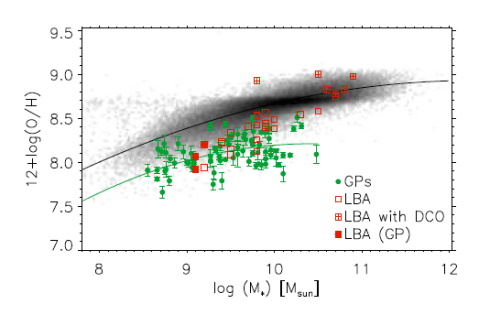 From: Amorin et al. (2010), arXiv:1004.4910. Horizontal axis: galaxy mass; Vertical axis: “metallicity”
What they find is different from our paper. Using a different method to measure the metallicity of the peas, they include the abundance of Nitrogen. This turns out to be anomalous in the peas, and suggests that the peas are less metal-enriched than we concluded. They then look at whether the peas have the amount of metals that other galaxies of similar mass have, and conclude that the peas are off the “mass-metallicity relation” (see plot above – green points are the peas,which are below the grey shaded area representing normal star forming galaxies). This is definitely different from what we concluded – we deduced that the peas are actually on the mass-metallicity relation.
They discuss what this means – if they are right, this makes the peas even more exceptional, since they don’t fit in with normal galaxies in our old, evolved Universe, and underscores their role as “living fossils” since the peas are more like primordial galaxies than evolved ones. The differences in this nitrogen abundance tells us something about the way the peas convert gas into stars that is quite different from what occurs in galaxies like our own Milky Way. Amorin et al. further suggest that the “pea” phase is likely short-lived as the intense star formation in the peas will quickly enrich the gas to make them appear more like their normal cousins. The differences in this nitrogen abundance can imply
So who is right? We don’t know yet. The Amorin et al. paper is appearing in the Astrophysical Journal as a Letter and hopefully starts off a debate on the topic. Stay tuned!
Kevin & Carie
XMM-Newton is observing Hanny's Voorwerp TODAY!

Hi all,
Just a quick note – our observations of IC 2497 and the Voorwerp have been scheduled for today and are taking place now. Since we’re observing in the X-rays, our “quick snapshot” to see what is going on actually takes almost a whole day. XMM-Newton‘s eye isn’t very sharp, so we won’t get a pretty picture. What we will get however is a really great spectrum of the X-ray emission of the black hole in IC 2497 (if it’s munching on stars and gas) and perhaps also the hot gas in the Voorwerp.
We won’t get the data right away though. First, the folks at the European Space Agency (esa) who are controlling XMM need to check out whether the data is OK and do some basic processing on it. Only then can they send it to us to have a look and that may take a few weeks.
Stay tuned!
Kevin
How to handle Hubble images
While we’re squirreling away processing the Hubble data on IC 2497 and Hanny’s Voorwerp, and starting to get some science out of them, here’s a guide to the kinds of things needed to get science from Hubble images and make them presentable. To demonstrate, I’ll use a galaxy that shows up in the opposite corner of the field in exposures with the Wide-Field Camera 3 (WFC3). Read More…
Who's looking at the Voorwerp?
I just got a notification from the XMM-Newton Science Operations Centre that our observations of IC 2497 and the Voorwerp have now been scheduled for April 19th. XMM-Newton is esa’s flagship X-ray satellite and can observe photons from 0.2-10 keV. We’ve already got our hard X-ray observations from Suzaku last year, so XMM will have a second, detailed look at the softer X-rays. Also, if there’s anything there, then XMM will give us a very rough image; Suzaku can’t take images, only spectra. After the data are taken, it may take a few weeks for esa to process the raw data before they send it to us. Stay tuned…
Ring of the Week: The Eagle Has Landed
“Fly me to the moon
Let me play among the stars
Let me see what spring is like
On a-Jupiter and Mars”
– Frank Sinatra, “Fly Me to the Moon”
This week I had the honour of meeting three legends of the 20th century; astronauts Capt. Neil Armstrong, Capt. Gene Cernan and Capt. Jim Lovell. Neil Armstrong is, of course, the first man to set foot on the moon (Apollo 11), Jim Lovell was the commander of Apollo 13 and Gene Cernan was the last man to walk on the moon (Apollo 17).

Right to left: Capt. Gene Cernan, Capt. Neil Armstrong and Capt. Jim Lovell
The astronauts were talking on behalf of the Foundation for Science and Technology at the Royal Society and Cernan and Lovell both spoke of their disappointment at the US plans to abandon the “Constellation” programme which aimed to put astronauts back on the moon by 2020. Cernan said that, walking on the moon in 1972, he never would have imagined that he would still be the last man to set foot on the moon’s suface over 37 years later. The astronauts also talked of their hope that they would be alive to see man set foot on Mars.
Politics aside, it was fascinating to hear the astronauts speak about their experiences. All of the astronauts agreed that travelling to the moon changed their perspective of life on Earth. Cernan said it was staring out of the window into the black “infinity of space”, whereas Lovell said it was looking back from the moon and “being able to cover the entire World with my thumb” that was the most life changing moment.
 My Ring of the Week this week is Galaxy Zoo image 587741708326863123 and is in honour of Neil Armstrong and his lunar module, the Eagle. You can see the ring on the bottom right of the image and an unusual, bird-shaped “Eagle” galaxy on the top left. The “Eagle” galaxy is at the same redshift as the ring and so at the same distance away from us. This means that the two galaxies are most likely interacting in some way.
It could be that the “Eagle” is a polar ring (see last week’s post), where stars have been gravitationally stripped from the larger ring galaxy to rotate around the poles of the smaller galaxy. Or perhaps this is a collisional ring system, the “Eagle” having crashed through the centre of the larger galaxy to create the blue ring of stars that we see on the bottom right of the image. At the moment I’m not quite sure exactly which option (if either!) is the right one so feel free to post your own ideas about what you think may be happening and I’ll let you know if I figure it out!
Ring of the Week: Arp 87
“Up on a hill, as the day dissolves
With my pencil turning moments into line
High above in the violet sky
A silent silver plane – it draws a golden chain
One by one, all the stars appear
As the great winds of the planet spiral in
Spinning away, like the night sky at Arles
In the million insect storm, the constellations form
On a hill, under a raven sky
I have no idea exactly what I’ve drawn
Some kind of change, some kind of spinning away
With every single line moving further out in time”
– Brian Eno, “Spinning Away”
Well if you ask me, what you’ve drawn there Brian is a “Polar Ring” galaxy.
Polar ring galaxies, unlike all other galaxies in the Universe, are made up of two distinct parts. In the centre we have a normal galaxy and around the outside we have a “golden chain” of stars and gas clouds. This ring is perpendicular to the “silver plane” of the host galaxy disk, rotating over the poles, and so it’s known as a polar ring.
So how are polar rings formed? Polar rings are thought to form when two galaxies gravitationally interact with each other. We believe that “one by one, all the stars appear” as they are stripped from a passing galaxy and “spiral in” to produce the polar ring we see today. Polar rings, although not quite as rare as smoke rings, are pretty hard to find. According to “New observations and a photographic atlas of polar-ring galaxies”, about 1 in every 200 lenticular galaxies (a type of galaxy between an elliptical and a spiral) have these “golden chains” of stars and gas spinning around them. Below is a selection of some of my favourite polar rings from the Galaxy Zoo:
 The Zooites have done fantastically well at finding Polar Rings and you can see all of their incredible finds on the Possible Polar Ring thread on the Galaxy Zoo forum.
My Ring of the Week this week is the stunning pair of interacting galaxies Arp 87. Located in the constellation Leo, approximately 300 million light years away from Earth, Arp 87 gives us a fantastic insight in to exactly how polar ring galaxies are formed. The image on the left is the Galaxy Zoo Arp 87 image and on the right is an image taken by the Hubble Space Telescope. We can clearly see the galaxy on the left gravitationally stripping away the stars and gas from the spiral galaxy on the right.

Unfortunately for Brian Eno, his hypothesis of a “golden chain” of stars that “spiral in” a “silver plane” came a full 23 years after the first polar ring galaxy was identified by J. L. Sérsic in 1967.
However, perhaps someone else had already had a genuine polar ring premonition a full 78 years before Sérsic’s discovery…?

– “Starry Night” 1889, Vincent Van Gogh
The Hubble image is part of a collection of 59 images of merging galaxies released on the occasion of its 18th anniversary on April 24, 2008. (NASA, ESA, the Hubble Heritage (STScI/AURA)-ESA/Hubble Collaboration, and A. Evans (University of Virginia, Charlottesville/NRAO/Stony Brook University))
Hubble observations – any week now!
Speaking of the long-awaited Hubble observations of Hanny’s Voorwerp – where are they? We know certain windows when each can be done, and is supposed to be carried out. One such week-long window has already gone by without getting data, so things are narrowed down a bit. Read More…
 Galaxy Zoo