She's an Astronomer: Did we really need that series?
A long time ago when I initiated the She’s an Astronomer series I came up with the idea that it would be nice to ask everyone the same questions so that we get a overview of what lots of different (female) astronomers thought about the same issues. I deliberately set up a range of questions to allow the interviewees to focus on both the positive aspects of being involved in astronomy (and particularly the wonderful science Galaxy Zoo does) as well as any negative aspects of being a female in a very male dominated group.

And just in case there are any doubters out there I want to make it very clear that astronomy, both professional and amateur, remains very male dominated at almost all levels (and in professional astronomy, with declining participation the more senior the role). The UK’s professional astronomer group, the RAS has the following statement on the gender make-up of professional astronomers in the UK (admittedly now from 13 year old data):
“The 1998 PPARC/RAS survey for the first time enquired into the gender of members of the UK astronomical community. Women comprised 22% of the population of PhD students, which compares favourably with the 20% of students accepted for undergraduate places in physics and astronomy. However, only 7% of permanent university staff in astronomy are female. Of the UK IAU membership in 1998, 9.2% are female.”
and from our American friends at AAS, they provide a more recently updated table of Statistics which shows the encouraging statistic that in the US now about 40% of the PhD students are now women (but still only about 10% of permanent staff).
Statistics on amateur astronomers are a bit harder to find. You’d think our own Zooite database would help, but unfortunately we don’t track that kind of information. From experience though (as a speaker) I know amateur astronomers are an extremely male dominated group and disappointingly there has been very little change in this over the last few decades. This article in Sky and Telescope (which incidentally pictures one of the professionals we interviewed – Prof. Meg Urry) celebrates the improvement in the numbers of professional women astronomers since the late 70s, but reports that the situation hasn’t changed nearly as much in amateur astronomy: “According to Sky & Telescope reader polls, in 1979 only 6 percent of subscribers were female. By 2002 that number had grown to [only?] 9 percent.” And thanks to my friends on Twitter I found more recent S&T reader demographics which lists only 5% female readers as of January 2010. So that’s very disappointing. And in case you think such figures are somehow S&T only, my friends at the Jodcast tell me their mid 2010 survey of listeners resulted in a figure of 14% women (consistent with 9% women from 2007 within statistical uncertainty).
Anyway back to our She’s an Astronomer series and let’s see what the women who are involved have to say about all this. As it’s been several months now since the last post I’ll remind you that the questions we asked ranged from the personal (to give a bit of background) to more general. They were:
- How did you first hear about Galaxy Zoo?
- What has been your main involvement in the Galaxy Zoo project?
- What do you like most about being involved in Galaxy Zoo?
- What do you think is the most interesting astronomical question Galaxy Zoo will help to solve?
- How/when did you first get interested in Astronomy?
- What (if any) do you think are the main barriers to women’s involvement in Astronomy?
- Do you have any particular role models in Astronomy?
Also if you remember we interviewed 16 different women – which comprised all 8 of the professional astronomers (from students, to senior professor) who had been involved in Galaxy Zoo at that time, plus 8 of the Zooites.
The full list of interviewees was:
- Zooites:
- Hanny Van Arkel (Galaxy Zoo volunteer and finder of Hanny’s Voorwerp). Hanny’s interview in het Nederlands.
- Alice Sheppard (Galaxy Zoo volunteer and forum moderator).
- Gemma Couglin (“fluffyporcupine”, Galaxy Zoo volunteer and forum moderator).
- Aida Berges (Galaxy Zoo volunteer – major irregular galaxy, asteroid and high velocity star finder). Entrevista de Aida en español.
- Julia Wilkinson (“jules”, Galaxy Zoo volunteer. Frequent forum poster.).
- Els Baeton (“ElisabethB”, Galaxy Zoo folunteer. Frequent forum poster, and member of most of the spin-off projects!). Els’s interview in het Nederlands.
- Hannah Hutchins (Galaxy Zoo volunteer, forum poster and co-creator of Galaxy Zoo APOD)
- Elizabeth Siegel (Galaxy Zoo volunteer, forum poster)
- Researchers:
- Dr. Vardha Nicola Bennert (researcher at UCSB involved in Hanny’s Voorwerp followup and the “peas” project). Vardha’s Interview auf Deutsch.
- Carie Cardamone (graduate student at Yale who lead the Peas paper).
- Dr. Kate Land (original Galaxy Zoo team member and first-author of the first Galaxy Zoo scientific publication; now working in the financial world).
- Dr. Karen Masters (researcher at Portsmouth working on red spirals, and editor of this blog series.)
- Dr. Pamela L. Gay (astronomy researcher and communicator based at Southern Illinois University).
- Anna Manning (Masters’ Degree Student in Astronomy at Alabama University working with Dr. Bill Keel on overlapping galaxies)
- Dr. Manda Banerji (recent PhD and author of the machine learning paper)
I’ve been wondering for quite some time if the group agreed with each other on anything, and if we can come up with any interesting conclusions by looking at the different answers to each question. As some of you know I’ve been a bit distracted (little things like having a second baby, and getting some exciting Zoo2 results out), but I have now collated the answers to two of the most general questions (“What do you think is the most interesting astronomical question Galaxy Zoo will help to solve?” and “What (if any) do you think are the main barriers to women’s involvement in Astronomy?”) and plan to present my summary of the responses in upcoming blog posts.
I was going to chicken out and start with the science – the less controversial question (and where there was the most agreement), but thinking about it, perhaps it’s better to get the negative out of the way first, so I’ll leave the exciting science answers for next time and instead start with:
What (if any) do you think are the main barriers to women’s involvement in Astronomy?
Here there was a lot of disagreement, but some interesting trends with the level of formal education/career progression in the field (unfortunately in the sense that there were more perceived problems the longer a person had worked in astronomy).
For the most part the Zooites focussed on the problem of presenting science (to both girls and boys) as a boring/hard subject in schools (and to a lesser extent in the media). Our youngest interviewee, Hannah (who is working on her IGCSEs as a home schooled student) summarized the general view most clearly “because it’s taught so badly at school, it shuts down any interest”, and Alice (a science writer and former science teacher) agrees: “I think poor education is a far worse barrier than gender”. Gemma (a postgraduate student in engineering) muses that perhaps it’s because: “maths and science are [not] presented in an interesting way for girls at school and they are perceived as hard, rigid, dusty disciplines”. And Julia (an amateur astronomer with a degree in Economics) finishes it off by saying that she “think[s] that the media is partly to blame for propagating this myth by getting it badly wrong when presenting some science programmes and portraying maths as something we all hated at school”.
There were some positive views from the Zooites though. Hanny (a Dutch school teacher) expressed a her view that if you’re determined enough you’ll make it: “I can’t think of something that would’ve stopped me to be honest”, and there was a view expressed by the volunteers with more life experience that things were improving with time, for example Julia says: “I think things have improved slightly since [I was at school] but the popular myth still exists that maths is hard and science is stuffy and boring” and Els (a secretary in Belgium) says: “as you can see with the Galaxy Zoo community there are lots of women involved of all ages and backgrounds. So I think we’re getting there, eventually.” Aida (a stay home Mom in Puerto Rico, originally from the Dominican Republic) agrees saying “now I see that the universities [in the Dominican Republic] are full of women studying and that makes me so proud. There are no barriers now for us”.
And our ever resourceful Zooites provided some suggestions for improving the first formal introduction to science. Gemma says it best “if people could see more clearly at a young age how many cool things you can do with maths and science and the sense of achievement you get from problem solving, that they aren’t dry subjects that you learn by rote and that there are still many interesting things to discover, I’m sure a lot more people would be interested, be they women or men.”
From the younger members of the professional astronomers there was really good news in a generally positive feeling that the days of really strong barriers/discrimination are over. Anna (a Masters student) told us that “A female office mate and I were discussing how we don’t think there have been any obstacles for us”, Manda (a recent PhD recipient) says; “I don’t think astronomy is any longer a male dominated subject” and that “today [the many barriers which were around 10-20 years ago are] much less of an issue”, Carie (another recent PhD recipient) says that “I’ve never personally felt any discrimination as a female Astronomer,” and Kate (who recently left professional astronomy after completing her PhD and a first post doctoral position says: “I was always given enormous encouragement from my peers and never felt discriminated against.”. We even hear that (again from Anna) “A male office mate brought up that he believes it is easier to be a woman than a man in astronomy”. Unfortunately the picture coming from the more senior astronomers is not so rosy, and our most senior professional Prof. Meg Urry even explains that this was a shift in opinion for her as she remained in the field: “As an undergraduate and graduate student […] I frankly didn’t expect any problems and I didn’t notice any.”, but “30 years in physics and astronomy have shown me [..] the huge pile of female talent that goes wasted every year.” and that “When I see young women today with those attitudes” (i.e.. that there is no problem), “I find myself hoping that in their case, it will be true” (although she carefully adds that “I don’t think it’s a bad thing to be oblivious, as I was – it probably kept me from dissipating energy fighting the machine”). Unconsciously addressing the view of Anna’s male peer that it might be easier for the women than the men now, she describes that even 30 years ago she was being told that “as a woman, I would benefit (the implication was, unfairly) from affirmative action” and concludes “When people say this today, as they often do, I have to laugh. . I sure do wish it were true [..]”
Many of the professional astronomers focussed on the problems the career path poses. Carie explains the situation: “An astronomer must spend much of her 20s and 30s moving from institution to institution, completing a graduate degree and a couple of postdoctoral positions before finding a permanent position.” and Kate (who gave up on professional astronomy because of her dislike of the career path) says: “I don’t think the academic career path suits women particularly well. […] I personally wasn’t keen on the post-doc circuit of moving about every few years…”, Manda agrees saying: “the need to move around frequently for postdoc positions often means people have to make very tough choices”, and Karen (that’s me – and I’m a fairly senior postdoc now) says: “to remain in a career as a researcher is very difficult for both men and women, and I believe slightly more so for women” and I suggest that this career path “doesn’t seem optimized to retain the best researchers – merely the most persistent or flexible”, but Manda points out that “in my experience there are many men who worry about this too and many women who don’t so I don’t think this is a barrier that is specific to women by any means.”
However, another problem posed by the research career path is the balancing of duel careers, something which preferentially hits women scientists as I explained: “because of the current gender imbalance, a higher proportion of female scientists than male scientists are married to other scientists” and as I know from personal experience “the balancing of two careers as junior academics at the same time is something which is really very difficult and stressful”. Carie agrees: “there are numerous problems to consider if both partners are academics, a common situation for female astronomers”.
Worries about combining a life in research with having a family are also mentioned several times. Carie says that if you’re “thinking about starting a family, it can be very difficult [..]”. and from Vardha (another senior postdoc): “I think that it must be difficult for women to have children while pursuing an astronomical career, since both tasks are quite time demanding.” Alice is the only Zooite to mention the demands of family, but points out that for many women (herself included) “Having a family one day is important enough to me that I would choose that over a career if I was forced to pick one or the other. ” Of course as Vardha says, “there are many women in astronomy who prove that it is possible [to do both]” and in fact we have two examples of professional astronomers with children who were interviewed (that’s me and Meg), although I did say that “having children while a postdoc [was] a difficult choice to have had to make” (and would add that the impact on my staying power in the field is yet to be determined as I do not have that sought after permanent job yet). Alice mentions three more female astronomer role models with children (Cecilia Payne-Gaposkin, Jocelyn Bell-Burnell and Vera Rubin) and says in particular that a blog post on Vera Rubin was “very encouraging on that front” (i.e. the ability to balance astronomical research and having children), but then Manda says that “There are very few female astronomers in very senior academic positions and even fewer who have chosen to have a family”, and goes on to comment that “This does sometimes make me doubt if I can pull off both having a successful academic career as well as a family because there are so few examples of women who have actually achieved this!”
Our most senior professional astronomers (our two Profs: Meg and Pamela) both have comments about the sometimes poor climate and the still prevalent (but usually subtle) discrimination. Pamela says that “I think a lot of academia is still very much an old boys network”, and describes examples of subtle discrimination which just make the women feel they don’t belong (for example “too few women’s bathrooms”, “equipment [..] designed for tall, flat chested, heavy object lifting men” etc.). Meg says that 30 years in the field have shown here that “Fewer women are sought after as speakers, assistant professors, prize winners, than men of comparable ability”. Going back to the school years, Zooite Julia says that “Girls just weren’t encouraged to take sciences”, and Aida recalls how when she was at school (in the Dominican Republic) “girls were supposed to marry young and be housewives”. And not to depress you further, but some of our 16 interviewees had some horrible stories of less subtle discrimination to share. Meg has “seen talented women ignored, overlooked, and sometimes denigrated to the point where they abandon their dreams”, Pamela recalls the common assumption that “since I’m in a physics department, [..] I must be a secretary”. And I remembered that “It was hard to be a teenage girl who was good at maths/science and I spent a lot of time learning to hide it”. From the Zooites, Alice mentioned Cecilia Payne-Gaposkin and Jocelyn Bell-Burnell who she comments were “both treated outrageously unfairly” and has some sad stories of her own to share too.
But moving back to the positive I’ll say again that there was a real sense that things are improving – just very slowly. Pamela (who remember is based in the US which has the worst maternity leave policy of any developed country and poor health care for most people not in stable jobs) concludes her comments with the statement that ” I suspect it will take at least a generation (and major reform to things like maternity leave and health care) for real change to take place, but I believe the change has started.”. I agree saying ” I hope eventually society’s perception of women in science will change […], but I think this will be a very slow process.”
And finally as encouragement for all the girls and women out there interested in astronomy as a career I’m going to reproduce almost the whole last paragraph of Meg’s answer with some helpful suggestions for getting around the problems which remain.
“[..] let me keep it simple: there is discrimination, and it is done by all of us, men and women both, quite unconsciously for the most part. There is a large body of research in the social science literature (which, unfortunately, natural scientists rarely read) documenting the natural tendency of all of us – people raised in a society where men dominate leadership roles in most fields – to undervalue women. I hope young women don’t experience what I did – and there’s a good chance they won’t – but every young woman or under-represented minority scientist should learn about this “unconscious bias” so that, should they ever find themselves getting discouraged or feeling inadequate as scientists, they will correct for the effect of a harmful environment and recognize their own considerable achievements and talents. Or just call me! I’ll be happy to try to reassure them. It’s probably not them, it’s that they are trying to do science in an environment that is unwittingly toxic.”
So that’s why I thought we needed a blog series showcasing the women of Galaxy Zoo. Next time – all the fun science which after all is the reason we all tough it out when we have to!
Preparing the pixels
At Zoo headquarters we like to be efficient. That means avoiding redoing work that has already been done by someone else. Particularly if those others have already spent a long time thinking how to do it best. Getting the images for the original Galaxy Zoo (way back in 2007!) was particularly easy. The fabulous Sloan Digital Sky Survey (SDSS) had already done all the work of taking the images, calibrating them, stitching them together, combining images at different wavelengths to make colour images, and optimising their appearance. All we had to do was ask their servers for an image, giving it the required location and size, and voilà, a image ready for adding straight into the Galaxy Zoo collection!
Life was rather more difficult when we added the special ‘Stripe 82’ images from the SDSS. For these, Galaxy Zoo team member Edd needed to do the stitching, combining, optimising, cutting-out and resizing. The details of how he did that are all here. We wanted to be able to compare the Stripe 82 images to the normal SDSS images, so we tried to keep things like the brightness scaling and appearance of colours as similar to the original as possible. Even so, it took us a couple of attempts to come up with a solution we were satisfied with.
With the Hubble data, as with Stripe 82, creating the images for the Zoo isn’t completely straightforward, but again most of the hard work had already been done for us. For the launch of Galaxy Zoo: Hubble, data was taken from several surveys:
- GOODS: The Great Observatories Origins Deep Survey
- GEMS: Galaxy Evolution from Morphology and SEDs
- AEGIS: All-wavelength Extended Groth strip International Survey
We’ve also recently added in COSMOS: Cosmic Evolution Survey images – more about the nitty gritty details of those images in a future post.
The data calibration business was already taken care of by the science teams for each survey. The next steps, finding the galaxies, cutting out images at each available wavelength and combining them into colour images, was handled by Roger Griffith, who already had a system set up to do exactly that. Roger used a nifty piece of software called GALAPAGOS to manage the business of finding, cutting out and measuring the galaxies. The difference that Galaxy Zoo added to Roger’s system was that, like with Stripe 82, we wanted the properties of the colour images to match those from SDSS as closely as feasible, to enable us to compare the results from each of the Galaxy Zoo datasets as fairly as possible.
One particular issue with making colour HST images is that many surveys only produce data at two different wavelengths. Normally, colour images are made by choosing a different wavelength image for each of the three primary colours: red, green and blue. For the HST images we instead use one image for red, another for blue, and then just take the average of the two for green. The primary colours used in your computer display don’t usually match the colour filters that were used in the telescope at all, so the colours you see are only an indication of the true colour. Nevertheless the colours contain a lot of information: galaxies containing only old stars will look red, while those which are actively forming new stars will often be blue. Getting the images looking right, with fairly similar appearance to the SDSS images, required a cycle of testing and exchanging images back and forth, but we came to an agreement fairly quickly.
The HST images in Galaxy Zoo might not look as impressive as some of the press images you’ve seen from Hubble over the past twenty years. That’s because press images are usually picked specifically for their attractive appearance. The images chosen are often of nearby nebulae and galaxies for which HST allows us to see huge amounts of detail. The objects in Galaxy Zoo: Hubble are much more typical of the huge number of galaxies in HST surveys. Although HST can see much more detail than ground-based surveys, its mirror and field-of-view are smaller than most ground-based telescopes, so it can only cover a much smaller area of the sky in a reasonable amount of time. Surveys with the HST therefore focus on faint, distant galaxies, so we end up with images having similar quality to those from SDSS, which is remarkable given how much further away the HST galaxies are compared with those from SDSS.
The similarity between the images of galaxies in the early universe from HST and those relatively nearby from SDSS is actually a big advantage. It means that we can fairly compare the morphologies of galaxies at these two eras in the Universe’s history. That’s what professional astronomers will be doing with your Galaxy Zoo: Hubble classifications over the coming year.
A Spindle in the Dragon
This week’s OOTW features Alice’s OOTD posted on the 30th of December 2010.

NASA, ESA, and The Hubble Heritage Team STScI/AURA
This is the Spindle Galaxy, otherwise known as NGC 5866. It’s a beautiful lenticular that lurks 44 million light years away from us in the constellation Draco.
Lenticular galaxies are a bit like spiral galaxies in the fact that the main part of the galaxy is a flattened disk of stars, but like an elliptical galaxy they have no arms. The star forming material in lenticulars is mostly used up, so these galaxies mostly consist of old stars rather than new ones.
NGC 5866, unlike most of the galaxies that share its morphology, has a dust line stretching through its galactic plane – its disk – and as the dust lane is perfect for churning out stars, it has a string of hot, young, blue stars accompanying it.
The images on MAST and the Hubble Legacy Archive are certainly worth a look too!
Happy New year! 🙂
When do we see the Hubble results? The final countdown.
Now it can be told – the Hubble results on Hanny’s Voorwerp and IC 2497 will be released in a press conference on Monday, January 10, at 12:45 p.m. Pacific Standard Time. This is during the meeting of the American Astronomical Society in Seattle, where two presentations will discuss recent work on Hanny’s Voorwerp (and a couple of additional poster papers deal with “voorwerpjes” from the Zoo). You will see some familiar names on the press event schedule, and more should be there for the event itself (we’re keeping a little bit of mystery still). That time converts to 2045 UT, 2145 in the Netherlands, and so on). At that time, the processed color display images will also be visible and available for download. Watch the blog – we will have a lot more to say at that time, with full background on what the data show and what it means.
Keep in mind – there will be a lot more detail to see than this image from the WIYN telescope shows! Not only that, but the Hubble data span from the ultraviolet to the near-infrared. That let us pick out PHRASE EMBARGOED and quite unexpectedly, see TOPIC NOT YET RELEASED. Only 11 days to go – I really need to get our presentation graphics finished!

Galaxy Zoo in der Süddeutschen Zeitung
Ein Artikel über Citizen Science und Galaxy Zoo ist in der Süddeutschen Zeitung erschienen, inklusive Kommentare von einem Mitglied des “Peas Corps”.
Mergers Author Poster
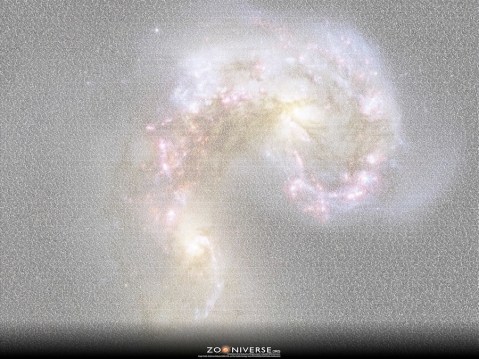
The final in our series of Zooniverse project posters, created from the names of contributors, is Galaxy Zoo Mergers. The posters features an image of the Antennae Galaxies made up of the names of the 13,000 mergers participants who agreed to have their names published.
You can download the large, 5000-pixel version (15 MB) or the smaller 3,000-pixel version (6 MB).
Galaxy Zoo Multi Mergers
Our latest merger paper is called “Galaxy Zoo: Multi-Mergers and the Millennium Simulation.” We used the original catalogue of 3003 mergers from the previous mergers study to find the interesting subset of systems with three or more galaxies merging in a near-simultaneous manner. We found 39 such multi-mergers (which you can see in the image below) and from this we estimated the relative abundance of such multi-mergers as being ~2% the number of binary mergers (which were themselves ~3% the number of isolated ‘normal’ galaxies). We also examined the properties of these galaxies (colour, stellar mass and environment) and compared them to the properties of galaxies in isolated and binary-merger galaxies; we found that galaxies in multi-mergers tend to be more like elliptical galaxies on average: they’re large, red and in denser environments.

Describing what we see in the world is all well and good, but the equally important thing in science is to compare what we see with what others have claimed to see or to have predicted through theory. Since ours is effectively the first such catalogue of multi mergers, there simply are no other observational sets to compare to. We therefore compared these merger fractions and galaxy properties to a large and well-known simulation called the Millennium Run. This is a cosmic scale simulation of Dark Matter that starts off smoothly distributed (similar to the CMB) within a 500 Mpc box and, over time, clumps together to form structures. Now, galaxies are of course made out of normal matter, so to model how galaxies form and evolve within the Dark Matter, one can take the resulting clumps of Dark Matter from the simulation and, using sensible sounding rules (e.g. bigger Dark Matter clumps get more normal matter because they’ll gravitationally attract more), come up with predictions for numbers of stars formed within the simulation (and where, when, etc.). This means that one can create (with enough fiddling) predictions of what galaxies will look like in such a Dark Matter dominated Universe. These are called ‘Semi-Analytic Models’ and are an important strategy for simulating the Universe since computers would struggle to compute the many many additional interactions between particles in a full N-Body simulation with both Dark Matter and normal matter (Dark Matter is relatively easy since it only feels the 1/r^2 force of gravity).
So what we did in the paper was to compare the results of our multi-merger galaxies to those of the Semi-Analytic Models in the Millennium Simulation (double ‘n’ because it’s a largely German initiative). This is a good test of the Semi Analytic Models because there is no way they could have been fiddled to get the right answer because ours is the first such observational constraint on what multi-mergers look like. And what we found is that the Simulation did rather well – it predicted the relative abundance of multi-mergers to within a few percent and it predicted that galaxies in these systems should have properties more like a typical elliptical rather than a typical spiral. This gives us independent confidence that these Simulations are on the right track and that the assumptions that went into them are sensible ways to get at how the Universe behaves.
In the future, the Galaxy Zoo interface might well allow users to indicate the presence of multi-mergers!
Many thanks to you all for your help in making this interesting study happen.
New content. New images. A refreshed Galaxy Zoo.
This month the advent calendar has brought you beautiful images (some covered in your name), new Zoos, and much laughter. On the 22nd day of advent the Zooniverse brings to you a new way of exploring galaxies. It’s not another galaxy related Zoo (we did that already with The Milky Way Project). It’s not a new task in Galaxy Zoo. It’s something a lot simpler: It’s words and images and even history discussing what we know and how we know it about extragalactic astronomy. We call this new section of the website “Explore Galaxies.”
Along with bringing you new content, we’re also bringing you new images!
Through your combined efforts, you’ve classified your way through the Hubble Space Telescope’s GOODS, GEMS and AEGIS images. This means it’s time for new images! Today we’re introducing to Galaxy Zoo a large batch of images from COSMOS: The Cosmic Evolution Survey. These images, taken during 590 orbits of the Hubble Space Telescope, map out a 2 square-degree region of the sky. While tiny compared to the area of the Sloan Digital Sky Survey, these images are sensitive enough to see objects almost 100 times fainter! (For those of you wanting the numbers, SDSS gets to i = 22.3, while COSMOS gets to I > 27!) These images have been used to map out the distribution of dark matter and the large-scale structure of the universe. Now, thanks to you, these images can extend our understanding of galaxy morphology out to more distant galaxies and down to fainter nearby galaxies.
Day 22: Galaxies and Content, these are our gifts to you.
And more will be coming. The content we have up today isn’t comprehensive: it’s a base layer that will be growing over time. As you search for content, we’ll track what you search for and add needed content. As the Zooniverse continues to discover new things – as you discover new things – we’ll work to add that content too. For advent, we offer you a chance to start learning about galaxies on the Galaxy Zoo website, and we’ll work to make it possible for you to keep learning in the times to come.
In addition to adding content to Galaxy Zoo, we also added a set of quiz questions. This your chance to test your knowledge of galaxy related concepts, one question a day. Any of you who have used Moon Zoo (which should be all of you – really, if you haven’t already, go try it out at http://www.moonzoo.org) have seen these types of questions before. Just as we use your responses to the classification tasks to do astronomy research, we use your responses to these quiz questions to do learning research. When you answer these questions, we’ll tell you if you got them right or wrong, but because you may see the questions again (and because that friend or family member looking over your shoulder may see the question later), we can’t explain the right answer if you get the question wrong. This is only a temporary problem however. After we get enough data (sadly, this may take a year) to see what you are learning, we will post all the answers in Explore Galaxies.
On this 22nd day of Advent, our gift to you is information. Please: go read, go learn, go search, and know that more content is coming as we learn what you want to know (and let us know what you do know by answering the once a day quiz questions).
Galaxy Zoo Image of the Year
The 19th door opened of the Zooniverse Advent Calendar leads us to M51, the beautiful Whirlpool Galaxy, taken on the SDSS telescope that we used for Galaxy Zoos 1 and 2.
For a few days after 25th November, the Galaxy Zoo Forum nominated their favourite galactic images from the thousands gathered over our three and a half years of existence, and voted on 48 of them. Here was the selection – as you see, it was a tough choice!

The winner was the stunning blue spiral, merging with a yellow galaxy so torn apart by gravitational forces that it would be hard to classify!

M51 is 33 million light years away and so bright that it has potential to fry the SDSS camera’s delicate optical instruments – so SDSS avoided looking at it too directly. Therefore, it has no reference number; but you can go into its pages and move up, down, right and left by adjusting the RA and DEC until you can more or less centre in on it.
M51 was discovered by Charles Messier, and put into his collection of objects that he thought were pain-in-the-neck smudges giving him false hopes of having discovered a comet! Jules wrote an Object of the Day about him and some of our other Messier Objects on the forum here. The pair of galaxies are also known as NGC 5194 and 5195. I’ve seen them described as 23 million, 31 million and 33 million light years away. The spiral is large, and famous for its dust lanes and intense star formation. You can resolve it in dark skies with a good pair of binoculars; it’s in the constellation Canes Venatici, though you find it just south-west of the brightest star of the Plough’s “saucepan handle”.
You can see a great deal more of this gorgeous object at Hubblesite, Astrocruise, NOAO and four different views altogether (and probably quite a few more) on APOD! The SDSS Telescope also has it proudly displayed on its home page, with a caption if you zoom in.
It won by only 1 vote; many other galaxies got almost as many. We’ve had plenty of time at Galaxy Zoo now to decide which galaxies we love best . . . and the answer is quite often “all of them”. M51 has never had any special attention on the forum that I recall, though it has of course had its fair share of admiration. I guess there are just too many things there to love!
A galactically happy Christmas to all our zooites from our oldest Zooniverse project.
A Dark Secret in Virgo
This week’s OOTW features my OOTD ‘A Dark Secret in Virgo‘ posted on the 11th of December 2010.

On the 17th of March 1781, Pierre Méchain discovered this beautiful galaxy. NGC4254 lurks 50 million light years away in the constellation Coma Berenices. It’s a disturbed spiral, with its right arm jutting out further than the other. So what’s caused this? Let’s zoom out…
There’s nothing to see that could have caused the disruption, right? Well, let’s zoom into this patch of sky in Coma Berenices’ next door neighbour, Virgo:
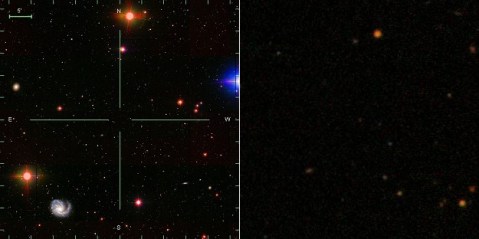
Is it a black hole? No. Is it a gigantic cloaked alien ship that tugs galaxies?! Nope. It is in fact VIRGOHI21; a HI region 50 million light years away that was first detected by the Lovell telescope. A HI region is a mass of neutral hydrogen, and in this case it has hardly any or no stars. But there’s something more to this object than meets the eye…

This is a screenshot of an animation (my attempts at posting the animation here failed!) which shows a map of VIRGOHI21. According to this website here the larger brighter mass is NGC 4254, and you can see the cloud is cascading down from the disturbed spiral arm in a stream of neutral hydrogen to the centre of the image. Astronomers have calculated that the total mass of this HI region is 2×10^8 Mʘ (solar masses), but the velocity and spin of this object indicates that there is more mass than we can detect and so the object actually has a mass of 10^11 Mʘ! So where does the rest of the mass come from…?
Dark matter! It is currently thought that VIRGOHI21 is a dark galaxy, which is a starless galaxy made up of mostly dark matter with little else apart from dust and hydrogen. This dark galaxy is interacting with NGC 4254 like any other normal galaxy would!
VIRGOHI21 is currently the best dark galaxy candidate out there, but others include HE0450-2958 which is a quasar that appears to be galaxy-less! Usually quasars have a host galaxy, but this one doesn’t appear to have one that we can see, so it has been proposed that the Quasar is actually part of a dark galaxy.
A survey called AGES uses the Arecibo observatory to find HI regions that are in connection with dark galaxies: http://www.naic.edu/~ages/
 Galaxy Zoo