Letting Things Slide: A New Trial Interface for Expressing Uncertainty
“How many spiral arms are in the image – is it two or three? Is that a disk viewed edge-on? I think so, but I’m not quite sure…” If you’ve interacted with Galaxy Zoo before, you may have asked yourself questions like these. Real galaxy images can be confusing. You may be uncertain!
Until now, you have always had to make a choice. There was no way to express uncertainty in your annotations. But now there is! Try it here.
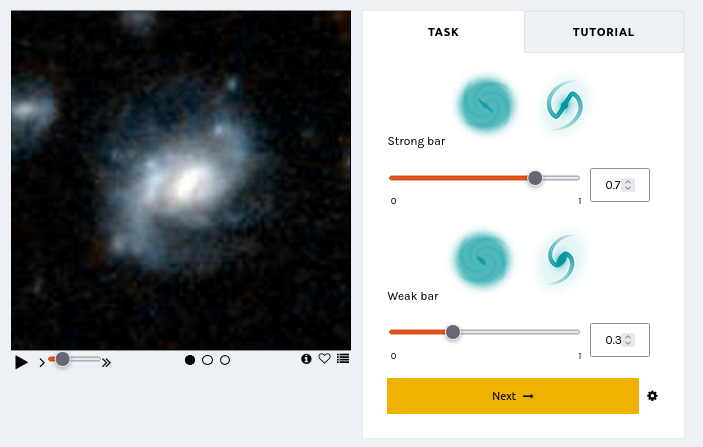
We are trialing a new experimental interface that lets you express your confidence in your annotations by dragging on a slider. This design is motivated by recent research indicating that we may be able to learn more, faster, by collecting annotator uncertainty [see this paper, this paper, this paper, this paper]. Allowing you to express your uncertainty by dragging a slider means that you – Zooniverse Friend – are providing more information with each click.
We believe this slider design might help us – through your support – discover more about galaxies, faster!
This is the second trial project we’re starting, adding to the Tags trial that Hayley introduced earlier on the blog. The big picture here is that we’re trying to think about how Galaxy Zoo could evolve in the coming years. As with any science project, we need to gather data and test our ideas.
Join in here and help us improve Galaxy Zoo.
We’ll run this trial for a short time – perhaps a couple of months – to gather your annotations and feedback. You can still use the current Galaxy Zoo that you know and (hopefully) love, at www.galaxyzoo.org.
Thank you for helping us,
Mike, Katie, and Ilia.
Go West, Young (?) Astronomer
Many bargains must be made in pursuit of an academic career, and chief among them is an openness to a nomadic early-career life in exchange for a better chance at staying permanently put somewhere later. Grad students and postdocs move around. Not only do we travel all over the world sharing and discussing our research, but the relatively short duration of postdocs, and the fact that in astronomy doing at least 2 of them is now the norm, means we regularly pull up roots and dash off to live somewhere else. My friends have collectively done postdocs on all continents, including Antarctica. Including places thousands of miles from friends and family; including places where they can neither read nor speak any of the native languages.
In this context, I am so, so lucky. My first postdoc moved me only a medium distance (across just one ocean), and to a place where I could at least understand the words, even if I didn’t always get every nuance of meaning. At Oxford I made lifelong friends and built great collaborations, and I thought the research itself was pretty good, too.
Turns out NASA agrees with me. Last year I applied for and was awarded an Einstein Fellowship, which is an early-career award lasting 3 years, an independent postdoc that can be taken to any institution in the US. They’re very competitive (I had applied the previous year without success), and I was thrilled to be awarded one at my top-choice host institution. My first day was last week.
Here’s what the 2015 Fellows page has to say about my research plans:
Brooke uses a variety of multi-wavelength data, including highly accurate galaxy morphologies from the Galaxy Zoo project, to research the connection between supermassive black holes and the galaxies that host them. This connection appears to exist over many orders of magnitude in black hole and galaxy mass, but its fundamental origin is still a puzzle. As an Einstein Fellow at the University of California, San Diego, Brooke will investigate supermassive black hole growth in the absence of galaxy mergers, using a rare sample of galaxies which have never had a significant merger yet host growing black holes. These active nuclei, selected because their host galaxies lack the bulges which inevitably result from a galaxy merger, provide powerful leverage to disentangle the complex drivers of black hole growth and determine the origin of observed black hole-galaxy correlations.
During my fellowship I’m planning on moving forward with the research we first published in 2013 investigating bulgeless galaxies with growing black holes. That is: it’s Galaxy Zoo research.
Galaxy Zoo research brought me to Oxford, and now it has brought me to California. UCSD is a great place, and I’ve already made some really excellent scientists. UCSD is also part of the Southern California Center for Galaxy Evolution and has access to some of the world’s best telescopes, so the future is full of potential.
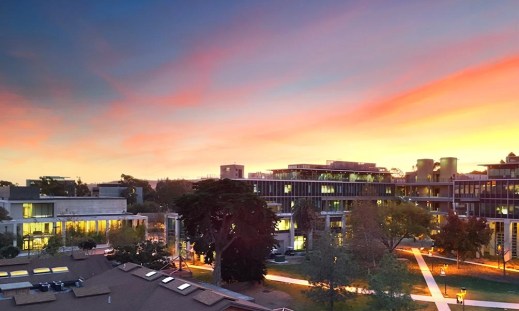
For now, though: I wouldn’t be here, watching sunsets from my office, without your contributions to Galaxy Zoo over the years. Thank you.
Galaxy Zoo in der Süddeutschen Zeitung
Ein Artikel über Citizen Science und Galaxy Zoo ist in der Süddeutschen Zeitung erschienen, inklusive Kommentare von einem Mitglied des “Peas Corps”.
Galaxy Zoo in the News!
Last year Kevin wrote about all the publicity we gained so far, from media covering the story of Hanny’s Voorwerp. In the meantime, that list kept growing. But also, with the launch of Zoo 2 and the discovery of the Peas, we got more and more attention.
Recently Kevin asked me to make a list of links to all those pages writing about Galaxy Zoo and to announce here where you can find it, which is on the Galaxy Zoo Forum. If you find an article I haven’t on my list yet, please feel free to send me a personal message so I can include it. And if you’re not a member yet, you can also send me an e-mail using: vampke83(at)hotmail.com.
Let’s keep spreading the word.
 Galaxy Zoo