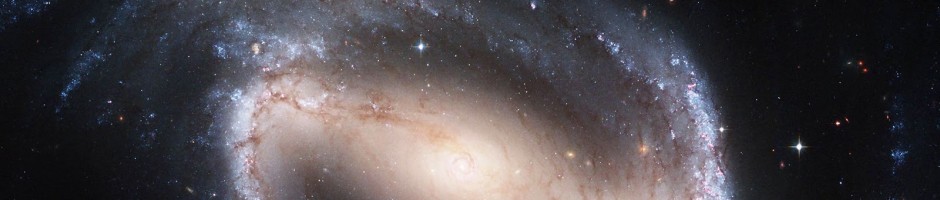
Announcing the Galaxy Zoo JWST project!
We are thrilled to announce the launch of the Galaxy Zoo JWST project, with ~300,000 galaxy images from the COSMOS-Web survey taken with NASA’s James Webb Space Telescope (JWST)! We now need your help identifying the shapes of these galaxies by classifying them on Galaxy Zoo. These classifications will help scientists answer questions about how the shapes of galaxies have changed over time, and what caused these changes and why.
As we look at more distant objects in the Universe, we see them as they were billions of years ago because light takes time to travel to us. With JWST able to spot galaxies at greater distances than ever before, we’re seeing what galaxies looked like early in the Universe for the first time. The shape of the galaxies we see then tells us about what a galaxy has been through in its lifetime: how it was born, how and when it has formed stars, and how it has interacted with its neighbours. By looking at how galaxy shapes change with distance away from us, we can work out which processes were more common at different times in the Universe’s history.

Image credit: COSMOS-Web / Kartaltepe / Casey / Franco / Larson / RIT / UT Austin / CANDIDE.
Now, with data from JWST, we’re able to look deeper into the cosmos and further back in cosmic time than ever before, investigating the wild and wonderful ancestors of the Milky Way and the galaxies which surround us in today’s Universe. Thanks to the light collecting power of JWST, there are now over 300,000 images of galaxies on the Galaxy Zoo website that need your help to classify their shapes. If you’re quick, you may even be the first person to see the distant galaxies you’re asked to classify. You will be asked several questions, such as ‘Is the galaxy round?’, or ‘Are there signs of spiral arms?’. These classifications are not only useful for the scientific questions we want to answer now, but also as a training set for Artificial Intelligence (AI) algorithms. Without being taught what to look for by humans, AI algorithms struggle to classify galaxies. But together, humans and AI can accurately classify limitless numbers of galaxies.
We here at Galaxy Zoo have developed our own AI algorithm called ZooBot (see this previous blog post for more detail), which will sift through the JWST images first and label the ‘easier ones’ where there are many examples that already exist in previous images from the Hubble Space Telescope. When ZooBot is not confident on the classification of a galaxy, perhaps due to complex or faint structures, it will show it to users on Galaxy Zoo to get their human classifications, which will then help ZooBot to learn more.

You might also notice a slight difference to the classification interface for this project. Each image has two main colour versions available to help you see different features in the galaxy. Both of these colours images are built from the four COSMOSweb filters (F115W, F150W, F277W, and F444W) but with two different scalings. On the right the scaling is set to reveal bright central features more clearly, while the lefthand version should reveal fainter outskirts. You can also see the original four single filter images if you’d like in the flip book (see the two circles below the centre of the two images). By providing all of these images we’re hoping that it’ll be easier for volunteers to classify the images, and allow us to extract the most information about a galaxy from each image.
We’re really excited about this project on the team, not least because it’s been in the pipeline for a long time! We have had two team meetings at the International Space Science Institute (ISSI) in Bern, Switzerland over the past year in preparation for this launch, so it’s great to be finally at this point. We’re particularly excited though because of the science that will be made possible thanks to this project. Given JWST’s incredible sensitivity to light (thanks to that beautifully large mirror!), we’ll be able to classify the shapes of galaxies out to much greater distances than ever before. This means we can see further back in time in the Universe’s history to trace how the shapes of galaxies have changed earlier in cosmic time. We’ve already taken a look at your classifications from the pilot JWST project we ran on ~9000 galaxy images from the CEERS survey (another JWST galaxies survey, that’s smaller then COSMOS-Web that’s launching today) and with your help we found disk galaxies and galaxies with bars out to greater distances than ever before. So with even more JWST galaxies now on the site, all of us on the team are buzzing with excitement thinking of all the new discoveries coming our way soon.
If you do decide to take part: THANK YOU! We appreciate every single click. Join us and classify now.
Cosmic Disco: Help us characterize galaxy merger stages!
You have helped classify the morphologies of millions of galaxies through various Galaxy Zoo campaigns! Among those several millions are colliding galaxies (aka galaxy mergers) that are experiencing a significant change in their morphology and physical nature. Previously you have answered questions about the presence of disturbed morphological features (e.g., major or minor disturbance). As the process of galaxy merging can take several millions to a billion years, the merging galaxies we observe present to us in a plethora of configurations depending on their merging stage.

Identifying the stage of merging can help us better associate the impact of mergers to specific changes in the galaxy properties. An alternative approach is to use the disturbed morphological signatures (also called tidal features) as a proxy for merger staging. We are launching a new project Cosmic Disco: Characterizing Galaxy Collisions where you can help characterize the images containing mergers into objective categories.

We are looking forward to doing awesome science with your help! Happy Classifying!
Letting Things Slide: A New Trial Interface for Expressing Uncertainty
“How many spiral arms are in the image – is it two or three? Is that a disk viewed edge-on? I think so, but I’m not quite sure…” If you’ve interacted with Galaxy Zoo before, you may have asked yourself questions like these. Real galaxy images can be confusing. You may be uncertain!
Until now, you have always had to make a choice. There was no way to express uncertainty in your annotations. But now there is! Try it here.
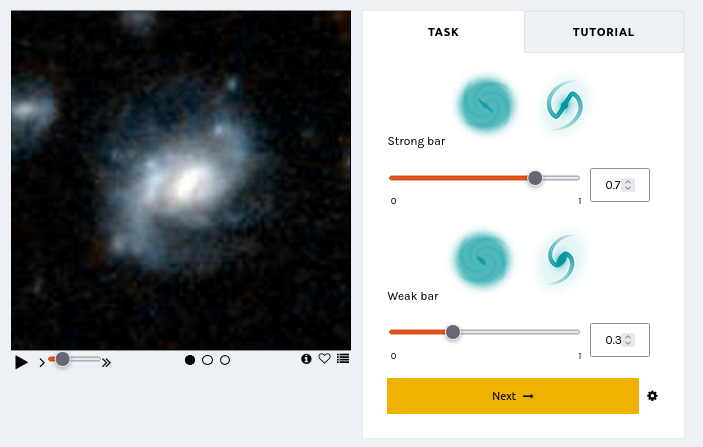
We are trialing a new experimental interface that lets you express your confidence in your annotations by dragging on a slider. This design is motivated by recent research indicating that we may be able to learn more, faster, by collecting annotator uncertainty [see this paper, this paper, this paper, this paper]. Allowing you to express your uncertainty by dragging a slider means that you – Zooniverse Friend – are providing more information with each click.
We believe this slider design might help us – through your support – discover more about galaxies, faster!
This is the second trial project we’re starting, adding to the Tags trial that Hayley introduced earlier on the blog. The big picture here is that we’re trying to think about how Galaxy Zoo could evolve in the coming years. As with any science project, we need to gather data and test our ideas.
Join in here and help us improve Galaxy Zoo.
We’ll run this trial for a short time – perhaps a couple of months – to gather your annotations and feedback. You can still use the current Galaxy Zoo that you know and (hopefully) love, at www.galaxyzoo.org.
Thank you for helping us,
Mike, Katie, and Ilia.
Announcing the Galaxy Zoo: Euclid project!
We are thrilled to announce the launch of the Galaxy Zoo: Euclid project, with 820,000 galaxy images fresh from ESA’s Euclid Space Telescope’s first year of operations! This will be the public’s first chance to see survey images from the Euclid telescope. If you take part in the project, you could be the first human to ever see that image from Euclid. Not only that, you could be the first human in the Universe to ever lay eyes on the galaxy in the image. These classifications will help the Galaxy Zoo and Euclid science teams answer questions about how the shapes of galaxies have changed over time, and which processes in the Universe have caused these changes.

First off, if you’re not familiar, let’s start with the Euclid Space Telescope. The European Space Agency’s (ESA) Euclid space telescope launched in July 2023 and has begun to take its survey of the sky. Euclid has been designed to look at a much larger region of sky than the Hubble Space Telescope or the James Webb Space Telescope, meaning it can capture a wide range of different objects all in the same image – from faint to bright, from distant to nearby, from the most massive of galaxy clusters, to the smallest nearby stars. With Euclid, we will get both a very detailed and very wide view (more than one third of the sky) all at once.
In November 2023 and May 2024, the world got its first glimpse at the quality of Euclid’s images with Euclid’s Early Release Observations which targeted various astronomical objects, from nearby nebulae, to distant clusters of galaxies. Below is an incredible image of the 1000 galaxies in the nearby Perseus cluster taken by Euclid. What you’ll notice in the background though is a plethora of distant galaxies all ready for their shapes to be classified! At the latest count, there’s 100,000 background galaxies in this one image alone.

The sheer volume of data from Euclid is a huge challenge to us astronomers; Euclid is set to send back 100GB of data per day for six years. That’s a lot of data, and labelling that through human effort alone is incredibly difficult. So we will once again be deploying our AI algorithm, called Zoobot, for this project. If you want to know more about Zoobot, Mike wrote a great blog post explaining it in more detail last year. In short, Zoobot learns from Galaxy Zoo volunteers to predict what they would say for new galaxy images. After being trained on the human answers that you will contribute in the next few months, Zoobot will then be able to give us detailed classifications for hundreds of millions of galaxies found by Euclid over its next six years of observations, creating the largest detailed galaxy catalogue to date and enabling groundbreaking scientific analysis on topics like supermassive black holes, merging galaxies, and more.
Zoobot will sift through the Euclid images first to classify the “easier” galaxies that we already have a lot of examples of from previous telescopes. However, for the galaxies where Zoobot is not confident in its classification, perhaps because the galaxy is unusual, it will send those images to volunteers on Galaxy Zoo to get their human classifications, which then help Zoobot to learn more. The Galaxy Zoo: Euclid project will therefore see AI and humans working together to learn more about our Universe.
We’re really excited about this project on the team, not least because it’s been in the pipeline for a long time! But also, because of the science that will be made possible thanks to this project. Given Euclid’s unique design that gives us both a very detailed and very wide view, we’ll be able to classify the shapes of galaxies out to much greater distances than ever before. This means we can see further back in time in the Universe’s history to trace how the shapes of galaxies have changed earlier in cosmic time. While JWST also makes this possible, the images from JWST are from a much smaller area of sky. Euclid, however, will cover one third of the entire sky and give us a look at the entire galaxy population that’s visible to us from within the Milky Way. Even as I’m typing this I’m getting excited at the population statistics that GZ: Euclid will make possible!
What’s more is that Euclid’s main focus has always been to understand the distribution and effects of dark matter in our Universe. Dark matter is matter that we know is there because of its gravitational effect on things around it, but it doesn’t emit, reflect, or absorb light, so we can’t see it. The Euclid team are planning to make a 3D map of the positions of all the galaxies they find, and trace out where all the visible and dark matter is. Combining this map with your classifications of the shapes of galaxies, we will for the first time be able to ask the question: how does dark matter affect the shapes of galaxies over cosmic time?
So I hope I’ve convinced you about how exciting this project is and you are now ready and raring to go with your classifications. You can find a link to the project below. If you do decide to take part: THANK YOU! We appreciate every single click. Join us and classify now.
Becky Smethurst, on behalf of the the Galaxy Zoo and Euclid science teams
P.S. Some of you might notice that metadata is absent for these images for now. This is because the images you’re seeing are not yet publicly available. Extra data will be added upon Euclid’s first data release in 2025.
 Galaxy Zoo