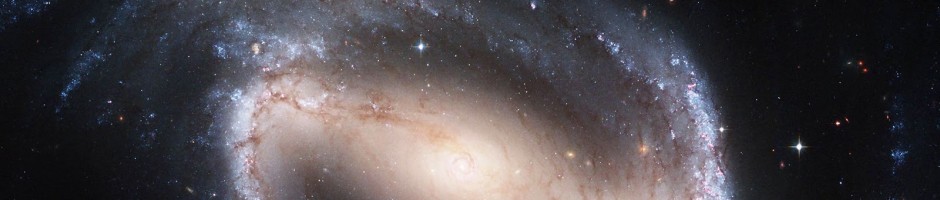
Peas Through a Lens
This week’s OOTW features today’s OOTD by Budgieye.

SDSS view of SDSS J001340.21+152312.0
This yellow fuzzy galaxy is a Quasar 1.59 billion light years away from Earth in the constellation Pegasus; it’s just above to the left of the star Gamma Pegasi.
When you zoom in with the Keck observatory you’re treated to this beauty:

Credit: F. Courbin, G. Meylan, S. G. Djorgovski, et al., EPFL/ Caltech/WMKO
Now what the Keck telescope can see and the Sloan telescope can’t are the two red smudges in the blue glow of the Quasar. These smudges are in fact one Pea gravitationally lensed by the QSO sitting in front of it! This is the first ever example of a Quasar strongly lensing an object. This is where a galaxy or a cluster of galaxies are so massive that they bend space-time so much that it visibly bends light around them. So the light emitted by an object sitting behind a cluster of galaxies gets bent around the cluster, creating multiple images of one object.
So how can we tell they are multiple images of the same object?
A quote from Budieye’s OOTD:
To ensure that the two red objects on each side of the quasar is actually the same object, each object must have their spectrum taken separately.
Both blobs of red light had identical spectra, indicating that both blobs are the same object, and that the quasar is bending the light from the distant galaxy into two blobs.
Me, HST and the history of surveys
Before I start with a new series of posts, please let me introduce myself.

My name is Boris Häußler (look at my horribly out-of-date website here). I am German but currently working as a research fellow in Nottingham, UK, where I have just recently started my second postdoc with Steven Bamford, whom many people here may know. I have spent the last years (actually, my whole scientific life so far) working on Hubble Space Telescope (HST) data, mainly on the GEMS and STAGES surveys, and have gathered particular experience in the field of galaxy profile fitting, trying to measure sizes, shapes, etc. of distant galaxies. Whereas my previous projects have mainly been working on galaxies at redshift z~0.7, my new job is trying to do similar and more advanced things on more local galaxies, mainly SDSS galaxies, which of course everyone familiar with Galaxy Zoo will know as these are the galaxies classified in both Galaxy Zoo and Galaxy Zoo 2. Initially, one would think that this is a much easier job to do, but as this data is from ground-based telescopes, it proves to be challenging.
 This brings me to an interesting position. Although Galaxy Zoo is not my primary science project, I am now connected to the survey through Steven, our galaxy sample and (for now) more directly through this blog. Having worked on HST galaxies for ages, it is of course very interesting for me to see these galaxies now being classified in Galaxy Zoo: Hubble. Having created some of the colour images that both GEMS and STAGES have used for outreach purposes, I have looked at thousands of these galaxies myself and know how stunningly beautiful they can be. I very often got lost on our images, simply browsing around and being fasctinated by the variety of the galaxies. At least in GEMS I know many galaxies by heart and could possibly directly point you to at least some of the brighter and/or more interesting galaxies.
Being kind of an HST expert, Steven has asked if I would want to write a series of posts about HST, an offer that I found hard to turn down, so I’ve decided to write quite a long series about the HST, its history, its future and especially introducing some of the bigger HST surveys, some of which of course build the content of Galaxy Zoo: Hubble now. But before I write and post all this, I would be interested to know what people would actually want to know about Hubble and everything connected with it. So if you have any comments, any wishes, any questions, please post them below and I will try to answer them in the future.
My current plan for the next months contains the following posts, roughly running through the history of Hubble in chronological order:
- Who is Edwin Hubble, the man that gave HST it’s name?
- History of Hubble, the planning and the start 20 years ago
- HST gets spectacles, first service mission
- HDF, the Hubble Deep Field, the first famous survey,
- Another service mission, putting new cameras (e.g. ACS) on HST
- GOODS, the Great Observatories Origins Deep Survey
- GEMS, Galaxy Evolution from Morphologies and SED
- AEGIS , the Deep Extragalactic Evolutionary survey
- HUDF, the Hubble Ultra Deep Survey, the deepest survey ever made
- STAGES, Space Telescope Abell901/902 Galaxy Evolution Survey
- COSMOS, the Cosmic Evolution survey
- The service mission to put in another camera (WFC3)
- Upcoming surveys: CANDELS
- The Future of HST
- HST’s successor, the James Webb Space Telescope (JWST)
If you want to know about anything else, please let me know below.
Thanks and Cheers for now,
Boris
Supernova updates
Hello from the William Herschel Telescope, where I’m observing some of those lovely supernova candidates that have been pouring out of The Supernova Zoo lately.
It’s been a while since our last update. We’ve been running supernova zoo in a very serious way now for several months, and, after ironing out a few little bugs and adding some improvements, the zoo is making a massive contribution to the supernova identification effort in The Palomar Transient Factory. The zoo has already classified some 20,000 supernova candidates, usually several hundred every day; it’s a fabulous effort. You’ve classified every supernova candidate that we’ve put in the zoo!
We also hope that you’re beginning to see feedback on the supernova candidates that you spend your time classifying (at least the better ones!). From this current observing run I’ve been adding comments as I classify the events that you’ve highlighted, so you might see them appearing in your “MySN” area (of course, the more you classify, the more likely this is to happen!).
Here are some of your nice recent finds, all Type Ia Supernovae.
This one seems to live in a galaxy located in a cluster of galaxies:

This is one in a nearby NGC galaxy – the SN is located directly in one of the spiral arms.
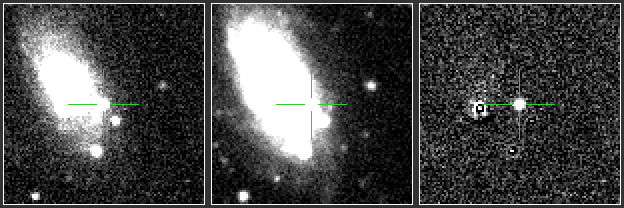
And this one is also in a spiral galaxy – but one that is more edge on:

We’re currently preparing a scientific publication that will detail supernova zoo and how it works – and we also have plans to add a new survey to give you even more supernova to play with. So stay tuned!
OK, my exposure has just finished, so I’ll sign off here and go and see what the latest supernova candidate turned out to be!
— Mark
 Galaxy Zoo