Why build the Hubble Space Telescope?
After I had started my post about the planning phase of the HST up to the start, I have noticed that the arguments (which I thought to be a small section in there) for building a Space Telescope in the first place took up quite some space, so I have decided to post this for now and delay the rest of the post into a different one (trying to keep the posts from getting too extensive as I promised last time), possibly the next.
At first sight it doesn’t sound like a terribly good idea to put an expensive telescope on an expensive rocket (which doesn’t mean it’s a successful start at all, usually expensive equipment and large quantities of explosives are kept well apart for a reason) and shoot it into orbit where again many things can (and did) go wrong and telescope maintenance is either impossible or at least very expensive. Why not simply build a ground-based telescope which is a lot cheaper but would still have a much bigger mirror (so can collect more light and potentially create sharper images, see below) and would still be much cheaper and easier to maintain? Where a new camera simply needs to be screwed on (a simplification about which many telescope engineers could rightfully complain), rather than having to employ the (again expensive) space shuttle to even get there in the first place and then having to work in unhandy space suits to get the new equipment in (with the risk to notice that a bolt might be too long and the camera doesn’t even fit in); and if it doesn’t work afterwards, you’re screwed and you cannot simply take it down again and fix it? Not even talking about potentially simple problems like cooling the camera chips for which you need liquid nitrogen or helium, which, on earth, you can simply refill with a tank, but which in space becomes a rather more complicated task altogether.
So at first sight, it looks like people need a very good reason to even think about Space Telescopes, an then start developing, maintaining and upgrading one with new cameras. So what are these advantages that made scientists built the HST (and many other Space Telescopes)?
Well, there are 2 main reasons, one of which solves a problem that was at least impossible to overcome back then and one that solves a fundamental problem alltogether:

 The first problem: In principle, the angular resolution of a telescope should be given by the wavelength of the observed light and the diameter of the mirror (or lens). This is simple optics that every physics student learns and it says that the bigger a mirror, the better the resolution. But there is one very large problem: This is pure theory for an ideal telescope in a vacuum. As in the old physicist joke: ‘Yes, I’ve got a solution, but it only works for spherical elephants in a vacuum’. But here, talking about telescopes instead of elephants, the problem really IS the atmosphere which changes the situation completely.
The atmosphere has its upsides for breathing, weather (sometimes we could do with a bit less atmosphere here in England 😉 ), airplanes and stuff, but for astronomers, it’s really just ‘in the way’. The air, or better to say the movement of the air, the turbulences of hot and cold air bubbles, bends the starlight on its way into the telescopes (very much like when you’re looking over the tarmac on a very hot summers day everything is flickering). This basically makes stars jump around very fast (Actually, you can see this effect by looking at the stars. Stars ‘flicker’ at night. Objects larger than this effect, e.g. planets, don’t flicker; That’s how you can tell them apart easily). As the apparent position of the stars jump around faster than the eye or a normal camera can detect, it doesn’t really make stars move in long-time exposures, but it leads to ‘blurring’ of the image (If you want to know what a stars picture actually looks like in extremely short exposures, read this article).
This effect is so big that it easily overpowers the resolution improvement due to a bigger mirror size. In fact, to get the maximum resolution of a telescope at sealevel, a telescope with something between 10 and 20 cm diameter is big enough. Any bigger than that does not increase the image resolution due to seeing. Groundbased telescopes can therefore not see details smaller than 0.5-1.0 arcsec in size, even at the best telescope sites (which are usually in very dry places very high up. Dry weather is usually less turbulent and building telescopes at high altitude avoids having to look through large parts of the atmosphere in the first place, so ‘seeing conditions’ are usually better). For comparison, the Hubble Space Telescope has a resolution of only 0.05 arcsec due to it’s position outside the atmosphere and its size of around 2.5 meter.
I show the effect of seeing in the images above. The top one is a picture taken by a 2.2 meter (so similar to HST) telescope in Chile from the Combo-17 survey. The bottom one is the same area of the sky taken by HST (to be precise, it’s a small bit of the Hubble Ultra Deep Field H-UDF, stay tuned for one of my later posts about this survey). You can clearly see that all the objects in the groundbased survey are blurred and some of the faint objects are actually blurred so much, that they cannot even be seen at all above the sky background. In the space based image, the details and features of the galaxies are visible much more clearly. This is the reason why these images were now chosen to be classified in Galaxy Zoo: Hubble. From groundbased telescopes a classification of galaxies at similar distances is simply not possible.
Of course, a big telescope has another obvious advantage: It collects a lot of light, so it enables us to see fainter objects. This is the main reason why telescopes in the past were built bigger and bigger and this trend continues even today.
Also, there are a few things that can be done to improve the image quality, but most of them go beyond the scope of this blog, but if you want to know about it, read e.g. this article and links therein. Basically, either interferometry (where several telescopes far apart are used, unfortunately, this does not produce a full ‘image’ of the object) or movable and distortable mirrors can be used. The latter is called adaptive optics, a very complicated and expensive technique, in which the wavefront of the starlight that has been distorted by the atmosphere can be corrected by a mirror, which is generally speaking distorted exactly in the opposite way to make the wavefront flat again (The mirrors shape has to be adjusted around 200 times per second). A flat wavefront will create a sharp – ‘diffraction limited’ – image, using the complete power of the big mirror used. Adaptive optics was only developed in recent years on several telescopes. The Hooker telescope mentioned in my last blog runs one, for example, and most big telescopes like Gemini, Keck or the VLT run these facilities, too. Although I did call this technique ‘expensive’, it is, of course, a lot cheaper than building a Space Telescope.

In fact this is one of the reasons why the HSTs ‘successor’, the JWST telescope (also one of my later posts) will not be observing at the same optical wavelengths as HST but will rather concentrate on IR wavelengths. Running adaptive optics facilities, groundbased telescopes now produce images of the same quality as the HST, although on a smaller field of view and only close to stars (they need bright-ish stars to compensate the effect of the atmosphere, although laser guide stars will avoid at least the second problem in the future). The 30-40 meter telescopes that are currently planned around the world will show much better resolution again and using very sophisticated adaptive optics might have a similar or even bigger field of view as HST currently has. In the image below (please click for full resolution), you can see an estimated example for a telecope called OWL (Overwhelmingly Large telescope, not kidding, the image above shows a simulation. The speck in the foreground is a car for size comparison). This was a planned telescope which has now been cut down to 42 meters, we now call it the E-ELT (the Extremely Large Telescope, yes, astronomers are not very creative when it comes to telescope names). It’s design is different (but OWL of course is more impressive and their website provided the images I was looking for), but very recently, its cite has been selected to be on a neighbouring mountain to Cerro Paranal, the cite of the VLT.
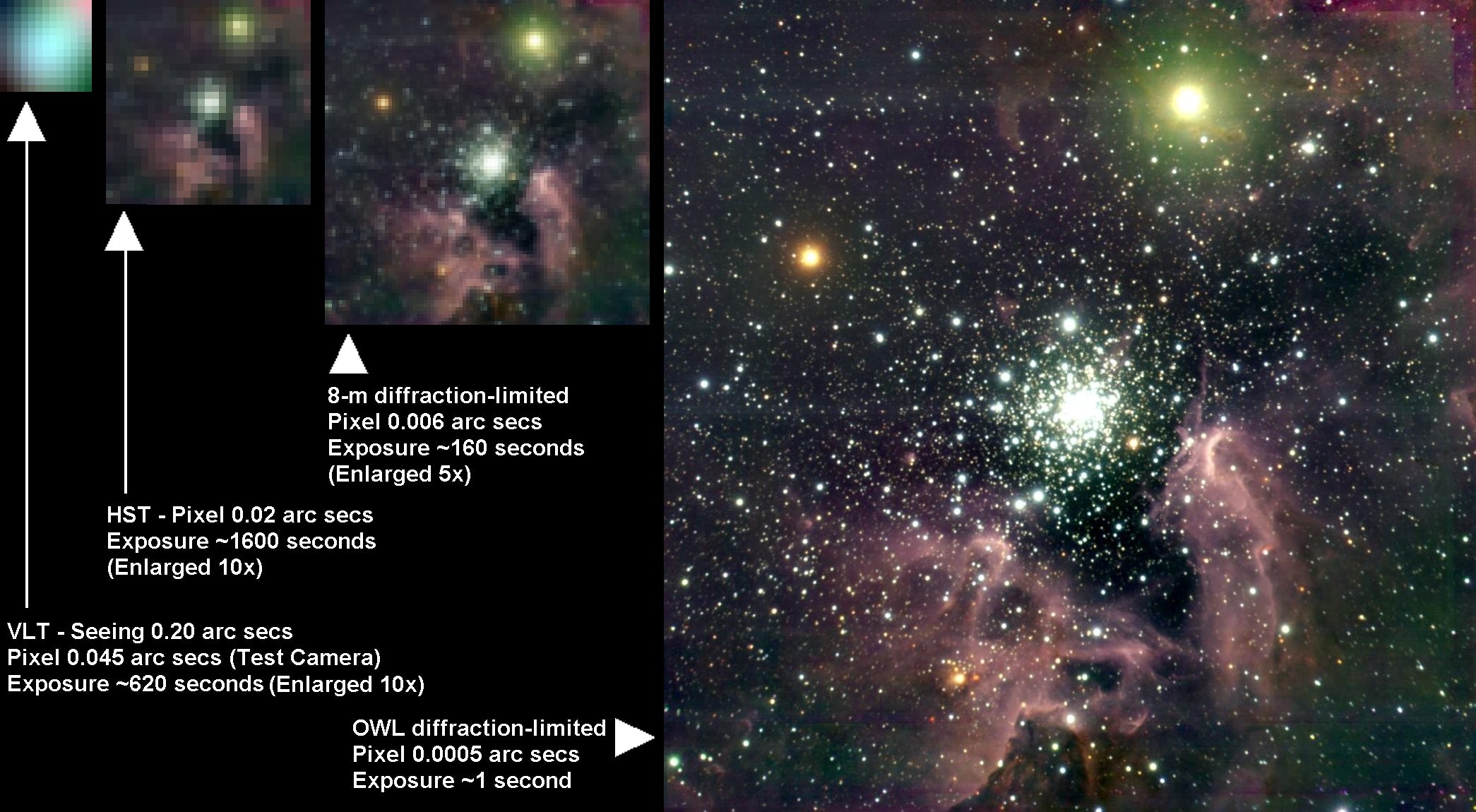
Resolution comparison for OWL (Click for better resoultion)
As you can see on the left, this telescope would, with perfect adaptive optics (diffraction limited) indeed produce much sharper images with much higher resolution then even HST can provide today. So in principle, the problem of the atmosphere can be overcome using clever techniques. The field of view on which this works today is still a lot smaller than what is covered by HST survey cameras, but this is a matter of technique and might be overcome in the future (if interested, google ‘multiconjugate adaptive optics’). In the past, when HST was planned, non of this existed, so a Space Telescope indeed sounded like a good idea.
 But groundbased telescopes have an even more fundamental problem which is simply put impossible to overcome. At ground level, only certain wavelengths in the electromagnetic spektrum can be observed. (Far) Infrared, ultraviolet and gamma light cannot be observed at all from groundbased telescopes as the light is strongly absorbed by the atmosphere. The image on the right shows the height above ground at which light is basically absorbed by the atmosphere. As you can see, only optical and radio (and a bit near infrared) observatories make sense on earth, even on the highest mountains. For any other wavelength, you need a space telescope to be able to observe galaxies at all.

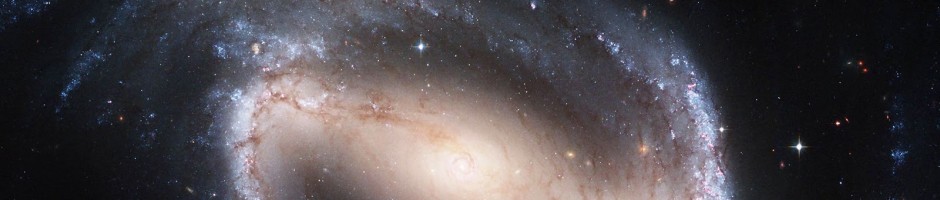
NGC1512 screengrab from Wikipedia
Different wavelengths can be very interesting, a galaxy looks completely different in optical than in X-ray or Radio and all these wavelengths show different physical parameters, e.g. star formation rates (X-ray) or the amount of ‘dust’ in the galaxy (in IR). A good and famous example for this is NGC 1512, a barred spiral galaxy whose center has been observed at different wavelengths by the same telescope. You can see the results on the right. Generally speaking, very blue light (shown in purple) shows very young stars, redder light (up to orange) older stars, red shows dust. Remember, these are all still more or less optical wavelengths, in X-ray or far infrared, this galaxy would look even more different.
The HST works at optical wavelengths, so this was not really a reason to build it, most things (although HST does have some IR filters) could indeed be observed by groundbased telescopes. But as I mentioned above, the HSTs successor, the JWST will exclusively be working in IR for exactly this reason. Optical cameras are not really needed in space anymore (although it’s of course a shame that we won’t have an optical space telescope in the future), but for IR observations it’s vital to be in space. Other famous Space Telescopes in other wavelengths include Spitzer (IR), Chandra (X-ray), GALEX (UV) and XMM-Newton (Xray), all of which are impossible to be replaced by earth-bound instruments.
There are also quite a few focused satellites for certain experiments in space, e.g. WMAP (to observe the afterglow of the Big Bang), Keppler (to detect exo-planets, planets around other stars than the sun) and others, but these are focused projects and not open telescopes everybody can apply to, which of course everyone can at the HST. I will talk about this and some big projects that successfully got their time on the HST in my future posts.
All in all, you can see, there are several good reasons to build a Space Telescope, scientists don’t do this because it’s ‘fun’ or ‘cool’. For observations in certain wavelengths it is still important today, for others it has at least been important in the past. Which brings us back on track: At some point, the decision was made to build the HST (although it wasn’t named Hubble then) and the planning began. But this will be my next post, so stay tuned. I am travelling a lot in the next month, so I might not be able to hold the 2-week schedule, but I’ll do my best.
Cheers,
Boris
Previous history of this series:
- August 2nd, 2010: Me, HST and the History of Surveys
- August 16th, 2010: Edwin Hubble, the Man behind the Telescope
A star with a full house
This week’s OOTW features Lightbulb500’s OOTD posted on the 27th of August.

HD 10180; Credit: ESO
This star, HD 10180, lurks in Hydrus 127 light years away. It’s a sun-like star, and through 190 observations of the stars wobble with the High Accuracy Radial Velocity Planet Searcher (phew) it is found to have five gas giants, and two more wobbles are suspected to be due to two or more additional planets! One it has been proposed is another gas giant, much like Saturn, and the second planet is thought to be Earth-sized, but although it could be the right size for life, its orbit around HD 10180’s solar system certainly isn’t the best at 0.02 arc seconds from the star, to give you an idea of how close that is, it orbits its star in 1.8 Earth days! Toast anyone?
Read more about this planetary system here, and there’s a wonderful video on the system here!
X-ray paper submitted!
Just a quick note: I’ve finally submitted the paper on the X-ray observations of IC 2497 and the Voorwerp with XMM-Newton and Suzaku. It’s a Letter so we should hear back fairly soon, so stay tuned!
Preethi's Cross-Eyed Galaxy

Remember this object from back in February? It turned up in a paper that I was reading today, going by the name of Preethi’s cross-eyed galaxy.
The paper, by Preethi Nair (now in Italy) and Roberto Abraham from the University of Toronto, is going to be really important as we analyze data from Zoo 2 and from Galaxy Zoo : Hubble. As part of her thesis work, Preethi examined over 14000 galaxies – twice each, to check for consistency (!) – in order to produce the largest detailed morphological catalogue in existence. We’ll be comparing your results to hers, and hopefully showing that the classifications for the other 280,000 or so galaxies in Zoo 2 are as reliable as her 14,000.
Or at least, that’s the theory. In practice I’ve spent the day trying to be sure I understand which of her objects match which of ours. But seeing an old friend – albeit with a new name – crop up still made me smile.
A Comic Voorwerp

line art: Elea Braasch, color: Chris Spangler
This past Monday, at about 8pm Central (GMT -4), a Voorwerpish webcomic was delivered to Sips Comics for printing. Tuesday morning we got the page proofs, and now, one by one, they are being made into full color reality.
We could say a lot of things right now: We could tell you about playing round robin with the script, digitally passing it from person to person under the guidance of Kelly, sometimes into the wee hours of the night. We could tell you about watching the art come to life; transforming from line drawings to fully rendered pages in the hand of our artists Elea and Chris. We could tell you how many pencil tips were broken, and how many digital files grew so big our computers crawled.
We could talk a lot, but instead, let us invite you to join us for the World Premier and share with you a few images.
You’re Invited to a World Premier
- Time: 3 September, 10pm Eastern (GMT -5)
- Online: via Hanny’s Voorwerp Webcomic or via direct UStream Link
- In Person: At Dragon*Con
Crystal Ballroom
Hilton Atlanta
255 Courtland Street NE
Atlanta, GA
Come meet the artists, hear a brief talk by Bill, and generally revel in the Voorwerp’s awesomeness.
And come dressed as a Voorwerp for a chance to win a prize for best costume!
See you in Atlanta?
Pamela, Hanny, Bill, Kelly, Elea and Chris

A Grand Bold Thing : The story of the Sloan
In many ways, the team here at Galaxy Zoo are freeloaders, making the most (with your help) of the hard work of the astronomers who work hard for years to design, build and operate the telescopes that produce the images for us to classify. The project’s first two incarnations were based entirely on images from the Sloan Digital Sky Survey, the star of A Grand Bold Thing, a book that was released this week.
Several Zookeepers were interviewed for the book, and while I don’t know for sure that we made the final cut I asked the author, Ann Finkbeiner to explain why she’d devoted so much of her time to writing about the Sloan. Over to Ann :
My book on the Sloan Digital Sky Survey — the source of those galaxies in Galaxy Zoo and the mergers in Galaxy Zoo Mergers — came out yesterday. The Sloan was, and still is, the only systematic, beautifully-calibrated survey of the sky and everything in it. And it’s the first survey to be digital, that is, log on to the website and download galaxies.
Before the Sloan, cosmology was fractured into many fields whose relation to each other wasn’t obvious and wasn’t being studied. Sloan found all kinds of things in all areas of astronomy: asteroids in whole families, stars that had only been theories, star streams around the Milky Way, the era when quasars were born, the evolution of galaxies, the structure of the universe on the large scale, and compelling evidence for dark energy. Now, after the Sloan, cosmologists are beginning to see the universe as a whole, as a single system with parts that interact and evolve.
A Grand and Bold Thing is about the very human scientists who built the survey: people doing their best, screwing up anyway, fixing it, screwing up again, running into trouble with the young folks, running into trouble with the money, getting their feelings hurt, forming hostile camps, and managing the unintended consequences of their best intentions. But they never give up, they’re astonishingly stubborn, they just keep at it until they’ve done it.
And what they did has had an enormous impact: as Julianne Dalcanton
of the University of Washington said in the blog, Cosmic Variance, about the Sloan, “You take good data, you let smart people work with it, and you’ll get science you never anticipated.” Some of that science is being done by the good people of the Zooniverse. Surveys open to the public have always been high altruism. I think the Sloan is still surprising.
Ann Finkbeiner’s last book was The Jasons. She teaches in Johns
Hopkins University’s Writing Seminars and blogs at Last Word on
Nothing.
Supernova zoo offline this week
Just to let you know that the supernova zoo will be offline for most of this week. The search that feeds data to us, the Palomar Transient Factory, is undergoing some maintenance. They’re re-aluminising the mirror of the telescope to improve the sensitivity, which usually takes a few days during which the telescope can’t be used. (It’s also the beginning of “bright time”, coming up to full moon, when the sky is brighter and the search less sensitive – so it’s a good time for maintenance.)
So, you can all take a well-deserved break from the supernova classifications.. and perhaps explore some other areas of the zooniverse which need your help! We’ll be back in a few days.
Galaxy Zoo gets highlighted by the 2010 Decadal Survey
Every decade, the US astronomy community gets its leaders together to write up a report on the state of the field and to recommend and rank major projects that should be supported by the government over the next decade. It’s a blue print, a wish list and often also a sober exercise in what to fund (a little) and what to cut (a lot). The current Decadal Survey was finally released by the US National Academies last Friday and every astronomer is poring over it to see if their project or telescope is ranked highly.
Galaxy Zoo isn’t competing for hundreds of millions of dollars in funding to launch a space observatory, but it did get not just one but two mentions in the 2010 Decadal Survey, one in the text and a figure. For those of you who are keen to read the whole thing for themselves, you can get the report at the National Academies website here (you have to click on download and give them your details to get the free PDF download). Here on the blog we only show you the highlights, i.e. the Galaxy Zoo mentions. From the text in the section on “Benefits of Astronomy to the Nation” where they discuss how “Astronomy Engages the Public in Science”:
Astronomy on television has come a long way since the 1980 PBS premier of Carl Sagan’s ground-breaking multipart documentary Cosmos. Many cable channels offer copious programming on a large variety of astronomical topics, and the big three networks occasionally offer specials on the universe too. Another barometer of the public’s cosmic curiosity comes from the popularity of IMAX-format films on space science, and the number of big-budget Hollywood movies that derive their plotlines directly or indirectly from space themes (including five of the top ten grossing movies of all time in America). The internet plays a pervasive role for public astronomy, attracting world-wide audiences on websites such as Galaxy Zoo (www.galaxyzoo.org, last accessed July 6, 2010) and on others that feature astronomical events, such as NASA missions. Astronomy applications are available for most mobile devices. Social networking technology even plays a role, e.g., tweets from the Spitzer NASA IPAC (http://twitter.com/cool_cosmos, last accessed July 6, 2010).
They also have a lovely figure, which has a small blooper in it (see if you can spot it!). Word is that this is going to be corrected in the final version:

Thank you all for making Galaxy Zoo such a success!
Edwin Hubble, the man behind HST
Who is Edwin Hubble, the guy who gave the Hubble Space Telescope its name? Who is the mysterious guy behind the telescope?

Edwin Hubble
Well, actually, Edwin Powell Hubble is not the ‘man behind the telescope’ at all. He was born on 20th of November 1889 in the US and studied Physics and Astronomy in Chicago. He then, interestingly, went to Oxford, UK (now, of course, one of the main departments participating in Galaxy Zoo), to study Jurisprudence, later Spanish. Given that he was also very sporty (he won several state track competitions and set the state’s high school high jump record in Illinois), I think it is fair to call Hubble a person with multiple talents. In England, he also picked up some English habits and his dress code, some to the annoyance of his american colleagues in later years. I don’t know many pictures of him, the one on the right is possibly the most famous (usually used in scientific talks at least). Smoking his pipe on his desk, he really looks like an English gentlemen of his time (Well, maybe he’s lacking a hat).
Edwin Hubble died on September 28th 1953 in California (his house is now a National Historic Landmark at this location), long before the real planning for the HST had begun. Earlier ideas did exist, since 1923, after it was explained how a telescope could be propelled into Earth orbit and in 1946, Lyman Spitzer (who interestingly enough has his own space telescope named after himself now) had already discussed the advantages (which I will discuss in the next post about the planning of the HST) of an extraterrestrial observatory, but it took until 1962 for the US NAS (not NASA!) to recommend the development of a space telescope for other purposes than observing the sun (two orbiting solar telescopes were in fact already active at that time). In 1965, 12 years after Hubbles death, Spitzer was appointed head of the committee to define the scientific objectives for this new telescope, so really, he is the ‘man behind the Hubble Space Telescope’.
So why is the telescope named after Edwin Hubble then?
After some years of teaching at the university back in the US and after serving in WWI as a major, he returned to the Yerkes Observatory at the University of Chicago, where he finished his Ph.D. in 1917. The topic of his thesis was ‘Photographic Investigations of Faint Nebulae‘ (it only consists of 17 pages, a fact that possibly makes every PhD student cry nowadays). At that time, these nebulae were still considered to be part of the Milky Way, something that was waiting for a real genius and careful observer to be revealed as a mistake.

The Hooker Telescope
In 1919, Hubble took on a staff position in California at the Mount Wilson Observatory near Pasadena where he stayed until his death in 1953. Just 2 years previously, a new telescope had been finished at the site, the Hooker telescope (the slightly unfortunate name comes from John D. Hooker who funded the project), a 100-inch Reflector telescope, which today is still there and, after some recent upgrades and modifications (although preserving the historical origin wherever possible), is again used for scientific purposes. With its ‘adaptive optics’ system (see next post) its resolution today is 0.05 arcsec, the same as resolution of the HST. From 1917 to 1948, the Hooker telescope was the world’s largest telescope.
Hubble used this new, state-of-the-art telescope to continue the work on nebulae that he had started in Chicago by identifying Cepheid variable stars in them. Cepheids have the very convenient characteristic, that the period of their variability is a simple function of their brightness. So by measuring their period, astronomers can immediately tell how bright these objects are in a standard system. Measuring their apparent brightness allows to measure their actual distance. By doing this, Hubble noticed that they are far too distant to be part of our own galaxy, but instead are extragalactic systems, islands of stars (and possibly life) in the vast nothingness of space. Other distant ‘Milkyways’, just like our own.
We now call them ‘galaxies’.
Being some of the closest galaxies to our own, most of the objects that he worked on are now very famous, some also through images by the HST. The most famous of all is possibly M31, the closest big galaxy to our own, the Andromeda galaxy, or what Hubble called it, the Andromeda Nebula.

The original version of the Hubble diagram
Additionally to his distance measures of 46 galaxies Hubble further took measurements from Vesto Slipher of their escape velocity. This is basically the speed with which ‘the galaxies move away from Earth’ (what we now understand to be the cosmological redshift) and can be relatively easily measured by looking at the galaxies’ spectra, in which all spectral lines, previously known from lab experiments, are shifted by the same amount. When Hubble plotted the escape velocity of galaxies over their distance (we call this a Hubble diagram), he noticed something interesting:
The further galaxies are away from our position, the faster they move away.
This was a pretty radical idea as it proved that the Universe is not a static place at all as was widely believed before. For example, Einstein had introduced an additional term into his cosmological formula in general relativity to make his universe static/non-dynamical (something Einstein called the biggest blunder of his life after he had seen Hubble’s data. Funnily enough, this constant is now back in there to explain the accelerated expansion of the universe. It resembles the ‘dark energy’). Instead, this effect means that either the Earth is in a very special spot of the Universe where everything is flying away from it (a thought that many people, amongst them Einstein, considered wrong. The hypothesis that there is nothing special about the place where the Earth is other than that it is where we happen to live, is one of the basic fundamentals of cosmology) or there was a time in the past when everything was at the same point, much like in an explosion. Of course, we now know it was not an explosion in the traditional sense, but the beginning of time, the Big Bang.
Of course, as with most big new discoveries, these new findings were heavily discussed, not many people believed in them in the beginning. One after another, people started believing in Hubbles results, though, and the view that astronomers have on the universe changed completely. The Big Bang Theory (besides being a brilliant TV series) is now the generally accepted picture today.
As a small anecdote on the side: Due to errors in his distance measurements, Hubble measured the expansion parameter (the Hubble constant) to be 500 km/s/Mpc, which for today’s measurements is a pretty bad value, actually. After new, better data and improved data analysis were used, there were 2 big groups of people debating the real value, some said it was 50 km/s/Mpc, some others said it was 100 km/s/Mpc. For the past 10-15 years, this battle seems solved Solomonically, the value is now assumed to be just inbetween these values, somewhere between 70 and 75 km/s/Mpc. So, although Hubble was very wrong in the number that came out of his measurements, he somehow got the principle spot on.

Using the images that he had taken for his work, Hubble also came up with a system to classify these nebulae and galaxies depending on their appearance. This is what we call the Hubble sequence or the tuning fork of galaxies, and Galaxy Zoo initially used a system that was based on this diagram for their classifications.
As the Hubble Space Telescope was primarily constructed and built to observe distant galaxies (besides of course looking at objects in the solar system and interesting regions in our own galaxy), it was named after Edwin Hubble in honour of his groundbreaking work in this field.
Edwin Hubble has not only got a Space Telescope with his name, but several laws, constants and numbers are named after him, too.
Some examples:
- The Hubble constant as explained above, called H0
- The Hubble time is 1/H0 and gives the approximate age of the universe. It is currently estimated to be around 13.8 billion years.
- The Hubble length is c/H0and is equivalent to 13.8 billion lightyears. This is not the ‘size’ of the universe, but is an important length in cosmology
- The Hubble diagram as described above
- The Hubble sequence of galaxies.
- Hubble’s law
Additionally, there are:
- An asteroid: 2069 Hubble
- The crater Hubble on the Moon.
- Edwin P. Hubble Planetarium, located in a High School in Brooklyn, NY.
- Edwin Hubble Highway, the stretch of Interstate 44 passing through his birthplace of Marshfield, Missouri
- The Edwin P. Hubble Medal of Initiative is awarded annually by the city of Marshfield, Missouri – Hubble’s birthplace
- Hubble Middle School in Wheaton, Illinois—renamed for Edwin Hubble in 1992.
- 2008 “American Scientists” US stamp series, $0.41
(I think when they make you a stamp and you’ve got your own highway, you’ve really made it!)
I think that’s more or less all that I can come up with about Eddi, the post is actually quite a bit longer than I thought it would be, I’ll try to keep it shorter in the future, scout’s honour. For now, I will end with a quote from Edwin Hubble:
“Equipped with his five senses, man explores the universe around him and calls the adventure science”
With this, keep together your senses, especially seeing (the galaxies in Galaxy Zoo) and feeling (your mouse button with your index finger) and help us to do more adventurous science with the classified galaxies that you help us with (hearing, smelling and tasting are only of second order importance in astronomy, unless of course you listen to some music and have a snack while classifying 😉 ).
Thanks and Cheers,
Boris
Hubble's View of NGC 4911
This week’s OOTW features an OOTD by Alice written on Thursday 12th of August.
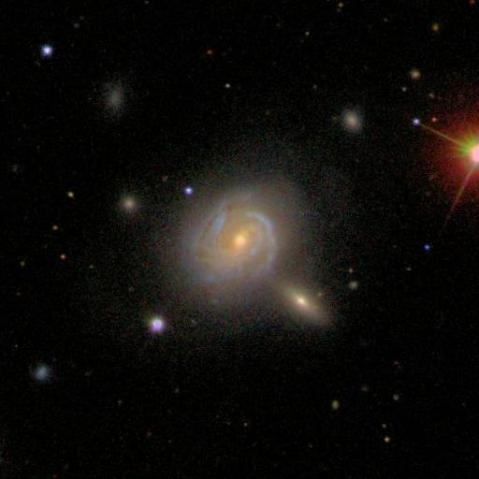
With a redshift of 0.027 this spiral galaxy lies 320 million light years away from us. It’s NGC 4911, a spiral galaxy in the Coma Cluster; a city of galaxies gravitationally bound to each other in the constellation Coma Berenices. LEDA 83751 – the larger elliptical overlapping the galaxy – is actually sat in front of the spiral, which isn’t the best situation for overlap hunters:
Overlapping galaxies are especially useful to Bill and other astronomers interested in dust – the background galaxy acts like a torch, showing what the dust is doing in the former one. The best situation is an elliptical being further away than a spiral, since spirals tend to be dustier and more interesting. Sadly this pair appears to have the bad manners to be the other way round. How rude :D.
– A quote from Alice’s OOTD.

A new Hubble image of this galaxy has been released showing in more detail the huge amount of star formation going on nearer to the nucleus of the galaxy, the dust lanes streaking their way around the beginning of its spiral arms, and the wispy spiral structures wrapping their arms around the bustling galactic centre.
 Galaxy Zoo