Introducing Galaxy Zoo: Clump Scout II
Hi everyone,
If you’ve been following Galaxy Zoo for a while, you may remember the Galaxy Zoo: Clump Scout project. Now, Clump Scout is back, and we need your help with Galaxy Zoo: Clump Scout II!
The first Clump Scout project
Back in 2019, we asked you to help us find giant star forming clumps (or just “clumps”) in nearby galaxies. With your help, the first Clump Scout project was a resounding success. Over 14,000 volunteers took part, looking at nearly 60,000 galaxy images from the Sloan Digital Sky Survey (SDSS) and making millions of individual classifications. When the project completed, you had helped us identify clumps in more than 7,000 galaxies, giving us what was then the largest catalogue of clumpy systems in the local Universe.
What have we been doing since Clump Scout finished?
We’ve learned a lot from the results of Galaxy Zoo: Clump Scout and they provided a crucial foundation for the research that followed. By using the results to train a Deep Learning model, we were able to discover 41,445 bright clumps in 34,246 galaxies by searching over 240,000 SDSS galaxy images. This expanded clumpy galaxy sample allowed us to investigate whether clumpy galaxies are more prevalent in dense galaxy clusters or in the sparse voids between clusters.
Since then, we have continued to update our clump detection deep learning model and we have tried to fine-tune it to detect clumps in survey data from more powerful telescopes like the Subaru Telescope, and most recently the Euclid Space Telescope. These telescopes allow us to find fainter, smaller clumps in more distant galaxies and they produce sharper images that start to reveal the individual clumps’ substructure.
New images
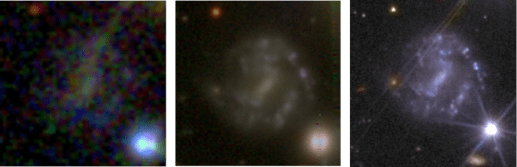
The three images in the figure below show the same galaxy as seen by the SDSS, the Hyper Suprime-Cam (HSC) camera on the 8-metre-diametre Subaru Telescope, and the two cameras on board the Euclid Space Telescope. The galaxy is barely visible in the SDSS image and certainly doesn’t show any obvious signs of being clumpy. In the HSC image the galaxy is clearly visible and shows several clumps that appear as bright, somewhat blurry blobs lying along the galaxy’s spiral arms. The Euclid image is much sharper and shows that the individual clumps from the HSC have complex substructure.
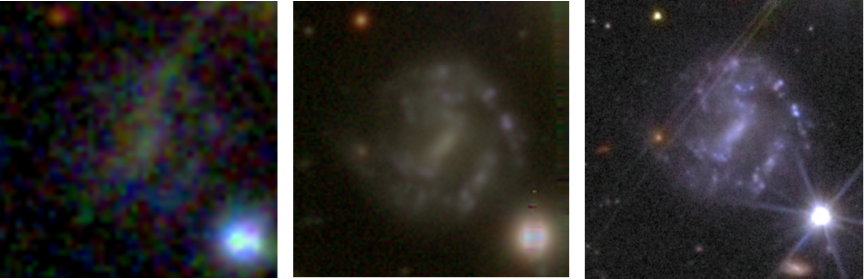
Figure 1. Three images of the same clumpy galaxy as seen by the SDSS Survey’s Apache Point 4 metre class telescope (left), the Hyper Suprime-Cam imager on the 8-metre diameter Subaru Telescope (centre) and the VIS and NIR cameras on the Euclid Space Telescope (right).
New science
Clumps are sites of intense star formation, which can deliver energy to their surroundings via several processes, which are often described collectively as “feedback”. For example, stellar radiation, stellar winds (streams of fast-moving charged particles launched from stars’ surfaces) and supernova explosions can all inject energy into the interstellar medium in and around the clumps. These feedback processes can have profound implications for the effect of clumps on galaxies’ growth and evolution. However, the effects of feedback depend crucially on how well it transfers energy out of the clump and how long the clump survives before being disrupted by material in their host galaxy’s disk. Both factors remain poorly constrained by observations.
How can high resolution Euclid images help to reveal the impact of feedback from clumps? Well, the Euclid images give us the ability to observe and study the detailed substructure of clumps. This is very useful because it allows us to compare real clumps with those produced in high resolution simulations of clumpy galaxies. An example comparison is shown in the figure below. These high-resolution simulations suggest that clump substructural morphology (the distribution of sub-clump shapes and sizes) is strongly correlated with feedback-related properties of clumps, including their longevity and how much energy from their internal star formation they can impart to their surroundings.
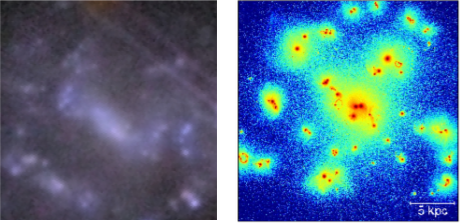
Figure 2. A clumpy galaxy observed with Euclid (left) compared to a simulated clumpy galaxy (right). With the detailed images we are now getting from Euclid, we can begin to study the substructures of clumps that we see should be there in simulations, telling us about clump properties like how long they can survive.
If clumps are resilient to disruption, then tidal forces are expected to make them migrate slowly towards the centres of their host galaxies. Feedback that is generated by the clumps’ as they migrate can regulate star formation in their host galaxies and may even drive gas and dust into the surrounding interstellar medium. Once clumps reach their host galaxy’s centres, they can dissolve and contribute to the growth of galaxy bulges.
The physical properties of simulated clumps can be directly extracted from the simulation data. If we find populations of real and simulated clumps with matching substructural morphology, then we will be able to infer that the physical properties of the real clumps are similar to the known properties of the simulated clumps.
New challenges
The new Euclid images provide new insights into the physics of clumps and clumpy galaxies but they also bring some challenges. Our clump detection model was trained using images with relatively coarse spatial resolution in which clumps normally look like blurry blobs. The complex substructure of the clumps in the Euclid images makes them more difficult for our model to identify. Our model that worked so well on low resolution images now gets confused and starts to mistake other objects, like foreground stars and background galaxies for clumps. Teaching the model to avoid these mistakes is one of the main purposes of Galaxy Zoo: Clump Scout II.
New project
Your task in Galaxy Zoo: Clump Scout II is to correct the clump labels generated by our model. You will be shown an image of a galaxy that our model thinks is clumpy with different coloured boxes, representing our model’s labels, overlaid. The figure below shows an example of the classification interface.
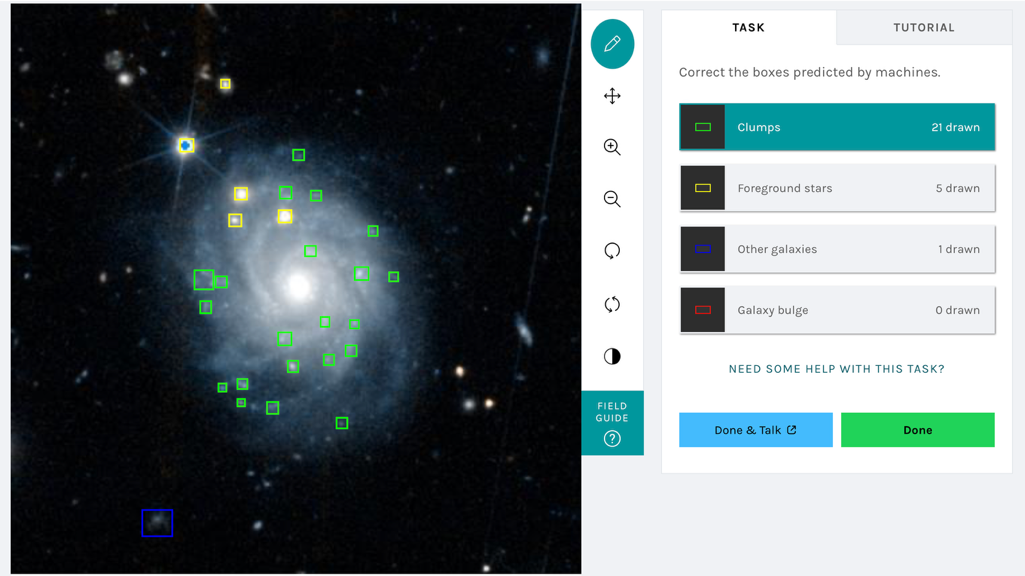
Figure 3. The Galaxy Zoo: Clump Scout II interface
The different box colours represent different types of astrophysical object – green for clumps, yellow for foreground stars, blue background galaxies and red for galaxies’ central bulges. We need you to examine all the boxes, make sure they surround real objects and check that those objects are marked with boxes of the correct colour. We also need you to mark any clumps that our model has missed. Your corrected labels will be used to incrementally retrain our model until it is able to accurately find all the clumps and contaminating clump-like objects in Euclid images.
Our finetuned model will ultimately allow us to search over 250 million Euclid galaxy images for clumps and assemble an enormous catalogue of clumps to analyse, helping to reveal the internal physical processes that drive the evolution of clumps, their host galaxies and their extragalactic surroundings.To get involved head over to Galaxy Zoo: Clump Scout II and start classifying today!
This project makes use of Q1 data from European Space Agency’s Euclid mission; learn more here: cosmos.esa.int/web/euclid/euclid-q1-data-release


getting a 404 no link
Hi Bruno! can you say which link you are trying to follow that gives you a 404? Thanks!
Fine now