Designing the Lens Zoo: Have Your Say!
Over at the brand new Lens Zoo project blog we are starting to document our progress towards a new zoo being built this autumn – a zoo for finding gravitational lenses! A small but dedicated band of lens hunters has been active on the Galaxy Zoo forum for several years – while we are still working with them on the objects they have found so far, we’d also like to help them extend their science investigations by providing new data and new tools in the new zoo. If you’ve spent time on the forums looking for rare objects like lenses, or have stumbled across something unusual that has led to an interesting adventure in the Galaxy Zoo, we’d like to hear from you – we’re trying to figure out how to help you make one-in-a-thousand discoveries.
So: what features should the Lens Zoo website have, to help us find as many lenses as possible? We are planning a workshop in mid-July to discuss the interface and tools for the new Zoo, and to give us something to talk about, we’d love to hear from all you lens-hunters out there. We’ve setup a web form for you to send us any ideas about functionality or tools that you think would be useful in finding lenses. Here’s the address in full:
We’ll go through all your ideas when we meet up in Zurich, and keep you posted on the Lens Zoo blog!
Stay tuned, and thanks for your help.
Phil, Aprajita & the Lens Zoo team
Merger Zoo
Merger Zoo has come to a close.
Since the project started, we have had over 27,000 volunteers contributed their time supporting this project. Volunteers have reviewed over 3 million simulations. Out of this huge number of new simulations, we have been able to find the best models for each of 60 different merging galaxy systems using the data you generated in the Merger Wars and Simulation Showdown interfaces.


The two images above show an overlay for two of the best simulation from Merger Zoo. As the image fades between the simulation and the astronomical image, you can see how closely we matched the shapes of the real Merging Galaxies. Of course, the underlying purpose of this Merger Zoo was not to make pretty models. We are now in the process of analyzing the incredibly rich data set that has been generated to address a number of scientific questions.
The first paper we are working on addresses a simple question – how well can the orbit of the mergers be constrained from the shape of the tidal features? For decades we have been assuming that there is a true “best fit” orbital match for interacting galaxies. However, Merger Zoo has directly put this to a test. As an example, take a look at the plot below. The red line shows the distribution of different disk crossing angles (inclinations) from all the orbits that were viewed by our volunteers. The green line shows the states that were actually selected and survived the first rounds of the Merger War’s competition on the site. Even though none of the volunteers ever look at the inclination angle, the states our volunteers have selected are converging toward a single best angle.

The uniqueness of merger orbits is only the first of many of papers that we are working on. We are also looking how the star formation rates in mergers depend on the orbits between the two galaxies. We have come a long way on this analysis, and seem to be close to some nice results. We are also looking at ways to automatically model merging galaxies using computer vision. The Citizen Science data from Merger Zoo will be used as the training set for the computer vision program.
When Anthony and I look at this Merger Zoo today, we are thrilled with the quality and quantity of the data that you have generated in this project. I have wanted to have models for a large system of galaxy interactions for decades to test some of these difficult questions. Without your help, creating this set of models would not have been possible. With all these data that has generated, the hard work for Anthony and I is really just beginning. We will be spending our time to make sure we turn your time and effort into scientific knowledge. Of course, we will keep you informed as this process continues and results are published.
Thank you for all your help in this project!
John and Anthony, The Merger Zoo Team
Hubble spies the Teacup, and I spy Hubble
Our Hubble image of Voorwerpje galaxies continue to come in, and it seems each one is stranger than the last. Overnight we got our data on the Teacup system (SDSS J143029.88+133912.0). This one attracted attention through a giant emission-line loop over 16,000 light-years in diameter to one side of the nucleus.
I was worried to get email this morning that there had been a failure to lock on to one of the two needed guide stars so that the telescope might have rolled enough during the observations to compromise data quality. Inspecting the data, it looks like we’re OK. We’re OK and the galaxy is strange. This is a composite of [O III] (green) and Hα (red), right out of the software pipeline without any additional processing:

The Teacup AGN in raw emission-line Hubble images
Another giant hole whose origin is obscure. The loop doesn’t even show much sign of being connected to the galaxy. The strongest [O III] does seem to trace out ionization cones, as in showing from structures near the nucleus, but that seems independent of the distribution of the gas. There are filaments in the gas that are nearly parallel, sort of like waves. Well have our work cut out for us to understand more of what’s going on here. I can hardly wait for the next one!
There was an extra treat for me with these observations. Last night, I interrupted a session with my summer class at the campus observatory to look south with binoculars and catch Hubble passing far to the southeast, no more than 13 degrees from our horizon. This was during the Hα exposure, so I saw it while it was doing these observations (it was pointed just about up in my frame of reference, as it happens). I got a picture through a 125mm telescope, showing the telescope streaking by just north of the star k Lupi. At the time, Hubble was 1600 km away over Cuba. Hubble was watching the Teacup, I was watching Hubble, and a couple of slightly puzzled students were watching me.

Hubble trails across the sky north of the star k Lupi in this telescopic view.
Greetings from Anchorage Alaska!
Hi all,
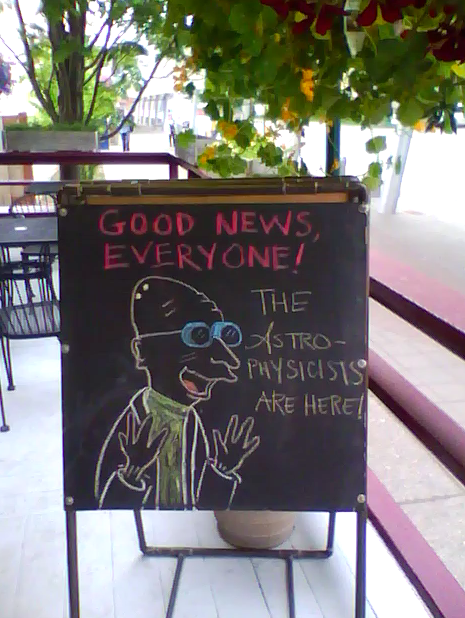
I’ve just arrived at the American Astronomical Society 220th meeting in Anchorage AK (#aas220 on Twitter, follow it). Quite a few people working on the Zoo are here too and it promises to be an exciting meeting.
But what I really wanted to share was this sign spotted by a cafe just outside the conference venue:
Update: the coffee store put up a new sign:

Also, thanks to the Zooite who came to chat to Steph at the Galaxy Zoo AGN inclination poster!
Chandra X-ray Observations of Mergers found in the Zoo Published
I hope you all had clear skies during the Transit of Venus. If not, it’ll be over a hundred years before you get another chance…. and in Zoo-related news, the Transit of Venus is an example of one way we find planets around other stars. We look for a dip in the brightness of the star as a planet moves across it from our point of view. Want to know more? Head over to the Planethunters blog, or put in some clicks looking for transits yourself!
So, in actual Galaxy Zoo news, I am very happy to report that the latest Galaxy Zoo study has been accepted for publication in the Astrophysical Journal. As we blogged a while back, we got Chandra X-ray time to observe a small sample of major mergers found by the Galaxy Zoo to look for double black holes. The idea is to look for the two black holes presumably brought into the merger by the two galaxies and see if we find both of them feeding by looking for them with an X-ray telescope (i.e. Chandra).
The lead author of the paper is Stacy Teng, a NASA postdoctoral fellow at NASA’s Goddard Space Flight Center and an expert on X-ray data analysis. In a sample of 12 merging galaxies, we find just one double active nucleus.

Image of the one merger with two feeding black holes. The white contours are the optical (SDSS) image while the pixels are X-rays. The red pixels are soft (low energy) X-ray photons, while the blue are hard (high energy) photons. You can see that both nuclei of the merger are visible in X-rays emitted by feeding supermassive black holes.
We submitted the resulting paper to the Astrophysical Journal where it underwent peer review. The reviewer suggested some changes and clarifications and so the paper was accepted for publication.
You can find the full paper in a variety of formats, including PDF, on the arxiv.
So what’s next? We submitted a proposal, led by Stacy, for the current Chandra cycle. To do a bigger, more comprehensive search for double black holes in mergers to put some real constraints on their abundance and properties. We hope to hear about whether the proposal is approved some time later this summer, so stay tuned and follow us on Twitter for breaking news!
 Galaxy Zoo