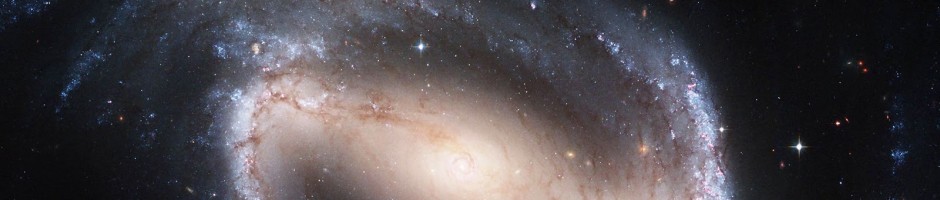
Overlaps and backlights and silhouettes – oh, my!
After a winding path, the first overlap paper from the Galaxy Zoo search has been accepted for publication. The title and abstract pretty much tell the story (the title links to the complete preprint):
Galaxy Zoo: A Catalog of Overlapping Galaxy Pairs for Dust Studies
William C. Keel, Anna Manning, Benne Holwerda, Massimo Mezzoprete, Chris Lintott, Kevin Schawinski, Pamela Gay, and Karen L. Masters
(PASP, likely January 2013 issue)
Analysis of galaxies with overlapping images offers a direct way to probe the distribution of dust extinction and its effects on the background light. We present a catalog of 1990 such galaxy pairs selected from the Sloan Digital Sky Survey (SDSS) by volunteers of the Galaxy Zoo project. We highlight subsamples which are particularly useful for retrieving such properties of the dust distribution as UV extinction, the extent perpendicular to the disk plane, and extinction in the inner parts of disks. The sample spans wide ranges of morphology and surface brightness, opening up the possibility of using this technique to address systematic changes in dust extinction or distribution with galaxy type. This sample will form the basis for forthcoming work on the ranges of dust distributions in local disk galaxies, both for their astrophysical implications and as the low-redshift part of a study of the evolution of dust properties. Separate lists and figures show deep overlaps, where the inner regions of the foreground galaxy are backlit, and the relatively small number of previously-known overlapping pairs outside the SDSS DR7 sky coverage.
This was the project that first drew me in to Galaxy Zoo, way back in August of 2007. Zooite’s contributions to this, perhaps the first science project organized on the Forum, exceeded my wildest hopes. As the paper shows, the previously-known set of backlit spiral galaxies in the local Universe contained only about 20, severely limiting what we could learn about the galaxies’ dust content. By the opening of Hubble Zoo, when we froze this particular list for publication, the combined catalog reached nearly 2000. Further use of this catalog is well along – we’ve had several observing runs at Kitt Peak 2.1 and 3.5m telescopes to do more detailed images, and colleague Benne Holwerda is headed to the 4.2m William Herschel Telescope atop the island of La Palma next month for more. With such a large starting sample, we can address questions we couldn’t before. How much variation in dust content and distribution do we see among apparently similar galaxies? How many dwarfish galaxies show the kind of unusual dust concentrations in their outskirts seen in one particular case? Do we see significant dust that is so cold that it eludes even far-infrared detection? On another keyboard, I’m working now to finish a paper on the ultraviolet absorption properties of dust in galaxies, combining a target list of spiral/spiral pairs from the GZ catalog with GALEX satellite data and our ground-based images. Not only is this interesting in knowing how clumpiness of dust affects its absorption properties, but is a key stepping stone toward another project – using backlit galaxies from Hubble Zoo to probe the history of dust in galaxies over cosmic time. We see some at such high redshift that the Hubble data sample light that started out well down toward the ultraviolet, so knowing how to compare that to our place and time is the basic starting point.
To show off the richness of this collection, this two-part figure from the paper shows how we divided them up into broad categories so that subsets useful for different things can be easily retrieved. This is one thing that lets us address different questions – we now have many examples of a broad range of geometry and combinations of galaxy types.
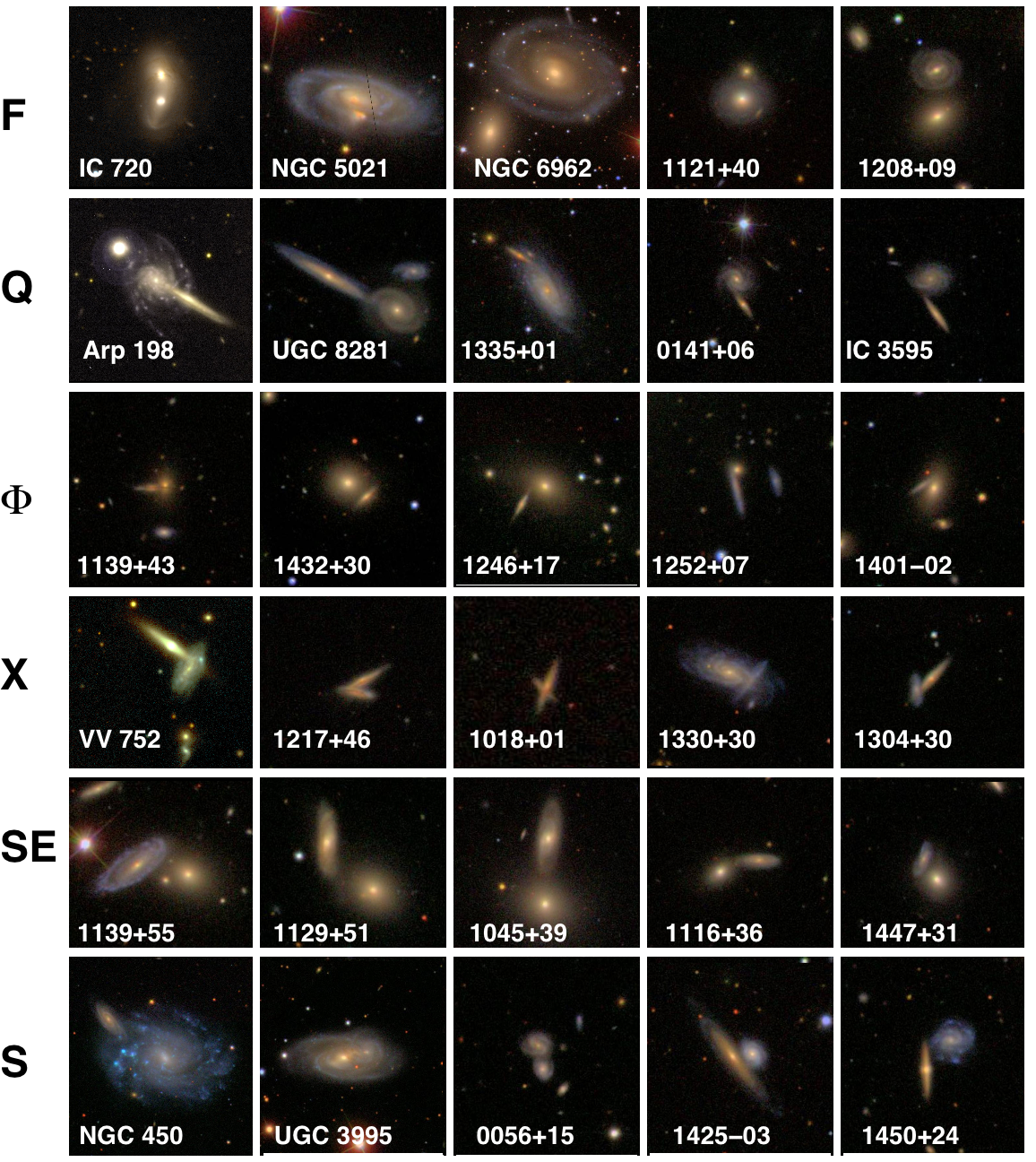
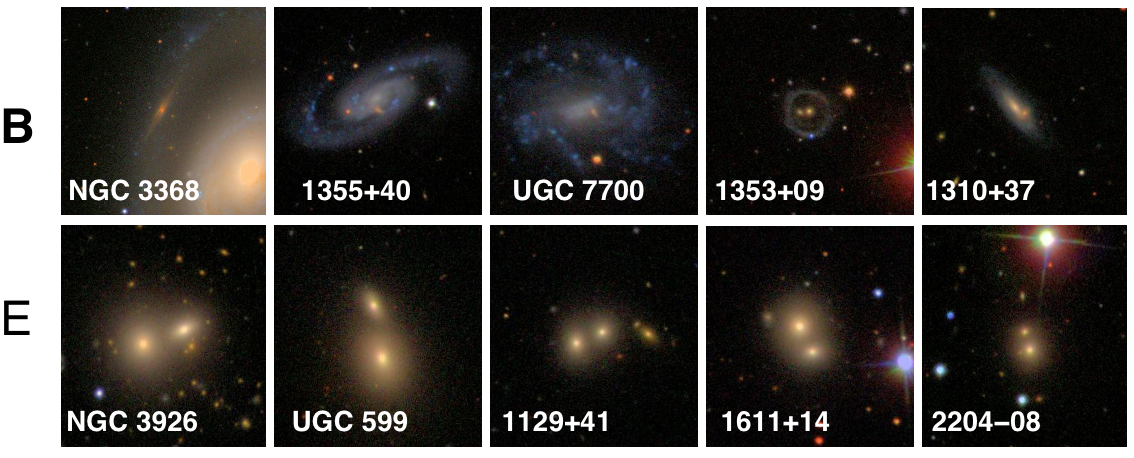 Nearly 600 Zooites contributed candidate pairs (we list the thread participants on the data page for seo services). A few deserve to be singled out. Half65, of course – not only did he find a remarkable fraction of these pairs, but he did a lot of work collecting their SDSS information. You’ll notice he’s a coauthor – fair is fair! Also, c_cld continues to display his remarkable SQL skills – he saved me a lot of time in revision by finding all the redshifts that were new when SDSS DR8 was released. Jean Tate corrected some typos in the data table (how does she do that?), and helped prod me to take the time to organize the pair members’ data more systematically by magnitude.
Regular Forum readers will recall that the first version of this paper was submitted last year. The MNRAS referees liked the analysis, but felt that the extensive catalog itself was better suited to another journal. As a result, we split that paper in two, sending the catalog and its documentation to the Publications of the Astronomical Society of the Pacific, and have been able to expand the analysis of dust distributions, so that paper will wind up even more substantial than we anticipated.
Once again – thank you to all who have taken part, and keep looking in the background as the Zoo takes in more of the sky from more telescopes!
Want to work with the Galaxy Zoo Team?
The Zoo team is once more expanding, this time in the new Black Hole and Galaxy Astrophysics Group at the ETH Zurich Institute for Astronomy in Switzerland!

Your new morning view could include the Alps…
We’re looking for:
A Postdoc
AAS ad: http://jobregister.aas.org/job_view?JobID=43152
The postdoc position is for two plus one year and comes with support for travel, computing, publishing etc. Research will include work with Galaxy Zoo data, especially the new Hubble Zoo data from CANDELS and also include the hunt for the first black holes in the universe.
Two Ph.D Students
AAS ad: http://jobregister.aas.org/job_view?JobID=43155
The Ph.D positions are fully funded for four years and also come with support for all things a student needs. Both thesis ideas are based on Zoo data and ideas. For the Ph.D position, you’ll need a Master’s degree in physics, astronomy, or related field.
Both postdoc and the students can get involved in the Zooniverse and getting more people to engage with science online.
Zurich is usually ranked in the top ten cities in the world in terms of quality of life and ETH is the highest ranked European university in the world. ETH ASTRO has expertise from planet formation to cosmology and is involved in a number of large projects and surveys. Also, there’s unlimited espresso.
The deadline for both is December 7 2012! For further details, please see the AAS ads.
 Galaxy Zoo