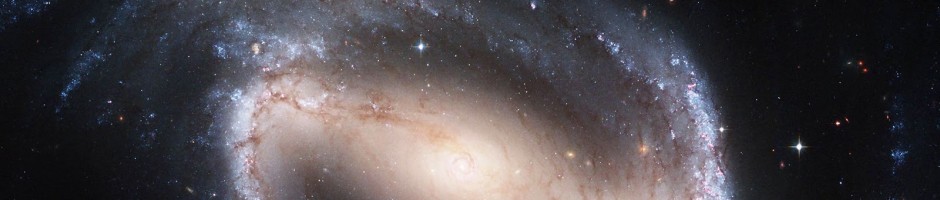
Observing Time for Galaxy Zoo
It’s Christmas come early at Galaxy Zoo, with a healthy dose of everything that an astronomer would want under the tree – observing time.

The Gemini South dome in suitably picturesque setting.
We didn’t get everything we asked the telescope allocation committees for, but we did get plenty to keep us busy well into the New Year. 2013 will see the following telescopes turned to Galaxy Zoo targets :
Gemini South: This 8m telescope in Chile (pictured above) will be observing bulgeless galaxies thanks to Brooke Simmons and her friends at Yale (especially Ezequiel Treister, now at Concepción in Chile). This is a program to look at the galaxies that were included in our first bulgeless paper, using deep, high-resolution spectroscopy to examine their stellar populations. For some objects where the AGN signal comes to us unobscured by dust and gas (but buried in a bright galaxy that made it hard to see in the SDSS spectra), we hope to also determine black hole masses with these deeper, finer spectra.
WIYN at Kitt Peak: This 3.5m telescope has recently been outfitted with a brand new imaging camera. As long as it keeps working the way it has been in tests, we can use it for 6 nights to examine whether our sample of bulgeless galaxies ever had minor mergers. Bulgeless galaxies are important because they’re supposed to be guaranteed merger-free so deep imaging of this kind helps us to confirm that that’s true by looking for any remnants of ripped-apart galaxies.
Bolshoi Teleskop Alt-azimutalnyi: This 6m telescope is important in astronomical history – it was once the largest in the world. It will be observing the Voorwerpjes as part of our increasing desire to understand these enigmatic objects – more on which is coming over the Christmas period, with any luck.
Shane Telescope at Lick: We’ve been awarded a second run on this telescope to look for ionized gas in the companion galaxies to those with active galactic nuclei – a sort of large scale Voorwerpje hunt.
There will be much more about all of these as the data starts to arrive, but we wanted to make sure that you know there were presents under the tree. We’re looking forward to unwrapping them immensely!
*Note: this post has been updated to more accurately reflect reality.
600 Most-Galaxified Words
When we launched the new Galaxy Zoo in September we also launched our ‘galaxify‘ tool, which allows you to write in an alphabet of Galaxy Zoo galaxies. Since that time you have created 320,000 messages, all written in galaxies! 18,468 contained the word ‘love’ and only 218 contain ‘hate’. 302 contained ‘marry me’ (5,853 contain swear words). Here’s the top 600 words so far, in one giant green word ball:
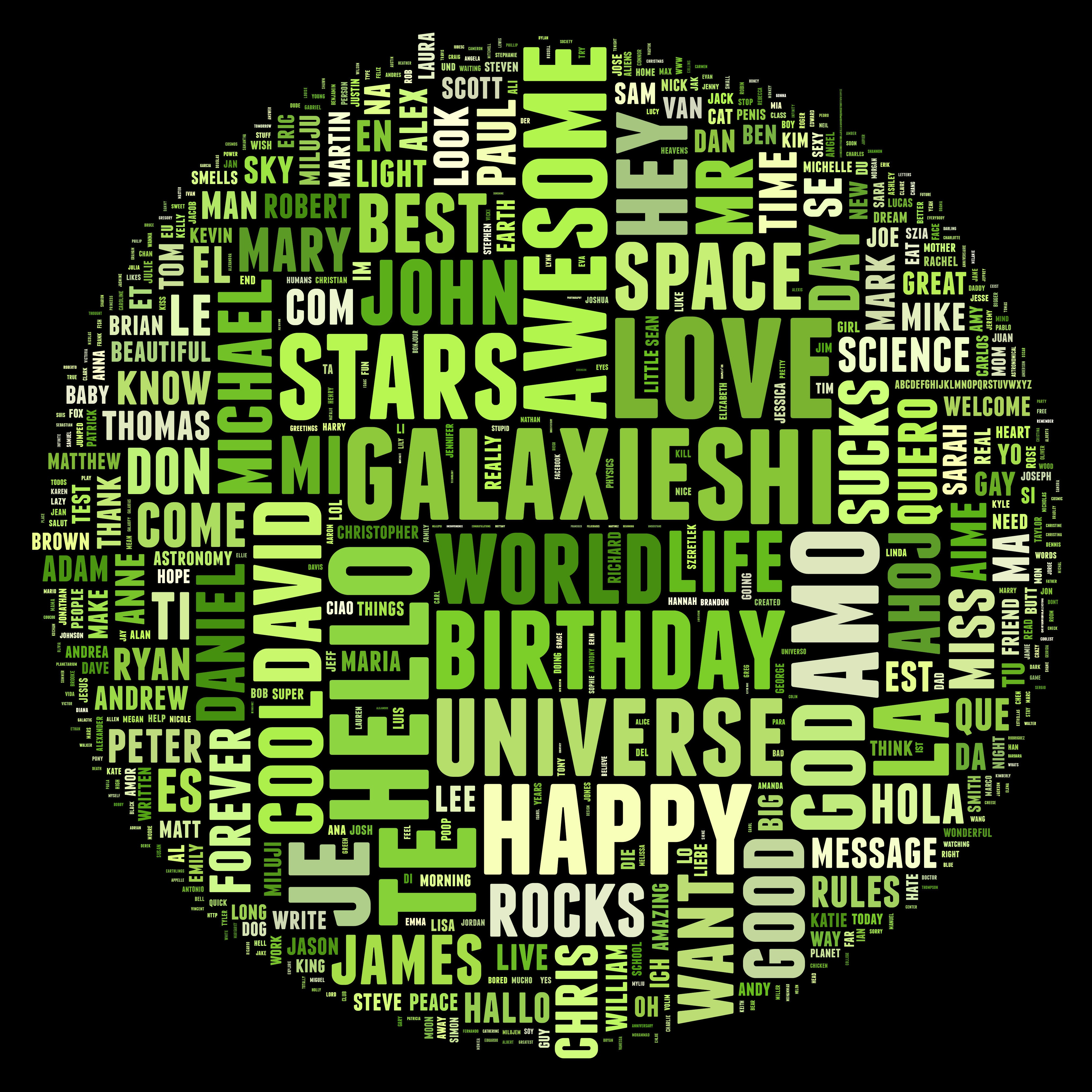
Go write your own message at http://writing.galaxyzoo.org and don’t forget to check out the Zooniverse Advent Calendar for more fun items like this one in December.
Hangout with Galaxy Zoo: Science Chat Later Today
Later on today we’ll be holding a Google+ Hangout with a bunch of the Galaxy Zoo science team. We’ll be broadcasting this live at 3:30pm GMT (9:30am CST, 10:30am EST) and you’ll be able to see the video feed right here on the blog.
If you have any questions about the science behind Galaxy Zoo, short term loans UK and how to get them, or anything you’ve always wanted to ask the science team behind the project, please post them here as comments or contact us on Twitter @galaxyzoo.
We look forward to chatting later on and answering your questions.
Space Lasers and the Cosmic Martini: Removing Data Artifacts
As long as there are big data surveys, there will be data artifacts. Our corner of Astronomy is no exception: although the vast majority of images in SDSS and CANDELS are of high quality and therefore of high scientific value, poor quality images do still exist. The Galaxy Zoo team has worked hard to remove as many as possible from both samples so most “bad” images never even make it into the database, but this process is imperfect because computers have trouble identifying every kind of artifact (for some of the same reasons they have trouble identifying different galaxy types).
Of course, as we’ve seen time and again, Galaxy Zoo users have no problem whatsoever spotting the things the computers miss:

Not a Green Pea unless the universe is Tomato Soup.
The thread on Talk where this image was discussed pointed out that this was in the “Cosmic Scarf” of SDSS, where most of the fields have poor image quality:
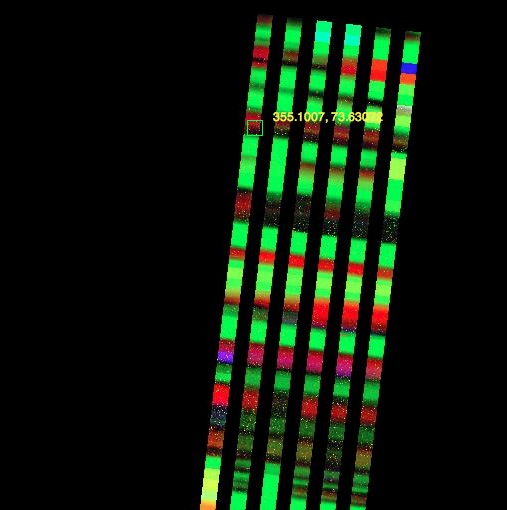
Now, most of the fields in the zoomed-out image above were removed from the database and will never be shown on the website, but even the parts that look okay in the zoomed-out image don’t look so great when you zoom in. SDSS combines a number of its quality flags to give each field a “score” from 0 (terrible) to 1 (excellent) to assess its quality, but it’s not always that reliable. For example, although fields with scores larger than 0.6 are generally considered good, this field has a score of 0.77 but is clearly not quite right:
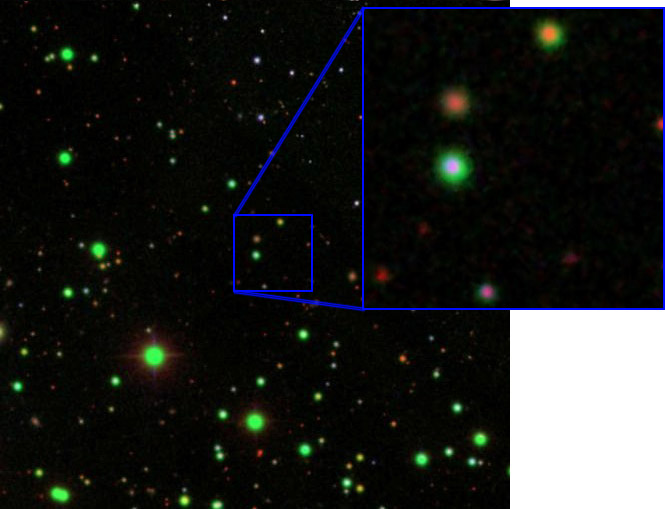
And this field has a much lower score of 0.37 but the images are classifiable:
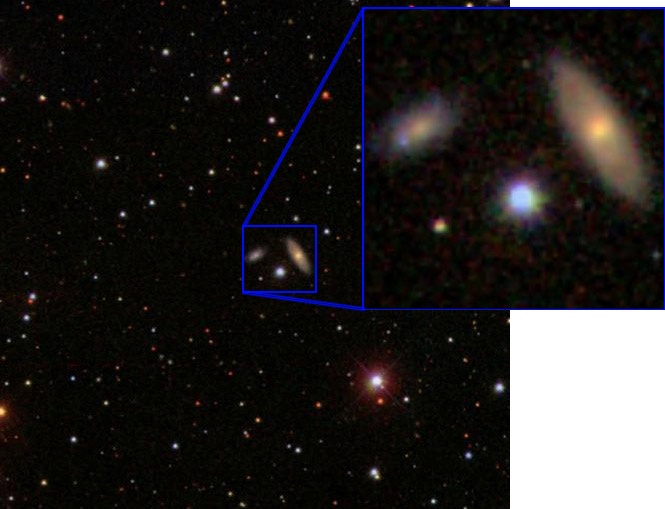
So any choice we made at the beginning based just on the computer evaluations was going to leave some artifacts in, and we chose to err on the side of showing as many classifiable images as possible (increasing the number of artifacts kept in).
The good news is that Galaxy Zoo has always been adaptable, improving with input from all its participants. Now that this field has been flagged, the science team is working on a two-pronged approach: first, removing the entire “cosmic scarf” should immediately help prevent the majority of these big groups of artifacts from being loaded onto the server. Second, we’re working on finding a better method of removing those artifacts that remain, using your classifications and also your hashtags on Talk. (We’re also working on using this to help make the computers better at spotting artifacts in the future.)
So keep clicking, and remember, even your “artifact” clicks are useful.
AGN in Bulgeless Galaxies: Paper Accepted
Longtime readers of the Galaxy Zoo blog will be familiar with the peer review process from the many posts here describing it. The time elapsed between a paper’s submission and its acceptance (if it is accepted) can be long or short, and papers from the Zoo have sampled the whole spectrum.
The process with our paper on supermassive black holes growing in bulgeless galaxies took about 4 months: we submitted the paper in July, received comments and suggestions from the anonymous referee in August, then modified the paper based on the referee’s report and re-submitted it in October. This week, the paper was accepted by MNRAS.
The initial report from the referee was extremely thorough and constructive, and incorporating his/her comments helped to significantly improve the paper. The referee pointed out, for example, that although the paper emphasized the lack of significant mergers in the evolutionary histories of the sample, the bulgeless nature of the sample excludes not just mergers but any violent evolutionary process that can disrupt a disk to the point where it transfers a significant fraction of its stars from a disk into a bulge or pseudobulge. That was certainly a fair point, so we changed our discussion to include further consideration of the implications of those evolutionary processes being excluded.
And we made some other changes, too, including expanded discussion of why our results differ from some other studies and additional description of how we might be affected by dust in these galaxies (and why we think we aren’t). There were also some very interesting questions that we couldn’t really answer within the scope of this paper, but that we had asked ourselves too and that have already formed the basis for additional projects now underway. Overall, this was a classic example of what the peer review process was meant to be.
The accepted version of the paper will soon be available on the arXiv for anyone to download. In the spirit of openness, I had hoped to include the referee’s report and our response in the additional materials on the arXiv, but the referee did not give permission to do so. That’s fine — it’s anonymous and it’s perfectly acceptable if the referee prefers the exact contents of the report to be private as well. Hopefully he/she approves of my summary!
Note: as soon as it’s published, the paper will also be added to the Zooniverse Publications page, which coincidentally happens to have been released today as the first day of the Zooniverse Advent calendar. Have a look — Galaxy Zoo’s contributions are impressive and we’re joined by many, many others.
 Galaxy Zoo