Radio Galaxy Zoo finds rare HyMoRS!
The following blogpost is from Anna Kapinska about the Radio Galaxy Zoo paper that she published recently with Radio Galaxy Zooite, Ivan Terentev on the first sample of candidate Hybrid Morphology Radio Sources (HyMoRS) from the 1st year of Radio Galaxy Zoo results.
Radio Galaxy Zoo scores another scientific publication! The paper ‘Radio Galaxy Zoo: A search for hybrid morphology radio galaxies’ has been published today in the Astronomical Journal. First of all congratulations to everyone, and what wonderful work from all our citizen scientists and the science team! Special thanks go to Ivan Terentev, one of our very active citizen scientists, whose persistent work on finding and collecting HyMoRS in a discussion thread on RadioTalk (link) without doubt earned the second place in the author list of this paper. But of course the publication wouldn’t be possible without all our volunteers, and special thanks are noted in the paper (check out the Acknowledgements on page 14):
“This publication has been made possible by the participation of more than 11,000 volunteers in the Radio Galaxy Zoo Project. Their contributions are acknowledged at http:// rgzauthors.galaxyzoo.org. We thank the following volunteers, in particular, for their comments on the manuscript or active search for candidate RGZ HyMoRS on RadioTalk: Jean Tate, Tsimafei Matorny, Victor Linares Pagán, Christine Sunjoto, Leonie van Vliet, Claude Cornen, Sam Deen, K.T. Wraight, Chris Molloy, and Philip Dwyer.”
But what are HyMoRS? HYbrid MOrphology Radio Sources, HyMoRS or hybrids for short, are peculiar radio galaxies that show atypical radio morphologies. That is, radio galaxies which we can resolve in our observations come in two principal flavours: 1) FRI – type; and 2) FRII-type — named after two scientists who introduced this classification back in 1974, Berney Fanaroff and Julia Riley [link to paper].
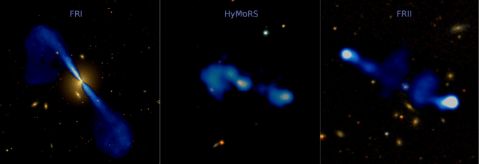
Figure 1. Three main types of radio galaxies. FRI type (3C 296, left panel), FRII type (3C 234, right panel), and a HyMoRS that shows a hybrid radio morphology of FRI on its eastern (left) side and FRII on its western (right) side (RGZ J103435.8+251817, middle panel). The radio emission from the jets is in blue, overlaid on the SDSS true colour images. Credits: Kapinska (based on FIRST/NRAO, SDSS, Leahy+Perley 1991).
Traditionally, FRIs and FRIIs are distinguished by different morphologies observed in radio images, where on the one hand we have archetypal FRIIs showing powerful jets that terminate in so-called hotspots (can be spotted in right panel of Figure 1 as two white bright spots at the ends of the jets), while on the other there are FRIs with their jets often turbulent and brightest close to the host galaxy and its supermassive black hole (left panel of Figure 1). HyMoRS are hybrids, they show both morphologies at the same time, that is they look like FRI on one side and FRII on the other side. Figure 2 shows two examples of the new HyMoRS candidates that Radio Galaxy Zoo identified in this latest paper.

Figure 2. Two new HyMoRS candidates found with Radio Galaxy Zoo: RGZ J150407.5+574918 (left) and RGZ J103435.8+251817 (right). The radio emission from the jets is in blue overlaid on the SDSS true colour images. The inserts show zoom-ins on the HyMoRS’s SDSS images of the hosts galaxies. Credits: Kapinska (based on FIRST/NRAO, SDSS).
How are HyMoRS formed? We still don’t have a very clear answer to this question. The thing is that there may be many reasons why one radio galaxy would have so radically different looking jets. One possibility is that the medium in which the jets travel through (the space around) is different on each side of the galaxy. In this case the FRI morphology could form if the medium is dense or clumpy for one jet, while FRII morphology could form if the medium is smoother or less dense on the other side for the second jet (but watch this space for more work from our science team). But there are also other options. For example, we may simply see the radio galaxy in projection, or we are observing rare events of a radio galaxy switching off, or switching off and on again. The more HyMoRS we know of, the better we can study them and pinpoint the scenarios of how they form.
For example, the science team at the University of Tasmania has produced a simulation of jets from an FRII-type radio galaxy located in the outer regions of a cluster (~550 kpc from the centre) and expanding in a non-uniform cluster environment. The jet on one side propagates into a much denser medium than the jet on the other side. The jets are very powerful (10^38 Watts) and the total simulation time is 310 Myr. The movies display the density changes associated with the jet expansion. Credit goes to Katie Vandorou, Patrick Yates and Stas Shabala for this simulation (link to simulation).
How rare are HyMoRS? We actually don’t really know, and this is because so far there are very few complete surveys of these radio galaxies. Current estimates indicate that they may be comprising less than 1% of the whole radio galaxy population. We are hoping that with Radio Galaxy Zoo and the new-generation telescopes we will be able to finally pin down the HyMoRS population. And our paper is definitely one big step towards that aim. It’s very exciting as with the fantastic efforts of RGZ we now have 25 new HyMoRS candidates — this could possibly double the numbers on known hybrids!”
So well done everyone and let’s keep up the fantastic work! We couldn’t have done it without you 🙂
Anna, Ivan & the coauthors on this latest paper
___________________
The official open access refereed paper can now be found at http://iopscience.iop.org/article/10.3847/1538-3881/aa90b7
The article can also be downloaded from: http://arxiv.org/abs/1711.09611
A CAASTRO story with embedded animation is now available at: http://www.caastro.org/news/2017-hymors
Shedding light on the mutual alignment of radio sources
The following blogpost is from Omar Contigiani about the Radio Galaxy Zoo paper that he published recently on the cosmic alignment of radio sources.
In the Radio Galaxy Zoo an incredible variety of creatures can be found — as our citizen scientists might know by now, radio sources in the sky can have all sorts of shape and sizes. The most powerful among them are plasma-filled jets emitted by the some of the largest elliptical galaxies in existence. Because of their precise structure, anyone can associate orientations to these sources by simply looking at the directions the jets point at.

Figure 1: Illustration of jet orientations distributed in the sky. Note that this figure only depicts a small fraction of the total area covered by the observations upon which RGZ is based. Credit: NASA, ESA, S. Baum & C. O’Dea (RIT), R. Perley & W. Cotton (NRAO/AUI/NSF).
Recently, our scientists have been looking at the directional properties of these fascinating beasts. If a particular source points in a direction, is it possible that its neighbours also tend to do the same? Because the distances between adjacent objects are (quite literally) astronomical, it seems intuitive to assume that the relative orientations should be random. However, nature always finds subtle ways to mess with our intuition and it turns out that this is currently an open question in astronomy. Thanks to Radio Galaxy Zoo’s numerous (almost two million) image classifications, the team was able to report the most precise measurement of this effect to date. The results are available in a scientific article published in Monthly Notices of the Royal Astronomical Society this November.
The analysis performed in the study suggests that relative alignment of radio sources is present on distances which are dubbed as cosmological. This is because only phenomena related to the history of the Universe as a whole are known to be connected to such large scales.
While this is an exciting step towards an answer, formulating any conclusive statement about this alignment and the reasons behind it appears to be difficult. What drives this effect? Is it related to a shared history or environment? More science needs to be done and more galvanising discoveries are waiting for us just around the corner.
Once again, without the contributions made by our volunteers all over the world, we would not have been so successful in our endeavours. A big thank you to all our Radio Galaxy Zooites!
However, we have only reached 74% of our classification target. Head to Radio Galaxy Zoo to become involved and you will be contributing to real science being done today and may be co-authoring another great discovery with us!
RGZ team spotlight: Francesco de Gasperin

Meet Francesco de Gasperin, an associate science team member (since 2015) who is very interested in the classifications resulting from Radio Galaxy Zoo
I am a VENI fellow at the Leiden University in the Netherlands. My research is mainly based on developing and exploiting new technologies in radio-astronomy to study active galactic nuclei (AGN), galaxy clusters, galaxies and ultimately everything which emits radio waves. I am part of the LOFAR collaboration and most of my time is invested in the commissioning of this new radio-telescope. I am now leading the effort to calibrate the low band antennas of LOFAR to observe the sky at decameter wavelength. Our plan is to ultimately produce the lowest frequency radio survey ever done.
I did my PhD at the Max Planck Institute for Astrophysics in Munich on a thesis titled: “The impact of radio-emitting supermassive black holes on their environment: the LOFAR view of the Virgo cluster”. During my master I also worked for the Planck mission, a satellite designed to study the Cosmic Microwave Background (CMB) – the relic radiation from the Big Bang.
******************
What has Francesco and his student, Omar Contigiani done lately ?
Is the orientation of radio galaxies totally random? Or is it driven by the large scale structure where galaxies are embedded in? Recently, some works on small regions of the sky claimed an intrinsic alignment of radio sources. This is in line with the observed alignment between quasar jets and the surrounding large scale structure at higher redshifts.
With the help of the RGZ we are now able to identify the orientation of a very large number of radio galaxies. This allows us to expand these studies to unprecedented scales, moving from regions of few square degrees to around 10 thousands.
 Galaxy Zoo