Galaxy Builder Results
For the past few years, a new Galaxy Zoo project has been under development. This project allows the creation of models of galaxies inside the Zooniverse website (although in a slightly experimental fashion). Many of you helped trial this project in December of 2017, and some have classified since it was quietly launched in late April. I’d like to take this opportunity to share with you some of the early results we have obtained from your classifications!
From the beta
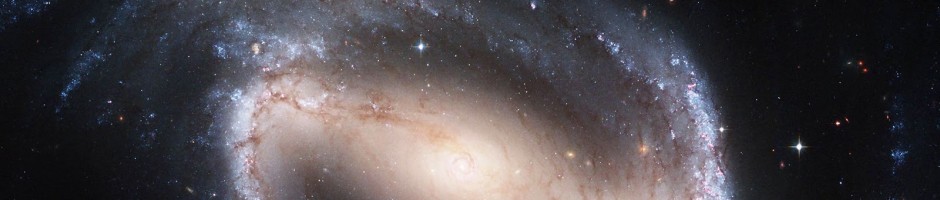
260 of you helped beta test and debug the project in our beta, providing invaluable feedback (most of which we hope we addressed!) and submitting over one thousand test classifications of our small test sample. One of the images in this sample was the SDSS r-band image of the galaxy below, catchily known as SDSS J104238.12+235706.8.

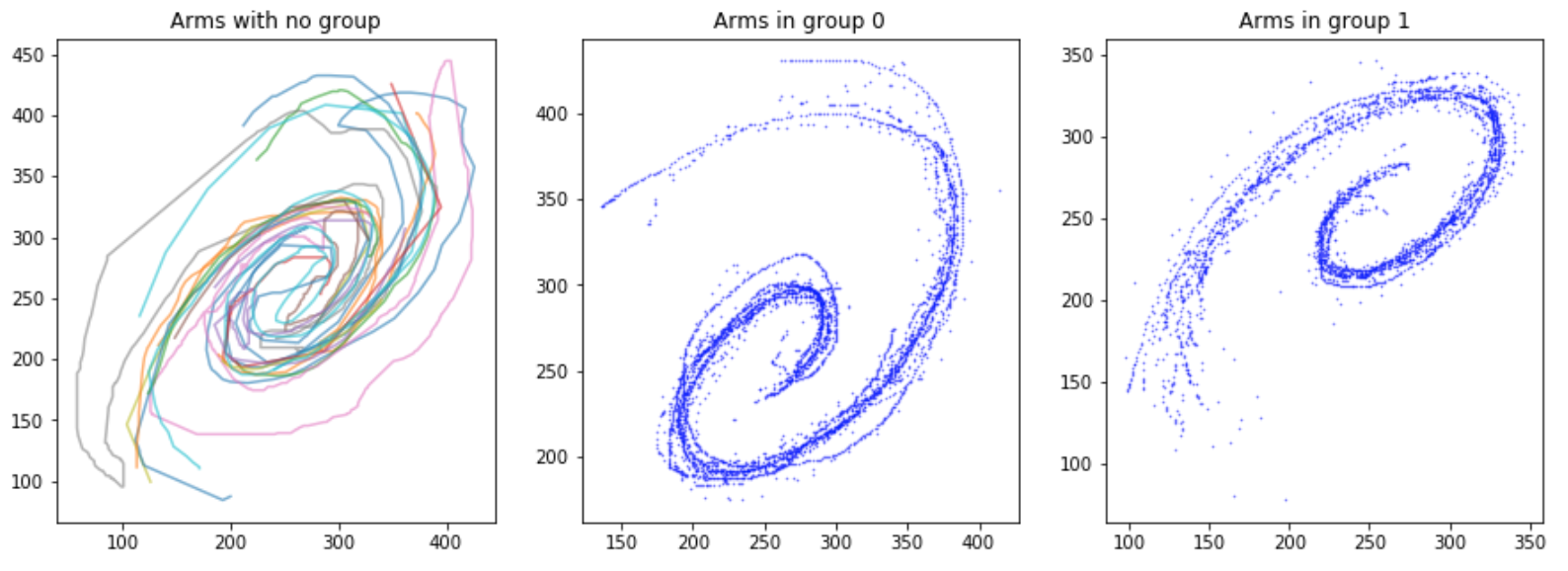
In this post we’ll look specifically at the spiral arms drawn on this galaxy, and how we can recover information about the shape of the spirals from your drawn arms. If we plot every spiral arm drawn on the galaxy, two distinct spiral appear:

There are a number of classifications which have either crossed the center of the galaxy, linking the two arms with one line, or which attempt to enclose the spiral (as in the GZ:3D project) rather than tracing along the center line. This confusion arose from the short tutorial and confusing help text present in the beta, which was flagged by our testers (thank you!).
Grouping Lines
We can make use of unsupervised machine learning techniques to cluster together these drawn arms, and extract points corresponding to each arm (while throwing away some lines which didn’t fit into our groups).
Cleaning up
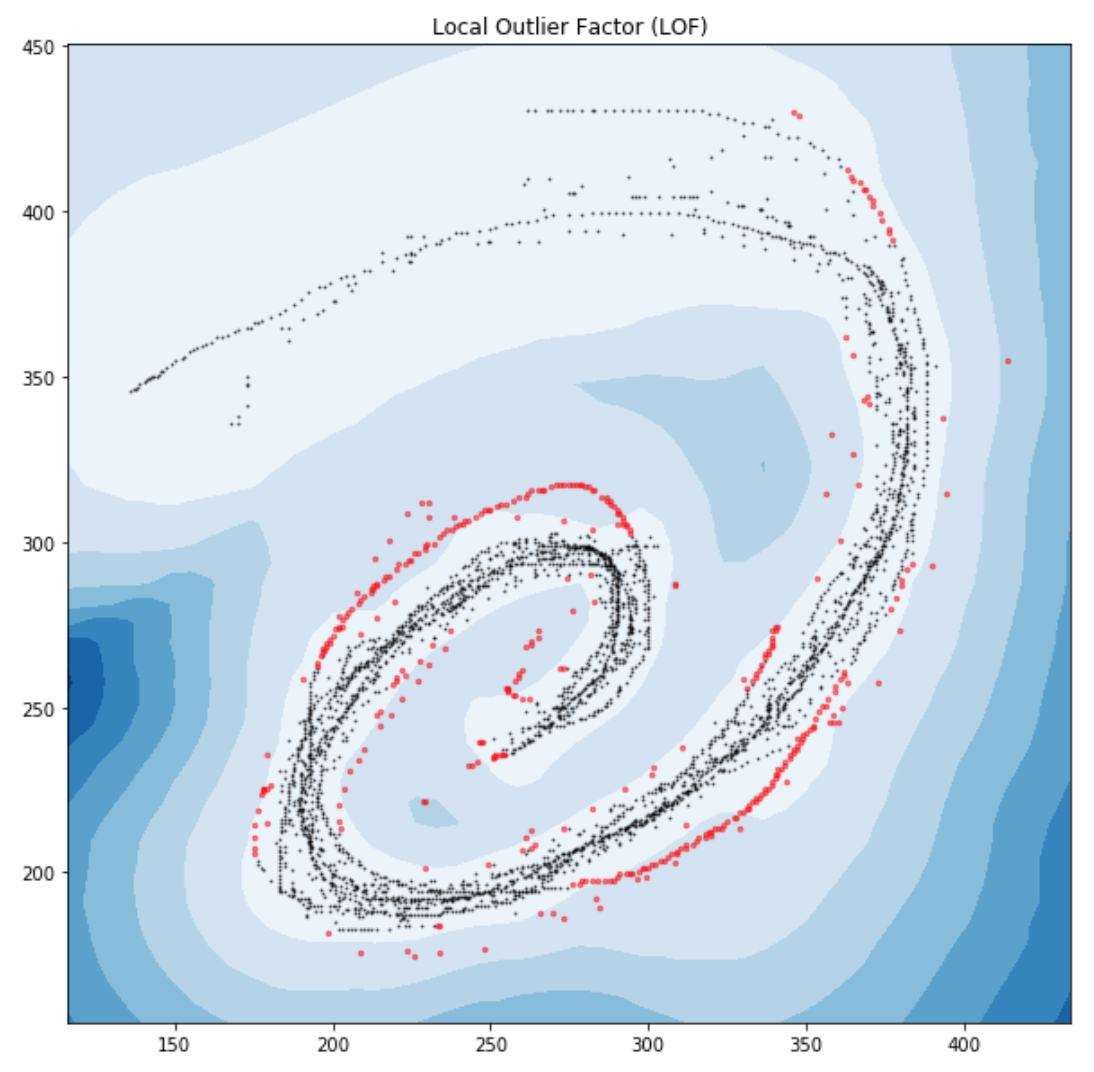
Taking one arm as an example, we identify points which could be considered outliers, and remove them to improve our later fit (using another unsupervised machine learning technique called Local Outlier Factor). In the image below, red dots correspond to points identified as outliers, and the blue contours can be seen as a probability map, with points in regions of darker blue being more likely to be an outlier.
Fitting a spiral
Brilliant – we now have a load of (unordered) points which roughly resemble the spiral arm of our galaxy! We’ll fit a smooth line to obtain a “best guess” of the galaxy’s spiral properties, the result of which can be seen below:

What we’ve discovered from the beta trial is that we need at least 20 attempts at drawing spirals on a galaxy to get reliable answers, so we’re keen to get more people trying to build galaxies on Galaxy Builder.
If you’d like to help please join us at https://www.zooniverse.org/projects/tingard/galaxy-builder. If that’s not your thing we still need classifications on Galaxy Zoo: 3D, and the classic Galaxy Zoo is still live with all new images from the DECaLS survey.
A Conference on Galactic Rings

Paul Eskridge and Karen Masters help Ron Buta unwrap the De Vaucouleurs classification diagram. Photo credit: Bill Keel.
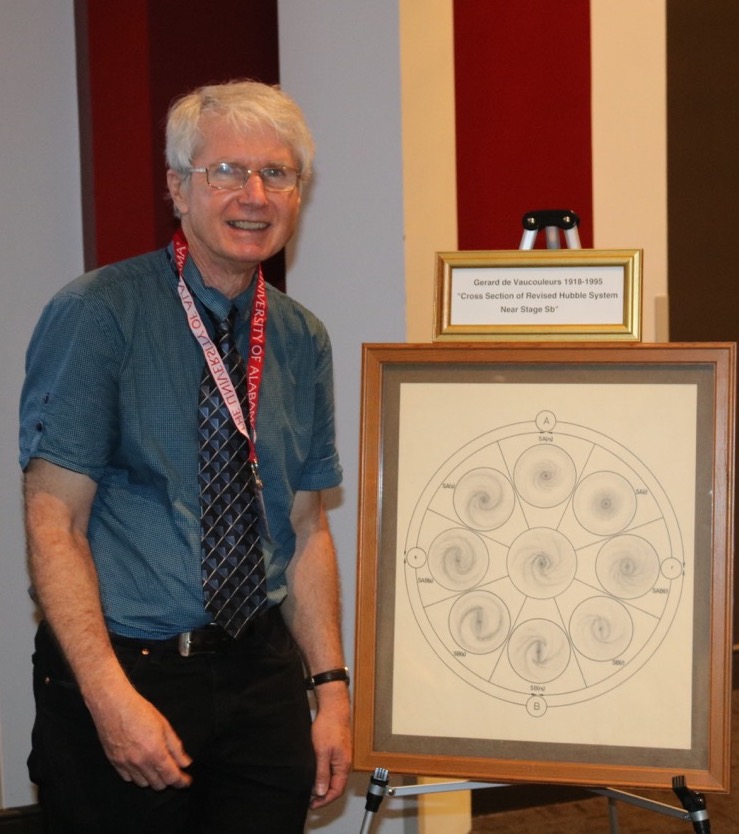
Ron Buta by the original diagram of the De Vaucouleur Classification Scheme for Sb galaxies. Gerard de Vaucouleur hand drew each galaxy in the diagram in pencil while clouded out on observing runs. Many of the structures discussed in this conference are clearly shown in this diagram. Photo credit: Bill Keel
There are various kind of rings we see in galaxies – nuclear, inner, outer, pseudo rings, collisional, accretion, maybe even disk instability at high redshift. We discussed how all of these are thought to form, and enjoyed a parade of beautiful images of ring galaxies.

A selection of ring galaxies. From left to ring: Hoag’s Object (an accretion ring), The Cartwheel Galaxy (a collisional ring) and NGC 3081 showing an inner and nuclear resonance ring (it also has an outer ring, not shown in this image). Image credits: Hubble Space Telescope for all three (composition by Karen Masters).
Spiral arms and how they form were a big discussion at the conference. Bill Keel (who you may now better for his work on overlapping galaxies found in the forum), presented work by the most recent Galaxy Zoo PhD – Dr. Ross Hart (who unfortunately could not make the meeting) on Galaxy Zoo constraints on spirals. This included results from a small side project Spiral Spotter. What is clear from this result (and many others presented at the meeting) on spirals – we really don’t understand which spiral arm formation mechanisms are the most important in galaxies, or how to tell in an individual galaxy which mechanism makes its spirals. There’s a dizzying array of possibilities – so lots of results to test with morphology. Overlapping systems did still get a mention – presented by Benne Holwerda.
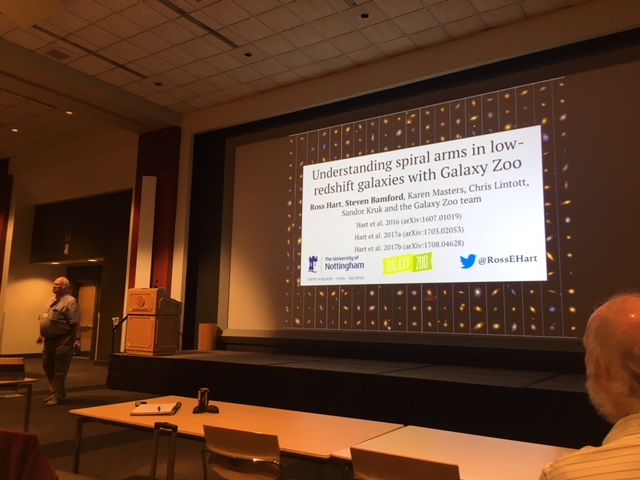
Bill Keel presenting Galaxy Zoo results on spiral arms. Credit: Karen Masters
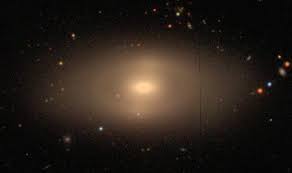
NGC 4371 and it’s clear bar (Credit: SDSS)

Karen Masters starting a talk with a review of 11 years of the Galaxy Zoo project. Credit: Bill Keel

A group of experts classify a photo of astronomers from 1995 (in the same location). Credit: Bill Keel.
 Galaxy Zoo