Hubble results on Hanny's Voorwerp – the whole story
We just submitted the journal paper describing the Hubble results on Hanny’s Voorwerp, to the Astronomical Journal. It’s not on arxiv.org yet – you can get a PDF here. Here’s a “brief” summary.
Data: In this paper we look at a whole collection of new data, obtained since the original discovery paper. These include:
Hubble, of course:
– WFC3 (Wide-Field camera 3) images in the near-ultraviolet, deep red, and near-infrared. These filters were designed to exclude most of the light from the gas, so we could look for star clusters, especially in Voorwerp and its surroundings, and with the IR image, look deeper into the dust around the nucleus of IC 2497.
– ACS (Advanced Camera for Surveys) images tuned to the wavelengths of [O III] and Hα emission. These were intended for fine structure in the gas and its ionization. As it turned out, we saw streamers, fine details, embedded star formation, and local interaction with a jet from IC 2497.
– STIS (Space Telescope Imaging Spectrograph) red and blue spectra across the galaxy nucleus. This let us isolate structure near the nucleus much better than from the ground, so we would look for any gas that has a line of sight to a brighter nucleus than we see directly (perhaps because of foreground dust).
GALEX (the Galaxy Evolution Explorer satellite): wide-field ultraviolet spectra and images, which help us put the Hubble UV data in context.
Kitt Peak 2.1m telescope – redshift of the companion galaxy, and the nature of star-forming regions just southwest of the nucleus of IC 2497
3.5m WIYN telescope BVI images – the best non-HST data, which we used to confirm techniques for reducing effects of cosmic-ray impacts in ACS images.
In no particular order, our major science results are:
1 – We found no evidence that the quasar in IC 2497 is still bright. The Hubble spectra show no highly-ionized gas near the center, as we might expect if it were bright but blocked by dust clouds from our point of view. In fact, with HST data we can refine our estimates of the radiation intensity seen by gas near the core and out in the Voorwerp, and these estimates only widen the shortfall. That is, we can constrain the quasar’s (former) brightness to have been brighter than our earlier lower limits from the ground-based data (because of the sharper Hubble images, we can tell better how close gas is to the nucleus of IC 2497 and how bright the brightest peaks are in the Voorwerp). To quote a famous 1960s television character, “It’s dead, Jim.”
2 – As we told everyone at the AAS, we found regions of star formation in the Voorwerp. This is part of a broader picture of a directed flow of gas out from IC 2497 in a fairly narrow jet or cone. The small radio jet seen with VLBI radio techniques (the Rampadarath et al. paper, using data from the UK MERLIN network at the European VBI network) points within about 10 degrees of the direction where we see a “small” area of star formation in Hanny’s Voorwerp (no more than 5000 light-years across), and this is precisely aligned with the one area where we see tendrils of gas pointed away from IC 2497 (the area I once called Kermit’s Fingers). We see these areas of star formation in two ways – in the images filtered to minimize the gas contribution, we see the light from young star clusters themselves, even into the ultraviolet. And in the images which isolate the ionized gas, we see its ionization state (and emission-line ratios) shift in local regions around the star clusters, to the ratios that we see when the gas is ionized by young stars and not AGN. In the color images, that shows up a a shift from green (where [O III] is much stronger) to red (where Hα is the stronger line). However, compared to some other active galaxies whose jets impact surrounding gas, the effects are modest in Hanny’s Voorwerp; the jet or outflow has compressed gas and triggered star formation, but at only a quarter the rate of the similarly-sized Minkowski’s Object, which sits right in the path of a more powerful jet from the radio galaxy NGC 541. The balance tells us something about the amount of material that can be in the outflow, in order not to have pulled any more gas out into filaments , and form any more stars, than we see. This also suggests something to look for in the future – star clusters in the middle of nowhere that were formed by outflows from now-faded active galactic nuclei.
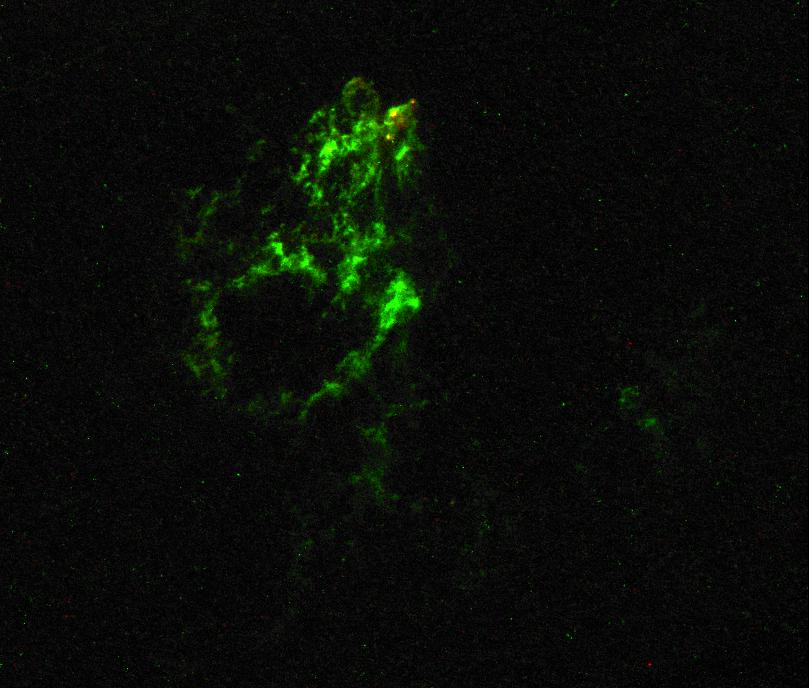
HST ACS image of Hanny's Voorwerp in oxygen III (green) and H-alpha (red)
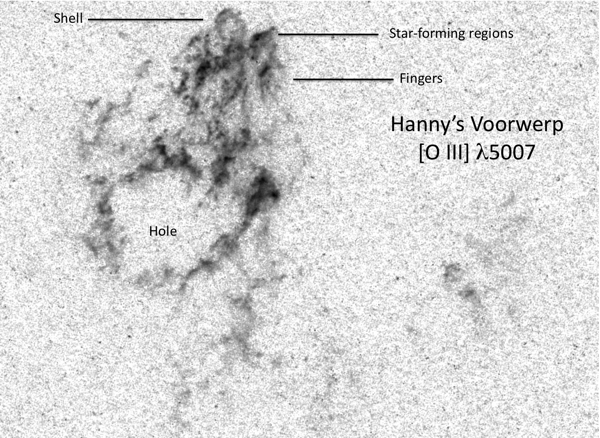
Features in Hanny's Voorwerp
The outflow of gas we see toward the Voorwerp may roughly match, in age, another find from the Hubble data – an expanding ring of gas, 1500 light-years in size, heading out from the core in the opposite direction. This is another sign that the AGN has begun to affect its environment through mass motions rather than radiation alone. This was a serendipitous find – only because the spectrograph slit happened to cut across it could we spot this region only a half arcsecond from the core where the Doppler shifts and emission-like properties were quite distinct. With some extra processing, it turned up in the emission-line images as well, which is how we know it forms a loop. We suspect that putting it all together may show that the black hole’s accretion in IC 2497 hasn’t completely shut down, but has shifted from producing radiation to pumping more energy into motions of surrounding gas (as it’s called in the jargon, switched from quasar mode to radio mode). The speed of such a switch would inform theoretical understanding of these accretion disks, happening not on the periods of days that we see for black holes in our neighborhood with a few times the Sun’s mass, to a million years (or now maybe rather less) in a galactic nucleus.
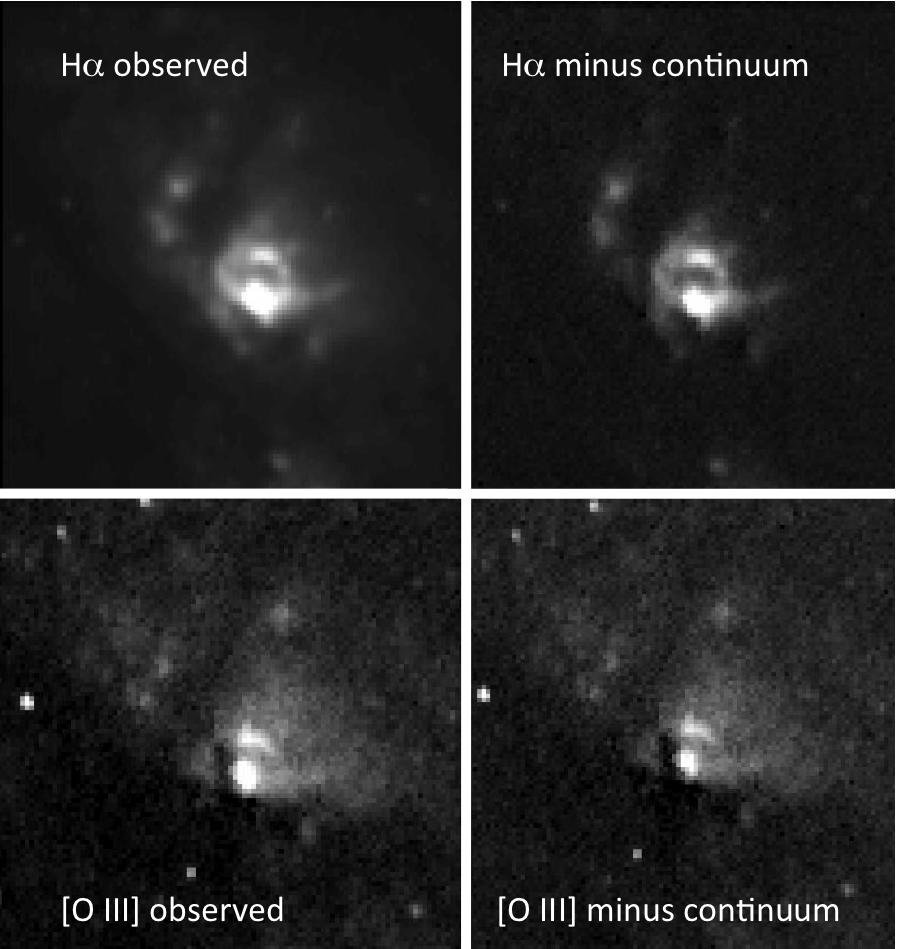
HST ACS images of the core of IC 2497
3 – As we could sort of see from the SDSS images, IC 2497 is disturbed. Its spiral arms are twisted out of a flat plane, with dust lanes cutting in front of the central region. This fits with the idea that a tidal collision pulled out the massive tail of neutral hydrogen. On the other hand, we now see that the companion galaxy just to its east is a beautifully symmetric, undisturbed spiral (which we now know to have a precisely matching redshift, so they are almost certainly close together). One picture that would fit these data would be that IC 2497 is the product of a merger something like a billion years ago (more precisely, before the time when we see it), a merger which was either quite unequal in galaxy masses or unusual in leaving the disk of the galaxy in place although warped. There is a suggestion that the patch of star-forming areas just to the southwest of the center of IC 2497 might be all that remains of the other galaxy.
4 – This result may be a bit of an acquired taste, delving into emission-line physics. From the lack of a correlation between level of ionization and intensity of Hα emission, we can tell that, despite the amazing level of detail of blobs and strings we can see in the Hubble images, that there is fine structure on still smaller scales. The areas that are brighter are not, by and large, any denser than average (which would be the most natural way to have brighter H-alpha emission), they have more small blobs and filaments with about the same density. This could be general – if the outflow from IC 2497 has not reshaped the gas in the Voorwerp, most of the neutral hydrogen that’s not ionized by the galaxy nucleus would have the same kind of structure. That in turn would suggest that the common giant hydrogen tails around interacting galaxies are composed of masses of narrow threads of gas (maybe held together by magnetic fields), which is not the first thing we would guess from the limited-resolution radio data that are the only way we can see these tails unless they are ionized by a nearby AGN.
Several of these are results we will also look for in the Hubble images of selected Voorwerpjes – do we see star formation indicating there is an outflow from the AGN, and do we see the same evidence for fine structure in the gas?
From the spectrum, we have a pretty good idea what the chemical mix of elements is – by mass, around 77% hydrogen, 23% helium, and 0.25% of everything else (what astronomers like to call “metals”, although that mostly means carbon, nitrogen, and oxygen). This tells us a bit about where the gas didn’t come from – it was not blown out from deep inside IC 2497, because gas near the centers of big galaxies gets progressively enriched in heavy elements produced inside massive stars (then blown out in supernova explosions or less violent planetary nebulae). If the gas in the 21-cm hydrogen tail was pulled out from the outer regions of IC 2497 during an interaction with another galaxy, this would fit, since gas far out in spirals has been less affected by material produced in stars.
This is the first technique that has been able to look across times of many thousands of years, rather than the few decades that astronomers have been able to watch AGN. Getting a better handle on this was a big part of the search for voorwerpjes (so we get a better since of how unusual IC 2497 and the Voorwerp might be). From our initial sample of 19, we could make a crude estimate that AGN stay bright for roughly 20,000-200,000 years at a time. This comes from comparing the numbers of galaxies with clouds whose AGN are bright enough to account for them with the number where the AGN is too faint to light up the clouds (where iC 2497 is the strongest example). I have a project slowly getting started to look for even fainter examples (too dim to be picked up by the SDSS) around bright galaxies, so we might be able to look back even longer (up to a million years if very lucky). Geeky it might be, but I couldn’t resist calling this the TELPERION survey. As an acronym it’s forced, but Middle-Earth aficionados will see how appropriate the connotation is.
All in all, quite an adventure beginning with “What’s the blue stuff?”
Star-formation, AGN and Ultra-luminous infrared galaxies
An update on mergers from Alfredo:
Star-formation, AGN and Ultra-luminous infrared galaxies (ULIRGs)
Looking at our galaxies in the infrared allows us to discover the overall star-formation rate of the system. Yet if we are interested in the fine details of what really fuel the energetic output of our mergers we need to have a closer look to the light we get from them.
Using a emission lines comparison technique called BPT (after Baldwin & Phillips & Terlevich 1981) we can tell what is really going on at the core of our galaxies.
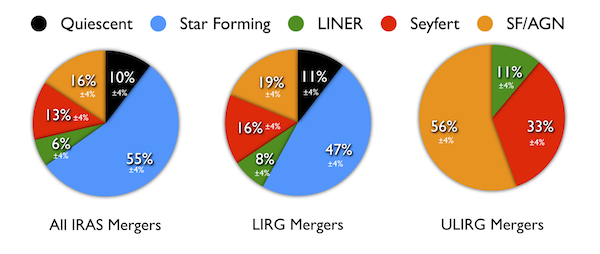
TV News says we don’t see any significant difference between the general IRAS-detected and the Luminous infrared galaxies. However, when we look at the most luminous infrared galaxies, the ULIRGs the fraction of AGN rises dramatically. This result is important because it conforms to many other studies on the role of AGN in ULIRGs.
We also explore the timescale for a LIRG to become a ULIRG. This is obviously an imperfect analysis for various reasons: firstly not all LIRGs turn into ULIRGs, secondly we use Newtonian mechanics in our calculations and lastly our constraints are quite approximate.
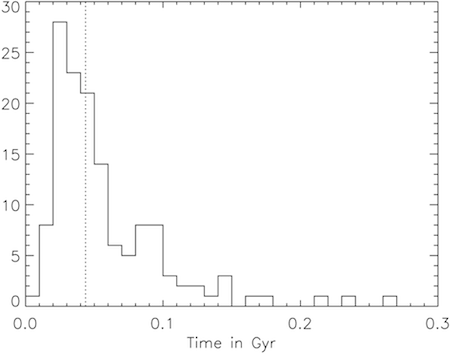
Gyr = gigayear = a billion years
We assume that the Infrared luminosity peaks when the two galaxies coalesce, so we discard all the post-merger LIRGs. Another requirement is that the total mass of the progenitor system is less than the mass of the ULIRGs. We calculate the distance between the two cores and we used a typical group velocity of 400km/s. Under those conditions we find a timescale of 50 million years.
Meeting the Astronomy World
This guest post is from Anna Han, an undergrad working on the Hubble data from Galaxy Zoo:
I attended the AAS Conference in Austin, Texas with the Yale Astronomy and Physics Department to present the results from my research last summer. Many thanks to everyone in the department and Galaxy Zoo who gave me this opportunity and continue to support me through my work. It is because of their guidance that I was able to present a research poster at the conference this winter and enjoy a whole new experience.
The AAS Conference was fascinating, motivating, and overwhelming all at the same time. Starting from 9:00am every morning, I listened to various compact 10-minute talks given by various PhD candidates, post-docs, and researchers from around the world. Though I must admit some of the ideas presented went over my head, I learned more and more with each talk I heard.
The midday lunch breaks made up one of my favorite parts of the conference. Yes, the ribs in Texas are good. But no amount of delicious southern cuisine compares to how welcome and at ease I felt with fellow astronomers kind enough to invite me, a newbie sophomore undergraduate, to lunch. Lunch became my 2-hour my opportunity to talk one-on-one with other researchers and get informed on their work. When my questions ran out, I gladly took the chance to introduce my own research and use their feedback to better prepare for my poster presentation.
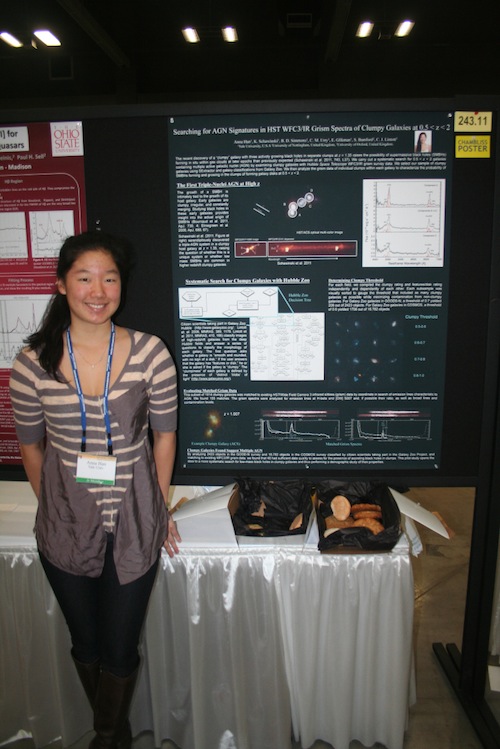
On Thursday morning, I tacked up my poster in the exhibit hall and stood guard, armed with organized details of my research and cookies as bait. Let me confess now that I have never been at or in a science fair, but I imagine it must be similar to what I experienced that day. Non-scientist citizens and experts in AGN alike perused my poster and asked questions. Every once in a while I recognized a familiar face: members from my research group, students I had befriended throughout the conference, and fellow researchers I had shared lunch with stopped by to see my poster. Explaining my research to someone who was interested (either in my work or the cookies) was an immensely rewarding experience. I felt proud of what I had accomplished and so thankful to the people who helped me do it. The encounters with other people also gave me ideas for future directions I could proceed in.
This semester, I plan to continue searching for multiple AGN signatures in grism spectra of clumpy galaxies. My experience at the AAS Conference has inspired me to develop a more systematic search for clumpy galaxies using Galaxy Zoo and explore in more detail the possibility of low redshift galaxies containing multiple AGN. To the citizens of Galaxy Zoo, thank you again, and I hope for your continued support!
The infrared properties of mergers
Another update from Alfredo Carpineti:
Following the previous post, we continue the analysis of galaxy mergers in the infrared.
We want to understand where our galaxies stand with respect to other mergers and other infrared luminous galaxies. Using infrared radiation we can extrapolate the number of stars produced by a galaxy every year, namely the star formation rate(SFR). This number is really important since the star content of a galaxy modifies both its colours and its intrinsic properties. The average star formation rate is around 15 solar masses per year, which is high, considered that the SFR for a common galaxy is of 1-2 solar masses per year.
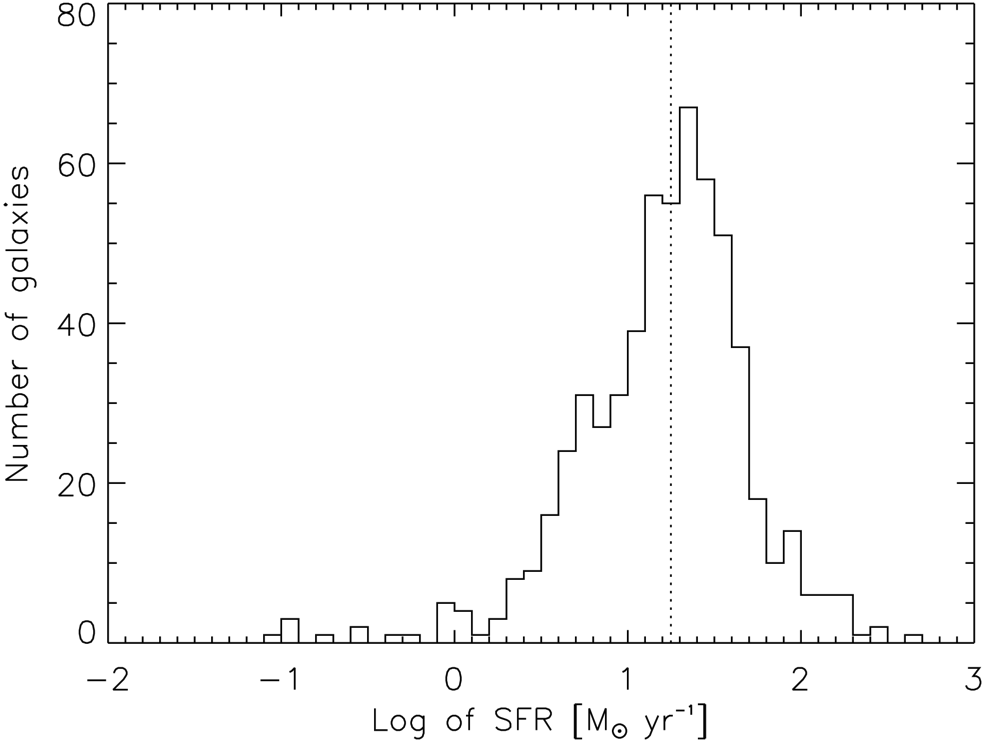
Let’s compare now the SFR with the mass. We can use two parameters to define the mass of a merger: the total mass and the mass ratio. The total mass is the sum of the masses of the two galaxies while the mass ratio is the ratio between the two masses. If a merger had a mass ratio between 1:1 and 1:3 is called a major merger, otherwise it’s a minor merger.
From the plot you can see that we don’t find any correlation between SFR and mass ratio, while we see a clear trend with the total mass.
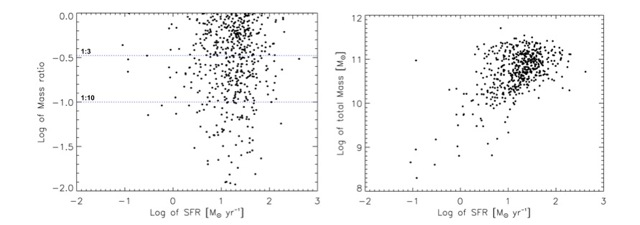
Another interesting parameter is the environment density. Density variations give way to difference in the tidal forces, approaching velocities and concentration of intergalactic gas and dust. These could lead to a dependence of the SFR on the environment. When we looked for it we found no such thing. The star formation rate seems independent of environment.

Galaxy overlaps at the AAS
Wednesday’s session at the Austin meeting of the American Astronomical Society will include new results from the Galaxy Zoo sample of overlapping galaxies. Extending the work in Anna Manning’s Master’s thesis, this marks an extension that helps us look ahead to comparison with the higher-redshift Hubble Zoo overlaps. Specifically, we compared visible-light data with ultraviolet data (from the GALEX satellite or a UV/optical monitor instrument on the European Space Agency’s XMM-Newton) to compare the amounts of optical and ultraviolet absorption in galaxies. This tells us, for example, how much we should correct Hubble measurements for high-redshift galaxies, where visible-light filters sample light which was emitted in the ultraviplet, to compare them with the rich SDSS data which see the visible range emitted by nearby galaxies. This is a key tool in trying to use backlit galaxies to search for changes in the dust content of galaxies over cosmic time, by comparing Hubble and Sloan results. Along the way, we see evidence that a common result – the flat so-called Calzetti extinction law in star-forming galaxies – results from the way dust clumps into regions of larger and smaller extinction that we usually see blurred together, since we see this in regions so far out in some galaxies that internal illumination by the galaxy’s own stars doesn’t matter. Here’s the poster presentation:

(That had to be shrunk to fit the blog size limits but should still be just legible – click for a bigger PNG). NGC 2207 is outside the SDSS footprint but had such good data that gave nice error bars that it wound up featuring a whole image series. Now to go back and apply that new set of analysis routines to more GZ pairs…
In other news, a Canadian astronomer working with NED found a new use for the overlap catalog including the “reject” list – to distinguish galaxies in pairs which are seen moving together or apart, since we often have both redshifts and from the dust we know which one is in front.
And to reiterate what it says at the end of the abstract – we thank all the Zooites who have contributed to the overlap sample and made this work possible!
X-ray observations of IC 2497 in the can!
As we tweeted about and as Chris noted in his blog post about the Zooniverse success at the American Astronomical Society meeting in Austin TX, half of the Chandra X-ray observations of IC 2497 (the galaxy next to Hanny’s Voorwerp) have been executed and so with bated breath we awaited the results.
From previous X-ray observations with Suzaku and XMM, we know that the quasar that lit up Hanny’s Voorwerp is dead, and that there’s just a weak source in the center of IC 2497 where the black hole lives and some evidence for hot gas. So we had turned to Chandra to figure out what was going on in the center of IC 2497. To puzzle apart the faint black hole at the center and the gas around, and Chandra has the sharpest X-ray eyes in the sky.
We got the notification from the Chandra X-ray Center that the observations had concluded and that we could have a preview of the raw frame. Bill and Chris happened to be near, so after Chris finished his talk on the latest Planethunters.org results (two new planets!), we got together in (possibly) the exact same spot where Chris and Bill viewed the first spectrum of the Voowerp at another AAS meeting in Austin four years ago.

Chris (left), Kevin (right)

From left to right: Bill, Kevin, Chris, all looking at the data.
So, without much further ado, here’s what we got:

Well that’s a bit underwhelming!
Or not!
First, we know that we have a bright source, so we can study the X-ray data in detail. Also, this is just a JPEG screenshot, so we can’t even zoom in and change the scaling to see if there’s anything else there. We don’t even know which way is North, so we don’t know where the Voorwerp is. So for now, all we can do is wait for the actual raw data to be available. This should take a few days. Stay tuned….!
Seeing mergers in a different light
Hello,
My name is Alfredo and I’m a Ph.D. student at Imperial College London. I’ve been asked to write a blog about how we take an idea and turn it into a paper, showing exactly what the man behind the scene does.
I’m working with galaxy mergers so the field from which we are going to pluck our idea has to be that one. Merger properties have been described extremely well by the Galaxy Zoo team, which used the Sloan Digital Sky Survey optical data so we thought it might be interesting looking at the GZ merger catalogue in different wavelengths, specifically in the infrared.
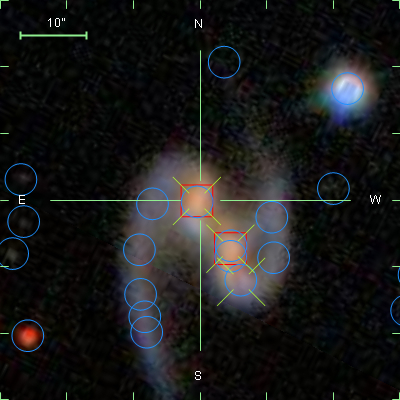
You can study pretty much every object in the infrared because what we call heat is simply the emission of infrared light. If you can measure it’s temperature then it radiates in the infrared. In astronomy infrared radiation allow us to see objects that are not too bright in the visible spectrum (cold stars, gas clouds), to probe regions that are obscure in the optical and to explore the early Universe. Our project will use the infrared fluxes to extrapolate interesting characteristics, mostly to do with the star formation process of the galaxies.

In the past, a huge number of papers have shown that galaxies which were very bright in the infrared ( called LIRGs – Luminous infrared galaxies, U(ltra)LIRGs and H(yper)LIRGs) were mostly mergers or post-mergers. We are going in the opposite direction: since we have a strong visually selected merger catalogue, thanks to your hard work, we can now see what’s the real connection between mergers and warm galaxies.
Galaxy Crash Debris: Post-merger Spherodials paper now out!
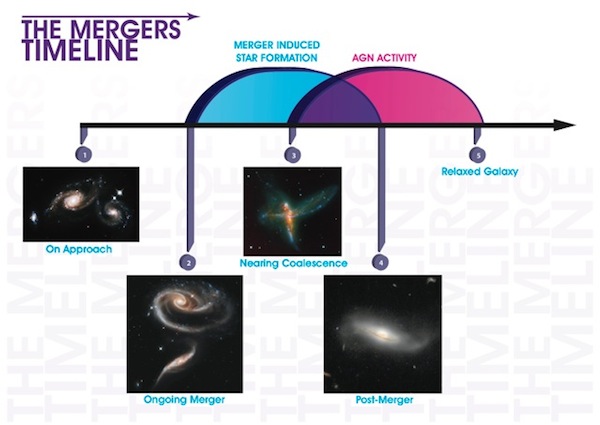
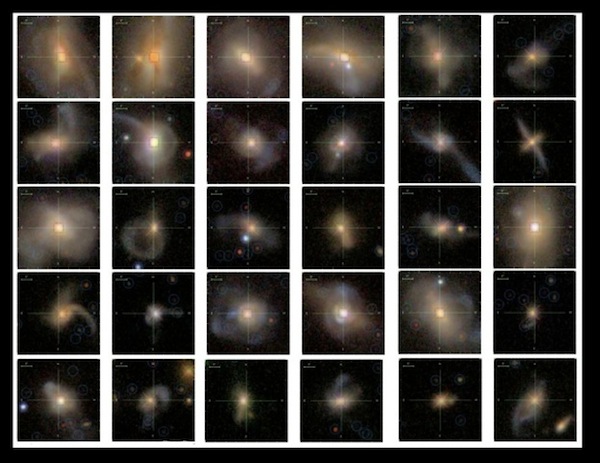
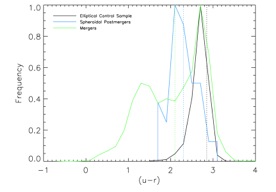
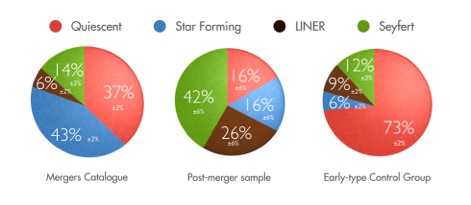
The specific subset we chose are the likely predecessors of elliptical galaxies, and we compared them to the general merger and an elliptical control sample to see how the properties of galaxies evolve along the merger. The SPMs are part of a sample classified by Galaxy Zoo as post-mergers. We looked at this sample again and we picked the ones which look mostly bulge dominated, a key feature of galaxies that are likely to be precursors of elliptical galaxies. You can see in the figure below how, even though these galaxies are similar in morphology to elliptical galaxies, they appear to be in the process of relaxing into relaxed ellipticals.
Post-starburst galaxies paper accepted!
Great news everybody!
The post-starburst galaxies paper has now been accepted by MNRAS. You can find the full paper for download on astro-ph.
 Galaxy Zoo
