Supernova hunters discover a rare beast
The work of the Galaxy Zoo : Supernova hunters recently paid off with the publication of a paper about a rather unusual supernova. Lead author, Kate Maguire – an astronomer at the University of Oxford working on supernovae and in particular exploding stars that can be used to measure the expansion of the Universe – tells us more :
The supernova named ‘PTF10ops’ was discovered by the supernova zoo using images from the Palomar Transient Factory Telescope in California and a report on this interesting SN has now been accepted for publication in the journal, Monthly Notices of the Royal Astronomical Society. Thanks to the very rapid discovery of this supernova by members of the supernova zoo, we were able to start taking observations very soon after explosion with many telescopes around the world such as the 4.2 m William Herschel Telescope on the Canary Island of La Palma, the 3 m Shane telescope at the Lick Observatory, California and at one of the two 10 m telescopes located at the Keck Observatory in Hawai’i.
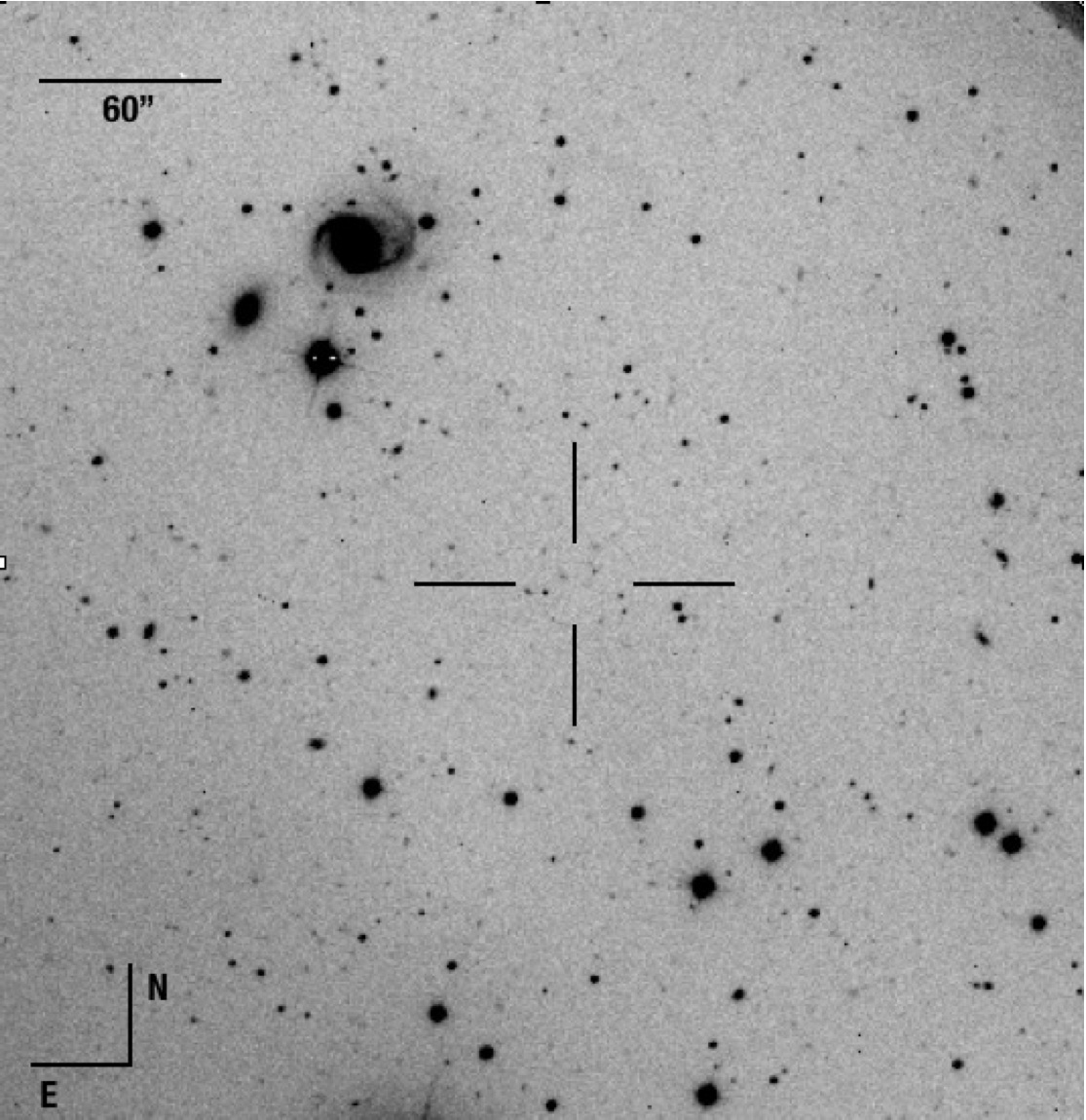
An image of the field of PTF10ops (located at the centre of the crosshairs) taken with the WHT+ACAM on La Palma, Canary Islands. The largest galaxy with spiral arms located in the upper left quadrant is the host galaxy of PTF10ops, located at a distance of 148 kpc from the supernova position. This is the largest separation of any SN Ia discovered to date.
PTF10ops turned out to be a very interesting supernova – a peculiar type Ia supernova. Type Ia supernovae are explosions that occur when a white dwarf (a small, dense star) collapses when it pulls matter from a companion star and grows to have a mass of more than 1.4 times that of the Sun. At this critical mass, a thermonuclear reaction is triggered, that destroys the star in a massive explosion that we call a type Ia supernova. Type Ia supernovae are very important because they are used as cosmological distance indicators and were used in the discovery that the expansion rate of the universe is accelerating.
PTF10ops had unusual observational properties that suggest that maybe a new type of supernova explosion has been discovered. It is located very far from its host galaxy, actually the farthest supernova from the centre of its host galaxy discovered to date. Its spectra also contained signs of rare elements such as Titanium and Chromium. In normal Type Ia supernovae, how long a supernova stays bright is directly related to its peak brightness, but PTF10ops did not follow this rule and stayed brighter for much longer than expected. It is still unclear what it was about the star that exploded that produced this unusual supernova, maybe it was very old star or maybe we are seeing some sort of new, unknown explosion.
In the future, we hope to take images of more objects like this using the Palomar Transient Factory and then with the invaluable help of the supernova zoo members, we can catch these supernovae very soon after explosion and start follow up observations immediately to get images and spectra to better understand these rare supernova explosions.
P.S. Here’s the piece of the paper crediting the discoverers – well done all!

Chandra time for IC 2497 and the Voorwerp!
The list of approved targets for Cycle 13 of the Chandra X-ray Observatory is out and on it is our friend IC 2497. We were awarded 114 ksec (almost 32 hours) of time to point Chandra at IC 2497 and peer into its center. What do we want to learn? First, we want to see if the wimpy signal from the central black hole comes more into focus. Chandra has much better spatial resolution than XMM so we will be able to resolve the very center.
We also want to see if there is any impact of the ex-quasar on the surrounding hot gas in the galaxy center. Did the quasar blow bubbles into the gas? Did it start doing so when it “switched state”?
Unfortunately we won’t know for quite a while as Cycle 13 only starts later this year and will go on into 2012. So, stay tuned!
The Peas – Now detected in Radio!
Last September I blogged about a proposal that had just been accepted at the Giant Metrewave Radio Telescope (GMRT) to follow up on the Peas with radio observations. Now the observations are in, and we have successfully detected the Peas at radio wavelengths!
The Peas, which have very high star formation rates, are expected to host a large number of supernova, which are created when the most massive stars die. These supernova create shocks that accelerate electrons in galaxy to relativistic energies. These relativistic electrons emit a type of emission, synchrotron radiation, that is visible in radio wavelengths. Therefore, the radio emission can tell us about the stars that live (or lived) in the galaxy.
Three of the Peas from our paper (Cardamone et al. 2009), were followed up with deep observations using the GMRT. It turns out that the Peas have comparable, but systematically lower flux when compared to local starbursts.
Using the observed radio emission, the magnetic field of the galaxy can be derived. These new observations suggest a magnetic field in the peas similar to that of the Milky Way. Because galaxies are thought to build up their magnetic fields over time, it is surprising to see such a large magnetic field in such a young galaxy. (Estimates of the age of the stars in the Peas are roughly 1/100th that of the age of the stars in the Milky Way).
One of the reasons that the Peas are so fascinating is their similarities to vigorously star forming galaxies found in the early universe (known as Lyman Break Galaxies). These Lyman Break Galaxies are so far away, they haven’t yet been directly detected in radio emission. However, estimates of their radio flux (from a technique called ‘stacking’) also suggest consistent radio fluxes with those observed for the Peas.
These observations suggest that galaxies like the Peas (and the Lyman Break Galaxies), may start out early in their life with very large magnetic fields. These observations challenge the assumption that galaxies build up their magnetic fields slowly over time and it is another piece of the puzzel in understanding of how galaxies are formed.
The article will be coming soon to astro-ph and I will post it here to let you all know.
Galaxy Zoo Voorwerpjes – now with Hubble data!
Some of us continue to exult over the approval of our Hubble proposal to look at some of the “voorwerpjes” found through the GZ forum. These are clouds of gas ionized by an active galactic nucleus, similar to Hanny’s Voorwerp except for being smaller and dimmer (hence the Dutch diminutive form of the word). This has been a very fruitful project, going back to the first few possibilities posted for discussion in different contexts by Zooites. From these, I realized that such clouds could be spotted based on their unusual colors from the SDSS images, and with contributions from Waveney and laihro setting up the web interface and one of our source lists, the hunt was on! The results staggered us – within 6 weeks each of the 18,000 candidate galaxies had been examined by at least 10 Zooites. Seven of you looked at them all! Then we could examine the highest-scoring galaxies, in three sessions from Kitt Peak and Lick observatories, measuring spectra to see which ones really show gas ionized by an active nucleus. Once again, Drew, alias sdrew123, has done a lot of the data reduction and Python action in this part of the project. Our sample of giant AGN clouds now includes 19, each showing gas more than 10 kiloparsecs (32,000 light-years) from the galaxy core, so we get information on its history over at least that many years.
Why do we want to find these? From what we’ve learned about Hanny’s Voorwerp, we have the possibility of tracing the history of active galactic nuclei – how fast they can fade, how long they stay on at once, and maybe how they influence their surroundings. It’s hard to generalize from a single instance (though astronomers are notorious for trying), so we want enough of a sample for statistically defensible conclusions.
Which of our objects should we ask to look at, balancing the demand for Hubble time against the fact that very often more data are better? From our current point of view, investigating whether active nuclei shut down very often within time spans roughly 100,000 years, we want to concentrate on the ones that show evidence for a deficit of energy from the core compared to that needed to light up the gas we see. This gives us a set of 7 (plus NGC 5252, which has been known for many years and already has archival Hubble images). They are:
SDSS J143029.88+133912.0, the Teacup (Kevin started calling it that in honor of the handle-like loop of gas extending more than 15,000 light-years to the side). This is the most distant galaxy in the sample, at z=0.085.
UGC 7342 (also known in some Zoo threads as the Crab galaxy), with its enormous filaments of gas stretching more than 100,000 light-years on each side (fully half as large as Hanny’s Voorwerp, and at about the same distance).
Another new SDSS AGN, and new Zoo find for its gas clouds, is
SDSS J220141.64+115124.4 (which I tend to abbreviate to SDSS 2201+11 for my own sanity).
SDSS J151004.01+074037.1, with symmetric clouds around a type 2 Seyfert nucleus, is another SDSS//GZ discovery.
NGC 5972 is pretty close to us at z=0.0297. This galaxy attracted some brief notice in a 1995 paper by Mira Veron-Cetty and Phillippe Veron, who established that what look like spiral arms are purely ionized gas features, and noted that this AGN is surrounded by a double radio source.
UGC 11185 is part of a very disturbed interacting pair, with a bright spray of ionized gas seen to the east of the AGN. Note to self: we need to take care in where we center the Hubble images to avoid problems with scattered light from the annoyingly bright star.
Mkn 1498, as the name suggests, has a long-known AGN, but its ionized gas shows such strong radiation
reaching it that this one may have faded even to its observed brightness.
We based our observation request on what we learned from working on the Hanny’s Voorwerp data. The most valuable results for these will probably come from images in Hα and [O III] for these, the clouds sometimes extend into the galaxy, so we need red and green starlight images to distinguish stars and gas. Our filter selection depends on the galaxy redshift – the brand-new Wide-Field Camera 3 (WFC) has cleaner performance but only a limited set of narrow filters, while the decade-old Advanced Camera for Surveys (ACS) has ramp filters which can tune to any desired optical wavelength, but its CCD detectors are really showing the ill effects of damage from years in the space environment. So we use WFC where we can and ACS otherwise, emboldened by the release of Jay Anderson’s software for partially undoing the effects of that radiation damage. We end up using 3 orbits per galaxy – one for each emission line and the other for broad-band filters to map the structure and color of each galaxy’s starlight.
We know some of the things to look for in the data – regions of star formation, gas outflow, maybe shadowing effects from material near the galaxy nuclei. But the best is often in what we don’t know to look for beforehand…
Next up – detailed observation planning, at which point we get our first hints as to when each galaxy could be observed.
Chandra X-ray Survey of Mergers Completed
Our Chandra programme to survey a sample of local merging galaxies found by you all to search for double black holes has just been completed. We’ve received the data for the final target. Now the data analysis can begin!
More Chandra data coming in…
Update on the Chandra program to observe the Galaxy Zoo mergers. After getting the first data late last year, Chandra has now observed five of the twelve approved targets and two more are in the long term schedule for the coming weeks.
Hanny's Voorwerp and Hubble
And here they are! The Hubble Space Telescope results on Hanny’s Voorwerp (and IC 2497) were just released during the Seattle meeting of the American Astronomical Society. You can see the press release and download several formats of the main image from STScI, download the poster presentation from the meeting, and view the abstract of the meeting presentation, but we can give you the whole story in detail here on the GZ blog. But before that, here’s the money shot:
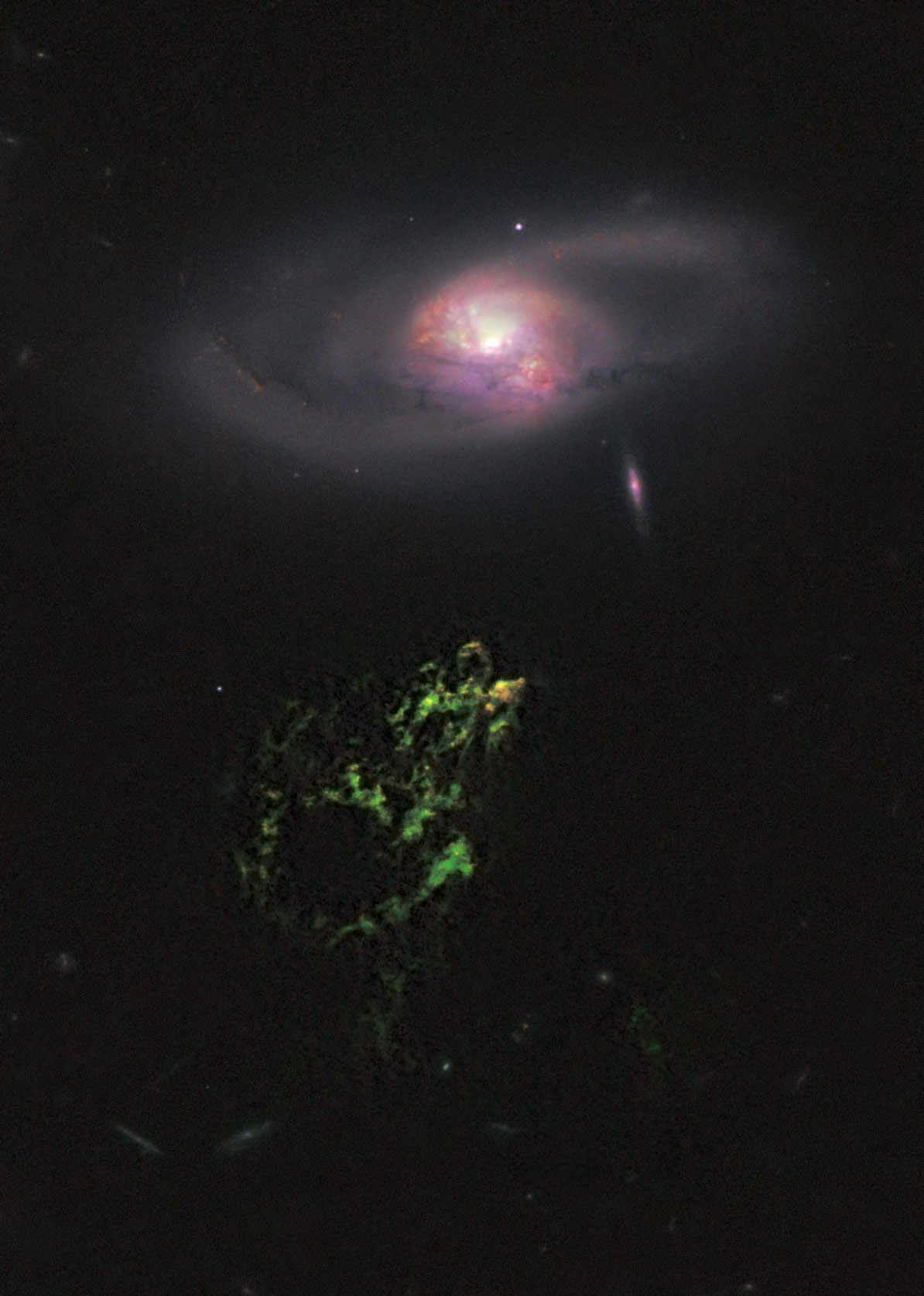
This combines different filter sets for IC 2497 and Hanny’s Voorwerp, to give the best overall view in a single image. The Voorwerp shows up in [O III] and Hα emission, close to natural color were our eyes sensitive enough. The galaxy IC 2497 is rendered from red and near-IR filters, so it’s a bit redder than we see in other images (for example, from the SDSS or WIYN data). This version does a very attractive job of contrasting the two objects in both color and texture; for reasons you’ll read below, Zolt Levay and Lisa Frattare at STScI had a daunting task to make a single image look this nice from our disparate data sets.
Looking back, we proposed these observations early in 2008, as it was just becoming clear what an interesting object the Voorwerp is and what the right questions might be. It was our good fortune that these observations remained relevant with all we’ve leaned since then, including radio and X-ray measurements. Each data set was specified with a particular goal as to selection of filter or diffraction grating, location, and exposure time. We had images and spectra, the latter looking for material very close to the nucleus of IC 2497 so we could zero in on what’s happening there with much less confusion from its surroundings than we get from the Earth’s surface. Full details of the observation planning appeared in this blog post after our proposal was approved.
The released image product combines four filters and two cameras – the Wide Field Camera 3 (WFC3), installed during the 2009 shuttle servicing mission, and the Advanced Camera for Surveys (ACS), electronically repaired during that mission. WFC3 offers superior sensitivity and small enough pixels to exploit the telescope’s phenomenal resolution, while ACS has a set of tunable “ramp” filters that allow us to observe the wavelength of any desired spectral feature at a galaxy’s particular redshift. Our WFC3 images were designed to look at IC 2497, at wavelengths deliberately minimizing the brightness of the gas in the Voorwerp so we could also look for star clusters in its vicinity, that might tell us whether its gas came from a disrupted dwarf galaxy. (This turned out to be a good idea for a slightly different reasons). Our filter choices included one in the near-infrared, at 1.6 micrometers; one in the deep red, close to the SDSS i band, and one in the ultraviolet. Comparing these, we would be able to say something about the age of any star clusters we found. The UV image would also show whether there were any particularly bright clumps of dust, which could serve as “mirrors” so we could later measure the spectrum of the illuminating light source.
The ACS narrow-band filter data were designed to probe the Voorwerp itself, seeking fine structure that is blurred away in ground-based images. We use both the strong [O III] emission (which made it so recognizable when Hanny picked it up from the SDSS images), and the Hα line of hydrogen. Their ratio changes as the conditions ionizing the gas change, so we could watch for variations as conditions differ from place to place. This also netted us gains we hadn’t quite asked for. We also had to work for them. it was known before its repair that the CCD detectors on ACS had suffered from exposure to energetic particles in space during its decade in orbit; all such devices do to some extent. One result of this cumulative damage is that they don’t transfer charge as efficiently as they originally did, and in particular, after being struck by a charged particle (“cosmic ray”), when the image reads out, the detector registers not only a bright spot (which is easy to filter out) but a long trail, so long that it’s not at all easy to filter out without blacking out much of the image. The situation improves if you combine two images, moving the telescope slightly in between them. That lets the software reject the bright cosmic-ray spots, but even after tuning the rejection parameters, the streaks still remain down the device rows. We ended up using what we knew about the remaining trails to filter them out, at the expense of losing the dimmest, smooth regions of emission. Fortunately, these dim regions don’t have enough signal to show new features in Hubble data, so we used ground-based images to fill them in around the edges and in the fainter interior regions of the Voorwerp. This panel shows four successive stages in the process:
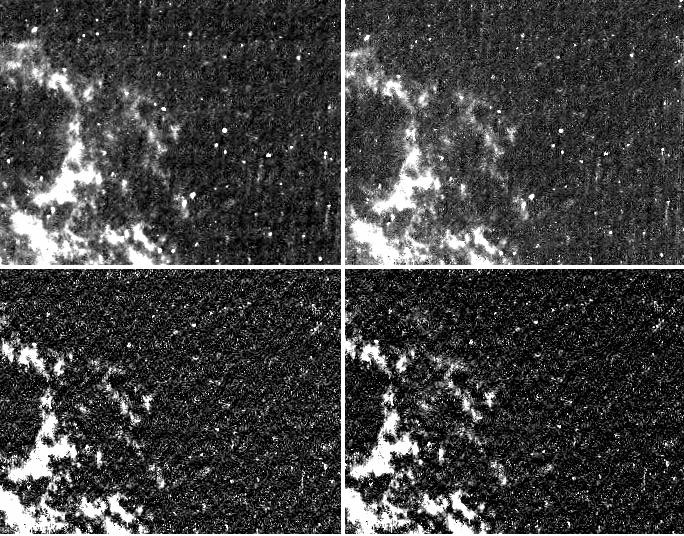
Processing steps for HST image of Hanny's Voorwerp
Now, as proud as I am of fixing this all up, you don’t really care – you want to know what we’ve actually learned from Hubble. I’m with you – here goes!
Stars are forming in a small part of the Voorwerp. We couldn’t see this from the ground because the regions involved are dim and blend with the overall gas emission. Hubble shows them in two ways. Our filters selected to minimize emission from the gas show bright blue spots, with the size and brightness of young star clusters, in a single area only 2 arcseconds long (about 2 kpc, 6500 light-years). Because the deep-ultraviolet spectrum of starlight is quite different than from an AGN, we see a second signature – the balance between light from [O III] and Hα tips in favor of Hα , again very different from the highly ionized gas elsewhere. In the picture at the top, that makes the star-forming regions show up as the reddish spots near the top bright region of the Voorwerp. These gaseous regions are likewise so small and comparatively dim that we couldn’t see them in even our best ground-based data. The hottest stars are so bright that it’s hard to tell how long these clusters have been forming stars; we know that they include stars so hot that they can be no more than a few million years old. It seems suspicious that we see these star-forming regions only in a small area, which lies closest to IC 2497 at least in our view (we don’t have enough information to be sure it’s really the part closest to the galaxy), and roughly lined up along the direction of outflowing material seen with radio telescopes. This all suggests that the star formation has been set off by compression as gas outflowing from the galaxy encounters the gas in the Voorwerp. We don’t see such star clusters anywhere else in the enormous trail of cold hydrogen of which the Voorwerp is the illuminated part, so their occurrence is connected to the Voorwerp specifically.
This kind of event – an active galactic nucleus blowing gas outward and driving formation of new stars – is one form of feedback, connections between AGN and their surrounding galaxies that seem to be important in regulating aspects of galaxy evolution. We see this process in some other galaxies, in some cases much more intensely than in Hanny’s Voorwerp. A favorite example is Minkowski’s Object, a brilliant emission-line object near the radio galaxy NGC 541 at only a third the distance of IC 2497. In Minkowski’s Object, the central AGN is almost solely a radio object, without the ultraviolet output that ionizes Hanny’s Voorwerp. In that case, where we see ionized gas, it’s lit up by hot, newly-formed stars. This object lies right in the path of the jet of radio-emitting plasma from NGC 541, which is disrupted right as it reaches the object; this looks like a cloud of gas, maybe a dwarf galaxy, that was quietly minding its own business until it was hit by a flow of relativistic particles. Star formation is happening over regions of about the same size in both Minkowski’s Object and Hanny’s Voorwerp, but there are important differences: gas is shedding back away from Minkowski’s Object much more violently than in the Voorwerp, the radio jet in NGC 541 is much more powerful than the small one in IC 2497, and it doesn’t have the additional UV output to light up the gas which is not forming stars. The point I take from this is that the outflowing material reaches the Voorwerp, but with only enough pressure to set off star formation in the densest and closest parts, without the massive reshaping we see in some other galaxies.
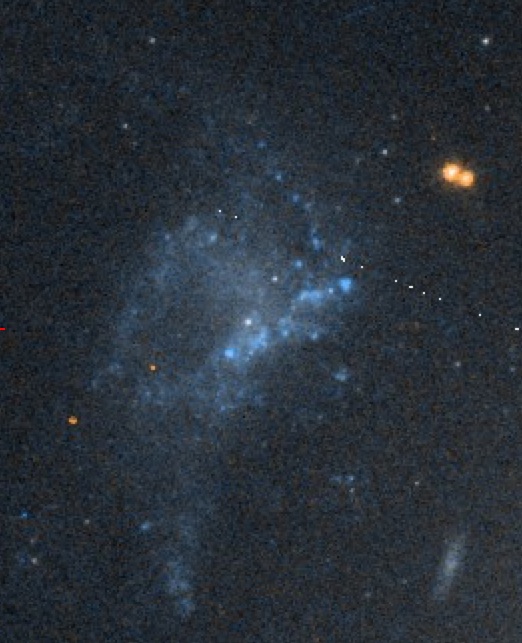
Minkowski's Object from Hubble Legacy Archive
The Hole This is probably the most obvious structural feature of the Voorwerp (sometimes seen as the space between the kicking frog’s legs). We wondered whether it might mark the site of some kind of titanic explosion, the space where a jet from IC 2497 drilled its way through the gas, or even the shadow cast by some dense cloud close to the galaxy nucleus. What we learned on this was mostly negative – we do not see streamers of gas blasting away from the hole, or the ionization of the gas being any higher near it, as we would expect for a jet or explosion. The idea of a shadow still makes sense, but we’d still like to know more (maybe from some Gemini-North velocity data still being analyzed).
The nucleus has faded dramatically, but it still knows how to make other kinds of fireworks.One idea we have been investigating, since we saw the first spectra, has been that the nucleus of IC 2497 might have faded in its output of ionizing radiation by hundreds of times since the light that we see reaching the Voorwerp left it. (Ignore for a moment the odd complications of verb tenses involved in light-travel time discussions). What Hubble could add is the ability to measure spectra from very small regions free of the mixing with light from the surroundings that occurs from the ground. This way we could get a good look at the nucleus of IC 2497, how much ionization its gas sees, and whether there might be shreds of highly ionized gas peeking through surrounding obscuring dust and gas which otherwise obscures our view. For this we used two spectra (blue and red) with the Space Telescope Imaging Spectrograph, newly restored to service by the astronauts of STS-125. We get a clearer measure of the gas – it sees a slightly weaker ionizing source than we thought from the ground because the gas is mostly closer to the core than we would have thought. This fits with the X-ray data in suggesting that the nucleus isn’t just hidden, it really has faded so we see its echo in the Voorwerp. (To indulge once again in a bit of geekdom, “It’s dead, Jim”.)
Or maybe not so much dead as… transformed. The spectra also show something else that we didn’t know to look for. Only a half arcsecond from the core we see a second set of emission lines, redshifted by about 300 km/second from the nucleus. At this location in the ACS images, we see a loop or bubble of Hα emission. The nucleus has been blasting out material, driving this wave into the surrounding gas. Depending on whether it has been slowed down as it snowplows into these surroundings, and on whether it lies exactly in the disk of the galaxy, this would have started less than about 700,000 years ago. This was probably well before the nucleus faded, but connects to an intriguing idea long suggested from looking at the various kids of active galaxies. There may be two modes of accretion power – one in which most of the energy comes out as radiation, and one in which it emerges as kinetic energy of expelled matter (“radio mode”). Has IC 2497 switched between them almost as we watched?
Here is that expanding loop. At left is the Hα image, showing it sticking out above the nucleus. In the middle is a broad-filter image taken to zero in the pointing to take the spectra – you don’t see the loop because it’s swamped by the starlight. At right, the spectrum near Hα showing the distinct emission-line clouds just above the nucleus.

IC 2497 expanding gas loop
IC 2497 has had a troubled past. It looked a bit odd in our earlier data, but the Hubble images make clear how disturbed this galaxy is. Spiral arms are twisted and warped out of a single plane, and thick dust patches also show that it has yet to settle into a simple form after the disturbance. This looks a lot like the aftermath of a strong interaction – and since we see no other culprit nearby, probably a merger where the other victim is now part of IC 2497. The companion barred spiral just to the east (left) may be only an innocent bystander – it shares the redshift and distance of IC 2497, but is so symmetric and undisturbed that it’s hard to picture it being involved in a collision that wracked the larger galaxy (and tore loose 9 billion solar masses of hydrogen gas from somewhere). These dust patches, plus our better understanding of the Voorwerp’s continuous spectrum aided by the GALEX UV data, now suggest that instead of slightly in front of IC 2497, the Voorwerp is more likely slightly behind it, roughly over the pole of the galaxy. This means that we see the reprocessed radiation via the Voorwerp perhaps 200,000 years after it left the galaxy nucleus. Old news can still be very informative.
Putting it all together, here is the sequence of events that we think led to what we see today. Perhaps a billion years before our present view (which is itself 700 million years behind the times, and there’s nothing we can do about the speed of light), a merger led to IC 2497 forming from two progenitors, with its disk slowly settling but still warped. One product of this merger was an enormous tidal tail of gas, which came to stretch nearly a million light-years around IC 2497. During this process, material accreted into its central supermassive black hole, rapidly enough to produce the energy output of a central quasar as a byproduct, and illuminating and ionizing gas that was exposed to its radiation, to make the Voorwerp. About a million years before we see it, it started to blow material away (and this may have been when its radio jet and outflow started). Then, later still, the core faded, maybe as its energy output switched from being mostly in radiation to mostly powering the motion of material out of the galaxy. And now we see Hanny’s Voorwerp as a very lively echo of the past, as the last radiation from the fading core aces outward but has yet to complete the zigzag trip from galaxy to Voorwerp to us.
Of course, we’d like to test these ideas further. There are plans to improve the spectral mapping, and perhaps look at the history of star formation to tell when things happened to IC 2497. And we want to see whether this behavior is at all common in galactic nuclei – if so, there may have been more active galaxies lately than we thought, and it would change how we think about the relation between “normal” and active galaxies. Zooites have pushed us along greatly in finding smaller cousins – voorwerpjes. But that was a separate meeting presentation…
Hunting Voorwerpjes, back on Earth
While the blog has reported some off-planet developments in the study of giant gas clouds ionized by active nuclei (voorwerpjes), we also have some news back here on the third rock from the Sun. Despite our expectations from the weather forecasts, a bit more than half the observing time last week at Lick Observatory’s 3-meter Shane telescope was good, so we could have a look at 13 candidates. Some of these turned out to have gas shining in such small regions that it’s not very interesting for our purposes (I mean, less than 10,000 light-years? Really?), and in some cases the features that gave interesting colors in the SDSS composites were due to star formation. But we did add three new giant clouds to our set.

Lick 3-meter Shane telescope
SDSS J100507.88+283038.5 has a type 2 Seyfert nucleus. Its SDSS image showed a very suspicious blue wedge pointing eastward. The spectrum confirmed that this is high-ionization gas which must be seeing a powerful AGN; we spent 2.5 hours collecting data with the spectrograph slit in two different orientations.
SDSS J074241.70+651037.8 = Markarian 78 is another type 2 Seyfert. The presence of extended gas in this one had been noted some years ago, and there are even Hubble spectra offset from the galaxy core. However, there are no Hubble images in visible light, so we fall back on the SDSS picture:
Finally, we come to SDSS J095559.34+395438.9. This may yet prove to be the most interesting of the three. Our spectrum shows a weak Seyfert 2 nucleus there was no SDSS spectrum for this member of the interacting pair). Until reduction of the data is complete, we’re not sure that the gas shows the characteristic He II emission showing that it sees an AGN; if so, this would be another rare case of finding an AGN through extended gas.
On the last night, we lined all the observers up on a service platform in front of the telescope for a team picture: from left, that’s me (the only one not from the University of California, Santa Barbara); grad students Alessandro Sonnenfeld, Anna Pancoast, and Anna Nierenberg; and Vardha Bennert. Fortunately for my fading sanity in the small hours of the morning, Anna and Anna are pronounced differently.

Observing team at Lick, December 2010
We have these new results in time to fold them in to the poster presentation being prepared by Drew Chojnowski for the next meeting of the American Astronomical Society a month from now in Seattle. There will also be some additional presentations there that will greatly interest Zoo participants; we hope to have exact dates and times in the next day or two.
XMM-Newton time granted to observe the Voorwerpjes!
Quick note to let you know that we’ve been granted time on XMM-Newton to observe three of the “top” Voorwerpjes. This follows the proposal we submitted earlier this year. The allocation is for priority “C” which means that they will take our observations if they fit into the schedule, but there is no guarantee.
Hunting Voorwerpjes from California
An especially nice side project of Galaxy Zoo has been uncovering giant gas clouds ionized by active galactic nuclei. Of course, the most striking of these has been Hanny’s Voorwerp, whose study has been fruitful enough! In addition, Zooites proved to be good at finding smaller, dimmer versions (“voorwerpjes”, using the Dutch diminutive form). We harvested these both from Forum postings, and from a targeted hunt of galaxies with known AGN (arranged by Waveney). To be sure what we’re dealing with, we need spectra of these clouds. We had observing runs to do this last summer from Kitt Peak and Lick Observatories, confirming many new cases (some of which may have a similar history of faded glory to what we infer for Hanny’s Voorwerp). Kevin led a further proposal to look at these in X-rays, so we can tell whether the suspiciously dim nuclei are really dim or actually hidden by foreground gas and dust.
We have another observing session this week with the 3-meter Shane telescope of Lick Observatory, a facility of the University of California. The proposal was led by Vardha Nicola Bennert from Santa Barbara, observing as before with UCSB students Anna Pancoast and Chelsea Harris. Here they are standing in front of the telescope’s mirror cell and instrument cluster.
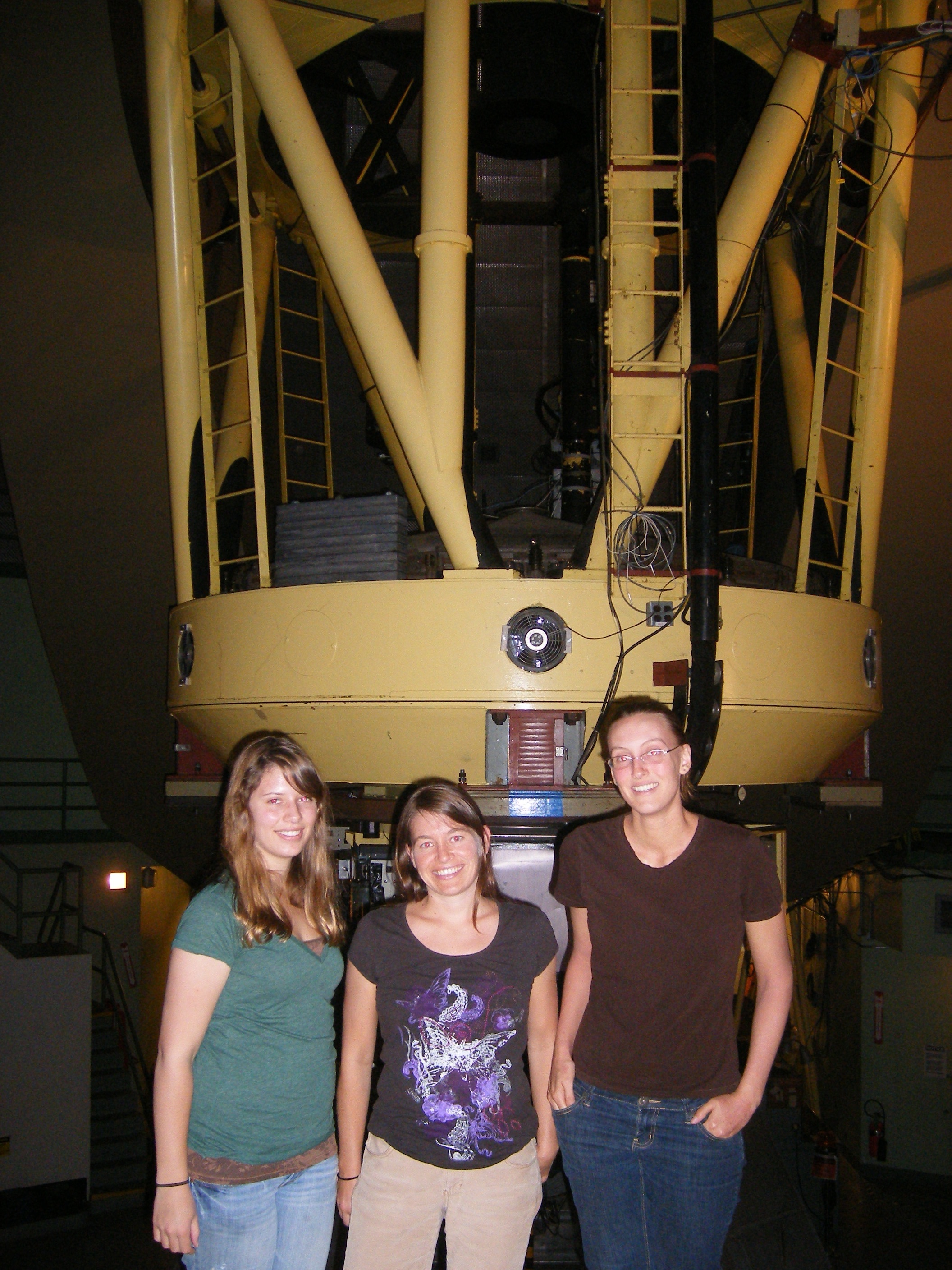
Vardha Bennert, Chelsea Harris, Anna Pancoast at Lick 3m telescope
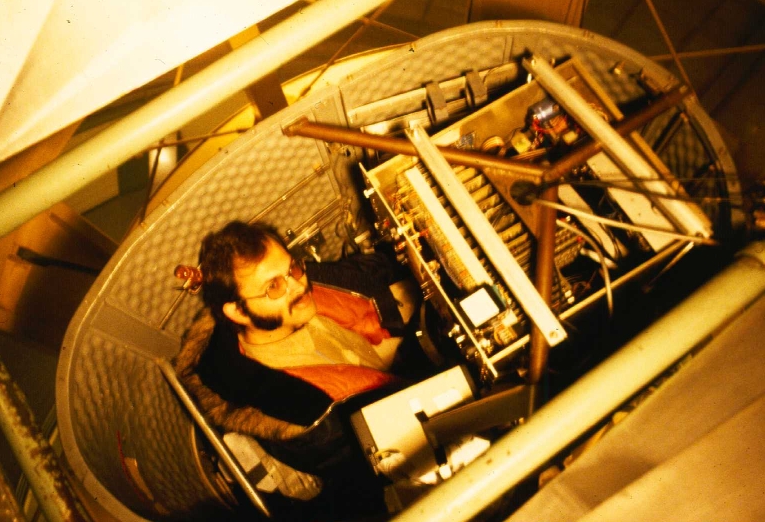
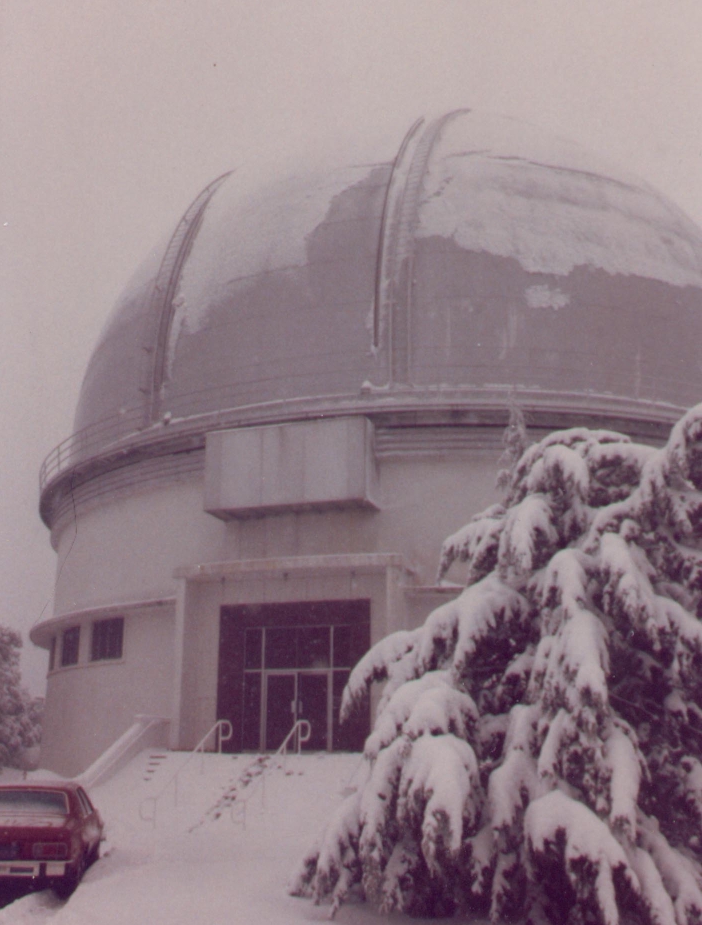
I was also able to arrange going to Mount Hamilton for these four nights. This will be sort of a homecoming for me – as a graduate student at UC Santa Cruz, Lick was where I cut my observational teeth. Checking some old logbooks, I have entries slightly over thirty years ago (and a collection of photos which should shortly be updated!). For my thesis, on the spectra of gas in normal galaxies and whether they contain weak AGN, I used over 70 nights on the then new 1m telescope. So not only was UCSC where I studied interpretation of spectra, but Lick was where I got my first (few hundred) galaxy spectra. Back then, the 3m was the primary telescope for UC astronomers, so graduate students worked with it only while assisting faculty members. I did manage to spend a few hours at the prime focus of the 3m while we were working on what might have been the observatory’s first CCD spectrograph (constructed by painful use of a hacksaw on one originally built for Margaret Burbidge to use image tubes with). We looked at a planetary nebula for wavelength calibration, giving me a lasting memory of just how green the [O III] emission lines appear. (I also managed to see the radio galaxy Cygnus A through the eyepiece while lining up the spectrograph slit). Another student and I managed to get allocated a single otherwise unused night of 3m time to split – and it snowed. Here’s documentation – that young-looking guy is in the cage sitting in the middle of the telescope at the top of the tube. This was such a stopgap setup that the only way to refill the CCD’s liquid nitrogen involved running a long tube between circuit boards of the control electronics. I categorically deny ever having dumped liquid nitrogen on my advisor. Almost.
Times have changed. Everything is remotely operated, and not only do CCDs rule, but the Kast double spectrograph uses a dichroic beamsplitter to separate blue and red light so that each goes into a separate spectrograph and CCD optimized for that part of the spectrum. We’re ready with a list of target galaxies winnowed down by reanalysis of the SDSS images after selection by Zooites. If last summer’s set is a guide, at least half of these will prove to have huge, galaxy-sized clouds illuminated by seen or unseen nuclei. I hope to get the results processed quickly; at the Seattle meeting of the American Astronomical Society in January, there will be a display presentation from last summer’s work led by Drew Chojnowski, and it would be great to double our sample size.
Of course, as with any ground-based observations, we will be at the mercy of the weather. You can keep track using the especially crisp webcam views provided by Lick (one of which looks across the brilliant city lights of the whole San Francisco Bay area, which have been kept slightly under control by extensive light-pollution lobbying but made Lick astronomers some of the first to use digital sky subtraction for spectra). And of course we’ll keep the Zoo updated on our data.
 Galaxy Zoo