Making Radio Galaxies in a Computer
At a conceptual level the formation of radio galaxies is pretty simple. According to a basic picture first introduced in the 1970s, a supermassive black hole in the center of a galaxy generates a symmetric pair of oppositely directed, high speed jets or beams of hot, ionized gas as a by-product of energy released or stored from matter falling onto the black hole. Those jets drill holes in the atmosphere of the galaxy and then even far beyond, dumping energy, excavating cavities and possibly entraining gas into the jets and cavities along the way. The jets carry magnetic fields and high energy electrons. Those electrons, spiraling in the magnetic fields light up the jets and the cavities they excavate in the radio band through a process called synchrotron emission.
While calculations based on this cartoon picture can correctly predict a few properties of radio galaxies, anyone who has looked at the images in Radio Galaxy Zoo can see that there must be a whole lot more to the story. Radio galaxies at best have only a rough bilateral symmetry with respect to their host galaxies. Furthermore, no two radio galaxies look alike, and most look pretty complicated; some could only be described as messy. In fact, the physics of radio galaxy formation is really very complex for a whole bunch of reasons that range from inherent instabilities in the dynamics of a fast jet, to the reality that the jets are not steady at the source. Furthermore, the surrounding environments are themselves messy, dynamic and sometimes even violent. All of these influences have impact on the appearances of radio galaxies.
The other side of the coin is that, if they can be understood, these complications may improve opportunities to decipher both the formation processes of the jets as well as the conditions that control their development and dissipation as they penetrate their environments. One part of piecing this puzzle together is expanding our awareness of all the things radio galaxies do, as well as when and where they do what they do. That’s what Radio Galaxy Zoo is about.
On the other hand, to go beyond the cartoon picture of what we see we also have to develop much more sophisticated and realistic models of the phenomena. This is very challenging. Because the detailed physics is so complex (messy!), astronomers have come to depend increasingly on large computer simulations that solve equations for gas dynamics with magnetic fields and high energy electrons. Pioneering gas dynamical simulations of jets in the 1980s already played an important role in confirming the value of the jet paradigm and helped to refine it soon after it was introduced.
Those early simulations were, however, seriously limited by available computer power and computational methods. In important ways the structures they made did not really look much like actual radio galaxies. At best they were too grainy. At worst important physics had to be left out, including the processes that actually produce the radio emission. This made it hard to know exactly how to compare the simulations with real radio galaxies. Thankfully, rapid improvements in both of those areas have led recently to much more realistic and detailed simulations that are starting to look more like the real thing and can be used to better pin down what is actually going on.
Our group at the University of Minnesota has been involved for some years now in pushing forward the boundaries of what can be learned about radio galaxies from simulations. I illustrate below some of the lessons we have learned from these simulations and some of the complex radio galaxy environments that it is now possible to explore through simulations. Each of these simulations was part of the work carried out by a student as part of their PhD training.
The jets responsible for radio galaxy formation propagate at speeds that can be a significant fraction of the speed of light. They are almost certainly supersonic. These properties lead to several related behaviors that are illustrated in Figure 1. It turns out that the flows within such a jet tend periodically to expand and then to contract. As they do so they form a sequence of shocks along the jet. These are visible in the figure. The jet also creates a sonic boom or bow shock in front as it moves forward. A close look at the jet in this figure also reveals that the jet actually does not remain straight as it moves forward. The end of the jet turns out to be unstable, so soon after launch begins to ‘flap’ or wobble. As a result the end of the jet tends to jump around, enlarging the area of impact on the ambient medium.

Figure 1: Shock waves in a simulated high speed jet propagating from the left end of the box. Since the jet is driving supersonically through its ambient medium, it also has created a bow shock (sonic boom) in the ambient medium on the far right.
Many radio galaxies form inside clusters of galaxies, where the ambient medium is highly non-uniform and stirred up as a result of its own, violent formation. This distorts and bends the radio structures. At the same time the energy and momentum deposited by the jets creates cavities in the cluster gas that lead to dark holes in the thermal X-ray emission of the cluster. Figure 2 illustrates some of these behaviors for a simulated radio galaxy formed at the center of a cluster. Even though the source of the radio galaxy is at rest, there are fast gas motions in the cluster gas that obviously deflect the radio galaxy jets. ‘Mock’ radio images representing synchrotron emission by high energy electrons in the magnetic field carried by the jets are shown on the right in the figure at two times. At the same two times mock images of thermal X-rays are shown to the left. The X-ray images have been processed to exaggerate the dark cavities produced by the jets. Note that each image spans about 700 kpc or 2 million light years.

Figure 2: Simulation of radio galaxy formation in a cluster of galaxies that was extracted from a separate simulation of galaxy cluster formation. Mock observations of thermal X-rays (left) and radio synchrotron emission (right) are shown at two times after a pair of oppositely directed jets formed in the cluster center.
Quite a few radio galaxies in clusters are not made by galaxies anchored in the cluster center, but are hosted by galaxies moving through the cluster. This is especially common in clusters that are in the process of merging with another cluster. In that case the host galaxy can be moving very fast, and even supersonically with respect to its local, ambient medium. Then the radio jets can be very strongly deflected into ‘tails’ by an effective cross wind and eventually disrupted. Figure 3 illustrates the mock synchrotron emission from such a simulated radio galaxy. The abruptness of jet bending depends on the relative speed of the jet with respect to its internal sound speed and the relative speed of the host galaxy through its ambient medium with respect to the sound speed of that medium. So, when strongly bent jets are seen in a radio galaxy it is a strong clue that the motion of the galaxy is supersonic in relation to its environment. When multiple tailed radio galaxies are found in a given cluster it provides potentially valuable information about the dynamical condition of the cluster, since a relaxed cluster ought not to have many galaxies moving at supersonic speeds through the cluster gas.
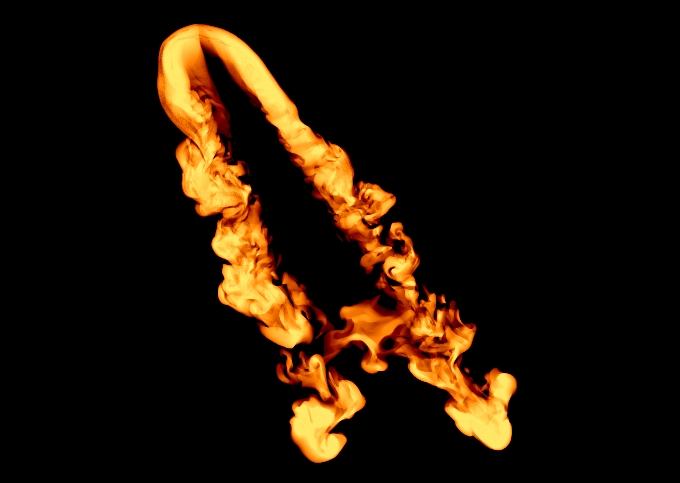
Figure 3: Mock synchrotron image of a simulated radio galaxy embedded in a supersonic cross wind. The two jets have bent into downstream, turbulent tails .
Even more complex motions between the host galaxies and the ambient gas are possible. Those can sometimes lead to really exotic-looking radio structures. One beautiful example of this is the radio source 3C75 in the merging cluster Abell 400. Evidently two massive galaxies have become gravitationally bound into a binary system with a separation of about 7 kpc. The orbital period should be around 100 Myr. The pair also appears to be moving together supersonically through the ambient medium. Each of those galaxies has formed radio jets. If it were not for the binary the expected outcome might resemble the situation pictured in Figure 3. However, the binary motions cause each of the two galaxies to oscillate in its motion and this causes the radio jets to develop more complex, twisted shapes before they disrupt into tails. Figure 4 illustrates a preliminary effort to simulate this dynamics. The image on the right shows the real 3C75, where pink is the radio emission (VLA) and blue is thermal X-rays (Chandra). The image on the left traces the distribution of gas expelled by each of the two galaxies in the binary system. This simulation seems to capture the general character of the dynamical situation responsible for 3C75.

Figure 4: Right-the radio galaxy 3C75 as seen in the radio (pink) and associated thermal X-rays from the cluster Abell 400 (blue). Left-Simulated jets from a binary pair of galaxies intended to mimic the dynamics of 3c75.
From this short set of simulation results it ought to be clear why many different kinds of radio galaxy structures are expected to form. It also ought to be apparent that we need better catalogs of what behaviors do exist in nature in order to see how to focus our simulation efforts and to establish what are the most important dynamical conditions in radio galaxy formation.
The Hunt Is On
One of our scientists Prof. Ray Norris put the call out to the Radio Galaxy Zoo community for a hunt on spiral galaxies hosting powerful radio sources. The first known galaxy of this type is 0313-192, a galaxy much like our Milky Way and has left astronomers baffled.
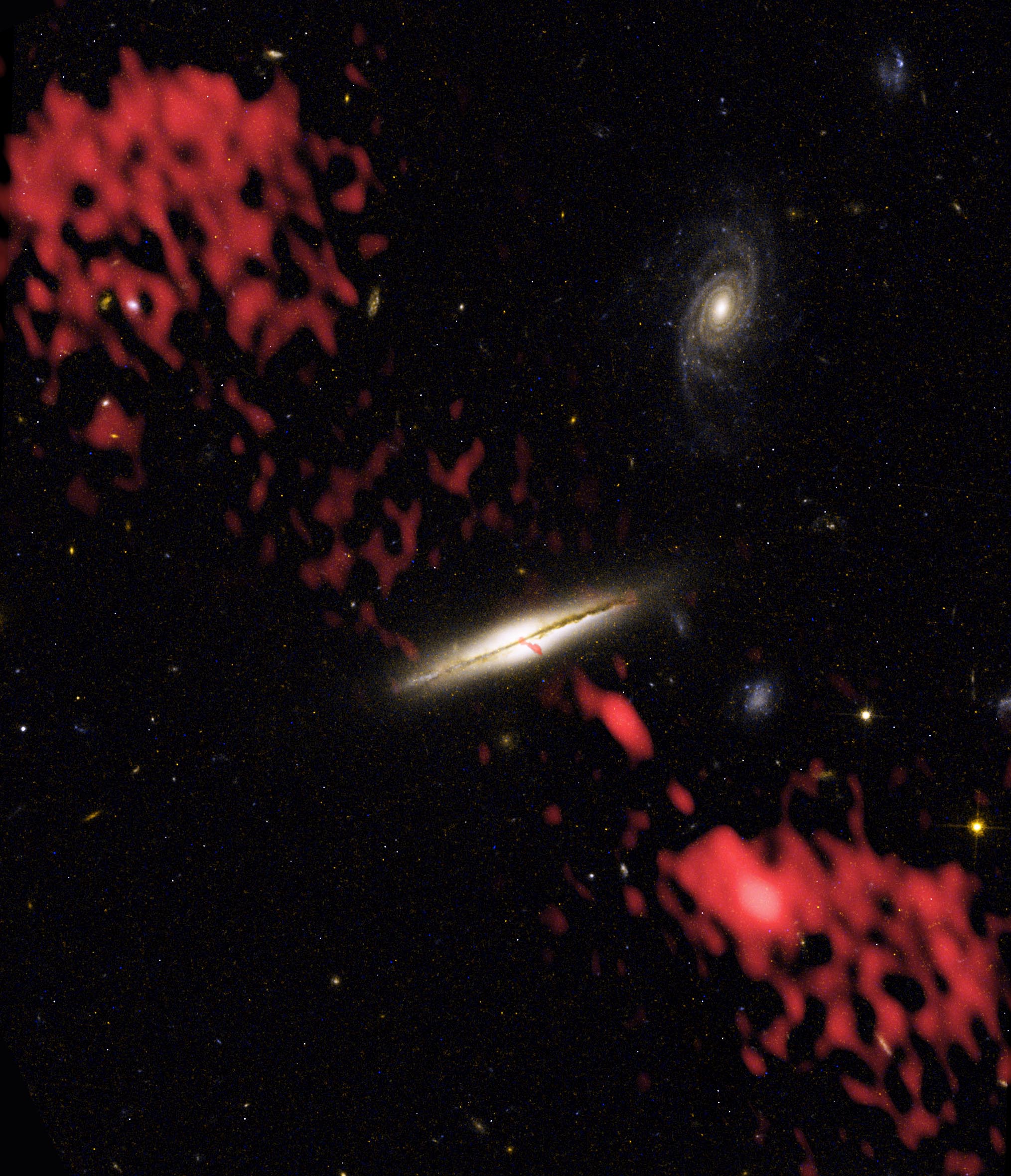 Figure 1: 0313-192 The wrong galaxy from the Astronomy Picture of the Day. Credit: W. Keel (U. Alabama), M. Ledlow (Gemini Obs), F. Owen (NRAO, AUI, NSF, NASA.
Here is Prof. Norris’ post:
Keep an eye out for any hourglass sources that seem to be hosted by galaxies that look spiral in the infrared. These objects are incredibly rare in the local Universe (only 2 or 3 known) and we may not see any in Radio Galaxy Zoo, but if someone does find one, that would be worth writing a paper about (with the discoverer as co-author, of course). The rarity of radio-loud spirals is thought to be because the radio jets heat up and disrupt the gas in the spiral, switching off star formation, and turning the galaxy into a “red dead” elliptical. But we might find one or two where the jets have only just switched on and haven’t yet destroyed the spiral. See The radio core of the Ultraluminous Infrared Galaxy F00183-7111: watching the birth of a quasar for another example of this process in its very early stage. So keep your eyes peeled and yell out (very loudly) if you find one!
We are pleased to announce that the Radio Galaxy Zoo community has identified over a dozen potential candidates and we are in the process of following these up.
Have you seen any? Head over to Radio Galaxy Zoo to join in on the hunt and let us know what you find.
RGZ Team Spotlight: Lawrence Rudnick
Meet Larry Rudnick, Project Advisor for Radio Galaxy Zoo. Larry is often seen chatting to volunteers on RGZ Talk; now he’s written a bit more of an introduction.
 I’m a Distinguished Teaching Professor of Astrophysics at the University of Minnesota. But before I was distinguished, I grew up in Philadelphia, where I decided in 6th grade that I would go into science while I was helping my grandfather pour molten lead into molds to make fishing sinkers. My bachelor’s and PhD degrees are in physics, but astrophysics was what really kept me up thinkng at night. I’ve worked mostly in the radio part of the spectrum, using telescopes all over the world, plus some work in X-rays and infrared. I’ve studied radio galaxies, since the late 70s when Frazer Owen and I introduced a classification system for tailed radio galaxies. Identifications were pretty painful then, taking about an hour each to get the radio and optical photographs lined up. We’ve come a long way! My students and I also spent some years studying the radiation from the supernova remnant Cassiopeia A and others, producing the first 3D image of an explosion. Today, my work focuses on clusters of galaxies and their connections with large scale structure.
The most interesting course I teach is one called “Nothing” where we explore everything from the vacuum, to the number zero, to blind people seeing nothing, to placebos, to King Lear. I’ve done a lot of K-12 work, training teachers in using hands-on science activities, and do a lot of public education, through lectures, radio and TV interviews, and working with our local Planetarium. Radio Galaxy Zoo is my first citizen science project, and I’m really looking forward to how much we’re going to learn.
The Curious Lives of Radio Galaxies – Part Two
This is the second half of a description of radio galaxies from Anna Kapinska, Radio Galaxy Zoo science team member.
Last time we discussed the early and mid stages of radio galaxy life that take up the majority of the radio galaxy lifetime. Today we will go much further following paths of aging radio galaxies.
‘Only few of us get here’
As we discussed last time, radio galaxies are typically between tens and hundreds of kilo- parsecs in size (30 thousands – 3 million light-years). However, some of our buddies will grow to enormous sizes. Once a radio galaxy reaches one Mega-parsec in size (3.3 million light-years across) it’s called a giant – that is, a giant radio galaxy. Not every radio galaxy will reach such enormous sizes; only the most powerful ones whose environments are not extremely dense do. We don’t see too many giant radio galaxies. There are two main problems. One is that they are of low radio luminosity, and so our telescopes are not always sensitive enough to detect more than a subset of radio galaxies reaching this stage of their lives. The other problem is that giants are often composed of numerous bright knots spread over a large area and it’s difficult for us to tell which of these knots are associated with the giant and which are from unrelated sources.

Figure 5: 3C 236, the second largest giant radio galaxy, extends nearly 15 million light- years across. It is located at a redshift z = 1.0 and has angular dimensions of over 40 arc-minutes in radio images. Credits: NVSS, WRST, Mack et al. 1996.
Giant radio galaxies are usually hundred of thousands, or more, years old and they are very large and extended. They can tell us a lot about what is going on within the space in between galaxies in groups and clusters, and that’s why radio astronomers cherish these giants! The largest giant radio galaxy known is 4.5 Mega-parsecs across (named J1420-0545), which is almost 15 million light-years! In radio images these radio galaxies extended over 20 or 30 arc-minutes, which means you will normally see only one of their lobes at a time in any of the Radio Galaxy Zoo images we classify. This is also the reason why we would tag these Radio Galaxy Zoo images as #overedge or #giants.
Fading away
But radio galaxies will not grow to infinity, they will eventually die. What happens then is that the radio galaxy starts fading away. Physically, at this point, the supermassive black hole stops providing jets with fresh particles, which means the jets and lobes or radio galaxy are not fed with new material. The electrons in the radio galaxy lobes have a finite amount of energy they can release as light, and so the lobes simply fade away until they are no longer visible with our telescopes. Dying radio galaxies become progressively less powerful, and less pronounced: no bright jet knots nor hotspots are present within the lobes anymore (see Figure 6). Eventually we can’t see these radio galaxies any more with our telescopes. You would typically mark these radio sources as #relics or #extended in Radio Galaxy Zoo images. It takes only ten thousand years for the brightest features of radio galaxy lobes to disappear, which is barely 0.01% of the total lifespan of radio galaxy. Again, just as the birth, it’s a blink of an eye!
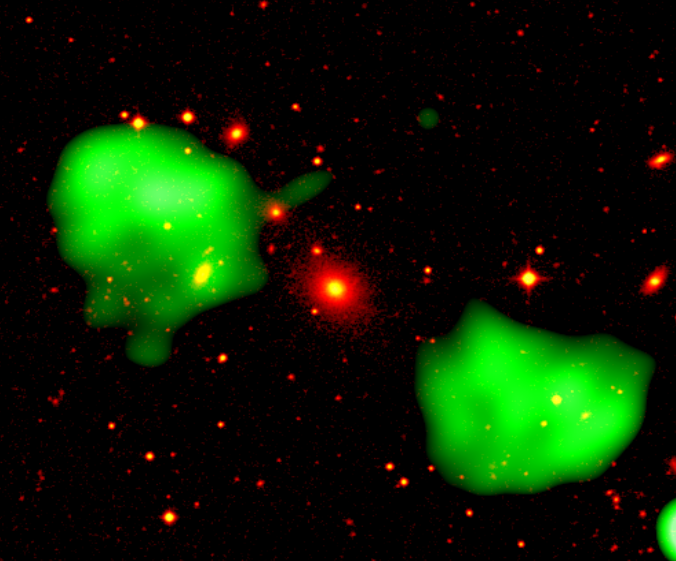
Figure 6: A prototypical dead (relic) radio galaxy, B2 0924+30. Radio waves are imaged in green, while optical image from SDSS is in yellow-red. The angular dimension of this galaxy is 13.5 arc-minutes, and it lies at a redshift z = 0.027, what translates to 430 kilo-parsec (1.4 million light-years) in size. Credits: Murgia
Rebirth
So is that the end?
Well… not really! Astronomers have seen evidence that radio galaxies re-start. What does that mean? That means radio galaxies sort of resurrect. After switching off, the supermassive black hole is radio silent for a while, but it can become active again; that is the whole cycle of radio galaxy life can start all over again. A single host galaxy can have multiple radio galaxy events. We still don’t know the ratio of how long the galaxy is in quiet, silent stage, to how long is in its active, violent radio galaxy forming stage. We also do not know if all galaxies go through the active, radio galaxy forming stage, or whether it’s just some of them. And we don’t know what exactly is the process that makes the galaxies switch on and off. But details on that… that’s yet another story!

Figure 7: Re-started radio galaxy, PKS B1545-321. This radio galaxy has the so-called double-double structure, which consists of two pairs of double lobes. The outer pair of lobes are older and they are slowly fading away. The inner pair of lobes are created after the radio galaxy is born again. This radio galaxy is also a giant, the outer lobes extend to one Mega-parsec (3 million light-years). Credits: Safouris et al 2002.
The Curious Lives Of Radio Galaxies – Part One
Today’s blog post is written by Radio Galaxy Zoo science team member Anna Kapinska, who works on radio jets and studies how they affect the galaxies which host them at various stages of the Universe’s evolution. This is the first of a two-part series.
As most of you know by now (after classifying hundreds of radio and infrared images in our amazing Radio Galaxy Zoo!) radio galaxies are not the type of object that most of us are used to. There’s no stars and dust; no light from that. It’s all about the jets – outflows of particles ejected from the vicinity of the galaxy’s monstrous supermassive black hole and moving nearly at the speed of light. Some of these particles, electrons, emit light while spiralling in the black hole magnetic field. By no means are the radio galaxies stationary or boring!

Figure 1: The famous Hercules A radio galaxy. The radio emission is imaged in pink and is superimposed on optical image (black/white) of the field. You can clearly see the jets extending from the central host galaxy to feed the lobes. Credits: VLA.
Radio galaxies can live for as long as a few hundred thousand or even a few million years. They grow and mature over that time, and so they change. They even don’t disappear straight after they die; that takes time too. So, how does the life of a radio galaxy look like?
Just as for ourselves, humans, we have names for different stages of radio galaxy life. There are newborn and young radio galaxies. There are adults – these are the most often encountered individua. There are also old, large giants. And there are dead radio galaxies – the slowly fading away breaths of magnificent lives – a rare encounter as they don’t stay with us for too long. So, how do these radio galaxies look like and what exactly happens during their lives? Over the next two blogs I will take you through the evolutionary stages of radio galaxies.
Let’s start off with a simple plot astronomers like to use for an overview of a radio galaxy evolution during its lifetime. The plot describes how the radio luminosity changes with the radio galaxy size (Figure 2). The larger the radio galaxy, the older it is (usually), so we can trace the changes in radio galaxy luminosity and structure (size) as it gets older.
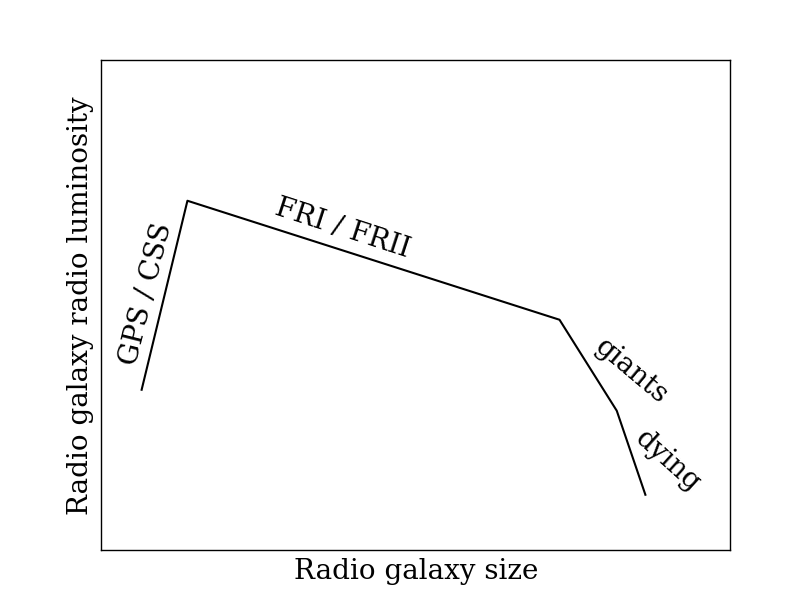
Figure 2: A schematic view of different stages of a radio galaxy life. Credit: Kapinska.
The early years
After a radio galaxy is born it will be growing up very quickly – in a blink of an eye its jets will be penetrating dense environments out to the borders of the host galaxy (the one you can see in optical and infrared wavelengths). Astronomers call these sources GPS (Gigahertz peaked sources) and CSS (compact steep spectrum) radio sources. The GPS/CSS sources are very small; they reach only kilo-parsec distances from the central black hole (3.5 thousand light years), which is merely few arc seconds, or even less, in radio images. This is the reason why we usually detect them as compact radio sources; however, one can sometimes see their double radio structure (that is the jets) in very high resolution radio images (Figure 3), hence really they are just mini-doubles!

Figure 3: A typical CSS radio source, 3C 237, as seen with the FIRST survey (left) and with 20 times higher resolution VLA observations (right). This small radio galaxy lies at a redshift z = 0.877 and is only 9 kilo-parsecs (30 thousand light years) in size. Credits: FIRST, Akujor & Garrington 1995.
This stage of radio galaxy life is the only one at which the radio galaxy luminosity rises steeply as the source grows in size. The stage lasts only for tens to hundreds of thousands of years, which is barely 0.1% of the radio galaxy’s lifetime. This means there is a very short window of time when we can spot CSS and GPS sources, but there are many of these sources around and they are also very bright (their radio luminosities are typically the maximum a radio galaxy can reach) so we often detect them.
The adulthood
After the childhood radio galaxies enter the adulthood. Astronomers have dozen of names to describe the adult radio galaxies and this depends on their structure observed in radio waves, but really, what these radio galaxies have in common is their age and size. They are usually tens to hundreds of millions of years old, and between tens and hundreds of kilo-parsecs in size (30 thousands – 3 million light-years). The luminosity of these radio galaxies slowly drops as they penetrate through the intergalactic space. When you inspect the Radio Galaxy Zoo images, these radio sources are the #hourglass, #doublelobe and #plumes. 3C 237 and Centaurus A are fantastic examples of what we usually see! (Figure 4).
You will quickly notice that there are two main types of these radio galaxies; one type that has very strong radio emission at the end of the lobes (#hourglass, #doublelobes) which is the signature of jets pushing through the ambient medium around radio galaxy. These radio galaxies are called FR IIs by radio astronomers, and the bright spots at the ends of the lobes are called hotspots. The second type has their maximum radio luminosity close to the supermassive black hole or half way through the lobes; these are #plumes within the Radio Zoo and are tagged FRIs by radio astronomers. Plumes are less powerful than the hourglass, but they are even more of a challenge to astronomers!

Figure 4: The FRII type 3C 237 radio galaxy (left) is 290 kilo-parsecs (0.95 million light-years) across. You can clearly see the bright yellow spots at the end of the radio lobes (orange). The blue objects are the optical galaxies and stars, and the white central object is the host galaxy of 3C 237. On the right is huge FR I type Centaurus A radio galaxy which is 700 kilo-parsecs (2.3 million light-years) in size; its radio structure in this image is marked in violet and in the centre we can see optical image of its host galaxy. In the left bottom insert of the image you can see the zoom-in of Centaurus A host galaxy together with small scale jets feeding the larger radio structure. Credits: NRAO, CSIRO/ATNF, ATCA, ASTRON, Parkes, MPIfR, ESO/WFI/AAO (UKST), MPIfR/ESO/APEX, NASA/CXC/CfA
The radio galaxy adult stage will be the majority of their lifetime, and that’s why they are the radio galaxies and radio structures one would typically see. Next time we will see what happens when the radio galaxy gets old!
RGZ Team Spotlight: Enno Middelberg
Meet Enno Middelberg, Radio Galaxy Zoo science team member from Ruhr-University Bochum, Germany:
 I grew up in northern Germany and developed in interest in astronomy only when I finished school. I went to Bonn to study Physics and Astronomy and, after my PhD, moved to Sydney to work as a postdoc. Here’s where I got involved with radio surveys of large portions of the sky, and also where I got involved in radio interferometric observations of large fields with continent-sized baselines (Very Long Baseline Interferometry). After moving back to Bochum, Germany, I got involved with the Radio Galaxy Zoo project, mainly because I just loved the idea and because I was able to quickly contribute to the project by making the images. Also, for a paper a few years back I had classified more than one thousand radio/IR sources the way RGZ users do it now – and I had to do it three times! So I know what it’s like, and I have seen my fair share of radio/IR images in my life. In general I like to fiddle with computers, software, and technology, so every project which requires crunching through, or trying to filter things out of piles of data is interesting.
RGZ Team Spotlight: Anna Kapinska
Meet Anna Kapinska, Radio Galaxy Zoo science team member from the University of Western Australia:
 I was born and grew up in Poland, where I also did my undergrad studies in astronomy. Since then astronomy was the force behind my life paths directing me via the Netherlads and the UK to Western Australia where I currently work as a Research Associate. I was introduced to radio astronomy during my masters studies when I learned all the fundamentals, and the tricky bits too, about radio interferometry. After that I moved towards more theoretical understanding of how radio galaxies grow and how they influence our evolving Universe. For that we still need large samples of radio galaxies of various sizes, shapes and luminosities – and here is where the Radio Galaxy Zoo and all your citizen science work is so invaluable!
Currently, I am also strongly involved in producing sky surveys with two fanstastic new radio telescopes, Lofar and MWA – hopefully we will be able to include these radio sky images in Radio Galaxy Zoo at some point too!
IFRS: The first supermassive black holes?
Today’s Radio Galaxy Zoo post is by Ray Norris, our Project Advisor. Ray researches how galaxies formed and evolved after the Big Bang, using radio, infrared, and optical telescopes.
In Radio Galaxy Zoo, some bright radio sources don’t have any infrared sources at all associated with them, and they have been given the hashtag #ifrs, for Infrared-Faint Radio Sources. So what are these IFRS?
In 2006, we discovered about 1000 radio sources in the Australia Telescope Large Area Survey (ATLAS). Conventional wisdom told us that all of these would be visible in the infrared observations taken by the Spitzer Space Telescope, as part of the SWIRE project. So we were astonished to find that about 50 of our sources were not listed in the SWIRE catalog. Could they be bugs in our data? After eliminating iffy sources, we were left with 11 sources that are bright in the radio but invisible in the infrared images. We dubbed these objects Infrared-Faint Radio Source (IFRS). With hindsight, we should have thought of a better name for them. But at the time we didn’t know that they would turn out to be important!

A very deep infrared image (from this paper), made by stacking images from the Spitzer Space Telescope at the positions of IFRS (shown by the cross-hairs). This image, about 300 times deeper than the WISE images currently being used in Radio Galaxy Zoo, shows that not only is there no infrared counterpart at WISE levels, but even if you go enormously deeper, there’s still almost nothing there in the infrared.
We suggested in 2006 that these might be high-redshift active galaxies – galaxies whose emission is dominated by a super-massive black hole at their centre (the galaxies you are looking at in Radio Galaxy Zoo). This was surprising, because we were finding so many of them that it meant there must be far more supermassive black holes in the early Universe than found by deep optical surveys, such as SDSS (whose images we use in Galaxy Zoo). It’s also far more than can be accounted for by conventional hierarchical models of super-massive black hole formation. Naturally, our colleagues were sceptical, and most of us harboured our private doubts too. But over the next few years we tested this idea and its alternatives. Gradually our confidence grew that these were indeed high-redshift active galaxies.
In 2011 we showed that they were similar to high-redshift radio galaxies (HzRG) but even more extreme. Crucially, we suggested that they follow the same correlations between the radio and infrared emission as the HzRG. If this suggestion turned out to be correct, then that would push them to be amongst the first supermassive black holes in the Universe.
Fortunately, it was possible to test this hypothesis by measuring the redshifts of less extreme objects, to see if they followed these same correlations. Two new papers confirm that they do indeed follow this correlation. In one, Andreas Herzog and his colleagues use the European Very Large Telescope to measure the redshifts of three of these less extreme objects, and find they lie on the correlation, at redshifts between 2 and 3, just as predicted. In the other paper Jordan Collier and his colleagues take exactly the same data now being shown in Radio Galaxy Zoo, and search for objects which are relatively much brighter in the FIRST (radio) data than in the WISE (infrared) data. 1,317 of these are found, of which 19 have measured redshifts. Again, all but one of these lie in the redshift range 2 to 3. This is strong support for the hypothesis!
Armed with this, we are increasingly confident that the most extreme IFRSs that will turn up in the fainter ATLAS and COSMOS field, to be released in Radio Galaxy Zoo in a few weeks, will include many supermassive black holes formed in the first half-billion years after the Big Bang. According to conventional hierarchical black hole formation models, these shouldn’t exist. So the race will be on to identify them and measure their redshifts using instruments like ALMA.
Not everything in Radio Galaxy Zoo classified as being an IFRS will turn out to be a high-redshift black hole, as the data currently being displayed (FIRST and WISE) are not deep enough to pick out the really high-redshift objects. But when the new ATLAS data are loaded into RGZ in a few weeks, almost every object that appears in the radio but not in the infrared will be one of these enigmatic objects. We can’t wait to see how many you find!
RGZ Team Spotlight: Ivy Wong
Meet our fearless (co-)leader, Radio Galaxy Zoo Project Scientist Ivy Wong:
Ivy is an Australian astronomer (currently based at CSIRO) who is interested in the how/why galaxies start and stop forming stars. She is currently obsessed with galaxies that have suddenly stopped forming stars (aka ‘post-starburst’ galaxies), blue spheroidal galaxies and galaxy interactions in general. Having worked with the original Galaxy Zoo project, she became super excited with the prospect of helping to launch Radio Galaxy Zoo. She is very keen to find out how the massive radio jets emitting from central supermassive black holes affect its host galaxy as well as neighbouring galaxies.
When not working for astronomy, she is slave to two feline overlords, Princess Pippa and Master Finian. These two can pass for the internet celebrities: Grumpy Cat and Chemistry Cat (although Finian does not approve of glasses and bowties).

In the week preceding the launch of Radio Galaxy Zoo, Ivy was the Duty Astronomer at the Australia Telescope Compact Array (ATCA, CSIRO)—where some of the radio images for Radio Galaxy Zoo originated. Inset: Ivy with her other overlords.
How do black holes form jets?

This post was written by Radio Galaxy Zoo team member Stas Shabala, an astronomer at the University of Tasmania.
The supermassive black holes at the hearts of galaxies are supposed to be simple. For someone looking at a black hole from afar, physicists tell us all black holes can be described by just three parameters: their mass, electric charge, and spin. For really big black holes, such as the ones astronomers deal with, things are even simpler: there is no charge (that’s because they are so big that there would always be enough neighbouring positive and negative charges to more or less cancel out). So if you know how heavy a black hole is, and how fast it spins, in theory at least you have enough information to predict a black hole’s behaviour.
Of course the black holes in Radio Galaxy Zoo often have at least one other, quite spectacular, feature – bright jets of radio plasma shooting through their host galaxy and into intergalactic space. Where do these jets come from?, I hear you ask. This is a very good question, and one to which astronomers are yet to find a wholly convincing answer. We have some pretty good hunches though.
The fact that black holes can spin might be quite important. Matter accreted by a black hole will rotate faster and faster as it falls in. Stuff closer to the equator will also rotate faster than stuff at the poles, and that causes the accreting material to flatten out into a pancake, which astronomers call the accretion disk.
The accreting matter near the black hole event horizon (a fancy term for the point of no return – any closer to the black hole, and not even light is fast enough to escape the gravitational pull) is subject to friction, which heats it up so much that individual atoms dissociate into plasma. These plasma (i.e. positively and negatively charged) particles are moving, so they are in fact driving an electrical current. When this current interacts with the rotating magnetic field of the black hole and the accretion disk, the charged particles are flung out at close to the speed of light along the axis of black hole rotation. We can see these fast-moving particles as jets in the radio part of the electromagnetic spectrum. A useful analogy is a car alternator, where electrical currents and magnetic fields are also combined to generate energy.

This artist’s conception is on a *really* different scale than the image at the top of this post. Compared to those (real) jets, this is zoomed in 100,000 times or so. Jets are big.
There are many things we don’t know. For example, we don’t know for sure where most of the jet energy comes from. It could be from the accreted matter, or the spin of the black hole, or a combination of both. We are also not sure exactly what sort of charged particles these jets are made up of. Understanding black hole jets is one of the great unsolved mysteries in astronomy. By studying a huge number of these jets at different points in their lifetimes, Radio Galaxy Zoo — with your help — will help us solve this puzzle.
 Galaxy Zoo