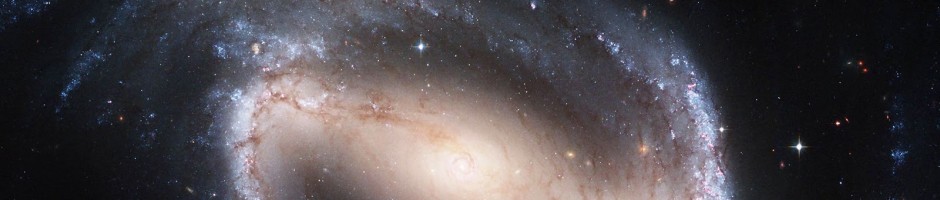
Why build the Hubble Space Telescope?
After I had started my post about the planning phase of the HST up to the start, I have noticed that the arguments (which I thought to be a small section in there) for building a Space Telescope in the first place took up quite some space, so I have decided to post this for now and delay the rest of the post into a different one (trying to keep the posts from getting too extensive as I promised last time), possibly the next.
At first sight it doesn’t sound like a terribly good idea to put an expensive telescope on an expensive rocket (which doesn’t mean it’s a successful start at all, usually expensive equipment and large quantities of explosives are kept well apart for a reason) and shoot it into orbit where again many things can (and did) go wrong and telescope maintenance is either impossible or at least very expensive. Why not simply build a ground-based telescope which is a lot cheaper but would still have a much bigger mirror (so can collect more light and potentially create sharper images, see below) and would still be much cheaper and easier to maintain? Where a new camera simply needs to be screwed on (a simplification about which many telescope engineers could rightfully complain), rather than having to employ the (again expensive) space shuttle to even get there in the first place and then having to work in unhandy space suits to get the new equipment in (with the risk to notice that a bolt might be too long and the camera doesn’t even fit in); and if it doesn’t work afterwards, you’re screwed and you cannot simply take it down again and fix it? Not even talking about potentially simple problems like cooling the camera chips for which you need liquid nitrogen or helium, which, on earth, you can simply refill with a tank, but which in space becomes a rather more complicated task altogether.
So at first sight, it looks like people need a very good reason to even think about Space Telescopes, an then start developing, maintaining and upgrading one with new cameras. So what are these advantages that made scientists built the HST (and many other Space Telescopes)?
Well, there are 2 main reasons, one of which solves a problem that was at least impossible to overcome back then and one that solves a fundamental problem alltogether:

 The first problem: In principle, the angular resolution of a telescope should be given by the wavelength of the observed light and the diameter of the mirror (or lens). This is simple optics that every physics student learns and it says that the bigger a mirror, the better the resolution. But there is one very large problem: This is pure theory for an ideal telescope in a vacuum. As in the old physicist joke: ‘Yes, I’ve got a solution, but it only works for spherical elephants in a vacuum’. But here, talking about telescopes instead of elephants, the problem really IS the atmosphere which changes the situation completely.
The atmosphere has its upsides for breathing, weather (sometimes we could do with a bit less atmosphere here in England 😉 ), airplanes and stuff, but for astronomers, it’s really just ‘in the way’. The air, or better to say the movement of the air, the turbulences of hot and cold air bubbles, bends the starlight on its way into the telescopes (very much like when you’re looking over the tarmac on a very hot summers day everything is flickering). This basically makes stars jump around very fast (Actually, you can see this effect by looking at the stars. Stars ‘flicker’ at night. Objects larger than this effect, e.g. planets, don’t flicker; That’s how you can tell them apart easily). As the apparent position of the stars jump around faster than the eye or a normal camera can detect, it doesn’t really make stars move in long-time exposures, but it leads to ‘blurring’ of the image (If you want to know what a stars picture actually looks like in extremely short exposures, read this article).
This effect is so big that it easily overpowers the resolution improvement due to a bigger mirror size. In fact, to get the maximum resolution of a telescope at sealevel, a telescope with something between 10 and 20 cm diameter is big enough. Any bigger than that does not increase the image resolution due to seeing. Groundbased telescopes can therefore not see details smaller than 0.5-1.0 arcsec in size, even at the best telescope sites (which are usually in very dry places very high up. Dry weather is usually less turbulent and building telescopes at high altitude avoids having to look through large parts of the atmosphere in the first place, so ‘seeing conditions’ are usually better). For comparison, the Hubble Space Telescope has a resolution of only 0.05 arcsec due to it’s position outside the atmosphere and its size of around 2.5 meter.
I show the effect of seeing in the images above. The top one is a picture taken by a 2.2 meter (so similar to HST) telescope in Chile from the Combo-17 survey. The bottom one is the same area of the sky taken by HST (to be precise, it’s a small bit of the Hubble Ultra Deep Field H-UDF, stay tuned for one of my later posts about this survey). You can clearly see that all the objects in the groundbased survey are blurred and some of the faint objects are actually blurred so much, that they cannot even be seen at all above the sky background. In the space based image, the details and features of the galaxies are visible much more clearly. This is the reason why these images were now chosen to be classified in Galaxy Zoo: Hubble. From groundbased telescopes a classification of galaxies at similar distances is simply not possible.
Of course, a big telescope has another obvious advantage: It collects a lot of light, so it enables us to see fainter objects. This is the main reason why telescopes in the past were built bigger and bigger and this trend continues even today.
Also, there are a few things that can be done to improve the image quality, but most of them go beyond the scope of this blog, but if you want to know about it, read e.g. this article and links therein. Basically, either interferometry (where several telescopes far apart are used, unfortunately, this does not produce a full ‘image’ of the object) or movable and distortable mirrors can be used. The latter is called adaptive optics, a very complicated and expensive technique, in which the wavefront of the starlight that has been distorted by the atmosphere can be corrected by a mirror, which is generally speaking distorted exactly in the opposite way to make the wavefront flat again (The mirrors shape has to be adjusted around 200 times per second). A flat wavefront will create a sharp – ‘diffraction limited’ – image, using the complete power of the big mirror used. Adaptive optics was only developed in recent years on several telescopes. The Hooker telescope mentioned in my last blog runs one, for example, and most big telescopes like Gemini, Keck or the VLT run these facilities, too. Although I did call this technique ‘expensive’, it is, of course, a lot cheaper than building a Space Telescope.

In fact this is one of the reasons why the HSTs ‘successor’, the JWST telescope (also one of my later posts) will not be observing at the same optical wavelengths as HST but will rather concentrate on IR wavelengths. Running adaptive optics facilities, groundbased telescopes now produce images of the same quality as the HST, although on a smaller field of view and only close to stars (they need bright-ish stars to compensate the effect of the atmosphere, although laser guide stars will avoid at least the second problem in the future). The 30-40 meter telescopes that are currently planned around the world will show much better resolution again and using very sophisticated adaptive optics might have a similar or even bigger field of view as HST currently has. In the image below (please click for full resolution), you can see an estimated example for a telecope called OWL (Overwhelmingly Large telescope, not kidding, the image above shows a simulation. The speck in the foreground is a car for size comparison). This was a planned telescope which has now been cut down to 42 meters, we now call it the E-ELT (the Extremely Large Telescope, yes, astronomers are not very creative when it comes to telescope names). It’s design is different (but OWL of course is more impressive and their website provided the images I was looking for), but very recently, its cite has been selected to be on a neighbouring mountain to Cerro Paranal, the cite of the VLT.
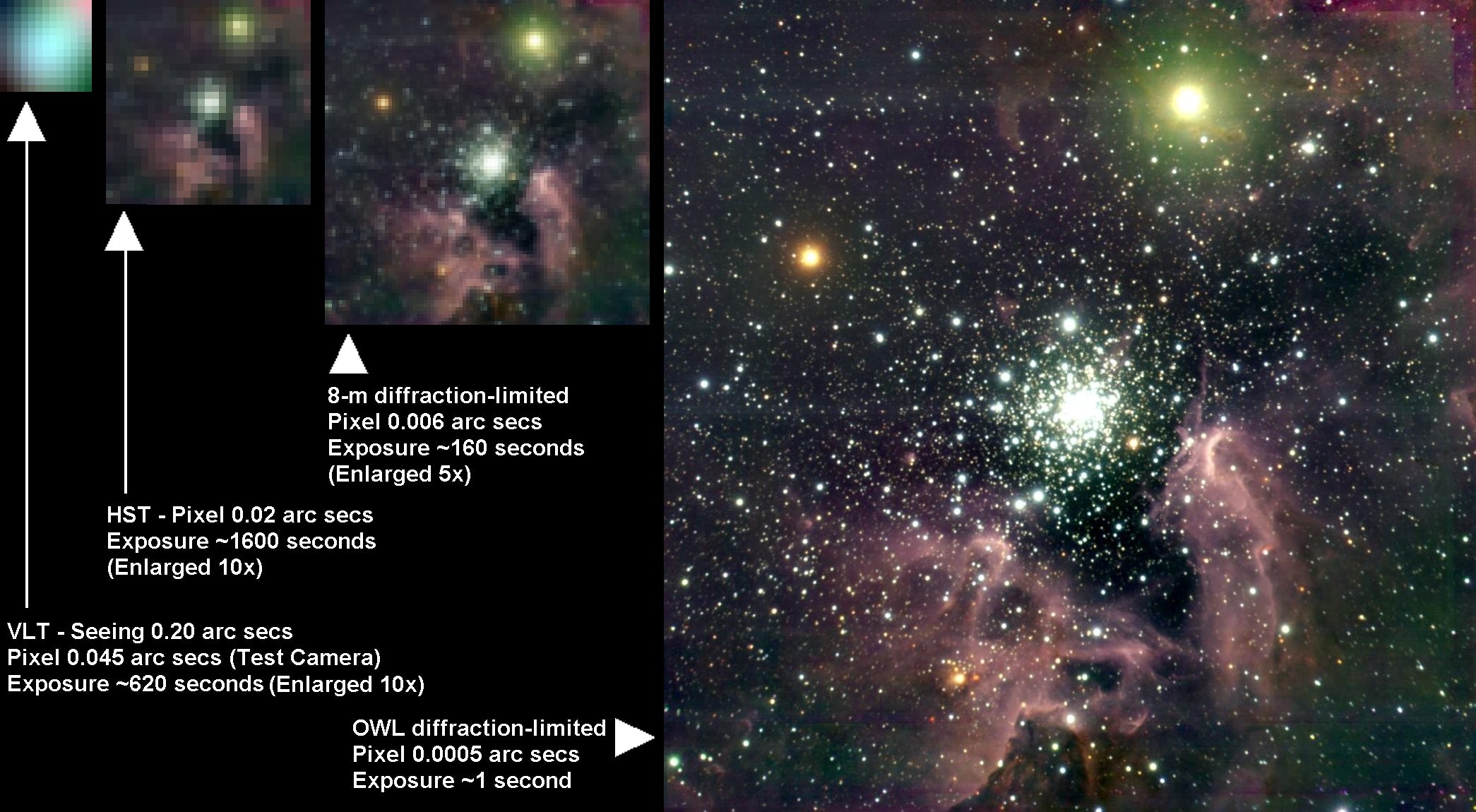
Resolution comparison for OWL (Click for better resoultion)
As you can see on the left, this telescope would, with perfect adaptive optics (diffraction limited) indeed produce much sharper images with much higher resolution then even HST can provide today. So in principle, the problem of the atmosphere can be overcome using clever techniques. The field of view on which this works today is still a lot smaller than what is covered by HST survey cameras, but this is a matter of technique and might be overcome in the future (if interested, google ‘multiconjugate adaptive optics’). In the past, when HST was planned, non of this existed, so a Space Telescope indeed sounded like a good idea.
 But groundbased telescopes have an even more fundamental problem which is simply put impossible to overcome. At ground level, only certain wavelengths in the electromagnetic spektrum can be observed. (Far) Infrared, ultraviolet and gamma light cannot be observed at all from groundbased telescopes as the light is strongly absorbed by the atmosphere. The image on the right shows the height above ground at which light is basically absorbed by the atmosphere. As you can see, only optical and radio (and a bit near infrared) observatories make sense on earth, even on the highest mountains. For any other wavelength, you need a space telescope to be able to observe galaxies at all.

NGC1512 screengrab from Wikipedia
Different wavelengths can be very interesting, a galaxy looks completely different in optical than in X-ray or Radio and all these wavelengths show different physical parameters, e.g. star formation rates (X-ray) or the amount of ‘dust’ in the galaxy (in IR). A good and famous example for this is NGC 1512, a barred spiral galaxy whose center has been observed at different wavelengths by the same telescope. You can see the results on the right. Generally speaking, very blue light (shown in purple) shows very young stars, redder light (up to orange) older stars, red shows dust. Remember, these are all still more or less optical wavelengths, in X-ray or far infrared, this galaxy would look even more different.
The HST works at optical wavelengths, so this was not really a reason to build it, most things (although HST does have some IR filters) could indeed be observed by groundbased telescopes. But as I mentioned above, the HSTs successor, the JWST will exclusively be working in IR for exactly this reason. Optical cameras are not really needed in space anymore (although it’s of course a shame that we won’t have an optical space telescope in the future), but for IR observations it’s vital to be in space. Other famous Space Telescopes in other wavelengths include Spitzer (IR), Chandra (X-ray), GALEX (UV) and XMM-Newton (Xray), all of which are impossible to be replaced by earth-bound instruments.
There are also quite a few focused satellites for certain experiments in space, e.g. WMAP (to observe the afterglow of the Big Bang), Keppler (to detect exo-planets, planets around other stars than the sun) and others, but these are focused projects and not open telescopes everybody can apply to, which of course everyone can at the HST. I will talk about this and some big projects that successfully got their time on the HST in my future posts.
All in all, you can see, there are several good reasons to build a Space Telescope, scientists don’t do this because it’s ‘fun’ or ‘cool’. For observations in certain wavelengths it is still important today, for others it has at least been important in the past. Which brings us back on track: At some point, the decision was made to build the HST (although it wasn’t named Hubble then) and the planning began. But this will be my next post, so stay tuned. I am travelling a lot in the next month, so I might not be able to hold the 2-week schedule, but I’ll do my best.
Cheers,
Boris
Previous history of this series:
- August 2nd, 2010: Me, HST and the History of Surveys
- August 16th, 2010: Edwin Hubble, the Man behind the Telescope
Galaxy Zoo gets highlighted by the 2010 Decadal Survey
Every decade, the US astronomy community gets its leaders together to write up a report on the state of the field and to recommend and rank major projects that should be supported by the government over the next decade. It’s a blue print, a wish list and often also a sober exercise in what to fund (a little) and what to cut (a lot). The current Decadal Survey was finally released by the US National Academies last Friday and every astronomer is poring over it to see if their project or telescope is ranked highly.
Galaxy Zoo isn’t competing for hundreds of millions of dollars in funding to launch a space observatory, but it did get not just one but two mentions in the 2010 Decadal Survey, one in the text and a figure. For those of you who are keen to read the whole thing for themselves, you can get the report at the National Academies website here (you have to click on download and give them your details to get the free PDF download). Here on the blog we only show you the highlights, i.e. the Galaxy Zoo mentions. From the text in the section on “Benefits of Astronomy to the Nation” where they discuss how “Astronomy Engages the Public in Science”:
Astronomy on television has come a long way since the 1980 PBS premier of Carl Sagan’s ground-breaking multipart documentary Cosmos. Many cable channels offer copious programming on a large variety of astronomical topics, and the big three networks occasionally offer specials on the universe too. Another barometer of the public’s cosmic curiosity comes from the popularity of IMAX-format films on space science, and the number of big-budget Hollywood movies that derive their plotlines directly or indirectly from space themes (including five of the top ten grossing movies of all time in America). The internet plays a pervasive role for public astronomy, attracting world-wide audiences on websites such as Galaxy Zoo (www.galaxyzoo.org, last accessed July 6, 2010) and on others that feature astronomical events, such as NASA missions. Astronomy applications are available for most mobile devices. Social networking technology even plays a role, e.g., tweets from the Spitzer NASA IPAC (http://twitter.com/cool_cosmos, last accessed July 6, 2010).
They also have a lovely figure, which has a small blooper in it (see if you can spot it!). Word is that this is going to be corrected in the final version:

Thank you all for making Galaxy Zoo such a success!
Edwin Hubble, the man behind HST
Who is Edwin Hubble, the guy who gave the Hubble Space Telescope its name? Who is the mysterious guy behind the telescope?

Edwin Hubble
Well, actually, Edwin Powell Hubble is not the ‘man behind the telescope’ at all. He was born on 20th of November 1889 in the US and studied Physics and Astronomy in Chicago. He then, interestingly, went to Oxford, UK (now, of course, one of the main departments participating in Galaxy Zoo), to study Jurisprudence, later Spanish. Given that he was also very sporty (he won several state track competitions and set the state’s high school high jump record in Illinois), I think it is fair to call Hubble a person with multiple talents. In England, he also picked up some English habits and his dress code, some to the annoyance of his american colleagues in later years. I don’t know many pictures of him, the one on the right is possibly the most famous (usually used in scientific talks at least). Smoking his pipe on his desk, he really looks like an English gentlemen of his time (Well, maybe he’s lacking a hat).
Edwin Hubble died on September 28th 1953 in California (his house is now a National Historic Landmark at this location), long before the real planning for the HST had begun. Earlier ideas did exist, since 1923, after it was explained how a telescope could be propelled into Earth orbit and in 1946, Lyman Spitzer (who interestingly enough has his own space telescope named after himself now) had already discussed the advantages (which I will discuss in the next post about the planning of the HST) of an extraterrestrial observatory, but it took until 1962 for the US NAS (not NASA!) to recommend the development of a space telescope for other purposes than observing the sun (two orbiting solar telescopes were in fact already active at that time). In 1965, 12 years after Hubbles death, Spitzer was appointed head of the committee to define the scientific objectives for this new telescope, so really, he is the ‘man behind the Hubble Space Telescope’.
So why is the telescope named after Edwin Hubble then?
After some years of teaching at the university back in the US and after serving in WWI as a major, he returned to the Yerkes Observatory at the University of Chicago, where he finished his Ph.D. in 1917. The topic of his thesis was ‘Photographic Investigations of Faint Nebulae‘ (it only consists of 17 pages, a fact that possibly makes every PhD student cry nowadays). At that time, these nebulae were still considered to be part of the Milky Way, something that was waiting for a real genius and careful observer to be revealed as a mistake.

The Hooker Telescope
In 1919, Hubble took on a staff position in California at the Mount Wilson Observatory near Pasadena where he stayed until his death in 1953. Just 2 years previously, a new telescope had been finished at the site, the Hooker telescope (the slightly unfortunate name comes from John D. Hooker who funded the project), a 100-inch Reflector telescope, which today is still there and, after some recent upgrades and modifications (although preserving the historical origin wherever possible), is again used for scientific purposes. With its ‘adaptive optics’ system (see next post) its resolution today is 0.05 arcsec, the same as resolution of the HST. From 1917 to 1948, the Hooker telescope was the world’s largest telescope.
Hubble used this new, state-of-the-art telescope to continue the work on nebulae that he had started in Chicago by identifying Cepheid variable stars in them. Cepheids have the very convenient characteristic, that the period of their variability is a simple function of their brightness. So by measuring their period, astronomers can immediately tell how bright these objects are in a standard system. Measuring their apparent brightness allows to measure their actual distance. By doing this, Hubble noticed that they are far too distant to be part of our own galaxy, but instead are extragalactic systems, islands of stars (and possibly life) in the vast nothingness of space. Other distant ‘Milkyways’, just like our own.
We now call them ‘galaxies’.
Being some of the closest galaxies to our own, most of the objects that he worked on are now very famous, some also through images by the HST. The most famous of all is possibly M31, the closest big galaxy to our own, the Andromeda galaxy, or what Hubble called it, the Andromeda Nebula.

The original version of the Hubble diagram
Additionally to his distance measures of 46 galaxies Hubble further took measurements from Vesto Slipher of their escape velocity. This is basically the speed with which ‘the galaxies move away from Earth’ (what we now understand to be the cosmological redshift) and can be relatively easily measured by looking at the galaxies’ spectra, in which all spectral lines, previously known from lab experiments, are shifted by the same amount. When Hubble plotted the escape velocity of galaxies over their distance (we call this a Hubble diagram), he noticed something interesting:
The further galaxies are away from our position, the faster they move away.
This was a pretty radical idea as it proved that the Universe is not a static place at all as was widely believed before. For example, Einstein had introduced an additional term into his cosmological formula in general relativity to make his universe static/non-dynamical (something Einstein called the biggest blunder of his life after he had seen Hubble’s data. Funnily enough, this constant is now back in there to explain the accelerated expansion of the universe. It resembles the ‘dark energy’). Instead, this effect means that either the Earth is in a very special spot of the Universe where everything is flying away from it (a thought that many people, amongst them Einstein, considered wrong. The hypothesis that there is nothing special about the place where the Earth is other than that it is where we happen to live, is one of the basic fundamentals of cosmology) or there was a time in the past when everything was at the same point, much like in an explosion. Of course, we now know it was not an explosion in the traditional sense, but the beginning of time, the Big Bang.
Of course, as with most big new discoveries, these new findings were heavily discussed, not many people believed in them in the beginning. One after another, people started believing in Hubbles results, though, and the view that astronomers have on the universe changed completely. The Big Bang Theory (besides being a brilliant TV series) is now the generally accepted picture today.
As a small anecdote on the side: Due to errors in his distance measurements, Hubble measured the expansion parameter (the Hubble constant) to be 500 km/s/Mpc, which for today’s measurements is a pretty bad value, actually. After new, better data and improved data analysis were used, there were 2 big groups of people debating the real value, some said it was 50 km/s/Mpc, some others said it was 100 km/s/Mpc. For the past 10-15 years, this battle seems solved Solomonically, the value is now assumed to be just inbetween these values, somewhere between 70 and 75 km/s/Mpc. So, although Hubble was very wrong in the number that came out of his measurements, he somehow got the principle spot on.

Using the images that he had taken for his work, Hubble also came up with a system to classify these nebulae and galaxies depending on their appearance. This is what we call the Hubble sequence or the tuning fork of galaxies, and Galaxy Zoo initially used a system that was based on this diagram for their classifications.
As the Hubble Space Telescope was primarily constructed and built to observe distant galaxies (besides of course looking at objects in the solar system and interesting regions in our own galaxy), it was named after Edwin Hubble in honour of his groundbreaking work in this field.
Edwin Hubble has not only got a Space Telescope with his name, but several laws, constants and numbers are named after him, too.
Some examples:
- The Hubble constant as explained above, called H0
- The Hubble time is 1/H0 and gives the approximate age of the universe. It is currently estimated to be around 13.8 billion years.
- The Hubble length is c/H0and is equivalent to 13.8 billion lightyears. This is not the ‘size’ of the universe, but is an important length in cosmology
- The Hubble diagram as described above
- The Hubble sequence of galaxies.
- Hubble’s law
Additionally, there are:
- An asteroid: 2069 Hubble
- The crater Hubble on the Moon.
- Edwin P. Hubble Planetarium, located in a High School in Brooklyn, NY.
- Edwin Hubble Highway, the stretch of Interstate 44 passing through his birthplace of Marshfield, Missouri
- The Edwin P. Hubble Medal of Initiative is awarded annually by the city of Marshfield, Missouri – Hubble’s birthplace
- Hubble Middle School in Wheaton, Illinois—renamed for Edwin Hubble in 1992.
- 2008 “American Scientists” US stamp series, $0.41
(I think when they make you a stamp and you’ve got your own highway, you’ve really made it!)
I think that’s more or less all that I can come up with about Eddi, the post is actually quite a bit longer than I thought it would be, I’ll try to keep it shorter in the future, scout’s honour. For now, I will end with a quote from Edwin Hubble:
“Equipped with his five senses, man explores the universe around him and calls the adventure science”
With this, keep together your senses, especially seeing (the galaxies in Galaxy Zoo) and feeling (your mouse button with your index finger) and help us to do more adventurous science with the classified galaxies that you help us with (hearing, smelling and tasting are only of second order importance in astronomy, unless of course you listen to some music and have a snack while classifying 😉 ).
Thanks and Cheers,
Boris
Peas Through a Lens
This week’s OOTW features today’s OOTD by Budgieye.

SDSS view of SDSS J001340.21+152312.0
This yellow fuzzy galaxy is a Quasar 1.59 billion light years away from Earth in the constellation Pegasus; it’s just above to the left of the star Gamma Pegasi.
When you zoom in with the Keck observatory you’re treated to this beauty:

Credit: F. Courbin, G. Meylan, S. G. Djorgovski, et al., EPFL/ Caltech/WMKO
Now what the Keck telescope can see and the Sloan telescope can’t are the two red smudges in the blue glow of the Quasar. These smudges are in fact one Pea gravitationally lensed by the QSO sitting in front of it! This is the first ever example of a Quasar strongly lensing an object. This is where a galaxy or a cluster of galaxies are so massive that they bend space-time so much that it visibly bends light around them. So the light emitted by an object sitting behind a cluster of galaxies gets bent around the cluster, creating multiple images of one object.
So how can we tell they are multiple images of the same object?
A quote from Budieye’s OOTD:
To ensure that the two red objects on each side of the quasar is actually the same object, each object must have their spectrum taken separately.
Both blobs of red light had identical spectra, indicating that both blobs are the same object, and that the quasar is bending the light from the distant galaxy into two blobs.
Me, HST and the history of surveys
Before I start with a new series of posts, please let me introduce myself.

My name is Boris Häußler (look at my horribly out-of-date website here). I am German but currently working as a research fellow in Nottingham, UK, where I have just recently started my second postdoc with Steven Bamford, whom many people here may know. I have spent the last years (actually, my whole scientific life so far) working on Hubble Space Telescope (HST) data, mainly on the GEMS and STAGES surveys, and have gathered particular experience in the field of galaxy profile fitting, trying to measure sizes, shapes, etc. of distant galaxies. Whereas my previous projects have mainly been working on galaxies at redshift z~0.7, my new job is trying to do similar and more advanced things on more local galaxies, mainly SDSS galaxies, which of course everyone familiar with Galaxy Zoo will know as these are the galaxies classified in both Galaxy Zoo and Galaxy Zoo 2. Initially, one would think that this is a much easier job to do, but as this data is from ground-based telescopes, it proves to be challenging.
 This brings me to an interesting position. Although Galaxy Zoo is not my primary science project, I am now connected to the survey through Steven, our galaxy sample and (for now) more directly through this blog. Having worked on HST galaxies for ages, it is of course very interesting for me to see these galaxies now being classified in Galaxy Zoo: Hubble. Having created some of the colour images that both GEMS and STAGES have used for outreach purposes, I have looked at thousands of these galaxies myself and know how stunningly beautiful they can be. I very often got lost on our images, simply browsing around and being fasctinated by the variety of the galaxies. At least in GEMS I know many galaxies by heart and could possibly directly point you to at least some of the brighter and/or more interesting galaxies.
Being kind of an HST expert, Steven has asked if I would want to write a series of posts about HST, an offer that I found hard to turn down, so I’ve decided to write quite a long series about the HST, its history, its future and especially introducing some of the bigger HST surveys, some of which of course build the content of Galaxy Zoo: Hubble now. But before I write and post all this, I would be interested to know what people would actually want to know about Hubble and everything connected with it. So if you have any comments, any wishes, any questions, please post them below and I will try to answer them in the future.
My current plan for the next months contains the following posts, roughly running through the history of Hubble in chronological order:
- Who is Edwin Hubble, the man that gave HST it’s name?
- History of Hubble, the planning and the start 20 years ago
- HST gets spectacles, first service mission
- HDF, the Hubble Deep Field, the first famous survey,
- Another service mission, putting new cameras (e.g. ACS) on HST
- GOODS, the Great Observatories Origins Deep Survey
- GEMS, Galaxy Evolution from Morphologies and SED
- AEGIS , the Deep Extragalactic Evolutionary survey
- HUDF, the Hubble Ultra Deep Survey, the deepest survey ever made
- STAGES, Space Telescope Abell901/902 Galaxy Evolution Survey
- COSMOS, the Cosmic Evolution survey
- The service mission to put in another camera (WFC3)
- Upcoming surveys: CANDELS
- The Future of HST
- HST’s successor, the James Webb Space Telescope (JWST)
If you want to know about anything else, please let me know below.
Thanks and Cheers for now,
Boris
Supernova updates
Hello from the William Herschel Telescope, where I’m observing some of those lovely supernova candidates that have been pouring out of The Supernova Zoo lately.
It’s been a while since our last update. We’ve been running supernova zoo in a very serious way now for several months, and, after ironing out a few little bugs and adding some improvements, the zoo is making a massive contribution to the supernova identification effort in The Palomar Transient Factory. The zoo has already classified some 20,000 supernova candidates, usually several hundred every day; it’s a fabulous effort. You’ve classified every supernova candidate that we’ve put in the zoo!
We also hope that you’re beginning to see feedback on the supernova candidates that you spend your time classifying (at least the better ones!). From this current observing run I’ve been adding comments as I classify the events that you’ve highlighted, so you might see them appearing in your “MySN” area (of course, the more you classify, the more likely this is to happen!).
Here are some of your nice recent finds, all Type Ia Supernovae.
This one seems to live in a galaxy located in a cluster of galaxies:

This is one in a nearby NGC galaxy – the SN is located directly in one of the spiral arms.
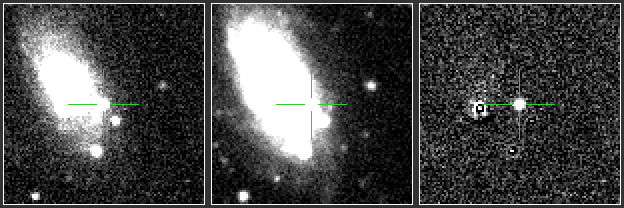
And this one is also in a spiral galaxy – but one that is more edge on:

We’re currently preparing a scientific publication that will detail supernova zoo and how it works – and we also have plans to add a new survey to give you even more supernova to play with. So stay tuned!
OK, my exposure has just finished, so I’ll sign off here and go and see what the latest supernova candidate turned out to be!
— Mark
Zoo 1 data set free
Hi all
It’s taken longer than it should have done – more than three years since the launch of the site – but the data from the original galaxy zoo is now available.

The paper describing the data set was only accepted by the journal yesterday, but we were confident enough after an earlier report to go ahead and make it public. The data can also be downloaded in a variety of formats from our site, or via Casjobs.
The data set is slightly updated from our previous efforts; while we’ve been busy with Galaxy Zoo, the good people of the Sloan Digital Sky Survey produced a new data release which included more spectra, allowing us to estimate biases for more galaxies than ever before.
We’ve had a lot of fun exploring this data set, and we hope that by making it available to all other astronomers then they will make use of your classifications too.
Knowing the Zoo, I wouldn’t be too surprised to see something interesting come from any of you who wanted to have a play – feel free to download and dig in, and let us know how you get on. Meanwhile, the team are working hard on Zoo 2, and hopefully it won’t take as long before that data set too is ready to go.
Observing Red Galaxies With VIRUS-P
Hi Zoo fans,
My name is Peter Yoachim and I’m currently a postdoc working in the Astronomy Department at the University of Texas in Austin.
I got involved with the Galaxy Zoo after I saw Karen’s paper on Red Spirals. When I first read the paper I thought, “Wow, that’s really cool, spirals shouldn’t look red like that, wonder what happened to those galaxies.”, followed shortly by, “OMG, we have the perfect instrument to make follow-up observations of these objects!”
While I’ve been at UT, I’ve been making extensive use of VIRUS-P (Visible Integral-field Replicable Unit Spectrograph Prototype), a new instrument at McDonald Observatory in West Texas. Right now, VIRUS-P is mounted on the 2.7m Harlan J. Smith telescope. While modest in size by current standards, the 2.7m has been a scientific workhorse since 1968 although it is probably most famous for having several bullet holes in the primary mirror.
As I tell my 101 students, images of the sky are a great starting point, but if you want to do Astrophysics, you need to observe some spectra. With galaxies, the full spectra can tell us how different parts of the galaxy are moving (via the redshift and blueshift of light), what kind of stars are in the galaxy, and if there is any hot gas present. VIRUS-P is great for getting spectra, especially for targets like nearby galaxies.
In the bad old days (like when I was doing my thesis work 6 years ago), it was common to pass light from the telescope through a narrow slit, then bounce it off a grating to disperse the light onto the detector to observe the spectrum. The problem is that the narrow slit blocks most of the light from the galaxy. This is a tragedy! That light traveled for (literally) millions of years only to bounce off the slit mask at the last second.
Rather than use a long slit, VIRUS-P uses a fiber-optic bundle to pipe the light around. Here’s an example from a recent paper. NGC 6155 is just a nice normal galaxy, here’s an image of it from the Sloan survey:

When I observe the same galaxy with VIRUS-P, I see this:

Each circle represents a fiber. I’ve color-coded the fibers so that the brightest spectra are blue and the faintest are red. This isn’t too fancy, it even looks quite a bit worse than the Sloan image. But look what happens if I calculate the velocity from the redshift of the spectra in each fiber:

Now we can see the rotation of the disk. The top left of the galaxy is moving away form us, while the bottom right is moving towards us. The redshift of light only shows us the part of the motion that happens to be along our line of sight, but that’s still enough to get a good idea of how the stars and gas in the galaxy orbit the center. The next trick is to add up the spectra from multiple fibers to build up the signal to make it possible to measure accurate ages for the stars.

What we see here is the center of the galaxy is old (~7 billion years), while the disk is young and still forming stars (average age ~4-6 billion years). The youngest section that’s 4 billion years old corresponds to the bright blue spiral arms in the Sloan image. The cool part is the very outskirts of the disk are made of very old stars (8-10 billion years old), a result some of my coauthors actually predicted.
It should be clear now how VIRUS-P will be great for observing the red spirals. We can compare the motions of red spiral disks to regular spirals, and we can measure stellar ages to try and determine when star formation shut off in these galaxies.
The observing of the red spirals has been done by intrepid UT graduate student John Jardel. With the remnants of hurricane Alex blowing through, the observatory has received excessive rain this summer. All that rain makes it hard to observe, plus it lets the rattlesnakes and scorpions thrive. Here’s a scorpion I caught in the observatory lodge last week:

Despite the weather and wildlife, John was able to observe 5 galaxies. We’ve just finished our last observing run of the season, so we haven’t had a chance to analyze the data yet. But looking at the raw images, we already see something interesting:

The horizontal stripes are the signal from each individual fiber. The bright vertical lines are emission lines from the earth’s atmosphere. The two circles show 5 fibers where we can see bright spots. Those spots are emission from hot Hydrogen gas in the galaxy. If there’s gas, it’s possible these red galaxies could start forming stars again and turn back to regular blue spirals. Since the gas is hot and in emission, it could even be the case that there is star formation going on right now.
Chandra Program to study Galaxy Zoo Mergers approved
Good news, everyone!
Earlier this year we submitted a proposal to use the Chandra X-ray Observatory to observe a set of merging galaxies in X-rays. The target list for Cycle 12 has just been released, and with a bit of scanning, you can find a set of targets with names like “GZ_Merger_AGN_1”. These targets are a set of beautiful merging galaxies discovered by YOU as part of Galaxy Zoo 1 and the Merger Hunt. The 12 approved targets are here:

These 12 mergers are all very pretty, but they have something else in common: they all host active galactic nuclei (AGN) – feeding supermassive black holes at their centers. X-rays are great for finding such hungry black holes, but we already know that all 12 of these mergers are AGN, so why observe them again? We’re looking for a mythical rare beast: the binary AGN!
Only a handful of these objects are known and they were discovered by chance. We believe that every massive galaxy has a supermassive black hole at its center and so when two galaxies merge, then there should be two black holes around for a while, that is, until they merge. The goal of our Chandra study of these 12 mergers is to systematically search for binary AGN in merging galaxies to work out what fraction of them feature two feeding black holes. Knowing whether such phases are common or not is important for understanding how black holes interact with galaxies in mergers and what exactly happens to them as they plunge towards the center of the new galaxies where they are doomed to merge and form a single supermassive black hole.
As usual, it may be quite a while before we get the data. The observing cycle won’t start for a while and takes about a year. Since our observations are short and we don’t have any time constraints (they’re galaxies, they don’t move!) the Chandra operators will most likely schedule our observations in between longer projects and time sensitive observations and so we won’t know when they will happen. Of course, once we do get the data, we’ll definitely update you.
Oh and you might notice some of the targets in the Merger Zoo in the near future. We’ll need your help to fully understand them….
Hunting Voorwerpjes from Arizona
We have a team working at Kitt Peak again, this time using a spectrograph to chase down Voorwerpjes. As the Dutch diminutive indicates, these are like Hanny’s Voorwerp, only smaller. They are clouds of gas within galaxies (or out to their edges) which are ionized by a luminous active galactic nucleus. In most of these, unlike Hanny’s Voorwerp, we can see other signs of the active nucleus, but the same considerations of hidden versus faded are important. Zooites have given us a rich new list of potential objects, many from the special object hunt set up by Waveney incorporating database queries done by laihro, and more from reports on the Forum. They often show up as oddly-shaped blue zones on the SDSS images, when strong [O III] emission lies in the SDSS g filter. At some redshifts, they look purple, when Hα enters the i filter.
I’m also working with four summer students from the SARA consortium at our 0.9m telescope, normally operated remotely but this time hands-on. (Last night was the first time I’ve ever operated its camera while in the same building as the telescope). One of these students , Drew, is spending the summer working on Voorwerpjes, and is also working on the spectra. Our first night here was devoted just to training at the SARA telescope.

Kitt Peak vista
Last night we started at the Kitt Peak 2.1m telescope with a long-slit spectrograph known as GoldCam (for its color). For each galaxy, we’ve used whatever previous data were available – SARA images, processed SDSS data, a few observations by other people – to work out the most informative direction to align the spectrograph slit, which then delivers data all along that line on the sky. To set the orientation, we physically rotate the spectrograph on the back of the telescope, taking care not to snag any of the cables. This made it interesting when there was a failure of the hydraulic platform we usually use to get to the spectrograph – it’s been ladders and flashlights to do this tonight. We have a luxurious span of 7 nights (although they are practically the shortest of the year), so we can plan a pretty extensive study. We needed to concentrate on one spectral region for best sensitivity and spectral resolution, so we are using the blue range (3400-5400 Angstroms). For the redshifts of these galaxies, that lets us measure the strong [O III] emission lines and look for the highly-ionized species He II and [Ne V]. These two species are signposts that the gas is irradiated by the UV- and X-ray-rich spectrum of a quasar or Seyfert nucleus, not a star-forming region. Our first task is to conform that this is the case for many of our candidates. Beyond that, the ratios of the emission lines tell us how dense the gas is in each region, and how strong the ionizing ultraviolet is. That, in turn, suggests whether the nucleus has remained at about the same luminosity over the timespan that its light took to reach these clouds, and whether it is hidden from our view by dense absorbing material. The most exciting cases may the the galaxies that seem to have [O III] clouds but no optical AGN; they could be additional examples of the kind of rapid fading from an active nucleus that we believe went on with IC 2497 and Hanny’s Voorwerp.
One of the galaxies I most wanted to see spectra from is UGC 7342, among the greatest hits of the forum and Voorwerpje hunt. It has roughly symmetric regions of highly ionized gas reaching 45,000 light-years from the nucleus on each side, which the images suggested were probably ionization cones. These are the result of radiation escaping the nucleus only in two conical regions on opposite sides (around a thick obscuring disk). This phenomenon is seen in some other type 2 Seyfert galaxies, and if the cones are pointed in another direction, we don’t expect to see deep into the nucleus directly. These pictures were done with the SARA telescope (as I sat in my den with the cats). From left to right, they show [O III] emission, Hα emission, and the starlight alone as seen in a red filter (which has been removed from the emission-line images).

UGC 7342 emission-line clouds: O++, H-alpha, and starlight alone.
We aligned the slit with the long axis of the emitting gas (and just about across the bright star at lower left). This paid off spectacularly. Here’s a first look at a 45-minute exposure from earlier tonight. Wavelength increases from left to right, and the bright streak across the bottom is the foreground star’s spectrum. At the wavelets of such lines as Hβ and [O III], the gas glows across a huge region around the galaxy (extending vertically in this display), lit up by an active nucleus which is partially hidden from our viewpoint.

Two-dimensional spectrum of UGC 7342 showing very extensive ionized gas.
This is a chance to mention how we (truth in advertising, mostly Drew over the last couple of weeks) have been using the SDSS images to narrow down the most likely candidates for [O III] clouds and get their exact locations for the spectrum. For objects with very strong emission lines in only one or two SDSS filters, we can use one of the other filters as a guess for what the starlight of the galaxy would look like in one of the emission-line filters. We subtract various amounts of this estimate from the filters with [O III] and Hα, and select the one that isolates the clouds best. It’s not perfect, since stars in different parts of galaxies may have different average colors, but does a pretty good job as a screening tool for these active galaxies.
We want to look not only at the best candidates, but a representative set of all kinds that have turned up. This includes “purple haze” a fairly shapeless glow combining the colors of [O III] and Hα, which we see almost solely around the brilliant nuclei of type 1 Seyfert galaxies. This may be what an ionization cone looks like when we look down its axis.
We’re coordinating what we do with three nights coming up in July using a double spectrograph at the 3-meter Shane telescope of Lick Observatory, being carried out by Vardha Bennert. The telescope is larger and the instrument can get good resolution in blue and red simultaneously, so that it makes sense for us to treat some of what we do now as a screening study which can be followed up next month. (Vardha checked a couple of our candidates during a slow part of the night last December, and confirmed a purple-haze object as genuinely large emission-line clouds. This allayed my concern that these might be artifacts of incomplete registration of the three SDSS filters going into color images).
We’re still going, with six more nights and an encouraging weather forecast…
 Galaxy Zoo