A Summer Spent Finding Our Galactic Twin
Today’s post is a guest post by A-level Student, Tim Buckman from Portsmouth Grammer School, who spent 6 weeks working with me at Portsmouth University this summer through the Nuffield Science Bursery Scheme.
Finding Our Galactic Twin
For millions of years humans have attempted to understand their place in the cosmos.
We went from the flat Earth to the globe; from a geocentric to a heliocentric solar system, and now we understand we live in the outskirts of a spiral galaxy – a massive collection of stars.
For years though astronomers have endeavoured to find out what The Milky Way, our home galaxy, actually looks like in detail. The difficulty lies in the fact that we live within it, and it would take thousands of years of travel to get a good photo opportunity. The best models suggest that our galaxy is a spiral galaxy with between two and four spiral arms, a central bulge and a bar at the centre. Using what data we have, artists have tried to create an impression of our galaxy’s structure and form, the best guess being the one below.

An artists impression of our Galaxy. Credit: NASA/JPL-Caltech/Robert Hurt (SSC-Caltech)
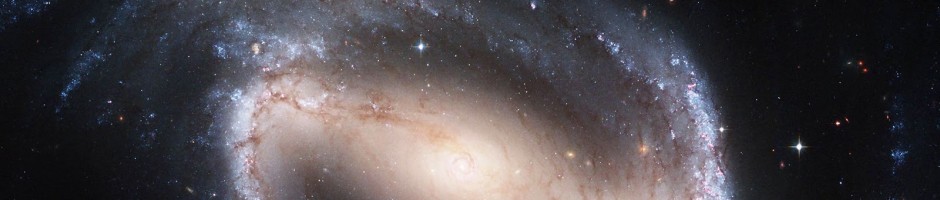
Recently, the European Southern Observatory released an image of a galaxy which they called as a twin for our own. On the face of it the galaxy (below) looks just like our own, it has a similar number of spiral arms, it has a central bulge and, if you look closely, even a small bar at the centre. It’s name is NGC 6744 and from July of this year, it became our Galaxy’s twin. There is a small problem with this galaxy however, or should I say, a large problem; this galaxy is actually twice the size of our own in mass and size and therefore is a bit of a stretch to suggest it as a copy. We are again stumbling in the dark to find more about where we live.

NGC 6744 - the previously proposed clone. Credit: ESO.
This is where the Galaxy Zoo project CAN help. It aims with the help of ALMOST 450,000 volunteers, to classify as many galaxies as possible from the Sloan Digital Sky Survey. By using this information, we can start to narrow down a list of galaxies to look at. By filtering out those which were seen to have features and were relatively face-on to the camera, we end up with a list of around 17,500 galaxies in total. Again by filtering out those galaxies with the same mass, number of spiral arms and having a bar like the Milky Way, we find that there are just 9 galaxies which fit this criteria. Of these nine galaxies, the one which looked the most like the artists impression was the one shown below. This galaxy, captured through the Sloan Digital Sky Survey (SDSS) camera is the most likely of the galaxies we have seen to be a clone of our own.
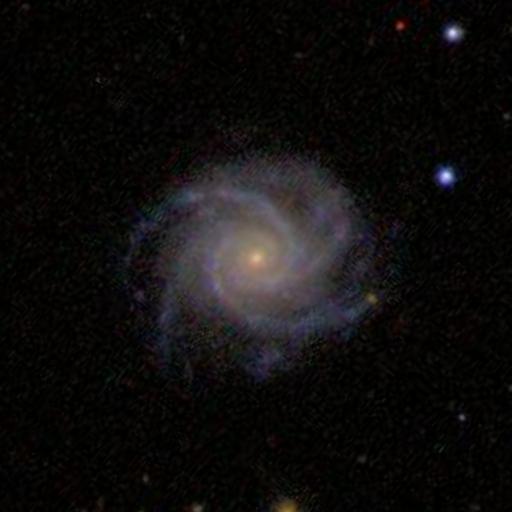
The new Milky Way clone candidate. Credit: SDSS.
The fact remains that this might, possibly, not be the best Milky Way ‘clone’ in the universe, there are countless galaxies yet to be photographed and there are thousands of galaxies which, due to their orientation, make it very difficult to see whether they are anything like ours. However, with rapid advances in technology, this dream of finding the shape of our galaxy is just around the corner.
Supernova hunters discover a rare beast
The work of the Galaxy Zoo : Supernova hunters recently paid off with the publication of a paper about a rather unusual supernova. Lead author, Kate Maguire – an astronomer at the University of Oxford working on supernovae and in particular exploding stars that can be used to measure the expansion of the Universe – tells us more :
The supernova named ‘PTF10ops’ was discovered by the supernova zoo using images from the Palomar Transient Factory Telescope in California and a report on this interesting SN has now been accepted for publication in the journal, Monthly Notices of the Royal Astronomical Society. Thanks to the very rapid discovery of this supernova by members of the supernova zoo, we were able to start taking observations very soon after explosion with many telescopes around the world such as the 4.2 m William Herschel Telescope on the Canary Island of La Palma, the 3 m Shane telescope at the Lick Observatory, California and at one of the two 10 m telescopes located at the Keck Observatory in Hawai’i.
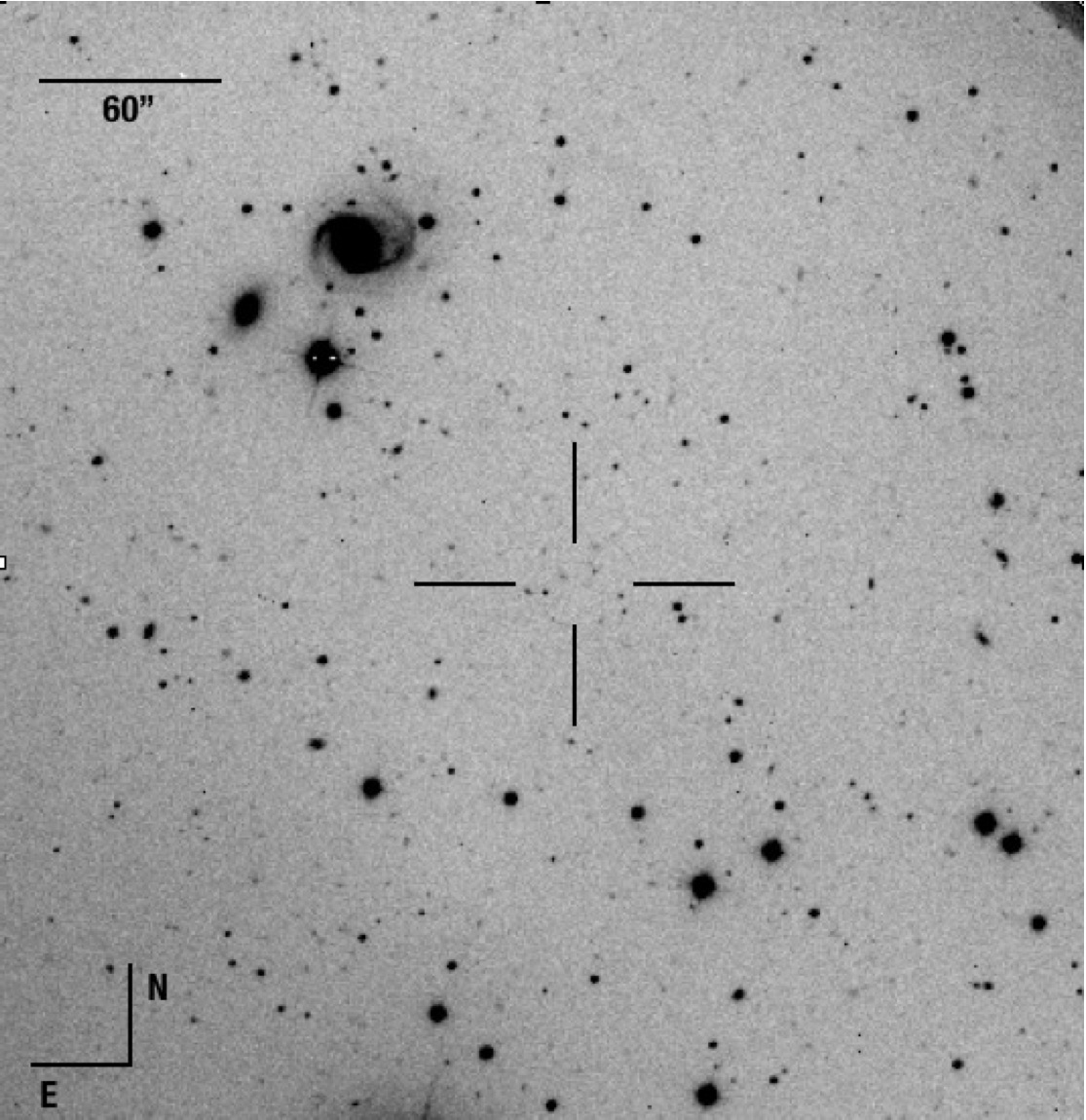
An image of the field of PTF10ops (located at the centre of the crosshairs) taken with the WHT+ACAM on La Palma, Canary Islands. The largest galaxy with spiral arms located in the upper left quadrant is the host galaxy of PTF10ops, located at a distance of 148 kpc from the supernova position. This is the largest separation of any SN Ia discovered to date.
PTF10ops turned out to be a very interesting supernova – a peculiar type Ia supernova. Type Ia supernovae are explosions that occur when a white dwarf (a small, dense star) collapses when it pulls matter from a companion star and grows to have a mass of more than 1.4 times that of the Sun. At this critical mass, a thermonuclear reaction is triggered, that destroys the star in a massive explosion that we call a type Ia supernova. Type Ia supernovae are very important because they are used as cosmological distance indicators and were used in the discovery that the expansion rate of the universe is accelerating.
PTF10ops had unusual observational properties that suggest that maybe a new type of supernova explosion has been discovered. It is located very far from its host galaxy, actually the farthest supernova from the centre of its host galaxy discovered to date. Its spectra also contained signs of rare elements such as Titanium and Chromium. In normal Type Ia supernovae, how long a supernova stays bright is directly related to its peak brightness, but PTF10ops did not follow this rule and stayed brighter for much longer than expected. It is still unclear what it was about the star that exploded that produced this unusual supernova, maybe it was very old star or maybe we are seeing some sort of new, unknown explosion.
In the future, we hope to take images of more objects like this using the Palomar Transient Factory and then with the invaluable help of the supernova zoo members, we can catch these supernovae very soon after explosion and start follow up observations immediately to get images and spectra to better understand these rare supernova explosions.
P.S. Here’s the piece of the paper crediting the discoverers – well done all!

Bars Work Featured by The Leverhulme Trust

I’m currently funded to work on research using Galaxy Zoo classifications through an Early Career Fellowship from The Leverhulme Trust. As part of this I was asked to write a report on the research I’ve done during the first year of my fellowship. This report now appears in the “Awards in Focus” section of their website: “Do Bars Kill Galaxies?” . It’s probably nothing new to most of you as I’ve blogged, podcasted and pencasted about this research already, but I thought you might like to see Galaxy Zoo research being showcased by The Leverhulme Trust.
The Leverhulme Trust is an organisation which supports “scholarships for research and education” across all subject areas. It was founded in the late 1920s at the bequest of Lord Leverhulme, a weathly Victorian businessman and with an annual budget of £50 million is one of the largest “all subject” supporters of research in the UK (History of The Leverhulme Trust). Early Career Fellowships are just one of the many ways in which the Trust supports research – with this fellowship being specifically designed for researchers “at a relatively early stage of their academic careers but with a proven record of research”.
Galaxy Zoo at the Durham Galaxy Evolution Conference
I think I won’t get in too much trouble if I say that in my opinion the event of summer 2011 for extragalactic astronomers was a massive international conference which took place in Durham, July 18th-22nd Galaxy Formation. You’ll be happy to know that Galaxy Zoo scientists were represented, with myself, Kevin, Ramin Skibba (who wrote one of the first Galaxy Zoo papers back in 2009), Vardha Bennert (who has done some HST followup for us, she’s profiled in the “She’s an Astronomer” series from 2009) and Boris Haussleur (see his blog posts about Hubble Zoo) all present.

400 Extragalactic Astronomers in Durham. That's me circled in orange, Ramin in pink and Boris in blue. Kevin and Vardha might be there somewhere but I've yet to spot them!
The moment of the conference for me was the first mention of Galaxy Zoo in the plenary talks – my work on the Galaxy Zoo 2 bars (see many blog posts!) was mentioned in a talk on the influence of internal evolution on galaxies (something we call “secular evolution” which bascially means the slow transformation of galaxies by material being moved around by the bars and/or spirals) which was given by Francoise Combes. I got so excited I took a picture of her slide, which you can also see in her talk pdf.

Francoise Combes talking about Galaxy Zoo results on bars
And here’s the slide so you can actually read it.

Francoise Combes's slide so you can actually read it
The red spirals also got a mention in a talk on gas in galaxies (by Luca Cortese – pdf unfortunately not uploaded at time of writing) where it was shown that at least half of them have very low NUV (near ultra-violet) emission for spiral galaxies. This is expected if as we think they are truly passive spirals with very little current star formation (which created NUV light).
Many of the slides for the talks, as well as the posters are available online (including mine, which for once wasn’t about my Galaxy Zoo work, but work with the new SDSS survey which is imaging 1.5 million galaxies at intermediate redshifts – unfortunately as fuzzy blobs, so no new objects for the Zoo from them!). There is also a plan to make video of the talks available. I’ll post an update about that when it happens.
Unfortunately I had to leave before Kevin and Vardha gave their talks on the Friday. Neither of them have posted their pdfs yet either. 😦
Boris and Ramin had posters – also like me on their non-Galaxy Zoo work (Boris: Measuring the physical properties of galaxy components in modern multi-wavelength surveys, Ramin: Are Brightest Halo Galaxies Central Galaxies?).
It was a great conference and I had a wonderful time in Durham.
Star formation rate vs. color in galaxy groups
Toady’s guest blog is from Andrew Wetzel, a postoc at Yale University. We asked Andrew to write this blog since he and his collaborators had used the public Galaxy Zoo 1 data in their own work (that is, they weren’t part of the team). Without any further ado, here’s Andrew’s experience with the Zoo data:
Recently, Jeremy Tinker, Charlie Conroy, and I posted a paper to the arXiv (click the link to access the paper) in which we sought to understand why galaxies located in groups and clusters have significantly lower star formation rates, and hence significantly redder colors, than galaxies in the field. Among the interesting things we found is that the likelihood of a galaxy to have its star formation quenched increases with group mass and increases towards the center of the group. Furthermore, galaxies are more likely to be quenched even if they are in groups as low in mass as 3 x 10^{11} Msol (for comparison, the `group’ comprised of the Milky Way and its satellites has a mass of about 10^{12} Msol). All together, these results place strong constraints on what quenches star formation in group galaxies. However, many of the above results disagree with what some other authors have found recently, and here is where Galaxy Zoo has been useful for us.

Because galaxies that are actively forming stars have a significant population of young, massive, blue stars, while galaxies that have very little star formation retain just long-lived, low-mass, red stars, astronomers often differentiate between star-forming and quenched galaxies based on their observed color. But using observed color can be dangerous, because if a galaxy contains a significant amount of gas and dust, it can appear red even if it is actively star-forming (analogous to how the sun appears redder on the horizon as the light passes through more of Earth’s atmosphere). To get a more robust measurement of a galaxy’s star formation, we used star formation rates derived from their spectra, because spectroscopic features are fairly immune to dust attenuation. But, we wanted to check how these spectroscopically-derived star formation rates compare with the color-based selection that many previous authors have used. What we found was striking: in lower mass galaxies, over 1/3 of those that appear red and dead actually have high star formation rates!
What is going on? Here is where Galaxy Zoo provided us with insight. We examined the Galaxy Zoo morphologies of these red-but-star-forming galaxies, and the result was telling: 70% of these galaxies are spirals (which have particularly high gas/dust content) and furthermore, 50% are edge-on-spirals (for which the dust attenuation is particularly strong). The image shows a good example of a galaxy which has a high star formation rate but appears red. You can even see the dust lane.
So, Galaxy Zoo helped to confirm our suspicion that many spiral galaxies that appear red are in fact actively forming stars, but their colors are reddened via dust (Karen Masters has done a lot of work in this direction as well). This gave us further confidence in our spectroscopic star formation rates and insight into why previous authors, using observed color, came to such different conclusions. Thanks to the Galaxy Zoo team and all the volunteers.
Voorwerpje paper submitted
Bill has written an excellent post about the Voorwerpje, or small Voorwerp, hunt over on the main Zooniverse blog. You should read it!
Off to Queen Mary
I worried I’d look big-headed writing this blogpost, but ZookeeperKevin asked me to do so separately from my AAS one to encourage anyone reading this who is thinking of applying for astronomy courses. This morning I got an idea for a way to start: the UKRC is asking you to nominate someone for inspiring women and/or girls into science. Well, I’ve got a personal nomination right here: Galaxy Zoo.
In April 2010 I helped organise the She is an Astronomer conference, which Hanny also attended. There were several talks full of statistics and stories, some historical, some modern; some about problems, some about initiatives . . . I gave a talk about the power of the internet in getting people into disciplines they wouldn’t have encountered otherwise – such as, in my case, citizen science and astronomy. My message was intended to be: there are more recruiting grounds for astronomers than straightforward academia; perhaps more women will join the profession through citizen science. And men, of course – since Waveney is now doing just that!
It’s long frustrated me that I’ve been unable to understand much of scientific journals or to do much with databases like CasJobs. I’d like to go further than popular science. And the AAS conference opened up my curiosity like a bursting dam. I’d loved astronomy since I was little, but since May I have just been dying to know more. And feeling that it is within my grasp.
Anyway, I applied for a masters in astrophysics as soon as I got home (a masters is a postgraduate course, not as major as a PhD, but I hope to go on to do a PhD in galaxies or astrochemistry). Last Sunday morning I received an e-mail back. Odd for a Sunday but I bet they were hunched over their desks on a Saturday night, groaning that they hadn’t got the selections done by Friday afternoon, fuelled on fourteen cups of corrosive coffee – or something like that.
Anyway – result: unconditional offer! It’s at Queen Mary University in north east London. These are the course modules – I can’t wait! I’ll be doing the course part-time as I’ll need a job and doubtless have a lot of maths to catch up on. I’ll hopefully be able to organise more zoo meet-ups from London too.
I hope that anyone else who’s been thinking they’d like to study astronomy formally will give it a try. If you think you haven’t time, or you’re not clever or well-informed enough – don’t rule it out. A lot of things that look scary turn out to be acronyms for simple concepts, for example. More to the point, ignore all the cultural depictions of academia as something set aside for inhuman people. Just give it a go.
Chandra time for IC 2497 and the Voorwerp!
The list of approved targets for Cycle 13 of the Chandra X-ray Observatory is out and on it is our friend IC 2497. We were awarded 114 ksec (almost 32 hours) of time to point Chandra at IC 2497 and peer into its center. What do we want to learn? First, we want to see if the wimpy signal from the central black hole comes more into focus. Chandra has much better spatial resolution than XMM so we will be able to resolve the very center.
We also want to see if there is any impact of the ex-quasar on the surrounding hot gas in the galaxy center. Did the quasar blow bubbles into the gas? Did it start doing so when it “switched state”?
Unfortunately we won’t know for quite a while as Cycle 13 only starts later this year and will go on into 2012. So, stay tuned!
Insane Happiness in Massachusetts
Today’s post is by Alice Sheppard:
Last winter I got a phone call from ZookeeperChris who asked me if I’d be interested in attending the next American Astronomical Society conference (spelled AAS, and pronounced “double-A-S”). The very idea seemed too good to be true – so too good to be true that I shoved it to the back of my mind in case it was all a dream.
But it wasn’t, and bit by bit I booked flights and sorted out an ESTA. This May’s conference was to be in Boston, the city south of the river from Harvard University, near which the writer Lois Lowry’s teenage heroine Anastasia lives. (“I have just returned from Boston. It is the only thing to do if you find yourself there,” the comedian Fred Allen is alleged to have said.)
That was especially neat for me, because there was some research I wanted to do in Harvard’s archives. (If it comes to anything, I will tell you all about it, but I’m not ready to make it public yet.) I started picking around for youth hostels at which to spend some extra time in Boston. Even in March and April, all the cheapest places were booked, but I set to planning my first visit to America with mounting excitement . . .
The journey across the UK took as long as that across the Atlantic. I had never been out of western Europe before. Flying over Nova Scotia was especially fascinating – great ripply expanses of dark rock and snow. At the airport I was greeted with two incredibly long queues and the ghastliest “welcome” video I have ever seen. As soon as I got through security (where they confiscated my sandwiches!) into Boston I knew I disagreed with Fred Allen entirely. The air was silky with a pleasant cool humidity, the streets were bright red and green with brick houses and healthy trees. Their version of the Tube was cheap, very frequent, and incredibly cute – random little walkways and steps up to the train from a rail-level platform everywhere. I clambered out of Copley Place station into a huge square surrounded by fast roads with long cars and grand-looking buildings, some of which had red curtains in the windows like palaces. The hotel ZookeeperJordan had booked me into (thank you!) was also the most glamorous place I’d ever seen. My own lecturers at university had spent field trips at cheap youth hostels with the rest of us, so all the glitz came as a bit of a shock, especially with the bottles of water being eight dollars each!
After 22 hours of travelling I failed to stay awake for the reception on Sunday night! I met Chris at 8 on the third floor of another glitzy hotel where the conference was taking place. There was a central room full of exciting – if difficult – posters from astronomers all over America, at the back of which stood a trolley full of delicious little pastries and two tables of tea and coffee each morning. Around this room were two floors full of all the different talks. There were usually at least four going at once, so I had to make a great many sorrowful sacrifices – I wanted to hear absolutely everything.
I was effectively there both as press and as a zooite, meaning I attended press conferences or the more technical lectures as I wanted. The press room was on the seventh floor; the lifts went so fast they made me feel sick, as if I was in a ship on a storm. (I don’t think all that travelling entirely agreed with me!) There was more tea and coffee up there, a nice big table to punch our laptops at, a pigeonhole for each of us full of press releases and dinner announcements – I signed up to a dinner on Tuesday evening. We spent a good hour or so trying to hear each other in a very noisy bus in Boston and Cambridge traffic, had a Chinese meal, and then wandered along to Harvard College Observatory.
The room we sat in was next to the largest telescope. It had railings at the top with planetary symbols welded into them. It had been built for public nights on the order of Harlow Shapley in about 1930 – and these public nights had continued ever since. This evening we began with a slideshow of ridiculous Boston signs, mostly along the lines of “Welcome to Boston – now get the hell out of my way” and “HA HA YOU’RE GOING TO BE LATE FOR WORK” – after all that time on the bus you can imagine us press folks screamed with laughter! We then went on to how Harvard College Observatory began, with its little army of “female computers” and how Henrietta Leavitt discovered Cepheid variables. That talk was followed by one from Richard Panek about his new book, “The 4% Universe”, which looks very good. Apparently the furthest supernovae were fainter than they should have been and this was how the acceleration of the expansion of the Universe was discovered. I thought this meant that things expanded slowly in the past and quickly now, and asked about this paradox, but the amount of offended-seeming yelling in my direction both that night and the next day from several well-meaning press people indicated that either I missed something fundamental about the idea, or they did about my question.
I went to a few press conferences, some of which were good, but the talks I enjoyed the most were the most technical presentations by the academics! I stuck mostly to these, my notebook’s scribble content growing wildly. (In between talks and amazing meals, I tried to keep the Zoo updated, but Stellar190 did a better job than me just through the tweets!) The Galaxy Zoo talks were about bars, red spirals, galaxies’ environments, active galactic nuclei and what feeds them, and more . . . I also heard about stellar weather and how it affects planets (as well as our ability to find them), about redshift-space and Margaret Geller and John Huchra’s work mapping the Universe, about polycyclic aromatic hydrocarbons – honeycomb-shaped sooty molecules – in Titan and in nebulae; about thrilling surveys of galaxies and of supernovae and of all other things; about planet-finding techniques and attempts to guess stellar age (which is remarkably difficult because stars look pretty much the same except when very young or very old); about what today’s great telescopes are up to; about the search for planets beyond Pluto which some astronomers assured me was pseudoscience while the speakers looked very sure of themselves; lots about quasars and active galactic nuclei; lots of strange techniques with unfamiliar acronyms – just the kind of thing to terrify me – until people told me what they meant and they suddenly became logical and something I could master.
There was a lot I didn’t understand. But three things were very reassuring: firstly, that there was a lot I did understand; secondly, when all the astronomers assured me they didn’t understand everything either; thirdly, when, after being a pest and asking several questions in it seemed every single talk, quite a few people asked me what I was studying and when I told them I’m just an amateur, urged me to do a PhD and go into academia because I clearly had a good grasp of the subject.
And this is someone who was ordered to drop maths and physics at age 16, and who struggled through a science degree and thought herself a failure as a result. This is someone who, five years ago, hadn’t a clue that astronomy was a subject anyone other than professionals could contribute to – much less that she herself could be part of.
And now I’ve spent four years moderating our beloved forum, learning so much from zooites and zookeepers – and this week really was the greatest payment I could possibly have had for my work. And I sense that it’s only the beginning.
On Wednesday, the third day and last full day, there is invariably an AAS party. I am not very good at parties and had to be forcibly dragged along. When the people who run AAS were also caught dancing and falling over with a flourish, intermingled with comments from other astronomers that they’re no good at parties either and many of them only dance twice a year, I certainly relaxed! I made some more friends – and I’d already made a few at the conference – and got back to the hotel some time into the small hours. I regrettably failed to manage the lecture first thing next morning, which was a pity because it was on the smallest, faintest galaxies and besides apparently being very good would have been right up Waveney’s street. I wrote a while ago that irregular galaxies, which Waveney is studying, might be the plankton and bacteria of the Universe – not the great tigers and elephants that are spirals and ellipticals, but perhaps just as important to understand – who knows? Maybe we Zooites will.
At lunch time on Thursday it was time for the astronomers all to jet off to their various locations – some with new toy mooses, because the next summer meeting will be in Alaska (it’s nice to know astronomers don’t have to act mature) – and me to stumble my heavy bags along to the youth hostel where I would spend the next nine days. I was so sorry the conference was over; it was like being in a brilliant shower of beautiful facts and news. It was lovely to see all the zookeepers I’d met before – Chris, Kevin, Carie, Lucy, Pamela – and to meet Karen, Ivy, Brooke, Alfredo (I sadly missed meeting Meg) – and my apologies to anyone I’ve forgotten there!
I had a great week exploring Boston and doing research. The temperature skyrocketed and suddenly the humidity became a real burden – now I know why all the East Coasters complain about it! A terrific storm broke on Wednesday night; for three quarters of an hour the clouds were almost constantly lit by sheet lightning, something I’d never seen. I turned off the light in my youth hostel room and sat at the window spellbound. It became distinctly less enjoyable when I looked at Twitter on my phone and discovered that there were the first tornadoes taking place in Massachusetts for decades and people had actually been killed.
Very early on the morning of Saturday 4th June, I was back at the airport on my way to Chicago to visit Chris at the Adler Planetarium, where he’s been spending his sabbatical developing (among other things) the Citizen Science Alliance – onto whose advisory board Jules and I are thrilled to be invited! Chicago was even hotter than Boston. You know those hot winds you get in the London Underground when a train is coming? We got those in Chicago outside – but hotter and much stronger! I felt myself wilting most of the time, and ached to dive into the beautifully clear blue water. My hotel there was toblerone-shaped and I was on the 27th floor – the view was spectacular! Chicago has a double layer of roads and railways, so you often have to go up stairs to get to the street you’re after – I think Chris said there’d been plans to flood it, among other eyebrow-raising engineering feats. I failed to spot any Chicago gangsters too. In fact my welcome to Chicago, apart from the crippling heat, was the best possible. The airport walls are lined with astronomy pictures. Just as we are reaching out to the stars, we are bringing the stars to the public, too, as is only right – but so delightful.
Adler Planetarium is beautiful. I can see why Chris loves working there. There is a wall display of the whole area of the Milky Way Project, archways like Moon rock, beeping flashing machines representing cosmic rays as they come through Earth’s atmosphere, a screen which shows you in infra-red light, and a small lecture theatre full of huge screens and computers – including 3D – in which to give talks. I found myself in here on my last day (about an hour before I was due to head off to the airport) giving a Galaxy Zoo talk to all the visitors that wandered in! That was a bigger challenge than most talks I give, because people were continually wandering in and out, and some stayed much longer than others. I also met a lot of scary “educators” or something, who Chris was telling about various Zooniverse projects, and heard more plans for the Zooniverse.
If you’re anywhere near Illinois, I strongly recommend the Adler Planetarium. On our first walk there, I joked to Chris about how if I ever get married I want it to be in a planetarium under a magnificent galaxy-filled sky, and he pointed ahead to show me that a wedding actually was taking place there!
I loved America and it was very sad to be on my way home (especially as one of the many friends I made had told me to look out for the aurora on the right – but not only did it not appear, we went so far over the North Pole that we stayed in daylight!). After setting off in late afternoon on Tuesday, I got home on Wednesday evening, and the very next day was bumbling around in my little office like an extremely clumsy zombie.
Thank you so very, very much to Chris and Jordan and everyone on the Galaxy Zoo team who arranged for me to come – it was the best present anyone could have given me – and for showing me round (including to excellent restaurants) and making sure I had such a wonderful time there. Thank you too to Rick Feinberg of AAS Press, who was invariably kind and extremely quick to help and explain things I needed to know. I hope more Zooites will be able to attend AAS conferences one day.
The August edition of the Astronomy Now magazine will contain six brief snippets on the conference from me – they’re just a few pretty starclusters out of a very big galaxy of delights, which will give you an idea of just what a wonderful conference it was!
The Peas – Now detected in Radio!
Last September I blogged about a proposal that had just been accepted at the Giant Metrewave Radio Telescope (GMRT) to follow up on the Peas with radio observations. Now the observations are in, and we have successfully detected the Peas at radio wavelengths!
The Peas, which have very high star formation rates, are expected to host a large number of supernova, which are created when the most massive stars die. These supernova create shocks that accelerate electrons in galaxy to relativistic energies. These relativistic electrons emit a type of emission, synchrotron radiation, that is visible in radio wavelengths. Therefore, the radio emission can tell us about the stars that live (or lived) in the galaxy.
Three of the Peas from our paper (Cardamone et al. 2009), were followed up with deep observations using the GMRT. It turns out that the Peas have comparable, but systematically lower flux when compared to local starbursts.
Using the observed radio emission, the magnetic field of the galaxy can be derived. These new observations suggest a magnetic field in the peas similar to that of the Milky Way. Because galaxies are thought to build up their magnetic fields over time, it is surprising to see such a large magnetic field in such a young galaxy. (Estimates of the age of the stars in the Peas are roughly 1/100th that of the age of the stars in the Milky Way).
One of the reasons that the Peas are so fascinating is their similarities to vigorously star forming galaxies found in the early universe (known as Lyman Break Galaxies). These Lyman Break Galaxies are so far away, they haven’t yet been directly detected in radio emission. However, estimates of their radio flux (from a technique called ‘stacking’) also suggest consistent radio fluxes with those observed for the Peas.
These observations suggest that galaxies like the Peas (and the Lyman Break Galaxies), may start out early in their life with very large magnetic fields. These observations challenge the assumption that galaxies build up their magnetic fields slowly over time and it is another piece of the puzzel in understanding of how galaxies are formed.
The article will be coming soon to astro-ph and I will post it here to let you all know.
 Galaxy Zoo