The Peas – Now detected in Radio!
Last September I blogged about a proposal that had just been accepted at the Giant Metrewave Radio Telescope (GMRT) to follow up on the Peas with radio observations. Now the observations are in, and we have successfully detected the Peas at radio wavelengths!
The Peas, which have very high star formation rates, are expected to host a large number of supernova, which are created when the most massive stars die. These supernova create shocks that accelerate electrons in galaxy to relativistic energies. These relativistic electrons emit a type of emission, synchrotron radiation, that is visible in radio wavelengths. Therefore, the radio emission can tell us about the stars that live (or lived) in the galaxy.
Three of the Peas from our paper (Cardamone et al. 2009), were followed up with deep observations using the GMRT. It turns out that the Peas have comparable, but systematically lower flux when compared to local starbursts.
Using the observed radio emission, the magnetic field of the galaxy can be derived. These new observations suggest a magnetic field in the peas similar to that of the Milky Way. Because galaxies are thought to build up their magnetic fields over time, it is surprising to see such a large magnetic field in such a young galaxy. (Estimates of the age of the stars in the Peas are roughly 1/100th that of the age of the stars in the Milky Way).
One of the reasons that the Peas are so fascinating is their similarities to vigorously star forming galaxies found in the early universe (known as Lyman Break Galaxies). These Lyman Break Galaxies are so far away, they haven’t yet been directly detected in radio emission. However, estimates of their radio flux (from a technique called ‘stacking’) also suggest consistent radio fluxes with those observed for the Peas.
These observations suggest that galaxies like the Peas (and the Lyman Break Galaxies), may start out early in their life with very large magnetic fields. These observations challenge the assumption that galaxies build up their magnetic fields slowly over time and it is another piece of the puzzel in understanding of how galaxies are formed.
The article will be coming soon to astro-ph and I will post it here to let you all know.
Great Review of Galaxy Zoo in this week's Science
There’s a great review of Galaxy Zoo and its achievements in this week’s Science Magazine. The link to the article is here and the summary reads:
Galaxy Zoo Volunteers Share Pain and Glory of Research
The Sloan Digital Sky Survey (SDSS) has compiled a list of more than 1 million galaxies. To glean information about galaxy evolution, astronomers need to know what type of galaxy each one is: spiral, barred spiral, elliptical, or something else. The only reliable way to classify galaxies is to look at each one, but all the world’s astronomers working together couldn’t muster enough eyeballs for the task. A volunteer online effort called Galaxy Zoo, launched in 2007, has classified the entire catalog years ahead of schedule, bringing real statistical rigor to a field used to samples too small to support firm conclusions. The Galaxy Zoo team went on to ask more-complicated classification questions that led to studies they hadn’t thought possible. And in a discussion forum on the Galaxy Zoo Web site, volunteers have pointed to anomalies that on closer inspection have turned out to be genuinely new astronomical objects.
Unfortunately accessing the full article requires a subscription.
AAS January Voorwerp even video available
As Bill has spotted on the forum, the video of the press conference at the January AAS meeting where we presented the Hubble Space Telescope of Hanny’s Voorwerp is now available from the AAS. We shared the event with two other cool results, so you can hear about them as well. The video (warning, large file!) is available here: video of the January press event
Hubble Zoo: Summer Research Starts!
Today’s guest post is from Anna Han:
Hi everyone!
My name is Anna Han, and I’m a sophomore undergrad at Yale studying black holes this summer. I’m currently working with images of galaxies observed by Hubble that you as members helped classify on Galaxy Zoo. So excited to be part of the community, and looking forward to sharing ideas with you all!
Galaxy Zoo Voorwerpjes – now with Hubble data!
Some of us continue to exult over the approval of our Hubble proposal to look at some of the “voorwerpjes” found through the GZ forum. These are clouds of gas ionized by an active galactic nucleus, similar to Hanny’s Voorwerp except for being smaller and dimmer (hence the Dutch diminutive form of the word). This has been a very fruitful project, going back to the first few possibilities posted for discussion in different contexts by Zooites. From these, I realized that such clouds could be spotted based on their unusual colors from the SDSS images, and with contributions from Waveney and laihro setting up the web interface and one of our source lists, the hunt was on! The results staggered us – within 6 weeks each of the 18,000 candidate galaxies had been examined by at least 10 Zooites. Seven of you looked at them all! Then we could examine the highest-scoring galaxies, in three sessions from Kitt Peak and Lick observatories, measuring spectra to see which ones really show gas ionized by an active nucleus. Once again, Drew, alias sdrew123, has done a lot of the data reduction and Python action in this part of the project. Our sample of giant AGN clouds now includes 19, each showing gas more than 10 kiloparsecs (32,000 light-years) from the galaxy core, so we get information on its history over at least that many years.
Why do we want to find these? From what we’ve learned about Hanny’s Voorwerp, we have the possibility of tracing the history of active galactic nuclei – how fast they can fade, how long they stay on at once, and maybe how they influence their surroundings. It’s hard to generalize from a single instance (though astronomers are notorious for trying), so we want enough of a sample for statistically defensible conclusions.
Which of our objects should we ask to look at, balancing the demand for Hubble time against the fact that very often more data are better? From our current point of view, investigating whether active nuclei shut down very often within time spans roughly 100,000 years, we want to concentrate on the ones that show evidence for a deficit of energy from the core compared to that needed to light up the gas we see. This gives us a set of 7 (plus NGC 5252, which has been known for many years and already has archival Hubble images). They are:
SDSS J143029.88+133912.0, the Teacup (Kevin started calling it that in honor of the handle-like loop of gas extending more than 15,000 light-years to the side). This is the most distant galaxy in the sample, at z=0.085.
UGC 7342 (also known in some Zoo threads as the Crab galaxy), with its enormous filaments of gas stretching more than 100,000 light-years on each side (fully half as large as Hanny’s Voorwerp, and at about the same distance).
Another new SDSS AGN, and new Zoo find for its gas clouds, is
SDSS J220141.64+115124.4 (which I tend to abbreviate to SDSS 2201+11 for my own sanity).
SDSS J151004.01+074037.1, with symmetric clouds around a type 2 Seyfert nucleus, is another SDSS//GZ discovery.
NGC 5972 is pretty close to us at z=0.0297. This galaxy attracted some brief notice in a 1995 paper by Mira Veron-Cetty and Phillippe Veron, who established that what look like spiral arms are purely ionized gas features, and noted that this AGN is surrounded by a double radio source.
UGC 11185 is part of a very disturbed interacting pair, with a bright spray of ionized gas seen to the east of the AGN. Note to self: we need to take care in where we center the Hubble images to avoid problems with scattered light from the annoyingly bright star.
Mkn 1498, as the name suggests, has a long-known AGN, but its ionized gas shows such strong radiation
reaching it that this one may have faded even to its observed brightness.
We based our observation request on what we learned from working on the Hanny’s Voorwerp data. The most valuable results for these will probably come from images in Hα and [O III] for these, the clouds sometimes extend into the galaxy, so we need red and green starlight images to distinguish stars and gas. Our filter selection depends on the galaxy redshift – the brand-new Wide-Field Camera 3 (WFC) has cleaner performance but only a limited set of narrow filters, while the decade-old Advanced Camera for Surveys (ACS) has ramp filters which can tune to any desired optical wavelength, but its CCD detectors are really showing the ill effects of damage from years in the space environment. So we use WFC where we can and ACS otherwise, emboldened by the release of Jay Anderson’s software for partially undoing the effects of that radiation damage. We end up using 3 orbits per galaxy – one for each emission line and the other for broad-band filters to map the structure and color of each galaxy’s starlight.
We know some of the things to look for in the data – regions of star formation, gas outflow, maybe shadowing effects from material near the galaxy nuclei. But the best is often in what we don’t know to look for beforehand…
Next up – detailed observation planning, at which point we get our first hints as to when each galaxy could be observed.
AAS 218: Black Hole Growth and Host Galaxy Morphology
Following Karen’s AAS 218 roundup, here is my talk from the Galaxy Zoo special session:

You can get the whole talk as a PDF or as a Quicktime movie.
Galaxy Zoo Lunch at the AAS
Following our session on “Cosmic Evolution from Galaxy Zoo“, a number of the Galaxy Zoo group went to lunch at a local Boston seafood place. Ivy (Wong) took a few photos, which I thought you might like to see.

View down the table at lunch.

From right to left, Lucy, Kevin, Pamela, Carie and Chris.

From right to left, Alice, Brooke and me (busy talking).
By the way, the AAS abstracts are now up on the ADS, so I have put the links up on the previous post.
The Connection between AGN Activity and Bars in Late Type Galaxies AAS
At the center of every massive galaxy lies a supermassive black hole. In a small percentage of galaxies, so called Active Galactic Nuclei or AGN, these black holes are currently accreting gas and dust and shinning luminously as that material looses energy. It is thought that some galaxies have this AGN activity at their center and others do not because of the presence or absence of gas near-enough to the black hole to be accreted. But many questions remain, including how the gas which can live any where in the galaxy, gets down to the very central regions.
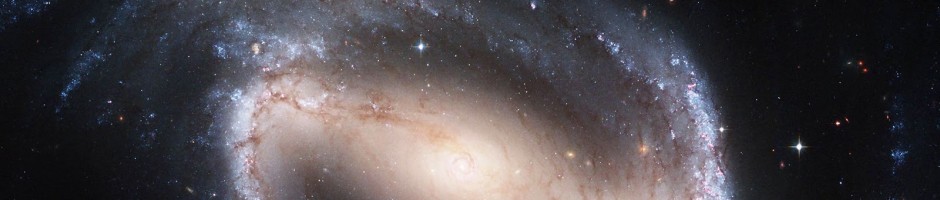
One solution to this problem could lie in the bar-like structures seen in many galaxies like this one from the Hubble Space Telescope:

Source: Hubblesite.org
These bar features are easy to form in a big disk galaxy and are likely transitory, first coming together and then dissipating. Most importantly, models suggest that these bars can drive gas inward towards the central regions of galaxies.
Whether or not these galactic-scale structures, which can transport gas towards the central regions of a galaxy, could be related to episode of AGN activity has been debated for decades. One of the simplest ways to approach this issue is to observer whether or not a bar feature in a galaxy is observed to correlate with the presence of accretion at the very center of the galaxy. In other words, if galaxies containing bars are more likely to host AGN, than we can hypothesize that the bar may be responsible for feeding gas to that AGN.
Because the scale of the central supermassive black hole is many orders of magnitude smaller than the regions into which the bar can transport gas, the connection is not as straightforward as the simple story seems to suggestion.
Before Galaxy Zoo, investigations looking into the connection between the presence of an AGN and that of a bar in galaxies suffered from being too small or looking at galaxies with only one particular color. Now With Galaxy Zoo we can search 10,000 galaxies and look at each for the presence of a bar, and use the spectroscopic data from SDSS to identify any AGN activity. We look at the votes from the viewers in galaxy zoo and assign a probability that a bar exists in a single galaxy by comparing the number of people who indicated a presence of a bar to the total number of people who viewed the galaxy. As the image below shows, we can accurately identify barred galaxies by selecting those where at least 50% of the classifiers identified a bar in the galaxy.

We found that both the presence of an AGN and the presence of a bar are tightly correlated with the color of a galaxy and its size. This explains why so many previous samples might have found contradictory results, depending on which types of galaxies in their sample contained AGN activity and which contained bars. However, because the sample of galaxies in Galaxy Zoo is so large, we can look at samples of galaxies with similar sizes and colors. And when we control for the effects of size and color, there is no longer a large correlation between the presence of a bar and central AGN activity.
This means that although the bar is responsible for driving gas inward in the galaxy, it doesn’t get it close-enough to the center to incite black hole accretion (or AGN activity). This result can have far reaching implications for models of galaxy evolution, which need to explain how galaxies (and their central black holes) grow. Unfortunately it rules out one popular idea: bars are not a key source of inciting black hole growth in galaxies.
Post starburst galaxies at the AAS.
At our AAS session, Ivy Wong (formerly of Yale, now back in her native Australia) talked about her work on post starburst galaxies. Post starburst galaxies are extremely rare, and in her paper (which is in the referee process at Monthly Notices), Ivy compares a sample of about 80 local post starburst galaxies to the parent sample they were drawn from which is made up of almost 50,000 of the galaxies you classifed in Galaxy Zoo 1.
The conclusion – post starburst galaxies are dominated by objects who have intermediate morphology (often half of you thought they were disks and half thought they were ellipticals – telling us that they are just hard to classify!). They are found in the low mass part of the “green valley” (ie. they are redder than most blue spirals, but bluer than most red ellipticals) and Ivy suggests this shows they are probably on the way to turning into the low mass end of the red sequence.
Ivy has provided the slides of her talk: Wong_AAS218talk.pdf.
Spheroidal Post Merger Systems at the AAS
I think Chris said it best – any session which is ended by a guy in a bowtie went well. And for our AAS Galaxy Zoo session, that guy in a bowtie was Alfredo Carpineti from UCL, who talked about his work on the properties of spheroidal post-merger systems selected with the help of the Galaxy Zoo merger classifications, and using a control sample of non-merging spheroidals (or ellipticals) also selected from Galaxy Zoo.
Alfredo provided me with the below description, and his slides are available to download at Carpineti_AAS218talk.pdf.
In this talk we discuss the properties subset of galaxies from the GZ mergers catalogue that are spheroidal ‘post-mergers’, where a single remnant is in the final stages of relaxation after the collision and shows evidence for a dominant bulge, making them plausible progenitors of early-type galaxies.
 Galaxy Zoo