She's an Astronomer: Meg Urry
Prof. Meg Urry is a professor of Physics and Chair of the Physics Department at Yale University. Her research concerns supermassive black holes: how and when they grew, how they inject power to their surroundings, and how they interact with their host galaxies.
Meg was born in the Midwest region of the U.S. and moved to the Boston area as a teenager. After high school she went to college nearby, at Tufts University, where she double majored in mathematics and physics.
After Tufts, Meg went to graduate school in Physics at the Johns Hopkins University in Baltimore, where she got her PhD for research on blazars at NASA’s Goddard Space Flight Center near Washington. Her JHU advisor was Art Davidsen, who during this time proposed the Space Telescope Science Institute (STScI) as the observatory to run the Hubble Space Telescope (HST) for NASA. While at Goddard she met her future husband, Andy Szymkowiak, also a graduate student in Physics. (Interesting fact: 2/3 of married women in physics are married to men in physics or closely related fields.)
Meg then took a postdoctoral position back in Boston, at the Massachusetts Institute of Technology (MIT), in Claude Canizares’s group.
After MIT, Meg moved back to Baltimore for a second postdoctoral position, at STScI, now in a new building, with 200 employees. (When she left JHU 3 years earlier, STScI had only a handful of employees housed in the JHU Physics building.) She also married Andy Szymkowiak, whom she met at Goddard. Three years after returning to STScI, she became an Assistant Astronomer on the tenure track there, rising through the ranks to tenure and then full Astronomer. She had her two daughters, Amelia and Sophia, while an Assistant Astronomer, after which (too late to benefit her own family) she agitated for better parental leave policies, onsite daycare, and a lactation room. She was the prime organizer, with Laura Danly, of the first Women in Astronomy meeting, held at STScI in 1992, which gave rise to the Baltimore Charter. For her day job, she managed the group of research assistants who helped staff and visiting scientists use Hubble and later ran the Science Program Selection Office, which determines what observations HST will do. Meg really enjoyed the proposal solicitation and review because it involved hundreds of scientists from around the world, engaged for a few intense weeks in reviewing and ranking exciting new ideas for Hubble science investigations.
But Meg was really born to teach. She loved being a Teaching Assistant in graduate school and a Recitation Instructors at MIT. She even took a 6-week detour from graduate school to teach physics to Air Force personnel at Ramstein Air Force base in Germany. Her students were talented non-commissioned officers who needed the Physics plus lab credit to qualify for Officer Candidate School, and she loved teaching them physics: lecture every morning, labs every afternoon, and help sessions every evening. Physics, physics, physics – and all of it fun.
In 2001, Meg moved to Yale University, roughly midway between Boston and Baltimore, thus ending her oscillations along the East Coast. There she directed the newly created Yale Center for Astronomy and Astrophysics, establishing a prize postdoctoral fellowship program, co-leading a Key Project in the Yale-Chile collaboration, and getting Yale involved in the Keck telescope consortium. She taught concept-based Introductory Physics, introducing “clickers” and peer-to-peer learning, and she created a new astrophysics course to introduce science majors to active frontiers in the field, namely, exoplanets, black holes, and the accelerating Universe. She developed a lively research group, with graduate students Jonghak Woo, Ezequiel Treister, Jeff van Duyne, Brooke Simmons, Shanil Virani, and Carie Cardamone (a blogger on the Galaxy Zoo forum); postdoctoral associates Eleni Chatzichristou, Yasunobu Uchiyama, Kevin Schawinski and Erin Bonning; and numerous wonderful undergraduates. In 2007, Meg was appointed Chair of the Physics Department, and was appointed to a second term this year. Her daughter Amelia is now a freshman at Yale and her daughter Sophia is a junior at Hopkins high school in New Haven.
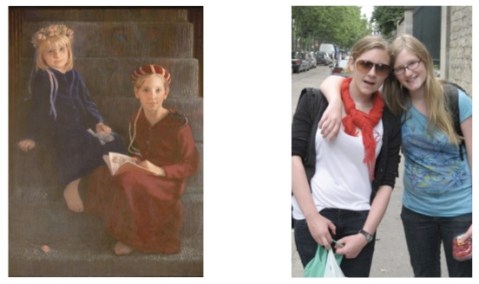
The most wonderful girls in the world (left portrait by Jada Rowland, 2001; right photo from vacation in Paris, 2008)
- How did you first hear about Galaxy Zoo?
In 2008 I hired a new postdoc, Kevin Schawinski, who co-founded Galaxy Zoo with Chris Lintott. When Kevin told me about the concept and what had already been accomplished, I was deeply impressed. It is a brilliant idea and the results are mind-boggling. Galaxy Zoo has greatly improved the quality of galaxy classification and has made possible investigations that could never have been done previously.
- What has been your main involvement in the Galaxy Zoo project?
In the past two years my group has used Galaxy Zoo results in several recent studies, led by Kevin Schawinski (now an Einstein Fellow in my group) and Carie Cardamone (a graduate student finishing her thesis with me). We have published on Green Peas (Cardamone et al. 2009), the phasing of black hole growth and star formation in the host galaxy (Schawinski et al. 2009), and the dependence of black hole growth on host galaxy morphology (Schawinski et al. 2010a). None of these results would have been possible without Galaxy Zoo. My favorite (because I still don’t understand the results) is the paper led by Kevin on the different modes of black hole growth in elliptical and spiral galaxies (Schawinski et al. 2010a). When Kevin suggested separating active galaxies (galaxies whose central supermassive black hole is actively accreting and thus producing lots of non-stellar light) by morphology, I frankly didn’t think the investigation would turn up anything interesting. Boy, was I wrong! We found that patterns of activity differ markedly in ellipticals and spirals, with high-mass black holes growing the latter and mostly low-mass black holes growing in the former. The trends in ellipticals may make sense if mergers are important in triggering AGN activity (see another paper from our group, Schawinski et al. 2010b, that uses Galaxy Zoo classifications of mergers ) but the results for spirals still have me puzzled. It’s a great, fun challenge to understand what’s going on.
- How/when did you first get interested in Astronomy?
I came late to astronomy compared to many of my colleagues. As a high school student, I liked every field – English (19th and 20th century British and American writers especially, History (I remember writing several papers on the Civil War just for fun), Math (*loved* calculus! Why don’t they teach it earlier?), languages (I’ve studied Spanish, French, German and Italian), Chemistry (thanks to the marvelous Miss Helen Crawley) – well, you get the picture: I was a thoroughly undecided undergraduate. Then I took Physics as a freshman at Tufts and for the first time, felt both the challenge and reward of understanding some difficult material. The summer after my junior year at Tufts, I was lucky enough to get a research internship with Richard Porcas at the National Radio Astronomy Observatory (NRAO) in Charlottesville, Virginia. (My roommate for the summer was Melissa McGrath, then an undergraduate at Mount Holyoke and later a colleague and planetary astronomy at STScI. Melissa now heads the Science Division at NASA’s Marshall Space Flight Center.) Porcas taught me some astronomy (he was probably a bit horrified to realize I knew very little), especially radio astronomy, and he also introduced me to Monty Python. (That summer, the Queen visited the U.S. and passed through Charlottesville. Porcas, a Brit, made sure to catch the procession.)
One of my main jobs was to use the Palomar Sky Survey prints to find optical counterparts to radio sources from the Jodrell Bank high declination survey. I kept a notebook carefully describing the fields around each radio source. (Since the spatial resolution of the Jodrell Bank radio telescope was not as good as that on the PSS prints, there were sometimes more than one candidate counterpart, often offset from the nominal position.) Two memorable things happened as a result of that work: I saw the first gravitational lens, 0957+561; a reproduction of my neat handwriting noting “two blue stellar objects of equal magnitude about 5 arcseconds from the radio source” appears in a paper by Dennis Walsh in 1979, which recounted its discovery. Of course, I had no idea I was looking at a gravitational lens – I didn’t even know what they were at that point. But it was nice nonetheless to be a part of history. The second funny thing was that Porcas realized, halfway through the summer, that he could get an unbiased estimate of the false detection rate of optical counterparts if he fed me some random, meaningless positions. Sure enough, I started finding more and more supposed radio sources with no optical counterparts. (In reality, these were just blank-sky positions.) I can’t remember if I noticed the dramatic change in identification rate or if Richard finally confessed his secret scheme – at the time, I was a bit chagrined to be duped so easily, but now I see it as an excellent research protocol.
In any case, my summer at NRAO was what got me into astronomy. It was fun, the people were friendly (weekly volleyball games were a favorite, as was watching the Olympics with my new astronomer friends, and it was amazing to realize people earned a living doing something so interesting. After that experience, I was going to do astronomy and astrophysics if at all possible.
- What (if any) do you think are the main barriers to women’s involvement in Astronomy or Physics or science generally?
It took me quite a while to accept that the playing field is not yet level for women in science. As an undergraduate and graduate student in an era when discrimination was supposedly over, women’s liberation was an established movement, and laws had been passed to chip away at discriminatory practices, I frankly didn’t expect any problems and I didn’t notice any. True, I was usually the only woman in my physics classes but at some level, I reveled in the distinction. (Even as a kid I had been motivated by the idea of being the “first woman,” as in first woman astronaut or first woman president. The first of those took place long after it should have, and we’re still waiting for the second.) But at first I didn’t detect any discrimination and I didn’t particularly feel the need to network with other women in science. When I see young women today with those attitudes, I find myself hoping that in their case, it will be true, by the time they are my age, that they have suffered no discrimination – it might happen, especially in Astronomy, which is more female-friendly than Physics. And I don’t think it’s a bad thing to be oblivious, as I was – it probably kept me from dissipating energy fighting the machine.
But it was inevitable I would take up “the cause.” As a postdoc, the lack of women started to bother me. Where were the other women who had gotten physics degrees? At MIT, I was the only female postdoc in space science, out of dozens. Meanwhile, people had been telling me for years that, as a woman, I would benefit (the implication was, unfairly) from affirmative action – I should have no trouble getting into grad school, getting a postdoc, getting a faculty position, whatever – because all the universities would be eager to hire women. When people say this today, as they often do, I have to laugh. I sure do wish it were true but 30 years in physics and astronomy have shown me, instead, the huge pile of female talent that goes wasted every year. Fewer women are sought after as speakers, assistant professors, prize winners, than men of comparable ability. I have seen talented women ignored, overlooked, and sometimes denigrated to the point where they abandon their dreams. It sounds harsh but I simply report what I have seen. Men, too, leave the profession, but the numbers don’t compare. The percentage of scientists who are women drops at every level, until there are too few women to make a statistically significant measurement.
Hmm, sorry, this has turned into a lecture. Didn’t mean to do that. So let me keep it simple: there is discrimination, and it is done by all of us, men and women both, quite unconsciously for the most part. There is a large body of research in the social science literature (which, unfortunately, natural scientists rarely read) documenting the natural tendency of all of us – people raised in a society where men dominate leadership roles in most fields – to undervalue women. I hope young women don’t experience what I did – and there’s a good chance they won’t – but every young woman or under-represented minority scientist should learn about this “unconscious bias” so that, should they ever find themselves getting discouraged or feeling inadequate as scientists, they will correct for the effect of a harmful environment and recognize their own considerable achievements and talents. Or just call me! I’ll be happy to try to reassure them. It’s probably not them, it’s that they are trying to do science in an environment that is unwittingly toxic.
- Do you have any particular role models in Astronomy?
I have definitely had role models, although often I didn’t recognize it at the time.
My father was a Professor of Chemistry at Tufts University and my mother had been trained as a zoologist. They met at the Museum of Science and Industry in Chicago, where they were docents (my mother used to give presentations on the “invisible woman,” a transparent human form whose internal organs and systems were visible) and where both were students at the University of Chicago. Years after the decision to study science, I realized that living with two scientist parents, I couldn’t help but think like a scientist. Much as I enjoyed other subjects like English or History, the scholarship in those fields felt too arbitrary, whereas science has as its focus Nature, which is what it is. That is, scientists may form hypotheses about Nature but they cannot choose what to believe – they simply discover it from observation.
My thesis research was done as a member of the X-ray astronomy group at Goddard, where my de facto advisor was Richard Mushotzky, now at the University of Maryland. My first postdoc at MIT was in Claude Canizares’s group. Like my father, both Richard and Claude were important role model for how to be a professor, mentor students, and run a research group.
I have mentioned male role models (my dad, Mushotzky, Canizares) – they definitely taught me how to be a professor – but the women were probably more important just because there were so few. They taught me how to keep going: Marie Curie, Helen Crawley, Anne Kinney, Vera Rubin, Margaret Burbidge, Andrea Dupree, Martha Haynes.
- What do you think is the most interesting astronomical question Galaxy Zoo will help to solve?
I don’t know. If it’s something I can imagine, it’s probably not very different from what we know/understand now. The most interesting question is probably something I can’t even think of. Take Hanny’s Voorwerp as an example: Galaxy Zoo volunteers found this, not professional astronomers. Who knows what you guys will come up with next? I can’t wait to see.
This post completes our She’s an Astronomer series on the Galaxy Zoo Blog run in support of the IYA2009 cornerstone project of the same name (She’s an Astronomer – we are listed on the She’s an Astronomer website in their Profiles.). In total we’ve interviewed 16 women involved in Galaxy Zoo – 8 zooites (or volunteers) and 8 researchers (or professional astronomers). All of the interviews were conducted in English, but we also posted native language translations for 4 of the particiants (Spanish, German and Dutch).
Here’s the full list of interviews:
- Zooites:
- Hanny Van Arkel (Galaxy Zoo volunteer and finder of Hanny’s Voorwerp). Hanny’s interview in het Nederlands.
- Alice Sheppard (Galaxy Zoo volunteer and forum moderator).
- Gemma Couglin (“fluffyporcupine”, Galaxy Zoo volunteer and forum moderator).
- Aida Berges (Galaxy Zoo volunteer – major irregular galaxy, asteroid and high velocity star finder). Entrevista de Aida en español.
- Julia Wilkinson (“jules”, Galaxy Zoo volunteer. Frequent forum poster, and member of irregular and HVS projects).
- Els Baeton (“ElisabethB”, Galaxy Zoo folunteer. Frequent forum poster, and member of most of the spin-off projects!). Els’s interview in het Nederlands.
- Hannah Hutchins (Galaxy Zoo volunteer, forum poster and co-creator of Galaxy Zoo APOD)
- Elizabeth Siegel (Galaxy Zoo volunteer, forum poster)
- Researchers:
- Dr. Vardha Nicola Bennert (researcher at UCSB involved in Hanny’s Voorwerp followup and the “peas” project). Vardha’s Interview auf Deutsch.
- Carie Cardamone (graduate student at Yale who lead the Peas paper).
- Dr. Kate Land (original Galaxy Zoo team member and first-author of the first Galaxy Zoo scientific publication; now working in the financial world).
- Dr. Karen Masters (researcher at Portsmouth working on red spirals, and editor of this blog series.)
- Dr. Pamela L. Gay (astronomy researcher and communicator based at Southern Illinois University).
- Anna Manning (Masters’ Degree Student in Astronomy at Alabama University working with Dr. Bill Keel on overlapping galaxies)
- Dr. Manda Banerji (recent PhD and author of the machine learning paper)
- Prof. Meg Urry (Professor at Yale, Zookeeper Kevin’s current boss!).
Hope you’ve enjoyed it. I still plan to write some roundup posts summarizing the series if I can find time here in baby land!
The latest on the peas – do they lack metals?
It’s sometimes difficult to know which papers will excite other scientists and get them to follow-up what you’ve done. Our peas paper already has seven references to it, so I wasn’t entirely surprised to find a whole paper discussing the peas on astro-ph today. Astro-ph is required reading for all astrophysicists and contains pre-prints of papers that are updated every day. Some papers are posted when they’re submitted to a journal, others only once they’ve been accepted. A wonderful thing about the field of astronomy is the free access to data and the wide sharing of ideas through forums such as astro-ph. This creates new and exciting scientific results at an amazing pace.
This paper, written by Ricardo O. Amorín, E. Pérez-Montero and J.M. Vílchez (all at the IAA-CISC), follows up on one of the aspects of the peas: the metallicity (amount of elements other than hydrogen and helium) that are polluting the gas in the peas. These elements (or metals, as astronomers confusingly say) are generated in supernovae, so the metallicity,and the ratios of specific elements, can give astronomers some idea of how “evolved” a galaxy is. The more metals, the more supernovae must have gone off and polluted the gas.
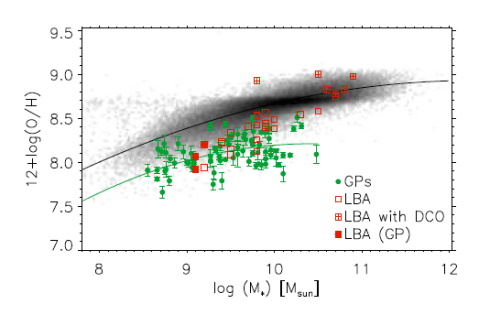 From: Amorin et al. (2010), arXiv:1004.4910. Horizontal axis: galaxy mass; Vertical axis: “metallicity”
What they find is different from our paper. Using a different method to measure the metallicity of the peas, they include the abundance of Nitrogen. This turns out to be anomalous in the peas, and suggests that the peas are less metal-enriched than we concluded. They then look at whether the peas have the amount of metals that other galaxies of similar mass have, and conclude that the peas are off the “mass-metallicity relation” (see plot above – green points are the peas,which are below the grey shaded area representing normal star forming galaxies). This is definitely different from what we concluded – we deduced that the peas are actually on the mass-metallicity relation.
They discuss what this means – if they are right, this makes the peas even more exceptional, since they don’t fit in with normal galaxies in our old, evolved Universe, and underscores their role as “living fossils” since the peas are more like primordial galaxies than evolved ones. The differences in this nitrogen abundance tells us something about the way the peas convert gas into stars that is quite different from what occurs in galaxies like our own Milky Way. Amorin et al. further suggest that the “pea” phase is likely short-lived as the intense star formation in the peas will quickly enrich the gas to make them appear more like their normal cousins. The differences in this nitrogen abundance can imply
So who is right? We don’t know yet. The Amorin et al. paper is appearing in the Astrophysical Journal as a Letter and hopefully starts off a debate on the topic. Stay tuned!
Kevin & Carie
101: The Great Debate
This is the first in a new series of blog posts under the title of ‘Galaxies 101’. These posts aim to explore the history and basics of the science of galaxies. I’ll be covering some of people who helped us understand these ‘Island Universes’ as well as some of the basics that would be taught during a first year undergraduate galaxies course at university.
It is fortunate that these posts are beginning in the week of the 90th anniversary of The Great Debate which occurred on April 26th, 1920. The Great Debate – or the Shapely-Curtis Debate – took place at the Smithsonian Museum of Natural History between two eminent astronomers, Harlow Shapley and Heber Curtis. Shapely was arguing that the ‘spiral nebulae’, that were observed at the time, were within our own Galaxy – and that our Galaxy was the Universe. He also argued that the Sun was not at its centre. Conversely, Curtis argued that the Sun was at the centre of our Galaxy but that the ‘spiral nebulae’ were not inside our Galaxy at all. He suggested instead that the Universe was much larger than our Galaxy and that these nebulae were in fact other, ‘island’ universes.
Below is a drawing of the ‘spiral nebula’ M51. This is an observation by Lord Rosse, drawn in 1845 using the 72-inch Birr Telescope at Armagh Observatory in the UK.

With 90 years of hindsight we can now say that Shapely and Curtis were both right and wrong. The Sun is not at the centre of the Galaxy and the Galaxy is only one of hundreds of billions of galaxies in the Universe. But how was the argument resolved? The answer, in part, comes from a very famous name in astronomy: Hubble.
Less a decade after the Great Debate took place, Edwin Hubble used the largest telescope in the world – the 100-inch Hooker Telescope on Mount Wilson – to observe Cepheid variable stars in the Andromeda Nebula/Galaxy. Cepheid variables are a type of pulsating stars whose pulsation periods are precisely proportional to their luminosities. This makes Cepheid variable stars a ‘standard candle’ – an object where the brightness is a known quantity. If you can observe the apparent brightness of a standard candle, then you can determine its distance by a simple inverse square law. Since Cepheid variable stars have pulse rates proportional to their luminosity, if you can measure the pulse rate of a Cepheid variable anywhere in the Universe, then you can determine how far away it is. This is what Edwin Hubble did in 1925 and he calculated the distance to Andromeda as 1.5 million light years.

At the time, Shapely thought that our Galaxy was around 300,000 light years across and Curtis believed it was around 30,000 light years. Hubble’s measurement placed Andromeda well outside our galaxy and showed that Curtis was correct in thinking that the ‘spiral nebulae’ could indeed be other galaxies. Today we think the Milky Way is about 100,000 light years across and that Andromeda is 2.5 million light years away.
The discoveries of the 1920s started a whole new adventure for astronomy. The Universe had gotten a lot bigger and was about to expand much, much more. It is important to remember that Shapely, although wrong about the nature of the nebulae, did correctly assert that the Sun was not at the centre of the Galaxy. This is the kind of Copernican shift that makes people think about things differently and it is important to realise that the issues discussed during the Great Debate were complex. For our benefit though, the Great Debate is a starting point for exploring the relatively new study of galaxies. Humanity’s view of the Universe, and our place within it, has changed an awful lot since 1920. The study of galaxies has had a lot to do with that.
If you want to read more about the Great Debate, and what else helped to resolve the arguments I can recommend this excellent NASA site. You can also read the published text of the debate online.
[Andromeda image credit: Robert Gendler]
Galaxy Zoo: Hubble

The Galaxy Zoo project has evolved once again – now we are classifying galaxies from the incredible Hubble Space Telescope! Galaxy Zoo: Hubble is the new incarnation of the Galaxy Zoo project and it continues to allow you to help astronomers with real scientific research by asking you to to visually classify galaxies online.
The original Galaxy Zoo and Galaxy Zoo 2 both used data from the Sloan Digital Sky Survey and recently, after reaching 60,000,000 classifications those projects began to wind down. The timing is excellent though and it allows Galaxy Zoo: Hubble to launch today, for the 20th anniversary of the space telescope. Images of galaxies taken using the legendary space telescope are there for everyone to classify and I recommend that you go and do just that.

A lot of the fainter galaxies look like those seen in the Sloan catalogue from Galaxy Zoo 2 (this is a good sign, since we don’t want galaxies to change wildly depending on what telescopes we use!) however in amongst these there are some real gems to be discovered in the Galaxy zoo: Hubble data. I just found a couple in my first tentative classifications, I’ve shown them here to whet your appetites.
Hubble has now been in orbit for 20 years. In that time it has helped us to understand the age of the Universe, to see more distant galaxies than ever before, to detect the presence of black holes in the centre of galaxies, to witness a comet collide with Jupiter, and much more!
Hubble has captured the imagination of people all around the world and it has given us some of the most iconic images of space that exists in the public consciousness. The image at the top of this post was taken during Servicing Mission 4, just after the Space Shuttle Atlantis captured Hubble with its robotic arm in May 2009, beginning the mission to upgrade and repair the telescope. Thanks to that upgrade, Hubble will continue to provide amazing images and science for many years.
So that’s enough chat from me – go and classify some Hubble galaxies!
XMM-Newton is observing Hanny's Voorwerp TODAY!
Hi all,
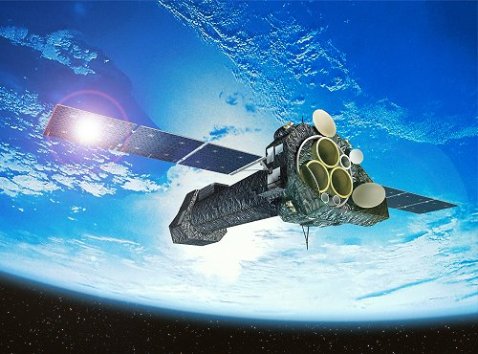
Just a quick note – our observations of IC 2497 and the Voorwerp have been scheduled for today and are taking place now. Since we’re observing in the X-rays, our “quick snapshot” to see what is going on actually takes almost a whole day. XMM-Newton‘s eye isn’t very sharp, so we won’t get a pretty picture. What we will get however is a really great spectrum of the X-ray emission of the black hole in IC 2497 (if it’s munching on stars and gas) and perhaps also the hot gas in the Voorwerp.
We won’t get the data right away though. First, the folks at the European Space Agency (esa) who are controlling XMM need to check out whether the data is OK and do some basic processing on it. Only then can they send it to us to have a look and that may take a few weeks.
Stay tuned!
Kevin
60 Million Classifications
Well, you’ve done it, more quickly than we would ever have thought possible. We have now reached a critical point – 60 million classifications means an incredibly robust, well-defined and scientifically valid catalogue of Sloan Digital Sky Survey galaxies. Congratulations to those who won prizes, and thanks to everyone who took part.
So what happens now? The site is still here, as you can see, and every classification you make will still improve our results, and will be saved in our database. To encourage you to keep clicking, we’re still giving away individual prizes to one person at random for each collection of 250,000 classifications. To take part, all you have to do is what you do best – classify galaxies – and it will help if you make sure your Zooniverse email address is up to date so we can contact you if you’re a winner.
What 60 million really means is that we can move on to the next phase of the project – and you won’t have long to wait…
How to handle Hubble images
While we’re squirreling away processing the Hubble data on IC 2497 and Hanny’s Voorwerp, and starting to get some science out of them, here’s a guide to the kinds of things needed to get science from Hubble images and make them presentable. To demonstrate, I’ll use a galaxy that shows up in the opposite corner of the field in exposures with the Wide-Field Camera 3 (WFC3). Read More…
Zoonometer Approaches 60 million

Having only announced the race to 60 million, only ten days ago, the Zoonometer is showing that we are now making the final 500,000 classifications! The response has been quite incredible and you can now start to see the winners going up on the Zoonometer page. We are still contacting winners as the classifications are made.
There is still one more prize draw to be made, at the 59,750,000 mark – when one classification from the previous 250,000 will be selected at random. Beyond that we await our 60,000,000th galaxy classification. The lucky person that makes that fateful classification will win a cool bundle of prizes:
- An original Sloan Digital Sky Survey plate
- A Galaxy Zoo mug and mousepad
- A Zooniverse t-shirt
Those of you that are wondering what will happen to Galaxy Zoo after the 60 million mark need not worry. We have a nice surprise in store for everyone very soon, but classifications will continue beyond 60,000,000 in the meantime. 60 million marks our minimum, best database. Every galaxy classified afterwards is still just as valid and useful as the 60,000,000 that preceded it and thus Galaxy Zoo will continue.
So if you want to be in with a chance of winning our prize for the 60,000,000th classification then go forth and classify! Watch this blog for more news and updates on the future of the Galaxy Zoo project.
[Image credit: NASA, ESA, K. Sheth (Spitzer Science Center, California Institute of Technology), and P. Capak and N. Scoville (California Institute of Technology)]
Machine Learning Paper Accepted!
Exciting News from Manda Banerji on the Machine Learning paper:
Hi Everyone!
This is to let you all know that the Galaxy Zoo machine learning paper has now been accepted for publication in the Monthly Notices of the Royal Astronomical Society journal. The final version of the paper is at http://arxiv.org/abs/0908.2033. You can read all about the paper in my previous blog post at http://blogs.zooniverse.org/galaxyzoo/2009/08/05/latest-galaxy-zoo-paper-submitted/.
The paper has already attracted a lot of interest from the computer science community demonstrating that your classifications are proving useful and interesting to non astronomers as well!
60 Million Classification Giveaway
Yesterday, Galaxy Zoo launched a fun little competition to mark the approach of our 60,000,000th classification. This is the point at which we can create an amazing and powerful database from the Galaxy Zoo 2 data.
Galaxy Zoo’s ticking clock of classifications, The Zoonometer™, has been steadily ticking away, toward our target of 60 million classifications for a long time. We can hardly believe it, but we’re nearly there! To mark this historic moment in Galaxy Zoo’s history, we’re giving away prizes to the people that provide the clicks that take us to our target.
The person that makes the 60 millionth classification will receive a bundle of goodies, including a Galaxy Zoo t-shirt and mug, a Galaxy Zoo poster and an original Sloan Digital Sky Survey plate! As well as this, we’re giving away individual prizes to one person at random for each collection of 250,000 classifications.

The prizes kicked off with the 57,000,000th classification, which was achieved last night at about 2100 UT (see extremely geeky screenshot). One of the 250,000 classifications that led us to the 57,000,000 mark will now be selected at random to win a Galaxy Zoo mousepad. We will also be picking a winner from the 57,000,000 – 57,250,000 range as well. The winners will be posted on the Zoonometer™ page. We are appaoraching 57,500,000 as I type this.
If you want to take part, all you have to do is what you do best: classify galaxies! It will also help if you make sure you’re Zooniverse email address is up to date so we can contact you if you’re a winner.
60 Million Target Explained
With 60,000,000 classifications in the database, the Galaxy Zoo 2 project will have reached a critical point. 60 million classifications represents our minimum, ideal database. With that many classifications you, the participants, will have collectively classified every galaxy enough times to create an incredibly robust, well-defined and scientifically valid catalogue of Sloan galaxies. Beyond the 60 million classifications, every additional click still goes into the database – it just means that our minimum science goal is achieved.
What is an SDSS Plate?
The person who classifies the 60 millionth galaxy will win an original Sloan Digital Sky Survey plate. These plates are quite large and make amazing memorabilia, since they were actually used to observe galaxies by the SDSS. We are lucky enough to have one of these plates at Zooniverse HQ, to give away. 640 holes have been drilled into the plate, with each hole corresponding to the position of a selected galaxy, quasar or star in the sky. During observations, scientists plug the holes with optical fibre cables. The fibres simultaneously capture light from the 640 objects and record the results in CCDs. The plates are interchangeable with the CCD camera at the focal plane of the telescope. You can read more about how the SDSS performed observations on their own webpages.
 Galaxy Zoo