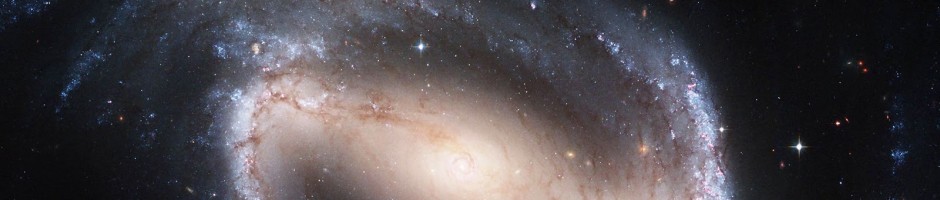
Voorwerp fever
Ever since it was first identified, Hanny’s Voorwerp has grabbed the attention of the Zookeepers and everyone else who comes across it. One reason we’ve been successful in getting such a wide range of observations over just a few months (and therefore why posts on here have been delayed!) has been that colleagues seem to find it equally compelling. So what is it? Our current best guess goes something like this:
A hundred thousand years ago, a quasar blazed behind the stars which would have already looked recognizably like the constellation Leo Minor. Barely 700 million light-years away, it would have been the nearest bright quasar, shining (had anyone had a telescope to look) around 13th magnitude, several times brighter than the light of the surrounding galaxy. This galaxy, much later cataloged as IC 2497, is a massive spiral galaxy which was in the process of tidally shredding a dwarf galaxy rich in gas – gas which absorbed the intense ultraviolet and X-ray output of the quasar and in turn glowed as it cooled. But something happened to the quasar. Whether it turned off, dropped to a barely simmering level of activity as its massive black hole became starved for gas to feed its accretion, or it was quickly shrouded in gas and dust, we don’t see it anymore.
But we see its echo. How could we come to such startling conclusions? An earlier blog entry showed some of our earliest data, when we already knew that the gas in Hanny’s Voorwerp was ionized in such a way that it must experience a radiation field of higher energy than normal stars can produce. In fact, it looks just like the pattern of emission given off by gas around the center of Seyfert galaxies, and on the outskirts of quasars and radio galaxies. This makes sense, except for the minor detail that we don’t see the active nucleus that should be there to light up the gas.
However, we could start from calculations done by astronomers trying to understand these objects, which could tell us how much radiation it would take to light up the Voorwerp. This wound up telling us how many ionizing photons there are per atom in the gas (known as the ionization parameter). That meant that we could find out how bright the missing core had to be if we could learn how dense the gas is.
Spectra are wonderful things – there is a pair of emission features from ionized sulfur atoms out in the red whose ratio depends on how often the atoms undergo collisions, and therefore on the density where they float. We had been contacting colleagues all over the map to see who might be doing spectroscopy in the red, and were fortunate to be put in touch with Nicola Bennert, who is a postdoctoral researcher at the University of California campus in Riverside. She was about to work for several nights with Lick Observatory’s 3-meter Shane telescope and a double spectrograph optimized to observe blue and red parts of the spectrum at once, and was intrigued by what we already knew of the Voorwerp.
She got a useful data set, in particular a very nice observation of the spectrum in red light. From this, we now know that the typical density of gas (for the pickier readers, that’s the RMS density) is no greater than about 15 particles per cubic centimeter – which means that the UV and X-ray luminosities of the object were somewhat less than a hundred billion times the Sun’s total energy output, in the range of quasars. (It was a nice extra feature that Nicola did her dissertation work on analysis involving measuring ionization parameters of gas in Seyfert galaxies, and she’s enthusiastically joined in the project).
From the features of sulfur and nitrogen, we also have good evidence that these elements are not very abundant in the gas – maybe 10% of the fraction seen in our part of the Milky Way, more like what we find in dwarf galaxies such as the Small Magellanic Cloud. So the gas looks more like something from a low-mass dwarf rather than something ejected from the center of a luminous galaxy like IC 2497.

Meanwhile, we had asked for a quick look with instruments on the Swift satellite. Swift is designed to detect gamma-ray bursts and follow them up quickly with X-ray and ultraviolet or visible-light observations, to localize them as fast as possible (“Swift – catching gamma-ray bursts on the fly” is their motto). Thus, Swift spends a lot of its time staring at the sky, especially parts of the sky that are easy to see from ground-based telescopes, waiting for something to happen. From being on one of too many NASA committees, Bil recalled that the Swift science team had realized that, since it didn’t matter exactly where they looked waiting for something to happen, they have a program to take requests. Usually these requests are for transient, time-sensitive events, but principal investigator Neil Gehrels agreed that our request would be appropriate.
So we crammed our whole science argument into 300 words and it was approved. Showing that “Swift” has more than one meaning, within a week we had our data. We had two questions in mind for its instruments. First, its X-ray telescope (known as the XRT) would easily see any active galactic nucleus, even a typical Seyfert galaxy. It saw – nothing. Second, we asked for ultraviolet images with the 30-cm Ultraviolet/Optical Telescope (UVOT). These were intended to tell whether the light outside of the bright gaseous emission lines came from stars or was reflected from dust particles. The distinction could be made because, as in the scattering that makes our sky blue, short-wavelength radiation scatters more effectively from interstellar dust. As an example, the blue reflected piece of the Triffid Nebula is bluer than the illuminating star – in fact bluer than any kind of star can be. And this is what we found in the Voorwerp. Filtering a slice of ultraviolet light that shouldn’t be much affected by the gas, we found the object to be ten times brighter in the mid-ultraviolet than in the shortest wavelength seen by the Sloan Survey. Not only does the gas see something bright, so does the dust.

UVOT image on the left, v band on the right
So now we have a bunch of pieces of the puzzle. Highly ionized gas, ionized by nothing we can see. Dust reflecting ultraviolet light from no apparent source. No central X-ray source, which makes it very hard to hide
something behind a cloud of gas and dust that leaves it visible from the Voorwerp. This was starting to look like a giant version of a phenomenon that astronomers have had to rediscover for several generations now – the light echo. Over the years, when we see a supernova explosion, bright nova, or a star that for some other reasons flares brightly, we often see reflections from foreground dust. If we trace the geometry of what dust we see at different times after the outburst, it must fall along an ellipsoid with the star at one focus and ourselves at the other.
It’s important that the echo has spectral characteristics of the exciting source. One team has used this fact to find locations of supernovae which we would have seen in the Large Magellanic Cloud centuries ago, as their reflections still come our way from larger and larger circles of foreground dust (see this very cool and very new press release). And now we are proposing that we’ve found the light echo from a faded quasar, which was there 50-75,000 years ago but is invisible now.
The importance of checking on this whole picture goes well beyond the admitted coolness value, or the flashiness of a proposal that we hope our colleagues who decide who gets to use big telescopes will look on with favor. We already know that quasars (and their relatives such as Seyfert galaxies) can undergo dramatic change on everything from cosmic timescales to human ones. We observe them to fluctuate in brightness, sometimes dramatically, over times as short as weeks. And at the outside, relations between quasars and mergers in some of their surrounding “host” galaxies wouldn’t exist if the quasars stay bright for much more then the nearly billion-year duration of a galaxy merger. (Only in astronomy and cosmology do we get to lump “mere” and “billion years”). In fact, we know that the whole population of quasars has changed over cosmic time – there used to be many more, and they grew brighter, in an era about 10 billion years ago. For that matter, the most powerful quasars must be temporary – if one were to shine at these enormous levels for all of cosmic history, even as miserly as gravitational energy can be about producing energy wile consuming mass, the central object would have long ago eaten its entire surrounding galaxy.
Of course we want to know more. There are more observations we can make which would test this idea, and tell us more about the nature of the Voorwerp and the history of the illuminating core. Chris headed up a proposal to map the gas with the OASIS system on the 4.2-meter William Herschel Telescope, so we could measure the Voorwerp’s Doppler shifts point-by-point and see whether there are correlated changes in strengths of emission lines that would show us brightening and fading of the central source (which would make rings in our view unless the gas has a very odd structure). And there was the Hubble proposal, which would take high-resolution images of the gas in two emission lines and then look in filter bands between them to see whether the Voorwerp has stars. Actually, with all the reflecting dust, we hope mostly to see star clusters, to tell whether it started life as a dwarf galaxy. And we want to take a really close look at the nucleus of IC 2497, using Hubble’s exquisite resolution to isolate the light from its innermost region in search of any gas that is lit up by even a weak active nucleus. Speaking of the nucleus of IC 2497, Bill is even as we write working to complete a proposal to use Chandra to see if we can tease out any X-rays from a now-quiet AGN. We’ve also requested time in the radio to see if we are only seeing part of a much larger structure.
So here we have a new possibility – of watching the history of a quasar either flaring up, practically turning off, or being hidden over a time span that we’ve had no other way to examine. The pattern of light emitted by gas in Hanny’s Vooorwerp, and the way its dust reflect the quasar light, should be able to trace the history of its decline. Never mind heading back to the future, we can go onward into the past. Once in a while, we have the opportunity to do what paleontologists can do only in the movies.
(Chris and Bill weren’t sure who should blog this. So in the spirit of Galaxy Zoo, we both did.)
Galaxy Zoo Poster – Improved Greatly by Julia
Several weeks ago, we issued a challenge: re-create the Galaxy Zoo poster in a new way to tell the story of Galaxy Zoo yourself. When I posted this, I wasn’t sure if anyone would find it interesting, but as always, your creativity is amazing. The first submission is in, from Julia, and it is breathtaking. Behold:
Julia’s Galaxy Zoo poster remix (1.2 MB JPG)
I think you’ll agree that this is a big improvement over the text-heavy original, and I think it’s one of the most amazing science posters I’ve ever seen. Congratulations to Julia on an amazing piece of science/art! (Julia, if you’re reading, please say hello in the Comments section.) If anyone else is interested in remixing the poster, send me a message in the forum (I’m zookeeperJordan).
Galaxy Zoo: Behind the scenes
For the past few months on this blog, we’ve been talking about the science of Galaxy Zoo – what your millions of classifications have revealed to us about the way the universe works. Right now, as Steven and I described Friday and Monday, the members of the Galaxy Zoo team are writing papers announcing our science results, and offering feedback on each other’s papers.
But of course, Galaxy Zoo has become much more than just a science project. The site has become an Internet phenomenon, and for the next few posts, we’d like to focus on some other aspects of the Galaxy Zoo phenomenon. Today, we wanted to talk about the thing that makes everything else work – the site itself.
Without a good-looking and well-functioning website, we could have never invited all of you to participate in this project, and you could not have generated the excellent scientific dataset that you have generated. The site was designed by two professional web designers: Phil Murray and Dan Andreescu. Galaxy Zoo is now proudly listed as a featured project on Phil’s web site.
Phil designed the look and feel of the site, and Dan wrote the code that allowed the website to take your input and write it into a database of classifications. Dan left the project in late 2007, and Danny Locksmith has taken over the coding.
The best way to tell the story of Galaxy Zoo’s design is to let Phil and Danny tell the story themselves. So here is Phil, talking about how he designed the layout of Galaxy Zoo:
GZ1.0 Visual Design
I was asked by Chris Lintott to design the Galaxy Zoo logo and web site in March 2007, and I realised early on that this had the potential to be a hugely successful project — little did we know just how successful it would be! I was given a completely free rein to handle the visual design of both the logo and the web site.
The Galaxy Zoo Logo
I wanted to create a visually appealing logo that would work in several formats – web and print. It had to be flexible enough to work as a standalone logo or to be incorporated into an overall page design – as is the case with the web site. The graphic part of the logo is in fact based on a Hubble image of Supernova 1987A Rings, which seemed to fit very neatly into the text of ‘GALAXY ZOO’ to form an official logo. A variation was developed for both web and print use.
The Galaxy Zoo Web Site
It seemed obvious that part of the attraction of the GZ1.0 project to non-astronomers was the sheer beauty of the galaxy images, plus the fact that many of these images had never previously been seen by human eyes. So I wanted to maximise impact right up front on the Home Page of the site by using a large galaxy image as a main background to the page and to carry this theme through into the inner pages. I wanted all text to sit on a semi transparent screened background to give the impression of depth on the page.
Choosing a colour palette was relatively straightforward given the colours within the logo, hence the basic black, grey, orange and gold colour scheme. It was decided to go with a slightly shallower header graphic for inner pages with all top navigation shown horizontally and any secondary navigation to be contained in a left column (as is the case in the Analysis Page). I decided on a fixed width solution catering for a minimum screen resolution of 1024×768 pixels.
When it came to the buttons for the Galaxy Analysis page, I spent some time designing what I hoped would be generic buttons for the various options on offer (Spiral Galaxy – Anticlockwise, Clockwise and so on). The intention was to try to design buttons that would not influence the decision making of the Galaxy Zoo visitor but also that they would be intuitive to use. In fact it quickly became apparent that having designed the buttons to look like they were part of an ‘online game’, was a feature which also helped with the appeal and overall usability of the site. The feedback and data received as part of GZ1.0 has given us some valuable information about how to present these and other buttons for GZ2.0.
As for building the site, I constructed all the pages as HTML templates, which were then integrated into the ASP.Net web programming environment by the excellent Dan Andreescu. Danny Locksmith has taken over the ASP.Net duties since late 2007.
I think you’ll agree that the site that Phil did a great job – he created a really beautiful site that was easy to navigate. Now here is Danny, talking about how he took over the coding from Dan:
Most of the ASP programming was decided on before I got involved. My task so far has been to try to understand how someone else thought it should work!
In effect this is how it works:
Your login to the site, your user preferences, etc. are all controlled by the .NET 2.0 framework. The site uses a template that provides the basic logic involved in recording your clicks and ensuring that the right person is credited with each classification. The persistant data is stored in a database.
When you load the Galaxy Analysis page, a galaxy is selected randomly and displayed on the page. Next to the galaxy’s image is a the Galaxy ID, which is a hotlink to an SDSS page where you can view details of the galaxy – its spectrum and a zoomable picture, etc. Watch for changes to this in GZ2!
Next to the galaxy image is a custom control which has the various buttons you can click to classify the galaxy. Since we learned about the anticlockwise bias, various theories have been put forward about to explain it – one of them is the design and layout of these buttons. Another problem here was that people tended to click the button several times, recording several results. This was worked around by only allowing one classification per galaxy. Yet another potential problem was that you could easily make an error, but you could not go back and fix it. Look for changes in GZ2!
Once you click a button, your classification, your user ID, the date and time, etc. are recorded in a database. The data that is stored was designed to answer specific questions, and the scientific papers which are to be published soon. With the advent of the bias testing phase, additional information was stored in the same database – the way the image displayed had been transformed.
In GZ2, the data collected will be more generic, and will create a very comprehensive catalog of galaxy information, almost certainly the biggest ever. To a great extent, the inner workings of the site are defined by the various scientists involved in the project. It is very much designed by the entire team, and as such my task is to ensure that the finished site meets all the goals of the team, and at the same time is pleasureable to navigate and to use.
You will be able to decide if I was successful when GZ 2 is launched!
I’ll add just two things to what Phil and Danny said:
1) The servers that run Galaxy Zoo are in the Physics and Astronomy building at Johns Hopkins University in Baltimore, Maryland, USA. (Here is the building in Google Maps – the Johns Hopkins lacrosse stadium is just to the north, and the building across the winding street is the Space Telescope Science Institute).
2) One of the things I find amazing about Galaxy Zoo is that no member of the team has ever met all the other members face-to-face. Chris has come closest – he has met everyone except Jan and Alainna, who do IT support for the servers at JHU. In addition, 8,549 km separates Anze in Berkeley, California from Chris, Kate, and Kevin in Oxford. The Galaxy Zoo team could not have existed without the Internet, and communication tools that allow us to work together productively on different continents.
Reading the drafts
As Steven mentioned in his post last Friday, we are hard at work on the first round of papers from Galaxy Zoo. Back when we started this blog, Chris listed the four papers that we expect to come out in the first round. To review them:
1) A paper summarizing the structure of Galaxy Zoo, with details of how we turn your clicks into a catalog of galaxies. Chris is the first author on this one, and Anze talked here on the blog about how we got our catalog of galaxies. Chris’s talk at the AAS meeting also gives a good introduction to what is likely to go in this paper.
2) A paper about the relationship between what a galaxy looks like and where it lives. Steven is the first author on this one, and he wrote about the results very clearly here.
3) A paper about the unusual “blue ellipticals” that you found. Kevin is the first author on that one, and he wrote about it here, with lots of really nice sample images.
4) A paper examining the structure of the universe by studying the rotation direction of galaxies. Kate is the first author on this one, and Anze is working closely with her. She wrote about the reasons for the study on the forum, and her paper will also include the results of the bias study. The bias study showed that the apparent excess of anti-clockwise galaxies seems to be a result of people’s perception of galaxies on the site, rather than any feature of the galaxies themselves or our position relative to them. We actually never expected to find any excess – and often in science, disproving a result is just as important as finding a new result.
Steven’s post Friday did a great job of describing what goes on in writing a scientific paper. Here, I’ll talk about what it’s like to read over a paper and provide comments to the first author.
The results so far have been really interesting, and it’s been a lot of fun to see them written down. I looked through Chris’s paper in detail, since I know a good deal about the process by which we created Galaxy Zoo, and the SDSS data on that Galaxy Zoo uses. I know less about the astronomy, so I’ve just skimmed through Steven and Kate’s paper. I haven’t seen Kevin’s yet.
We’ve been exchanging drafts of the papers as PDFs, then sending comments back to the first authors by E-mail. I’ve been reading along and making notes as I go. I’m trying to make sure that everything would make sense to an astronomer who hadn’t worked with Galaxy Zoo before.
One of the most important parts of any scientific paper is the figures. The old statement that “a picture is worth a thousand words” is definitely true in science, but in this case the pictures are usually plots of data. I’m checking over the figures to make sure the x and y axes are clearly labeled and the figure caption makes sense. A lot of readers read the figures first, then come back to the text, so the figure captions should make sense when read apart from the paper. The way that figures can depict scientific data is quite interesting, and creating figures for professional astronomers is frequently quite a different visual style from creating figures for the public.
The last section of any science paper is the References – the previous papers that this paper builds on. Any assertion that you make in a paper should either be a direct result of your study, blindingly obvious, or referenced in a standard style. So, when Chris talked about how images from Galaxy Zoo were generated, I sent him a reference on how we take individual black-and-white images in different wavelengths and combine them into a color image.
Can you feel a draft?
As you may have noticed from the sparseness of recent posts, the Galaxy Zoo team have all been buckling down in an effort to get some work done. Progress on my Galaxy Zoo paper has been a little delayed by the need to do some work for another project I’m involved with: the GAMA survey. The first observations for this survey will start in a few weeks time, so I couldn’t really put off doing my bit to help make sure we target the right objects! All astronomers usually have several different projects on the go, some of which span years. Juggling them all can get a little tricky. Anyway, with my most urgent work out of the way, I’ve had another push on my Galaxy Zoo paper and today I sent a draft version around to the team members for them to have a look at.
Generally, although several people may contribute to a scientific paper, the main business of writing the text and putting together the figures is done by one person, the lead author. This person is usually the one who has done the most work producing the results that are described in the paper, and their name comes first in the author list. Once the paper is mostly complete, although still at an early stage, it is often sent around the coauthors for comments. It is helpful to get input from the coauthors at this stage to help refine the overall structure and content of the paper before too much effort has gone into checking the fine details, because these will get messed up again if the paper ends up being rearranged following the coauthors feedback.
We’ve recently had drafts set around the Galaxy Zoo team by Kevin and Chris, and today Kate also sent hers. These are all looking good, though some still need a little bit more analysis including. When the rest of the authors have given their feedback, the lead author tries to incorporate their suggestions into the paper. Sometimes this process might go through a couple of cycles before a final draft is produced. The final draft is then proof read by some of the coauthors, to check the spelling, grammar, style, and to generally improve the clarity of the text.
Finally, when all the authors are content, the paper is submitted to a journal for peer review, prior to being publishing. We’ll describe that stage in a bit more detail when we get there.
Keep watching the skies!
One of the things that constantly amazes me about astronomy is how much we can learn from so little. The only information we get from stars and galaxies is the light they give off. Whether this light comes in the form of visible light, infrared radiation, radio waves, x-rays, and so on – it’s still just light. We can’t go see these galaxies ourselves, even by robotic probes. We can’t bring samples back. We can’t even get a different view of the galaxy – we are stuck here on Earth, watching from one location. And if something in the sky changes – as it does constantly, sometimes dramatically – we can’t say “hey, I missed that. Do it again!”
Given these constraints, it is sometimes amazing to me that we learn anything at all. But we have learned so much about the sky – everything from our planet’s place in the Solar System to the origin of the universe!
Since all our knowledge of astronomy is gained by looking, it makes sense that we should look as hard as we can. That’s the premise of the Sloan Digital Sky Survey, which you’ve heard a lot about, since it’s the source of all the images you see on Galaxy Zoo. The Sloan used a 2.5-meter telescope in New Mexico, USA to look up at the sky every clear night for five years. Its goal: to use these observations to make a map of the universe.
The more we look at the sky, the more likely we are to see something interesting. That’s the guiding principle of astronomy, of the Sloan Digital Sky Survey, and now of Galaxy Zoo.
Many of you are now scanning through SDSS images, classifying galaxies by shape. This is a critically important thing to do, but computers find it difficult, so it takes people watching carefully. And, as we have all seen with the Voorwerp (described here once, twice, three times), the more you look, the more you see.
And starting in 2013, the new Large Synoptic Survey Telescope will watch the sky as never before, viewing the entire sky at a higher resolution than the SDSS – every four nights.
It’s an exciting time to be involved with astronomy, and we’re glad that Galaxy Zoo has been a part of that. Keep looking up!
The Mystery of the Voorwerp Deepens!
A couple weeks ago, I talked about the Voorwerp (“object”), the strange blue object that Hanny posted to the Galaxy Zoo forum. She asked if anyone knew what it was, and we sure didn’t. Part of the problem was that we didn’t have a spectrum for it, so it could have been literally anywhere from right next door in our galaxy to the edge of the universe. Our colleague Bill Keel took a spectrum, which he posted about here in the blog, and found that the Voorwerp is associated with the galaxy above it. We’ve since been looking around for other colleagues that can help us figure out what the Voorwerp is.
Thanks to Matt Jarvis, who was observing at the 4.2m William Herschel Telescope in La Palma, we’ve been able to get some better images. The William Herschel Telescope is bigger than the telescope that gathers images for the Sloan Digital Sky Survey (SDSS is 2.4 m; WHT is 4.2 m), and the images that Matt took are longer exposures, so we can see fainter features in them. The conditions were also quite good (good “seeing” in astronomer’s lingo) and so the image has very good resolution (it’s “sharper”) as the atmosphere didn’t blur things too badly.
So what kind of data did we get? We got three images in filters very similar to the SDSS ones. We got a g, r and i-band image. Those correspond roughly to green, red and infra-red for human eyes. Just to make things confusing though, we colour g in blue, r in green and i in red to stay consistent with the SDSS/GZ images. Without further ado, here are the original SDSS and new WHT images:

Original SDSS image

New WHT image
The WHT image is rotated with respect to the SDSS image; look at the orientation of the galaxy and the Voorwerp to see how they compare. Once you mentally rotate the images so they match, you can see clearly that the Voorwerp is quite a lot bigger than we initially thought, because so much of it was too faint to be visible in the SDSS image. This immediately makes us want to get an even deeper g-band (blue colour) image to see just how much bigger it is! For that, we will probably go to the world’s largest telescopes such as ESO’s Very Large Telescopes, Gemini or Keck.
To give you an idea just how big the Voorwerp is by now, look at the spiral galaxy next to it. This galaxy is a very massive spiral galaxy, likely as big or bigger than our own Milky Way! That’s really, really big!
If you look at the new WHT image of the Voorwerp, you can also see a huge, gaping hole. From the SDSS images, it wasn’t really clear whether the fuzzy structure there was anything real, but the WHT image makes it clear that this is a genuine hole. Again, just to put it into proportion, that hole has a diameter of something like 10 000 light-years. We have no good idea of what could punch such a large hole. One possibility is that a massive burst of star formation occurred there, causing a string of powerful supernova explosions, causing an expanding bubble. Such holes presumably caused by supernovae have been seen in other galaxies, but as far as we know, nothing anywhere near this size.
In his last post, Bill mentioned that the spectrum of the Voorwerp showed some very odd emission lines, in particular Helium II (HeII) and Neon V. HeII only really appears in spectra when there is something really hot around to excite the gas – something hotter than the hottest star. This could be an active galactic nucleus(i.e. gas falling into a supermassive black hole, and heating up as it falls), or perhaps some high velocity shocks. We’re busy analysing the spectrum to understand better what’s going on here.
By a luck coincidence, the Voorwerp turned out to be at a redshift where the HeII line “redshifted” into a common narrow-band filter. Such a filter blocks all light except in a very narrow wavelength range, and so lets us take an image focusing only on those areas which are emitting light in that wavelength range. Below is the image of the Voorwerp in the wavelength range of the HeII line:

The Voorwerp in HeII
The HeII emission clearly comes from a good chunk of the whole Voorwerp (again,a deeper image might show even more), so whatever is exciting the gas in the Voorwerp seems to do it over quite a large volume.
What’s next? We really still have no idea of what the Voorwerp really is. The more data we take on it, the stranger it gets. Many of us are busy trying to convince friends of ours on observing runs to take observations of the Voorwerp so we can figure out what it is.
That’s how an observational science like astrophysics works: you find something new, you don’t know what it is, so you take more data to try and understand it better and form some hypothesis about what’s actually going on and then you confirm it with more data. But we’re still at the very start of this process. The mystery deepens… *cue scary music.
Tell the story of Galaxy Zoo yourself!
A couple weeks ago, Chris and I attended the meeting of the American Astronomical Society in Austin, Texas. At the end of the meeting, I uploaded the poster I had presented there:
Galaxy Zoo public outreach poster
In a comment to that post, mushroom made a fascinating suggestion:
Could be a fun visual communication exercise to try to make another poster which conveys the same information without using any text.
This is a fascinating idea. I talked it over with the team, and we’re not sure how to go about telling the Galaxy Zoo story without text. But we’re sure that with your creativity, someone can figure it out! And, to phrase mushroom’s suggestion in a different, more general way:
How would you tell the story of Galaxy Zoo?
Here is your chance. We invite you to “remix” the Galaxy Zoo poster, telling the story of Galaxy Zoo in your own words and images. You can start from the original work, or strike out on your own. Here is the original poster, as a JPEG image and as a Word file:
Galaxy Zoo public outerach poster (JPEG)
Galaxy Zoo public outreach poster (Word)
I have created a topic in the Galaxy Zoo Latest News forum called “Remix the Galaxy Zoo poster!” Post your ideas in that thread, or in comments here on the blog. Post your creations there, or if they’re too big to be uploaded, E-mail them to me at raddick “at” jhu.edu.
If any of you are wise in the ways of Photoshop, E-mail me, and I can send you the original Photoshop CS2 file.
We’re really looking forward to seeing what you come up with, and we hope this is fun for you too!
Have fun, and keep telling the story!
Details
You may change anything you want about the poster, as long as you leave the following elements. You may move them around, but you should maintain them visibly on the poster:
1) The author names and institutions (“TeamMembers” in the Word file). This is in the standard format for scientific posters and papers.
2) The names of the volunteers, which now appear at the end of the poster. But, of course, feel free to add your own name to our randomly-chosen list!
3) The logos of the institutions involved with Galaxy Zoo.
4) The copyright statement, including the Creative Commons logo.
Random thoughts
A user on the forum asked me what I meant by the word ‘random’ in my previous blog post. A statistician could explain this more precisely, but I’ll give my understanding of it in an astronomy context.
A random process is one in which a variety of alternatives could occur, but beforehand we cannot know which alternative actually will occur. The alternatives need not be equally likely, and the probabilities of each alternative happening (the probability density function) may be known very well. If we repeat the process many times, the number of times each alternative occurs will be very close to the probabilities we might already know. But we don’t know which alternative will actually happen each time the process occurs.
A random system is one which arises as a result of random processes. Everything has some element of randomness in it, nothing is perfectly ordered, but some things have a lot more order to them than others. The chair you are probably sitting on while reading this is a highly ordered system. Even though the atoms in it are jiggling around randomly to some extent, their overall motions are generally very ordered. The random motions of the atoms are not very large compared with the order that was instilled in the chair when it’s materials were constructed, whether that was by metal cooling in a mould or wood slowly forming in a tree.
The motions of stars in a spiral galaxy disk have a lot of order to them, as they are mostly formed by relatively gentle physical processes that maintain information about the history of the system. The galaxy started rotating long ago, and the stars which formed in it are still rotating today. In an elliptical galaxy some process has happened, for example a merger of two galaxies, which disturbs that order. The random process at work is the multiple close interactions of pairs of stars. The motion of two stars after they have passed close by one another is very dependent on the exact values of their motion before the interaction. If each of those stars then interacts with other stars we quickly get to a state where we could never know the stars’ initial motions well enough to predict their motions at a later time. This is an example of a chaotic system, and it can even occur for three objects interacting through gravity, never mind the billions of stars in a typical galaxy. There are many alternative paths the stars could travel along, and beforehand we don’t know which paths the individual stars will take. Despite this, we can go part way to determining what the result will be overall, a big fuzzy ball. The stars in elliptical galaxies are not moving totally randomly, there are certain ranges of orbits that are more populated than they should be for a truly random system. This order is a ‘memory’ of the initial motions of the stars in the merging galaxies. However, most of the stars’ movements are dominated by random motions.
Carnival of Space
Galaxy Zoo features in this week’s Carnival of Space, a collection of all the best space blog writing from the past seven days. This week it’s in a 50s detective story format…and it’s definitely worth a look.
 Galaxy Zoo


