Announcing the Galaxy Zoo: Euclid project!
We are thrilled to announce the launch of the Galaxy Zoo: Euclid project, with 820,000 galaxy images fresh from ESA’s Euclid Space Telescope’s first year of operations! This will be the public’s first chance to see survey images from the Euclid telescope. If you take part in the project, you could be the first human to ever see that image from Euclid. Not only that, you could be the first human in the Universe to ever lay eyes on the galaxy in the image. These classifications will help the Galaxy Zoo and Euclid science teams answer questions about how the shapes of galaxies have changed over time, and which processes in the Universe have caused these changes.

First off, if you’re not familiar, let’s start with the Euclid Space Telescope. The European Space Agency’s (ESA) Euclid space telescope launched in July 2023 and has begun to take its survey of the sky. Euclid has been designed to look at a much larger region of sky than the Hubble Space Telescope or the James Webb Space Telescope, meaning it can capture a wide range of different objects all in the same image – from faint to bright, from distant to nearby, from the most massive of galaxy clusters, to the smallest nearby stars. With Euclid, we will get both a very detailed and very wide view (more than one third of the sky) all at once.
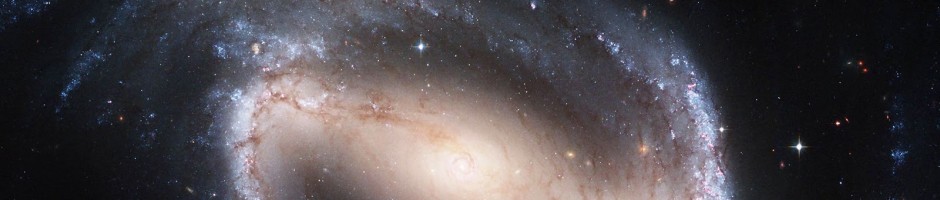
In November 2023 and May 2024, the world got its first glimpse at the quality of Euclid’s images with Euclid’s Early Release Observations which targeted various astronomical objects, from nearby nebulae, to distant clusters of galaxies. Below is an incredible image of the 1000 galaxies in the nearby Perseus cluster taken by Euclid. What you’ll notice in the background though is a plethora of distant galaxies all ready for their shapes to be classified! At the latest count, there’s 100,000 background galaxies in this one image alone.

The sheer volume of data from Euclid is a huge challenge to us astronomers; Euclid is set to send back 100GB of data per day for six years. That’s a lot of data, and labelling that through human effort alone is incredibly difficult. So we will once again be deploying our AI algorithm, called Zoobot, for this project. If you want to know more about Zoobot, Mike wrote a great blog post explaining it in more detail last year. In short, Zoobot learns from Galaxy Zoo volunteers to predict what they would say for new galaxy images. After being trained on the human answers that you will contribute in the next few months, Zoobot will then be able to give us detailed classifications for hundreds of millions of galaxies found by Euclid over its next six years of observations, creating the largest detailed galaxy catalogue to date and enabling groundbreaking scientific analysis on topics like supermassive black holes, merging galaxies, and more.
Zoobot will sift through the Euclid images first to classify the “easier” galaxies that we already have a lot of examples of from previous telescopes. However, for the galaxies where Zoobot is not confident in its classification, perhaps because the galaxy is unusual, it will send those images to volunteers on Galaxy Zoo to get their human classifications, which then help Zoobot to learn more. The Galaxy Zoo: Euclid project will therefore see AI and humans working together to learn more about our Universe.
We’re really excited about this project on the team, not least because it’s been in the pipeline for a long time! But also, because of the science that will be made possible thanks to this project. Given Euclid’s unique design that gives us both a very detailed and very wide view, we’ll be able to classify the shapes of galaxies out to much greater distances than ever before. This means we can see further back in time in the Universe’s history to trace how the shapes of galaxies have changed earlier in cosmic time. While JWST also makes this possible, the images from JWST are from a much smaller area of sky. Euclid, however, will cover one third of the entire sky and give us a look at the entire galaxy population that’s visible to us from within the Milky Way. Even as I’m typing this I’m getting excited at the population statistics that GZ: Euclid will make possible!
What’s more is that Euclid’s main focus has always been to understand the distribution and effects of dark matter in our Universe. Dark matter is matter that we know is there because of its gravitational effect on things around it, but it doesn’t emit, reflect, or absorb light, so we can’t see it. The Euclid team are planning to make a 3D map of the positions of all the galaxies they find, and trace out where all the visible and dark matter is. Combining this map with your classifications of the shapes of galaxies, we will for the first time be able to ask the question: how does dark matter affect the shapes of galaxies over cosmic time?
So I hope I’ve convinced you about how exciting this project is and you are now ready and raring to go with your classifications. You can find a link to the project below. If you do decide to take part: THANK YOU! We appreciate every single click. Join us and classify now.
Becky Smethurst, on behalf of the the Galaxy Zoo and Euclid science teams
P.S. Some of you might notice that metadata is absent for these images for now. This is because the images you’re seeing are not yet publicly available. Extra data will be added upon Euclid’s first data release in 2025.
What is a Galaxy? …the return
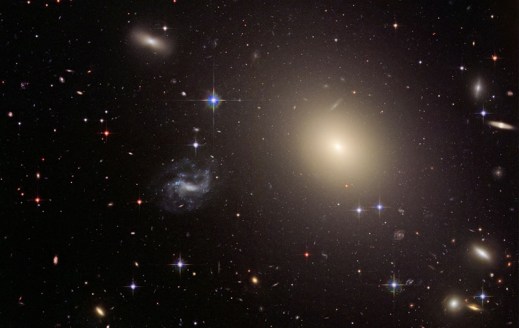
The first time I gave a public talk, I spent an hour describing why galaxy classification is fundamentally important to the study of the Universe, the origins of Galaxy Zoo, the amazing response of the volunteers and the diverse results from their collective classifications of a million galaxies near and far. I showed many gorgeous galaxy images, a few dark matter simulations and even a preview of the Hubble image of Hanny’s Voorwerp.
As I finished my talk and the Q&A began, I braced myself for the inevitably interesting and challenging questions (I seem to get a lot of questions about black holes and spacetime).
A brief pause, and then the first question echoed from somewhere in the darkened auditorium: …”What’s a galaxy?”
Oops. Apparently I’d forgotten that little detail at the start of the talk. So I described a typical galaxy (if there is such a thing): a collection of stars, gas, dust, dark matter, all gravitationally bound together. Then I made a joke about scientists forgetting to define their terms, and we moved on to the next raised hand.
Turns out, though, it’s not such an easy question. Even though my casual definition works fine for most galaxies, it’s not at all an agreed-upon standard. We’ve discussed this on the blog before, and even in the short time (astronomically speaking) since Karen wrote that very nice post, more work has been done to find galaxies that push the boundaries and force us to re-think what it really means to be a galaxy.
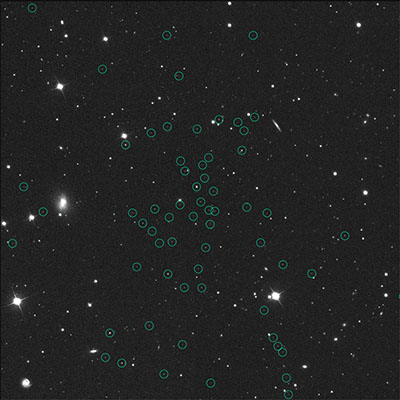
The circled stars (plus a lot of dark matter you can’t see) are Segue 1, one of the smallest galaxies we know about. To read more on this, click the image.
So, spurred by a very broad interpretation of a question left for us in the comments on the post announcing this hangout, we decided to re-visit the discussion, covering the various properties a galaxy must have, should have, could have, and can’t have. We discussed the smallest galaxies, found by counting and measuring each of their individual stars. We discussed the biggest, brightest galaxies in the universe, living in rich environments and grown fat by eating other galaxies. And everything in between.
Note: when we talk about Segue 1 and 2, I say that these galaxies are unique because they have low mass-to-light ratios. Despite the pause that indicated I was trying to keep from inverting numerator and denominator… that’s exactly what I did. The galaxies have very few stars compared to the amount of dark matter in them, so their mass is high and their light is low, so their mass-to-light ratios are high. Oops (again)!
 Galaxy Zoo