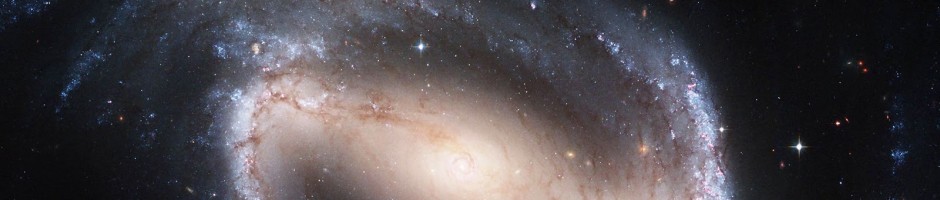
What's the blue stuff below?
‘Anyone?‘ asked Hanny from the Galaxy Zoo Forum. She came across a weird blue blob that none of us could really make any sense of. It’s right next to a rather massive galaxy that might be a spiral or a somewhat disturbed galaxy.

A highly scientific illustration.
At first, we had no clue. The mystery blob didn’t have a spectrum, so we couldn’t tell much about it at all. It could be in our Milky Way, it could be as distant as that big galaxy, or it could even be at the edge of the universe. Bill Keel enhanced the SDSS image a bit (see below) to reveal the intricate structure of what became known as ‘Hanny’s Voorwerp’ (object).

The five different SDSS bands (g,u,r,i,z), note the intricate structure in the g-band image.
The object seems to be very bright in the g-band image and virtually absent in the others. This led us to think that it must be an emission line object, i.e. an object which emits most of its light only in very specific atomic transitions. This usually means that what we are seeing is ionised gas, rather than stars. Still, it could be anything. Bill Keel kindly also obtained a multi-colour image with the 0.9m SARA telescope at Kitt Peak. The three colours here are much closer to what human eyes would see, so as Bill pointed out, it’s actually much more appropriate to call it the mystery *green* blob.

BVR image from the SARA telescope.
We’ve managed to contact a friend of ours who is currently observing at the 4.2m William Herschel telescope in La Palma and convinced him to take a spectrum of the Voorwerp for us. It shows us that the Voorwerp is…. *drumroll* at the same distance as the big galaxy. This implies that it’s really rather huge and luminous.What does all this mean? What is the Voorwerp? That’s not too clear yet. We have to properly analyse the spectrum to understand what exactly is going on. It’s likely forming stars at a huge rate, ionising lots of gas and making it shine. We’re also trying to get a deeper image to see if there’s evidence of an interaction between the big galaxy and the Voorwerp.So what’s next? We’ll have to do a lot of work to understand this mystery blob better. Right now, the Voorwerp is only slightly less mysterious than when we started, but I have a feeling that it’s going to be really good fun figuring out what is really happening here. It also shows the power of Galaxy Zoo and of having you guys go through the images by eye. If Hanny hadn’t spotted it and asked, we’d never have known about it!
Interview with Chris on cosmology
The Bad Astronomer has an interview with me on his site, talking about the cosmology results.
w00t!
I just got a compliment on my chef hat from a Nobel Prize recipient.
UPDATE: By popular demand, here is the slightly embarrassing photo:

In the eye of the beholder?
Hey guys and girls,
So, as you probably know, the last month or so of Galaxy Zoo has been dedicated to testing whether we have any bias in our classifications (and if you want to know why we are interested in looking at the rotation of galaxies then please have a read here). By ‘bias’ we basically mean some systematic error in the way people classify (you can get a good explanation in Jordan’s post), and this is different from just random general scatter of results. For example, we know that when a galaxy is faint or small then people are more likely to think it is an elliptical galaxy – and this particular mophology bias is something that Steven must compensate for in his work.
It has been really exciting to work on the rotation classifications of Galaxy Zoo, and as many of you know early on in the project we realised that people were classifying more galaxies as anti-clockwise (see the Telegraph article for example). Specifically, if we take those galaxies that are well classified (ie. more than 80% of people agree) then we find we have an anti-clockwise:clockwise ratio of about 52:48. This may not sound particularly significant, but as you increase the number of galaxies that you have in your sample (as more of you lovely people classify for us) then this ratio becomes more significant, and is highly unlikely for the ~35,000 galaxies that we have. [For those of you who like probability, the number of anti-clockwise galaxies that we expect is distributed according to a Binomial probability distribution. And if we assume that the ratio is really 50:50, then out of a total of N galaxies we expect N/2 to be anti-clockwise, with a standard deviation of sqrt(N/4).]
In the plot below we show the relative excess of clockwise votes (for users that classified more than about 300 galaxies) – this is the number of clockwise votes minus the number of anti-clockwise, votes divided by the sum of the two. For example, this number would be 1 if a user always clicks clockwise, and zero if they click both clockwise and anti-clockwise equally.
 This graph confirms that everyone is generally clicking anti-clockwise more often, because we see that the mean tends to lie below the zero line. But this plot cannot distinguish between intrinsic excess of anti-clockwise galaxies on the sky or human bias, and it is obviously very important for our rotation results that we get a handle on this as we could not announce our possible anti-clockwise excess result to the scientific community without doing these bias checks. So the basic idea is to look at the votes for a galaxy before and after a galaxy image is flipped. For example, if 6 out of 10 people thought it was originally clockwise, then after flippping we expect about 6 out of 10 people to now think it is rotating anti-clockwise (if there is no rotation bias).
Since the end of November many of the images in Galaxy Zoo have been flipped for this purpose (and we’ve been monitoring the status here), and we now think that we have enough data to measure the levels of bias. This week Anze has flown over from Berkeley (in California) especially to crunch the numbers with Kate (in Oxford); it is quite a job – with over 7 million classifications to go through! And during our analysis some rather subtle points arose… as with most science, things don’t go exactly to plan!
So we basically wanted to compare the classifications for a galaxy before and after flipping, but we quickly realised that peoples behaviour in the last month or so is very different to the earlier datasets (see Anze’s post for an explanation of how we reduce the data). For example, recently people have been more likely to click the ‘Star/Don’t know’ button. This might be because we have lots of new users, recruited through our latest publicity drive. Or maybe lots of old members have come back after receiving the newsletters. Either way it meant we couldn’t simply compare before and after votes. Also, annoyingly, the original unflipped images are no longer on the site and so getting a handle on this behaviour change was a bit tricky (note that one of the first rules of scientific experiements is to have a control test, but accidentally a miscommunication amoungst team members meant that in this case our control sample got left out!). Fortunately though, we are able to use the monochrome images that are currently in the site to compare to (as we observe that being in black and white does not change how people choose between anti-clockwise and clockwise).
So we want to know what the average votes per button are, for the average galaxy in Galaxy Zoo. This is where we encountered our second problem – our bias sample does not cover all of the Galaxy Zoo galaxies, but just 10% of them, and this 10% was not selected at random. In particular we know that we have more anti-clockwise galaxies in the bias sample (on the site at the moment). Therefore we needed to careful undo what we did when we selected this subsample, so to then construct an effectively random subsample of our full database. Then we could look at the average weights.
In the figure we show the average fraction of votes that a galaxy gets for clockwise (class=2) and anti-clockwise (class=3). We show the result for the original classifications in black (before December), for the monchrome images in red, and for the flipped images in green. We also show the 1 standard deviation errorbars from sampling.
 So what we see is that the class=3 points are always higher than the class=2 points, and crucially this is true even after we flip a galaxy image! Looking at the red points, we find that before flipping there is a 6.0% chance of hitting anti-clock and 5.5% of hitting clock for our sample. Then after flipping (green) there is a 5.9% of hitting anti-clock and 5.6% of hitting clock. So the point is that those numbers stay the same (within 1 standard deviation) when they should actually reverse if there is no bias. It is easier to think in terms of the ratio of fractions:
anti/(anti+clock)=0.522 before flipping
anti/(anti+clock)=0.512 after flipping.
And if we had:
a) no bias and no excess then these should both be 0.5.
b) no bias and a real excess then one should be the opposite of the other (ie. 0.52 and then 0.48)
c) a bias and no excess then we would expect them to stay the same and not equal 0.5.
But what we actually find is that 0.522 is 5 standard deviations away from 0.5, 0.512 is 3 standard deviations away from 0.5, and 0.522 & 0.512 are within 1 standard deviation of each other. So you see we appear to be convincingly in situation (c).
So what next? Well – it is fantastic that we have been able to get a handle on the bias even if it did turn out to be effecting our results. Only with Galaxy Zoo which has so many contributors were we able to detect the bias (and it may turn out to be an inherent bias in the way people see galaxies, which an interesting psychology result). Without so many classifications the excess result would have always remained uncertain. And while we no longer think we have an overall excess of anti-clockwise galaxies (which we never expected in the first place!) we can still do a lot of interesting work and pursue our original scientific aims, as explained here and here.
Thanks guys! And keep up the good work. Current classifications remain useful, and we hope to give you some more images next week (possibly returning to the full catalogue!).
Cheers, Kate & Anze
Down the pub with Alaskans*
It is a rule of scientific meetings that some of the most productive times are informal gatherings with your colleagues, who are also your friends. And like any gathering of friends, they often take place in the pub. Funding agencies won’t pay for the beers – we pick up that expense ourselves – but it’s worth it. Everyone is a bit more relaxed, and it’s easy to generate new ideas. One of my university professors tells a story of how he made an offhand suggestion to a friend of his in the pub after a long day of meeting – a suggestion that resulted in his friend winning the Nobel Prize.
Yesterday, I went to the Hilton hotel bar with Dr. Travis Rector of the University of Alaska Anchorage, along with some extremely bright colleagues from the University of Arizona and the Ohio Department of Education.
We discussed the state of science education in U.S. universities. Travis’s passion is getting all undergraduates taking astronomy courses to do some research – not just the science majors, but everyone. He came up with a brilliant analogy for the current state of affairs, and how we can improve it. The analogy was about baseball, so I will internationalize it.
The way we run a traditional science class is as if we were trying to teach students how to play soccer (football) by showing them videotapes of matches, without ever letting them play the game.
But it’s even worse than that! We tell them about the results of science as knowledge, which is like teaching about football by showing them highlight reels of spectacular goals, without showing them the careful match strategy – not to mention years of practice – that goes into creating those goals.
In science, it’s extremely rare that a result comes fully-formed from the mind of a single person, just as in soccer, it’s extremely rare that one person creates a goal all by themselves (sorry, England fans, that really is the archetypal example). How long do you think Maradona had to practice to do that? It took Johannes Kepler 10 years of poring over Tycho Brahe‘s data to figure out his laws of motion.
It’s our hope that exposing people to the day-to-day process of scientific research, through Galaxy Zoo and this blog, can help someone develop an appreciation for the day-to-day process by which science actually works.
*Actually, only one Alaskan, and he’s not originally from Alaska – he only works there. But having that title for a post was too good to pass up.
AAS Day 2, afternoon
Hi, all. I’m still at AAS. I haven’t been able to post as often as I would have liked because I’ve been tied up at the Sloan Digital Sky Survey exhibit booth (not literally). The SDSS is the source of all the images for Galaxy Zoo, so it’s an important part of what we’re all working on.
This morning, I finished my poster about Galaxy Zoo volunteers, which I’m giving tomorrow. Friday, Chris will be giving a talk about the science results, which have just gotten interesting again, in a way that is totally different from the way they were interesting before. More on that soon, from Kate.
Day 1 of the meeting is over, and Day 2 is underway. The highlight of Day 1’s programme was a speech by NASA Administrator Michael Griffin (not to be confused with American football player Michael Griffin). I wasn’t able to see it – these meetings are big enough, and there is always something going on, that not everyone gets to see everything – but Pamela, Fraser, and Phil did an excellent job reporting on the talk.
My day yesterday was pretty full. Like any big public meeting, AAS takes place in a convention center with a big open space for exhibits. A scientific meeting is similar in some ways to another such meeting, and different in some ways too. At a meeting like the Consumer Electronics Show (which is going on right now in Las Vegas), electronics manufacturers show off their latest consumer products in the exhibit hall. At AAS, there is also an exhibit hall, but what is being shown is astronomy results and equipment.
As I mentioned, I’m at the Sloan Digital Sky Survey exhibit booth. I’m in charge of it this meeting, so I should stay close – it’s good to have someone around at all times to answer questions from people that stop by. To my right is the booth for the Combined Array for Research in Millimeter-Wave Astronomy (CARMA), and to my right is the booth for the International Year of Astronomy 2009. That’s a good reflection of the meeting, actually – both research and public understanding of science are represented.
My job at the booth is to answer questions from astronomers and others who stop by. Of course, lots of my colleagues know I’m here, so they stop by too, and we chat about various projects we’re working on. I wear lots of different hats, one of which is quite literal. I’m doing demos of SkyServer, our data access site called Cooking with Sloan. I wear a chef’s hat for the demo – I hope to have a photo up on the blog soon.
Chris in Texas
I’ve just realised that everything I’ve just written in this blog post over at my personal site is relevant to Galaxy Zoo. Enjoy.
Howdy from Texas!
Howdy, y’all! I’m at the American Astronomical Society meeting in Austin, Texas. Many of you had said you wished you could come to this meeting. Zookeeper Chris and I are here, and we’ll try to give you a vicarious experience of what it’s like here. We’ll be posting more often than usual this week, as well as later – Austin is 6 hours behind the U.K. Next week, we’ll resume our normal Monday-Thursday schedule.
We’re also coordinating with a couple other astronomy blogs to better cover the meeting. We’re working with Fraser Cain and Pamela Gay from Astronomy Cast, and Phil Plait from Bad Astronomy.
You can follow all our blogging at the Astronomy Cast Liveblogging page:
http://www.astronomycast.com/LIVE/
Whenever any of us posts, we’ll mirror it on that site for everyone to see. If this works, we’ll try to do it again at future meetings. Hope you enjoy it!
Blue ellipticals – lots of them!
Hey all, as some of you know, I’m working on the blue ellipticals in Galaxy Zoo. I’ve been working on the formation and evolution of elliptical galaxies ever since I started my PhD. In many ways, they’re the most interesting galaxy type out there because they never really want to come out “right” in simulations. They are rather enigmatic objects and we’re not sure how they form.
They *appear* to be completely quiescent – i.e. not forming any stars* – but more recent work by our group has shown that that’s not entirely true. We used the GALEX ultraviolet space telescope to look for small amounts of hot, blue young stars in elliptical galaxies and to our surprise found them to be very common!
It turns out that it’s just too hard to really disentangle such small populations of young stars against the background of really old stars. Unfortunately, this idea that elliptical galaxies are all old and have no young stars in them led some people to specifically *exclude* any galaxies that might have young stars in them from the elliptical class. So our discovery from the ultraviolet data led us to search for more of these elliptical galaxies with young stars in them.
We knew that the only way to find them was my making our own catalogue of ellipticals where we would *not* throw out things that look like ellipticals but had the blue colours or spectra indicating young stars.
I did classify 50 000 galaxies from the SDSS by eye in a week, dividing galaxies into ellipticals vs. everything else; once I was done, I checked to see what was left. And lo and behold, there was a small but significant population of *very* blue elliptical galaxies! This project of course led to Galaxy Zoo, since 50 000 may sound a lot, but it’s only a tiny fraction of the 1 million in SDSS. So now with all the classifications from all you guys (thanks so much!), I’ve been able to study blue ellipticals in much more detail.
Here’s what I did: I selected a redshift (distance) range and a limit in absolute magnitude (luminosity – how bright the galaxies actually are) to create a “volume-limited” sample. That’s a sample where I know that I’ve got all galaxies down to a certain luminosity limit in a certain volume. That’s important when you want to compare numbers (e.g. blue vs. red ellipticals), because blue and red galaxies can have different luminosities, and we must compare apples to apples.
I already knew from earlier tests that your classifications are absolutely awesome, but when I pulled up the images of those galaxies that you classified as “elliptical” that also had very blue colours, I was amazed. Here they were! Blue ellipticals, lots of them!
So with this incredible sample in my hands, I started work on a paper. In Chris’s words, it’s a “classic astronomy paper” because we’re doing nothing fancy, but simply report what we find. The most important finding (I think) is that blue ellipticals exist (i.e. they aren’t misclassified spirals) and that they aren’t super-rare, but make up ~5% of the elliptical population.
We’ve also measured their star formation rates in a variety of ways and the measured rates make them by far the highest ever reported for ellipticals. We have some ellipticals with star formation rates of over 50 solar masses per year. To compare, our own Milky Way only manages about 3 per year!
Here are some example images (click for a larger view):

What’s next? I am still polishing the text and we’re doing some comparisons to a simulation. After that, I will circulate the draft with the other team members again for a final round of comments and then it’s probably good to submit to a journal.
Speak your weight
Following Anze’s post we’ve had a number of requests from people to see their weighting. Indeed we did think about this for a bit, but alas I reckon it’s a bad idea to publish users weights for a number of reasons – but mainly because it is very unclear what the weights really say about a user. For example, a user might be really upset to see that they have a low-weighting, indicating that they often disagree with the majority of people (if we use a democratic weighting scheme). They might then try to alter their classifying behaviour so to ‘improve’ their weighting. This would be disastrous, because perhaps they are actually excellent at classifying, and much more meticulous than the majority of other users. In this case a low weighting would be good! The majority ain’t always right, right?!
If providing this kind of feedback was to have any effect then this would be bad – because it would mean our data becomes correlated in complicated ways that we can’t trace i.e. the results from one week can affect the next week. Ultimately everyone will want to up their weighting, and I can imagine a horrible situation where everyone just clicks elliptical all the time! Because this would give everyone great weightings – but completely ruin the project!
Therefore, you see that knowing your weight can only have a bad effect (if it isn’t going to have an effect then there’s no need to know 😉 ). Ideally we don’t want anything to have an effect on you – we want everything to be as unbiased and open and transparent as possible when it comes to analysing the results.
Plus the weights change all the time, as more classifications are made and it is computationally very intensive to compute them. Further, there’s an infinite number of ways of working out the weightings! We could see how well you agree with each other for just the bright galaxies, or how well you agree with an ‘expert’. But the point of all this is that we do not know the true morphology of these galaxies – and therefore we cannot give you a true weight (ie. how well you are classifying).
I hope that helps to explain our situation a bit! I appreciate that it must be a bit frustrating not to get more feedback on your classifications. Perhaps when this phase of the project is wrapped up then we can feedback more… and ultimately all this data is probably going to be made public! Cheers, Kate
 Galaxy Zoo
