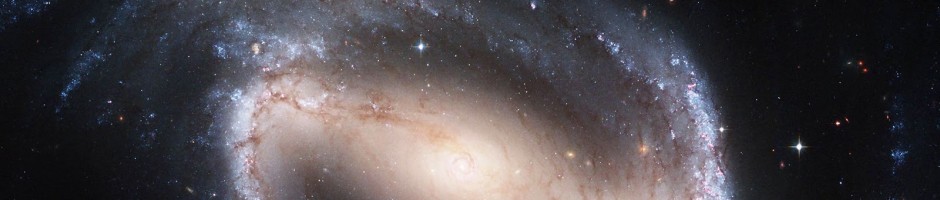
First Results from Galaxy Zoo: CANDELS
I am very happy to present the results from the first published paper based on your classifications of the HST-CANDELS Images.
Galaxy Zoo: CANDELS combined optical and infrared imaging from the Hubble Space Telescope, which allows us to probe galaxies back to when the universe was only around 3 billion years old (early than we could do with optical HST images alone). So we are looking at galaxies whose light has taken over 10 billion years to reach us!
Our first area of research with this data is to look at disk and barred disk galaxies, as the title suggests…….

This work is based on an initial sample of 876 disk galaxies, which are from the Cosmic Assembly Near-Infrared Deep Extragalactic Legacy Survey (CANDELS). We want to explore what happens to barred disk galaxies beyond eight billion years ago, building on our work looking at the evolving bar fraction with Galaxy Zoo: Hubble.
When we began this work, we were unsure what we would find when looking so far back. From our Galaxy Zoo: Hubble work we had identified that 10% of disk galaxies hosted a galactic bar eight billion years ago, but beyond this our knowledge of disks was limited to a single simulation of disk galaxies. This simulation predicted that bars in disk galaxies were very rare beyond the epoch we had observed to, as the Universe would be to young for disk galaxies to
have settled down enough to form barred structures.

Figure 1: The bar fraction of GZ: CANDELS galaxies (top), and the absolute magnitudes of all the disk and barred disk galaxies in the sample (bottom) (Figure 5 in the paper).
As Figure 1 shows, we actually find that roughly 10% of all disk galaxies host a bar, even back to when the Universe was only 3 billion years old! This is a very exciting result, as it shows that disk galaxies were able to settle at much earlier times than originally believed.
What we need to understand now is how do these disk galaxies form their bars? Could they be completely settled disk galaxies which have naturally formed bars, even during this epoch of violent galaxy evolution where galaxy mergers are more frequent? Or were these bars formed by a galaxy-galaxy interaction, as seen by some simulations? The answer could be one or the other, or most likely a combination of these two theories. Either way, we hope to explore this population of barred disk galaxies in greater detail over the coming months!
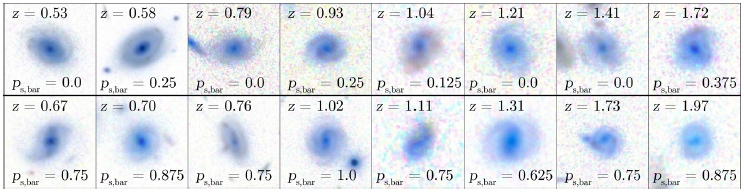
Figure2: Examples of disk (top row) and barred disk (bottom row) galaxies from Galaxy Zoo: CANDELS (Figure 3 in the paper).
So there is a summary of the first Galaxy Zoo: CANDELS paper. If you would like to see this in more detail, please take a look at the paper here, and why not check out the RAS press release too! Thank you all for your hard work, and keep classifying!
Posted on behalf of Tom Melvin.
New Galaxy Zoo Paper Accepted For Publication!
A paper that uses Galaxy Zoo: Hubble to study whether supermassive black holes are fueled by galaxy bars beyond the local universe has recently been accepted! The paper will be published in MNRAS, but for a short summary, here is the original blog post.
Fibers and Voorwerpjes
While preparing for more observations of the Galaxy Zoo giant AGN clouds (Voorwerpjes), this is a good time to introduce more complete ways of obtaining astronomical spectra. Traditionally, we’ve put a long slit in front of spectrographs, so we can measure everything along that line without worries about overlapping spectra of different objects or pieces of sky. In some cases, as with the optical fibers used by the Sloan Digital Sky Survey, we get the light summed within a circular aperture on the sky (with Sloan, from hundreds of different objects at each pointing of the telescope). But many of the things we want to understand are large and oddly shaped, so these approaches limit us to a very partial view (or to making many observations to cover everything of interest). Enter the Integral-Field Unit (IFU), which is any kind of device that lets us get the spectrum of every point in some region of the sky. They often use fiber optics to rearrange light from the object, so each small region of it comes out at a different place on what would otherwise be the spectrograph slit. After that it all becomes a software problem.
IFUs are becoming more common on large telescopes. We’ve gotten excellent data on some Voorwerpje systems with the unit on the 8-meter Gemini North telescope. Here’s a sample of raw data on UGC 11185. Each horizontal streak is the spectrum of an area 0.2 arcseconds square. The sampling, sensitivity, and image quality are superb, revealing multiple clouds of gas moving within a total span of almost 1000 km/s.

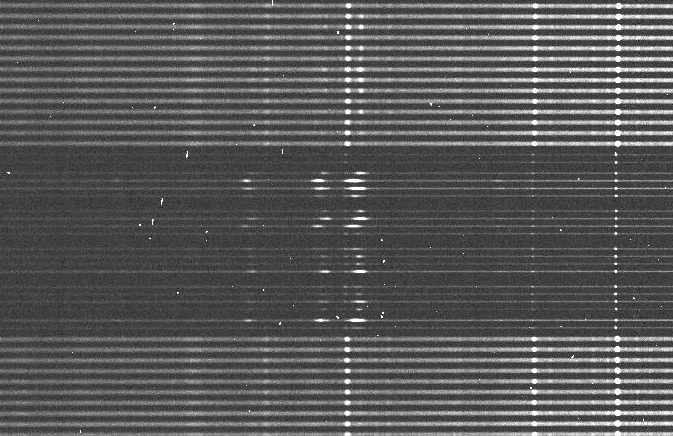
On the other hand, if we want to use its whole wavelength range, the Gemini device covers only 3.5×5 arcseconds of sky at once. I’m headed to the 3.5m WIYN telescope on Kitt Peak to use a complementary device called Hexpak, newly commissioned by instrument designer Matt Bershady of the University of Wisconsin (who I’ve been emailing about this since I learned of the project three years ago). This fiber bundle plugs into the multipurpose spectrograph kept in a climate-controlled room below the telescope, and combines small and densely-packed fibers in the middle (for things like galactic nuclei, small and bright with lots of structure) and large fibers near the edges (collecting a lot of signal from large diffuse surrounding material – sound familiar?). Matt and his team were able to get a short exposure through thin clouds of UGC 11185 as a feasibility test – here’s a piece of that raw data frame, showing the small central fiber and the larger surrounding ones (which show brighter night-sky airglow lines as well as more object signal; the bright [O III] lines and H-beta are near the middle, with wavelength increasing to the right for each spectrum). I hope to get a lot more data like this shortly.
Elsewhere, the European Southern Observatory has commissioned an enormous IFU, and the Sloan team has rebuilt their fiber bundles so that each one now makes multiple IFUs which can be placed on many galaxies at a time – this part of the Sloan survey extension is known as MANGA. Then there is the Spanish-led CALIFA project for hundreds of galaxies, which has publicly released data for their first two subsets. Then there are SAURON (whose data ca be tamed in software by GANDALF) and the upgrade of SCORPIO-2 and more… Swimming in data as we sift for knowledge, I am reminded of this anonymous computer error message in haiku form:
Out of memory.
We wish to hold the whole sky
but we never will.
Radio Galaxy Zoo: “gold standard” images and improving our calibration
First off, the science team for Radio Galaxy Zoo wants to thank our volunteers for their continued clicks, discussion on Talk, and continued participation in the project. As of today, we have 892,582 classifications on RGZ and over 45,000 subjects completed from the FIRST-SDSS sample. We absolutely could not do this without you, and we’re working hard on turning the data into interesting science.
We want to let you know of some particular galaxies that will be appearing slightly more often in the interface. One of the things I’ve been working on for Radio Galaxy Zoo over the last month is finding better and smarter ways of combining clicks from independent classifiers into the “final answer” for each galaxy. For past Zooniverse projects, we’ve been able to do this using relatively simple methods – users are weighted a little bit by their consistency with other volunteers, but the final data product is mostly just the vote fractions for various tasks. However, the task in RGZ is a bit more complex, and the simpler methods of combining classifications are proving very difficult. In order to accurately combine the information each volunteer gives us, we need to establish a bit more common ground than we currently have.
To calibrate the clicks across all citizen scientists, we need to look at galaxies that the same people have done. The science team has started this by labeling the correct morphologies (to the best of our abilities) for a smaller, “gold standard” sample. We use these as seed weights in our data reduction – that lets us calibrate users who have done the gold standard galaxies. These results are propagated outward to the full sample by looking at other galaxies done by both calibrated and uncalibrated users, and so on. Kind of like pulling ourselves up by the bootstraps. 🙂

Result of the science team classification of a small sample of 100 RGZ galaxies. The height of the bar represents how well a particular science team member agreed with the others. As a group, the results show very good consistency overall, near 90%. Using the results from this sample, we can apply similar calibrations to the tens of thousands of galaxies that RGZ citizen scientists are helping us with.
What we’re missing right now, though, are galaxies that lots of citizen scientists have jointly classified. Since each galaxy is retired after 20 people classify it, the chances of seeing a particular galaxy is pretty low. Some members of the science team, including myself, recently sat down with a sample of 100 galaxies taken from a combination of random selection and ones you’ve identified on Talk as having interesting or non-trivial morphologies (bent jets, triple systems, giants, no IR counterparts, etc). These is what we’d like to use for calibration. However, only about a dozen users so far have done enough of this sample to give us enough data for calibration.
So, in order to help the accuracy of the data pipeline, we’ve chosen 20 “gold standard” galaxies that will eventually be shown to all volunteers. They won’t all be in one bunch (you should see one every five subjects or so) and you shouldn’t see any galaxies that you’ve classified before. We’ll label the galaxies on Talk – look for the hashtag #goldstandard. I hope that another positive outcome will be users getting to discuss interesting features in galaxies that they haven’t come across before. After you’ve done all 20 galaxies in the sample, your future classifications will be randomly selected as usual.

ARG0001e8e – a very nice core + hotspot system, and slightly challenging morphology to classify. This is one example of the 20 “gold standard” galaxies we’re trying to have everyone in RGZ classify.
Please let us know on Talk if you have any questions about this, and I’ll be happy to discuss it further. Thanks again for all of your help – we hope this will let us produce a more accurate RGZ product and science papers in the coming year!
 Galaxy Zoo