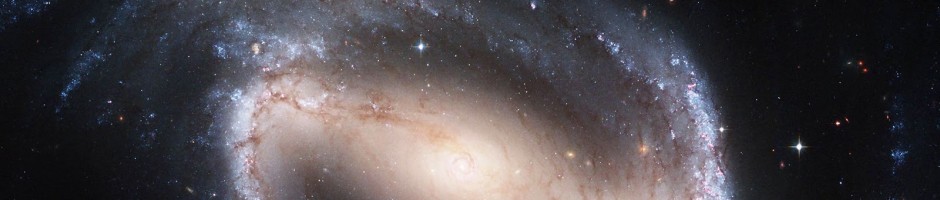
Galaxies spiralling out of control
Today’s OOTW features Alice’s OOTD, posted on the 29th of July.
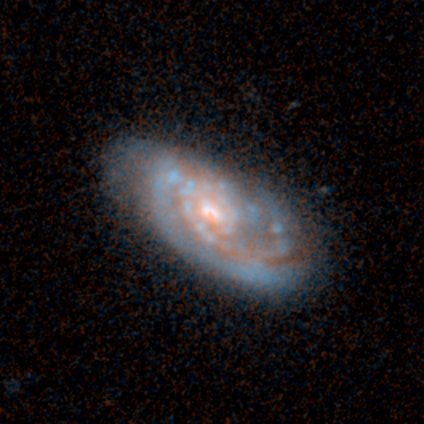
AHZ40004wr from Hubble Zoo
This is AHZ40004wr, a galaxy residing in the constellation Taurus around 3 billion light years away. It’s a wonderful spiral galaxy, and following its spiral arms is a large dust lane, a place full of young stars and stars that are only just being formed.

AHZ40004wr by Swengineer
Zooite Swengineer gave us a wider view of AHZ40004wr and the surrounding galaxies by working with the FITS images and revealed the mess of galaxies above. The main spiral galaxy in the background is 2MASS J03324999-2734330, an X-ray source according to SIMBAD, and it is also around 3 billion light years away.
You can view more images of these galaxies here and here, and to work with the FITS files I recommend DS9 or Aladin, which I used to find the other galaxies details.
And to highlight a request from Alice’s OOTD, Alice would very much like to know if anyone could write any FITS and image editing tutorials on the galaxy zoo forum.
Zoo 1 data set free
Hi all
It’s taken longer than it should have done – more than three years since the launch of the site – but the data from the original galaxy zoo is now available.

The paper describing the data set was only accepted by the journal yesterday, but we were confident enough after an earlier report to go ahead and make it public. The data can also be downloaded in a variety of formats from our site, or via Casjobs.
The data set is slightly updated from our previous efforts; while we’ve been busy with Galaxy Zoo, the good people of the Sloan Digital Sky Survey produced a new data release which included more spectra, allowing us to estimate biases for more galaxies than ever before.
We’ve had a lot of fun exploring this data set, and we hope that by making it available to all other astronomers then they will make use of your classifications too.
Knowing the Zoo, I wouldn’t be too surprised to see something interesting come from any of you who wanted to have a play – feel free to download and dig in, and let us know how you get on. Meanwhile, the team are working hard on Zoo 2, and hopefully it won’t take as long before that data set too is ready to go.
The Sunflower of Canes Venatici
This galaxy is featured in LizPeter’s OOTD for 24th of July 2010.
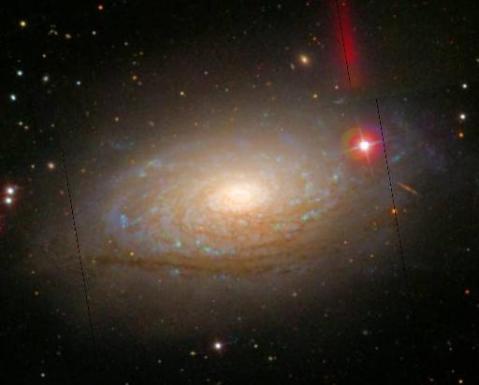
M63 from the SDSS
This is Messier 63, though I much prefer its other name, the sunflower galaxy. It’s a wonderful dusty spiral galaxy lying 22.9 million light years away from Earth in the constellation Canes Venatici. It’s one of 7 galaxies bound gravitationally together in the M51 group, and according to Wikipedia, it is one of the first objects to be seen to have spiral arms. This was pointed out in 1845 by William Parsons in a time when these objects were thought to be ‘spiral nebulae’ in our own galaxy, and not galaxies themselves. SIMBAD also claims that there is a cluster of stars lying in the foreground of the galaxy.
There are some brilliant Hubble Legacy images and spectra here, and some more from assorted observatories here!
Observing Red Galaxies With VIRUS-P
Hi Zoo fans,
My name is Peter Yoachim and I’m currently a postdoc working in the Astronomy Department at the University of Texas in Austin.
I got involved with the Galaxy Zoo after I saw Karen’s paper on Red Spirals. When I first read the paper I thought, “Wow, that’s really cool, spirals shouldn’t look red like that, wonder what happened to those galaxies.”, followed shortly by, “OMG, we have the perfect instrument to make follow-up observations of these objects!”
While I’ve been at UT, I’ve been making extensive use of VIRUS-P (Visible Integral-field Replicable Unit Spectrograph Prototype), a new instrument at McDonald Observatory in West Texas. Right now, VIRUS-P is mounted on the 2.7m Harlan J. Smith telescope. While modest in size by current standards, the 2.7m has been a scientific workhorse since 1968 although it is probably most famous for having several bullet holes in the primary mirror.
As I tell my 101 students, images of the sky are a great starting point, but if you want to do Astrophysics, you need to observe some spectra. With galaxies, the full spectra can tell us how different parts of the galaxy are moving (via the redshift and blueshift of light), what kind of stars are in the galaxy, and if there is any hot gas present. VIRUS-P is great for getting spectra, especially for targets like nearby galaxies.
In the bad old days (like when I was doing my thesis work 6 years ago), it was common to pass light from the telescope through a narrow slit, then bounce it off a grating to disperse the light onto the detector to observe the spectrum. The problem is that the narrow slit blocks most of the light from the galaxy. This is a tragedy! That light traveled for (literally) millions of years only to bounce off the slit mask at the last second.
Rather than use a long slit, VIRUS-P uses a fiber-optic bundle to pipe the light around. Here’s an example from a recent paper. NGC 6155 is just a nice normal galaxy, here’s an image of it from the Sloan survey:

When I observe the same galaxy with VIRUS-P, I see this:

Each circle represents a fiber. I’ve color-coded the fibers so that the brightest spectra are blue and the faintest are red. This isn’t too fancy, it even looks quite a bit worse than the Sloan image. But look what happens if I calculate the velocity from the redshift of the spectra in each fiber:

Now we can see the rotation of the disk. The top left of the galaxy is moving away form us, while the bottom right is moving towards us. The redshift of light only shows us the part of the motion that happens to be along our line of sight, but that’s still enough to get a good idea of how the stars and gas in the galaxy orbit the center. The next trick is to add up the spectra from multiple fibers to build up the signal to make it possible to measure accurate ages for the stars.

What we see here is the center of the galaxy is old (~7 billion years), while the disk is young and still forming stars (average age ~4-6 billion years). The youngest section that’s 4 billion years old corresponds to the bright blue spiral arms in the Sloan image. The cool part is the very outskirts of the disk are made of very old stars (8-10 billion years old), a result some of my coauthors actually predicted.
It should be clear now how VIRUS-P will be great for observing the red spirals. We can compare the motions of red spiral disks to regular spirals, and we can measure stellar ages to try and determine when star formation shut off in these galaxies.
The observing of the red spirals has been done by intrepid UT graduate student John Jardel. With the remnants of hurricane Alex blowing through, the observatory has received excessive rain this summer. All that rain makes it hard to observe, plus it lets the rattlesnakes and scorpions thrive. Here’s a scorpion I caught in the observatory lodge last week:

Despite the weather and wildlife, John was able to observe 5 galaxies. We’ve just finished our last observing run of the season, so we haven’t had a chance to analyze the data yet. But looking at the raw images, we already see something interesting:

The horizontal stripes are the signal from each individual fiber. The bright vertical lines are emission lines from the earth’s atmosphere. The two circles show 5 fibers where we can see bright spots. Those spots are emission from hot Hydrogen gas in the galaxy. If there’s gas, it’s possible these red galaxies could start forming stars again and turn back to regular blue spirals. Since the gas is hot and in emission, it could even be the case that there is star formation going on right now.
Markarian and the Blob
Today’s OOTW features an OOTD written by Alice on the 15th of July.
117 million light years away there lies a Markarian galaxy and a very interesting companion. As Alice says in her OOTD, these Markarians are galaxies that emit strongly in ultraviolet and visible light, and are often a host to AGN.
During the observation run at Kitt Peak the Galaxy Zoo team had some spare telescope time going after observing a list of Voorwerpjes, so Bill Keel asked Zooites on the forum to provide objects to get a spectrum for:
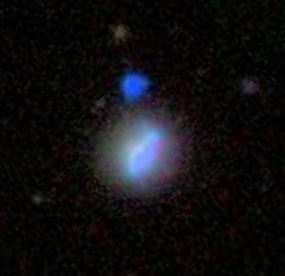
MRK 490 and its blue companion.
The bright blue blobby companion just above the Markarian galaxy MRK 490 centred in the picture above was one such object that was observed. The companion is brimming with new stars as shown by the huge emission line (amongst others) of OIII at around 5000 angstroms in the spectrum below, the object is very close to the galaxy below it going by their redshift, so it is suspected to be interacting with it!

Spectrum for MKN 490's companion; click for larger image.
Chandra Program to study Galaxy Zoo Mergers approved
Good news, everyone!
Earlier this year we submitted a proposal to use the Chandra X-ray Observatory to observe a set of merging galaxies in X-rays. The target list for Cycle 12 has just been released, and with a bit of scanning, you can find a set of targets with names like “GZ_Merger_AGN_1”. These targets are a set of beautiful merging galaxies discovered by YOU as part of Galaxy Zoo 1 and the Merger Hunt. The 12 approved targets are here:

These 12 mergers are all very pretty, but they have something else in common: they all host active galactic nuclei (AGN) – feeding supermassive black holes at their centers. X-rays are great for finding such hungry black holes, but we already know that all 12 of these mergers are AGN, so why observe them again? We’re looking for a mythical rare beast: the binary AGN!
Only a handful of these objects are known and they were discovered by chance. We believe that every massive galaxy has a supermassive black hole at its center and so when two galaxies merge, then there should be two black holes around for a while, that is, until they merge. The goal of our Chandra study of these 12 mergers is to systematically search for binary AGN in merging galaxies to work out what fraction of them feature two feeding black holes. Knowing whether such phases are common or not is important for understanding how black holes interact with galaxies in mergers and what exactly happens to them as they plunge towards the center of the new galaxies where they are doomed to merge and form a single supermassive black hole.
As usual, it may be quite a while before we get the data. The observing cycle won’t start for a while and takes about a year. Since our observations are short and we don’t have any time constraints (they’re galaxies, they don’t move!) the Chandra operators will most likely schedule our observations in between longer projects and time sensitive observations and so we won’t know when they will happen. Of course, once we do get the data, we’ll definitely update you.
Oh and you might notice some of the targets in the Merger Zoo in the near future. We’ll need your help to fully understand them….
Happy birthday to us.
Galaxy Zoo is three years old today. Three years ago, I opened my laptop in the back of a Royal Astronomical Society meeting, connected my laptop to the rather flakey wifi network and noticed the site had crashed under the sheer weight of demand.
Three years on, we’ve produced excellent science, have moved on to the distant Universe, built the Zooniverse and, thanks to the contributions of every single person who has ever classified a galaxy, established that involving the public in research is an excellent way to get things done. Here’s to the next three years.
Chris
P.S. You can hear Kevin and I discussing his work on active galaxies on today’s 365 days of astronomy podcast.
P.P.S. Thanks in particular to the forum for their birthday cards and best wishes.
Black Holes with an Appetite

SDSS J142005.59+530036.7 from AEGIS
This object has the imaginative name SDSS J142005.59+530036.7. It lurks in the Bootes constellation and although it looks like a star, it’s actually a Quasar 15.3 billion light years away from earth going by its redshift. I have a love for Quasars, so I couldn’t resist this one in Budgieye’s OOTD posted on the 6th of July!
In the heart of this galaxy lies a super massive black hole like most other galaxies. This particular one is an AGN, an Active Galactic Nucleus. AGN are super massive black holes in the centres of galaxies that are pulling in material from around them such as stars and gas. This material gets pulled into a ring doughnut shaped accretion disk around the black hole, and as this material swirls round it causes friction, releasing radiation out into the galaxy. The centres of these galaxies can be so energetic that they can outshine the galaxy itself; hence all you can see in the picture above is a star-like object- the nucleus of the galaxy.
This energy can also be concentrated into jets of high energy plasma racing out at near to the speed of light for thousands of light years from the poles of the black hole, and depending on how these jets are positioned in relation to us the galaxy the AGN is lurking in can be called radio galaxies, Blazars, Seyferts and so on. In this case it’s a Quasar, so the jet is positioned so that it’s not quite beaming directly at us. Here’s a great OOTD by Fluffyporcupine on AGN!
And thanks to Alice for helping me out! 🙂
From Voorwerp to webcomic – the quest continues
This weekend, we’re trying to make as much progress as we can toward producing the webcomic “Hanny and the Quest of the Voorwerp”, a NASA-supported public-outreach effort. Pamela (AKA starstryder) and Bill are at CONvergence in Minneapolis, Minnesota, meeting with writers and artists. In Galaxy Zoo style, we’ve invited people who want to help write it to get involved at three daily working sessions here (with professional writer Kelly McCullough doing the final editing and organizing), then passed onto the artist and colorist. We’ll swap passages with our views of the proceedings.
You can also follow us on Twitter @hannysvoorwerp
Day 0 & 1 (Bill)
I got an early start yesterday, getting here in time to give a seminar on Hanny’s Voorwerp (and its smaller relatives) to the astronomy department at the University of Minnesota. This is usually a good way to bounce ideas off colleagues that I don’t see all the time.
I thought ahead and arrived at CONvergence today properly attired for our sessions.
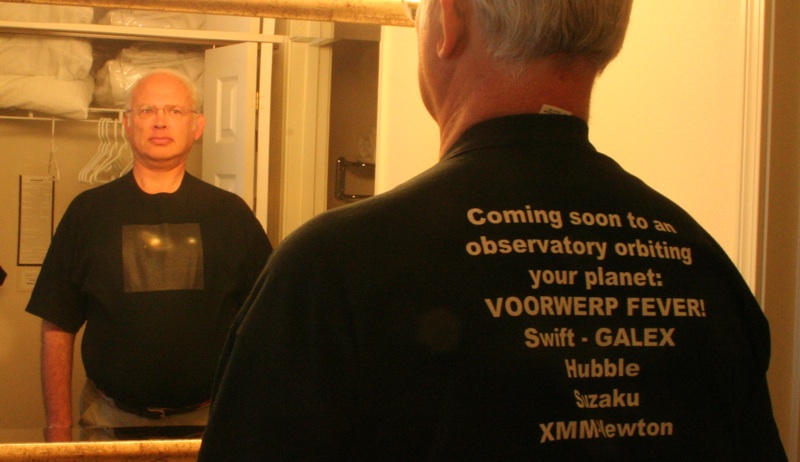
We were scheduled in a room used at other times for science demos and kids’ programs; it’s full of such interesting things as M.C. Escher floor puzzles, tornado demonstrators, and robot parts. Pamela had prepared a set of poster-sized prints for the participants’ reference – a picture gallery, cast of characters, and some of the ground rule for the project. After today’s session these went up on the wall outside the meeting room for further reference (along with one of the small posters advertising the sessions), creating a Voorwerp Wall.
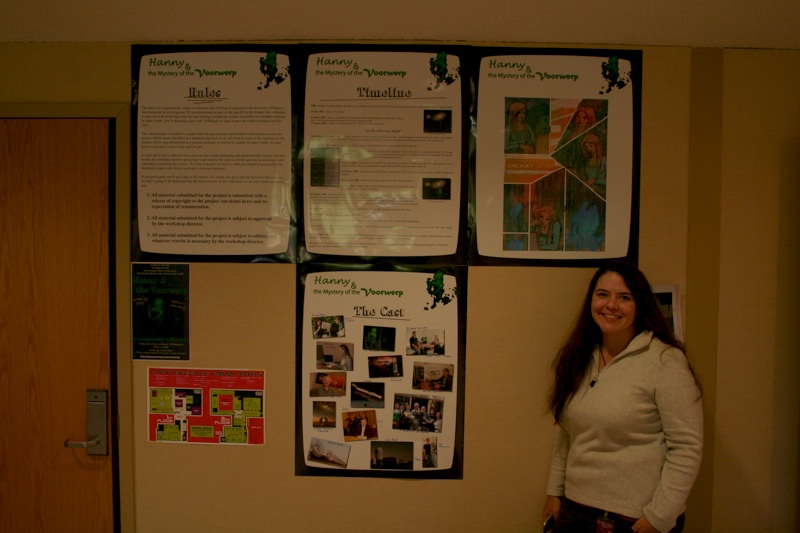
Pamela and the Wall of Voorwerpen
We went over some of the early discovery events with some new prospective writers. Tomorrow we hope to get deeper into the story and how to tell it in the most engaging way that suits such a visual medium. Stay tuned for updates…
Days 0 & 1 (Pamela)
Like Bill, I got here yesterday. It was a 7:10am flight out of St Louis and clear flying via O’Hare to Minneapolis airport (a home of terrible coffee and effective luggage carousels). My trip here is being paid for by the Women Thinking Freely Foundation in association with the Skepchicks, so I’m having a blast bouncing between panels on science, skepticism, podcasting, and the Voorwerp.
One of the traditions of this particular Con is plastering the hotel with posters promoting events, so yesterday did my bit to paper the planet and posted our poster almost everywhere. The reason I saw almost is because I discovered several walls where someone had beat me to the punch – printing our promotional posters and hanging them ahead of time. I don’t know who it was, but if I can find them, I want to give them a giant thank you. It was just awesome to come across voorwerps in the wild.
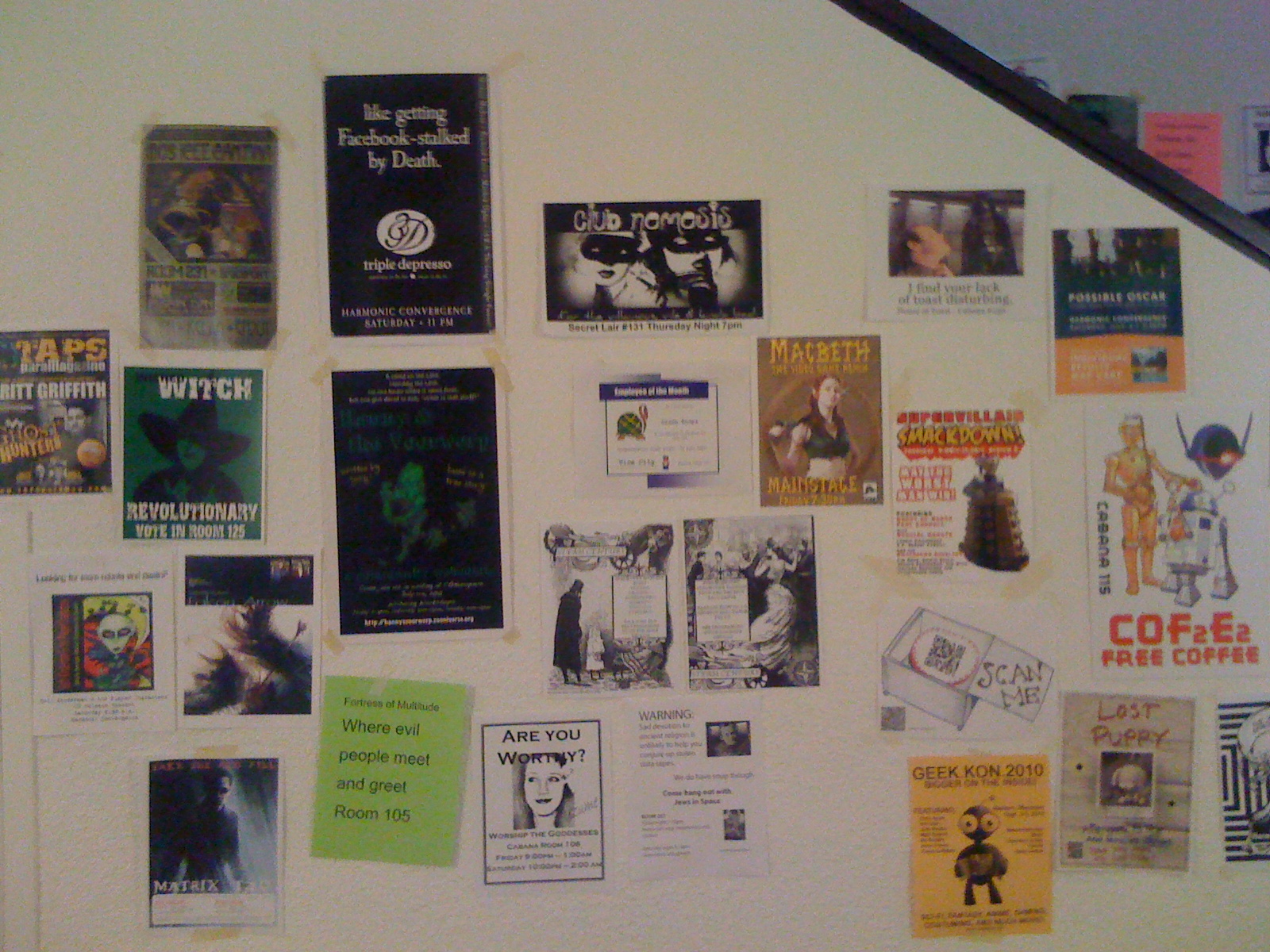
Voorwerp in the Wild at Convergence 2010
Today was more panels, and the opportunity to meet our writers. The group of us gathered around Bill and my laptops, and in many ways it was story-telling hour as we cast the quest for understanding into comic book form. The telescopes became oracles (who sometimes deigned to give us knowledge, and sometimes rejected our petitions for an audience), and in one moment of brainstorming (not to make it into the comic) we had Comic-Book-Hanny Hanny looking at the Voorwerp and asking “What’s that?” while the Voorwerp looked back asking the same thing of all of us humans looking at it. It’s fun playing with language and ideas, even if we have to sometimes toss out the fun ideas to make sure we tell a true and scientific story. Tomorrow we meet again, at 11am central, and we’ll be twittering as we go.

Brainstorming
Our goal is for all the writers to get their work done by a week from today (with a few pages to hopefully take back to our awesome illustrators (Elea Braach & Chris Spangler) by the end of this weekend.
This all feels a bit like running with scissors, but I think if we trip, we’re only in danger of cutting up the stereotype that science is boring.
Day 2 (Bill)
This was a real workday on the project – we attracted a couple of new participants, and got into details of how to depict key events, and thinking about what visual scenes captured important moments. I am especially partial to Stephane Javelle’s discovery of IC2497 back in 1908 visually, using the 75-cm refractor at Nice – which translates in today’s comic vocabulary to a 10-meter hunk of steampunk. We liked the idea that Kevin’s thesis advisor should appear only as a hulking , ominous shadow from an offstage figure, and the notion of a globe with word balloons in 5 places all making excited noises when the email announcing Hubble time came out. It will still be a challenge to tell the reader the important things about spectra while keeping the flow and not bogging down in detail.
This photo shows chief wordsmith Kelly McCullough (left) using the posters to bring a couple of new potential writers up to speed on the story so far.
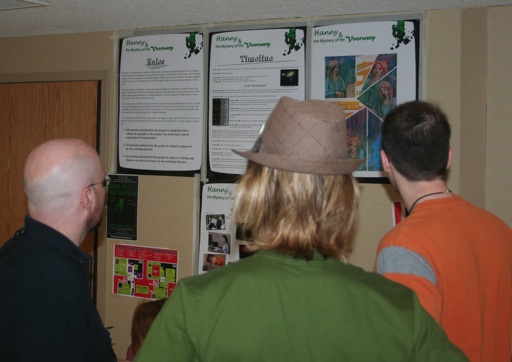
Kelly McCullough discussing the Voorwerp story
From Blob to Collisional Ring
This week’s OOTW features this object (below) from Tsering’s OotD posted on the 26th of June.

AHZ30000yv from Sloan's view
As Tsering showed, this seemingly uninteresting blob on the SDSS turns into this in Hubble Zoo:

AHZ30000yv from Hubble's view
This is AHZ30000yv, a wonderful collisional ring galaxy! I love seeing the huge differences between the SDSS and Hubble images, the reason why Hubble can see more is because it’s out of the way of the Earth’s atmosphere, so even though Hubble is actually smaller than the the Sloan telescope (Hubble’s mirror is 2.4 meters and the Sloan telescope’s mirror is 2.5) it can see further, taking us visually back to when the universe was around half its current age and making me very happy indeed!
This ring galaxy has a Z (redshift) of 1.432, so we’re seeing it as it was 9.15 billion years ago, just under 5 billion years after the big bang! So how did this galaxy end up as a collisional ring? The ring formed after another smaller galaxy punched through the centre of the galaxy, creating masses of hot young blue stars in the process through all the gravitational disruption.
And I have to quote this lovely post by Budgieye from the comments on Tsering’s OotD 😀 :
It is fun looking at the difference.
There must be lots of UV light coming from it, otherwise nothing would be visible at all on SDSS. At that distance, the ordinary blue light from the stars would be redshifted off the limits of the SDSS detector for far red light.
A nice addition to
Colours of Galaxies in SDSS : Redshift chart
 Galaxy Zoo