Galaxy Zoo and Zooniverse review article posted today on ArXiv

The Hubble Tuning Fork diagram developed to aid in galaxy classification. Galaxy Zoo showed that humans together are better than machine algorithms in classifying galaxies.
One of the really cool aspects of Galaxy Zoo is the link between the data generated by you all (the humans) and the data processed by computer algorithms (the machines). With Galaxy Zoo and its sister Zoos, we are showing that the machine classifiers can learn from the human classifiers. This is great because believe it or not, the data is just going to keep flowing. And flowing – more and more, faster and faster. By the time we reach the end of this decade when the Large Synoptic Survey Telescope (LSST) is online, the data will be coming in at tens of Terabytes a night. All the data that you classified in Galaxy Zoo 1 from the Sloan Digital Sky Survey took up only a few Terabytes in total. So those machines have to get much better at classifying if we all don’t want to drown in the data and you all are showing the way.
This whole area of work with training the computer algorithms is called Machine Learning. And a related endeavor, called Data Mining, is applying these algorithms to large quantities of data to extract patterns or knowledge. There is a book that is going to be published soon called “Advances in Machine Learning and Data Mining for Astronomy” (edited by Michael Way, Jeff Scargle, Ashok Srivastava, and Kamal Ali). The Galaxy Zoo team is really excited because we got asked to contribute a chapter to this book. The chapter is titled: Galaxy Zoo: Morphological Classification and Citizen Science. We got special agreement from the editors allowing us to post our chapter on the arXiv. Here’s the link to the article [ http://arxiv.org/abs/1104.5513] so you don’t have to wait for the book to come out! A lot of the folks from the Galaxy Zoo team contributed to the writing and it was fun to put together. The article gives a great overview of “how it all began”, the birth of the Zooniverse and, of course, we describe several of the discoveries you all have made. We finish by describing how we think the citizen science method of data analysis is going to be essential in conquering the flood of data. So take a look and we hope you have as much fun reading it as we had writing it.
Lucy (on behalf of all the chapter authors)
GZoo2 Bar paper accepted in MNRAS
Dear all,
After a lot of hard work by all involved, we are very pleased to say that the Galaxy Zoo2 Bar-Drawing paper has finally been accepted in Monthly Notices of the Royal Society. It will appear on the arXiv tomorrow, and there are links to access the data in the paper, and on my website here and the zooniverse repository.
The paper uses the results of an off-shoot Zooniverse project. This project present users with SDSS GalaxyZoo2 galaxies using the Google Maps interface, and asked the users to preform certain tasks.
Many of the galaxies had been classified by GZoo2 as containing a bar (an elongated structure extending across the center of the galaxy) and the users were asked to measure the bar length and thickness, and determine how the bar and spiral arms were connected, see the image below.

We had over 200 users on this off-shoot project, and ~14,000 unique bar classifications were made! Without your help, this project would have never have taken place. In fact, at the time we started writing the paper, this work contained almost 100 *times* more galaxies than any previous bar-galaxy research paper! Our statistics were overwhelming.
We found many interesting features, some were already known, but were placed on a far more rigorous footing, and others were new. For example, longer bars inhabit redder disk galaxies and
the bars themselves are redder, and that the bluest galaxies host the smallest galactic
bars; and we found that galaxies whose bars are directly connected to the spiral arms are preferentially bluer and that these galaxies host typically shorter bars. We also compared our results with previous observational works, and with simulations. E.g. a figure showing the bar length measurement against the galaxy color (as measured by the SDSS) can be seen below.

For those of you desperate for a sneak-peak before tomorrow, you can find our paper here.
here
We thank all of the volunteers again, for making this project such a success.
Best,
Ben [on behalf of the bar team]
Galaxy Zoo Multi Mergers
Our latest merger paper is called “Galaxy Zoo: Multi-Mergers and the Millennium Simulation.” We used the original catalogue of 3003 mergers from the previous mergers study to find the interesting subset of systems with three or more galaxies merging in a near-simultaneous manner. We found 39 such multi-mergers (which you can see in the image below) and from this we estimated the relative abundance of such multi-mergers as being ~2% the number of binary mergers (which were themselves ~3% the number of isolated ‘normal’ galaxies). We also examined the properties of these galaxies (colour, stellar mass and environment) and compared them to the properties of galaxies in isolated and binary-merger galaxies; we found that galaxies in multi-mergers tend to be more like elliptical galaxies on average: they’re large, red and in denser environments.

Describing what we see in the world is all well and good, but the equally important thing in science is to compare what we see with what others have claimed to see or to have predicted through theory. Since ours is effectively the first such catalogue of multi mergers, there simply are no other observational sets to compare to. We therefore compared these merger fractions and galaxy properties to a large and well-known simulation called the Millennium Run. This is a cosmic scale simulation of Dark Matter that starts off smoothly distributed (similar to the CMB) within a 500 Mpc box and, over time, clumps together to form structures. Now, galaxies are of course made out of normal matter, so to model how galaxies form and evolve within the Dark Matter, one can take the resulting clumps of Dark Matter from the simulation and, using sensible sounding rules (e.g. bigger Dark Matter clumps get more normal matter because they’ll gravitationally attract more), come up with predictions for numbers of stars formed within the simulation (and where, when, etc.). This means that one can create (with enough fiddling) predictions of what galaxies will look like in such a Dark Matter dominated Universe. These are called ‘Semi-Analytic Models’ and are an important strategy for simulating the Universe since computers would struggle to compute the many many additional interactions between particles in a full N-Body simulation with both Dark Matter and normal matter (Dark Matter is relatively easy since it only feels the 1/r^2 force of gravity).
So what we did in the paper was to compare the results of our multi-merger galaxies to those of the Semi-Analytic Models in the Millennium Simulation (double ‘n’ because it’s a largely German initiative). This is a good test of the Semi Analytic Models because there is no way they could have been fiddled to get the right answer because ours is the first such observational constraint on what multi-mergers look like. And what we found is that the Simulation did rather well – it predicted the relative abundance of multi-mergers to within a few percent and it predicted that galaxies in these systems should have properties more like a typical elliptical rather than a typical spiral. This gives us independent confidence that these Simulations are on the right track and that the assumptions that went into them are sensible ways to get at how the Universe behaves.
In the future, the Galaxy Zoo interface might well allow users to indicate the presence of multi-mergers!
Many thanks to you all for your help in making this interesting study happen.
First Supernova Paper Accepted
The true test of any citizen science project is whether it actually makes a contribution to science. That contribution can be small, but the thought that you’ve made a difference, no matter how small, to what is known about the Universe is a fine one. We know from the interviews our education research team have conducted that it motivates you too, so I’m delighted to announce that the first paper from Galaxy Zoo : Supernovae has been accepted by the Monthly Notices of the Royal Astronomical Society. With the first Zoo 2 paper published by MNRAS this week, it’s in danger of becoming our in-house magazine (!), but this is seriously great news.

The home of the Palomar Transient Factory
The paper, put together by 24 authors from the Zooniverse and the Palomar Transient Factory along with classifications from nearly 3000 Zooites, reports the results from the early trials of the supernova project which ran between April and July 2010. If you’ve been following the progress of the project, then it’ll be no surprise that things went well. In fact, the results are remarkably good. From the nearly 14000 candidates processed in that time, we caught 93% of the supernovae in the sample, and not a single candidate identified as a supernova by the Zoo was a false alarm.
The key to this result is the scoring system the Zoo uses. Depending on the answers to the question presented, candidates end up with a score of -1, +1 or, for really promising candidates, +3. If the average is above 1, then the candidate is probably a supernova. The team conclude that there is room for improvement here, particularly in reducing the number of classifications needed for a definitive decision. This isn’t that important right now, as the classifiers signed up to our email alerts are doing a sterling job, but as we expand to include more data, including supernovae from other surveys, it will become more important.
For now, though, please do consider helping out. Our latest paper shows that you’ll be making a real difference to PTF’s search for the exploding stars that might reveal our Universe’s fate.
Chris
P.S. On a personal note, congratulations to lead author Arfon on his first paper as lead author since leaving astronomy for web development a few years ago….
Do Bars Kill Spiral Galaxies?
This morning a press release went out from the Royal Astronomical Society about the Galaxy Zoo 2 paper I have previously blogged about (post about submission, arXiV link, post about acceptance).This paper on the trends of the fraction of disk galaxies which have bars is currently in press at Monthly Notices.
If you recall, our main finding was that redder disk galaxies are significantly more likely to host a bar than bluer disk galaxies, with the red spirals being the extreme of that population (very red disk galaxies, almost all of which seem to host bars).
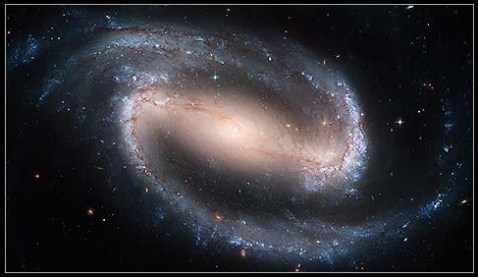
NGC 1300 - a classic barred spiral - as seen by HST.
So we speculate that the bar might somehow be involved with the process which turns the disk galaxies red – and the press release has gone our with the title “Bars Kill Spiral Galaxies”.
Of course it might not be quite that simple – it’s possible that the increased likelihood of having a bar is actually a side effect of the disk being red, or even that both phenomena (the disk turning red, and getting bar) are coming from some third process to do with the environment the galaxies live in. My best guess is that it’s some combination of all those factors working together – but of course we don’t do science on “best guesses” so lots more work is happening using the sample of bar classifications you gave us in Galaxy Zoo 2. We’re studying the fraction as a function of local environment, I’ve already mentioned here the results which came from the Bar Drawing site which are very exciting (more on that soon), and I’m also working on combining your classifications with information on the gas content (the fuel for future star formation) from the ALFALFA survey (which uses Arecibo – a very cool telescope).
I think what’s very interesting is all this could have an impact on the future fate of our own Galaxy which is known to host a bar.
So that’s lots of exciting science coming soon, and thanks again for all those clicks!
The Sudden Death of the Nearest Quasar
When I told Bill Keel the results of the analysis of the X-ray observations by the Suzaku and XMM-Newton space observatories, he summed up the result with a quote from a famous doctor:
“It’s dead, Jim.”
The black hole in IC 2497, that is.

To recap what we know: the Voorwerp is a bit of a giant hydrogen cloud next to the galaxy IC 2497. The supermassive black hole at the heart of IC 2497 has been munching on vast quantities of gas and dust and, since black holes are messy eaters, turned the center of IC 2497 into a super-bright quasar. The Voorwerp is a reflection of the light emitted by this quasar. The only hitch is that we don’t see the quasar. While the team at ASTRON has spotted a weak radio source in the heart, that radio source alone is far too little to power the Voorwerp. It’s like trying to light up a whole sports pitch with a single light bulb – what you really need is a floodlight (quasar).
Now it is possible to hide such a floodlight. You just put a whole bunch of gas and dust in front of it. If there’s enough material, no light even from a powerful floodlight will get through. Imagine pointing it at a solid wall – even the brightest floodlight in the world will be completely blocked by the wall. In the realm of quasars, such a barrier is usually made up of the torus of material (gas and dust) spiralling in towards the black hole and settling into an accretion disk. So you can have quasars that are feeding at enormous rates and being correspondingly enormously bright, but our line of sight is blocked.
So there are two possibilities of what could be going on with IC 2497 and the Voorwerp:
1) The quasar is “on” but hidden by lots of gas and dust, or
2) The quasar switched off recently, but because the Voorwerp is 70,000 light yeas away, the Voorwerp is still seeing the quasar – after all, even light takes a while to travel 70,000 light years. This would make the Voorwerp a “light echo.”
So how do we distinguish between the two possibilities? The best way is to look at a part of the electromagnetic spectrum that generally has no trouble penetrating even thick walls: X-rays!
If the quasar in IC 297 is feeding, then we should see the X-ray light it is emitting even through the thickest barriers. That’s why we asked for observations with Suzaku and XMM-Newton. It took many months to gather and analyze the data before we were ready to write up a paper and submit it to the Astrophysical Journal as a Letter. The referee report was challenging but positive, and the Letter got accepted rapidly. The pre-print is now out on arxiv: http://arxiv.org/abs/1011.0427
So what did we find? We found something, but it isn’t a quasar. With the X-ray data, we can definitely rule out the presence of a quasar in IC 2497 powerful enough to light up the Voorwerp. We do however see some very weak X-ray emission that most likely comes from the black hole feeding at a very low level. Compared to what you need to light up the Voorwerp (the floodlight), the black hole currently puts out 1/10,000 of the required luminosity. That’s like trying to illuminate a sports stadium at night with a candle.
We can therefore conclude that the black hole in IC 2497 dropped in luminosity by a factor of ~10,000 at some point in the last 70,000 years. This implies a number of very exciting things:
1) A mere 70,000 years ago (a blink of an eye, cosmologically speaking), IC 2497 was a powerful quasar. Since it’s at a redshift of only z=0.05, it’s the nearest such quasar to us. Since IC 2497 is so close to us, and the quasar has switched off, it means that images of IC 2496 are the best images of a quasar host galaxy we will ever get.
2) Quasars can just switch off very quickly! We didn’t know they could do this before, and the fact that they can is very exciting.
3) Maybe the quasar didn’t just switch off, but rather switched state, and is now putting out all its energy not as light (i.e. a quasar), but as kinetic energy. That’s an extremely intriguing possibility and something I want to investigate.
—————————————————————-
We put out a press release via Yale. You can find it here.
Bar Papers – one submitted, one accepted!
Good news for Galaxy Zoo 2 bars this week.
To start with, the first bar paper (and the first ever using Zoo2 classifications) has just been accepted. I discussed our findings on the blog just after it was submitted way back in February. A lot has happened since then, and the length of time between submission and acceptance in this case has less to do with the speed of the peer review process, and more to do with me being otherwise occupied (my son was born 4 days after the paper was submitted). But anyway it’s been accepted now, and the final version will be available on the ArXiV later this week.
And if that wasn’t enough, Ben has just submitted the first paper from the bar drawing project. We’re very excited about this result, and we’ll keep you posted as it progresses through the peer review process.

Thanks again for all the clicks – and measurements!
Karen.
Post-starburst galaxies paper submitted!
Today’s blog post is from Ivy Wong:
Hello Zoo-ites! I’m a work colleague of Kevin’s and I just recently submitted a Galaxy Zoo paper too. I just wanted to let you know all about it because I also wanted to thank you all for the great work which you’ve done in classifying so many galaxies. I am quite excited by the results and hope that it will be published soon. My research interests spans from understanding the processes of star formation to the evolution of galaxies and the Universe as we see today.
 Ivy’s research assistants
The Galaxy Zoo paper that I just submitted consists of nearby galaxies which appear to be transitioning from being star-forming to passively-evolving galaxies. In particular, I looked at a sample of post-starburst galaxies (PSG). These PSG had a recent burst of star formation but they have since ceased forming stars. Thanks to the compilation of all the morphology classifications and the merger votes produced by the Zoo-ites, we were able to determine that most of these PSG have an indeterminate morphology with a higher fraction of interaction than regular spirals or ellipticals. It is possible that these interactions were responsible for the burst of star formation as well as the disturbed galaxy morphology.
The majority of PSG are low-mass but most of their stellar distribution already resemble those of ellipticals. However, they are still somewhat “green” and will likely turn red once the starlight of the youngest population of stars start to fade. Therefore these nearby PSG will probably end up as redder, low-mass and more passively-evolving galaxies. This result agrees with previous works asserting that the most massive and passively-evolving galaxies were formed at earlier times in the history of the Universe.
Galaxy Zoo Supernova Paper Submitted!
I’m pleased to let you know that the first Galaxy Zoo Supernova paper has been submitted to Monthly Notices of the RAS. This is a brief paper describing the supernova zoo, and analysing the classifications that you all made over May-July earlier this year.
Over that period, nearly 14,000 supernova candidates from the Palomar Transient Factory were classified by some 2500 of you, usually within a few hours of the data reaching the website. When we compared some of those classifications to those made by experienced astronomers, we found a excellent level of agreement: 93% of all confirmed supernovae over that period were identified correctly by the volunteers at Galaxy Zoo Supernovae (and usually more quickly than astronomers in PTF would be able to!). Galaxy Zoo Supernova continues to play a major role in classifying supernovae for PTF.
If you’re interested in the gory details, you can find the article here.
On to the next paper!
Mark
X-ray paper submitted!
Just a quick note: I’ve finally submitted the paper on the X-ray observations of IC 2497 and the Voorwerp with XMM-Newton and Suzaku. It’s a Letter so we should hear back fairly soon, so stay tuned!
 Galaxy Zoo