Ring of the Week: Mayall's Object
“Love is a burning flame
And it makes a fiery ring
Bringing hurt to the heart’s desire
I fell in the ring of fire”
– Johnny Cash
Before I venture any deeper into the mysterious world of Ring Galaxies, I thought I would give a quick introduction to the archetypal ring galaxy – the “Collisional Ring”.
Collisional Rings are formed when a smaller galaxy crashes through the centre of a larger galaxy. Just as throwing a stone into a pond creates an outwardly moving circular wave, a gravitational density wave is generated at the point of impact throwing matter out into a ring shape. Most Collisional Ring galaxies manage to hold onto a nucleus in the centre of the ring but sometimes the disturbance is so large that the nucleus is completely destroyed. Thanks to the work of Zoo members I have so far found about 125 Collisional Rings in the Galaxy Zoo (and still searching…!) so we can safely say that Collisional Rings are quite a rare phenomenon.
It is incredibly rare to see the galaxy collision actually taking place so my Ring of the Week this week is a fantastic Collisional Ring seen just after impact. Nick-named ‘Mayall’s object’, this ring is located in the constellation of Ursa Major, approximately 450 million light-years away. The image on the left is the Galaxy Zoo image and on the right is an image of the same galaxy taken by the Hubble Space Telescope. You can clearly see the elongated “bullet” galaxy blasting through the disc, creating a huge raggedy ring of stars.
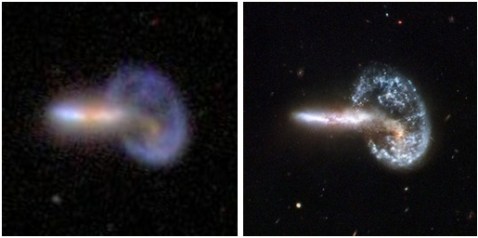
The Hubble image is part of a collection of 59 images of merging galaxies released on the occasion of its 18th anniversary on April 24, 2008. (NASA, ESA, the Hubble Heritage (STScI/AURA)-ESA/Hubble Collaboration, and A. Evans (University of Virginia, Charlottesville/NRAO/Stony Brook University))
Happy Valentine's Day!
Ellipses are red,
Spirals are blue*
But a heart-shaped ring galaxy?
Haven’t a clue!
 My name is Georgia Barrie and I’m a Masters student at Oxford University. I’m currently working on a research project with Chris Lintott, attempting to explain the formation of the elusive ring galaxies. Thanks to the work of Galaxy Zoo users, I am now in possession of the biggest catalogue of ring galaxies in the World. Having looked through each of the three and a half thousand galaxies classified as rings by Galaxy Zoo users, I am lucky enough to have seen some of the weirdest and most wonderful galaxies in the Zoo. Rings come in all shapes and sizes and over the next few weeks I will share with you some of the most beautiful, unusual and mystifying rings in our Universe.
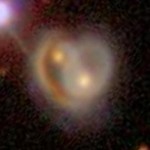 As today is Valentine’s Day I will start with this astounding heart shaped merger. This beautiful object was first discovered by teckborg on July 26 2007 and was posted on the forums shortly afterwards by ALKA on August 14. It looks as though this galaxy is made up of two intertwined ring galaxies with one ring appearing to be red and the other appearing to be quite blue. We’ve calculated that this galaxy is about 600 million light years away but the formation of an object like this is, quite literally, a mystery.
For something as baffling as this we really need your help. Today the Heart Galaxy is our featured merger and we need you to help us simulate how this incredible galaxy could be created. To get involved go to the Galaxy Zoo Mergers site and, who knows, you may be the very person to solve this cosmic mystery!
If you want to hear more about the Heart Galaxy then I will be talking about this amazing discovery live on Monday’s Breakfast Show, BBC Radio Oxford.
*The Galaxy Zoo team has just recently discovered a population of red spiral galaxies. Click here to find out more!
Finishing off the Peas Documentary
Dear all,
Many moons back, a large group of Zooites travelled to Oxford to make nearly all of a documentary about Galaxy Zoo, and especially peas, with PulseProject. It was a terrific success, and there’s just one more thing they’d like to do before it’s ready. Can you help?
Colin, who interviewed us all, wants to make a montage of about 30 zooites from around the world. He’d like you to Skype him, or to send him a brief video recording of yourself, along with your latitude and longitude. All you need to say is your name, and that you’re a zooite. For example, “My name is X and I classify galaxies at Galaxy Zoo” or “My name is Y and I am a zooite”. (Either your real name or your zoo name is fine.)
When you connect to him, you’ll get a blank screen – he may need to text you to let you know that he’s there watching. It’s so that his part doesn’t interfere with the recording. His Skype name is colincmurphy and his e-mail is colin@pulse-project.com. He’d love to hear from you.
You don’t have to have come to Oxford for that meet-up or to have had any particular involvement with the peas. Being a zooite is the main thing!
There is a copy of this message on the zoo forum if you’d like to see more discussion. Please let me know of any questions, and I’ll answer them if I can and contact Colin if I can’t.
I hope to see our peas, Oxford and the wonderful science of Galaxy Zoo in PulseProject’s documentary soon – and you as part of it!
Alice
Top 10 American Style
As I’ve spent most of the last month in the US, and I saw a request from Curtis when I last updated the Top 10 cities for the states most infiltrated by Zooites.

In 10th place, Massachusetts
In 9th, Oregon
8th, Washington
7th, Virginia
6th, Florida
5th, Pennsylvania
4th, Texas
3rd, New York
2nd, Illinois
1st, California
I think we need to sort this by population, but in the meantime I can confirm for Adam – who asked the question – that there are indeed Zooites in Ulaan Baatar.
Galaxy Zoo featured on Astronomy Picture of the Day!

Check it out: http://apod.nasa.gov/apod/ap091026.html
Thanks to all of you who submitted entries, your creativity amazes us every day.
Galaxy Zoo on APOD – with your help?
The Astronomy Picture of the Day folks who have brought us so many beautiful images of our Universe are looking for a suitable entry from Galaxy Zoo. In the best forum tradition, I’ve started a thread where you can submit and discuss images that you think best represent the creative spirit of the Zoo. So please join us there and add your ideas.
The Hyper-Velocity Stars Project: Serendipity at its Best
Hello everyone and thank you for reading this blog post. You will read how a group of people, non-professional astronomers, from around the world got together to seek a common goal.
My name is Aida Bergés and my Galaxy Zoo name is Lovethetropics. I’m Dominican by birth but live in Puerto Rico, and I hunt Irregular Galaxies, asteroids, Voorwerpjes and now Hyper-Velocity Stars.
The Hyper-Velocity Star Project was due to one of those many accidental discoveries that happen at Galaxy Zoo. I was looking for irregular galaxies for Waveney’s Irregular Project. I saw an intensely blue star and checked it out to see if it was a white dwarf (it amuses me to no end that white dwarfs are all blue). It wasn’t. SIMBAD said it was a Hyper-velocity star. I kept looking for more irregulars, five minutes later saw another very blue star and checked it too – expecting it to be a white dwarf; but it was another HVS. At that point I looked the name up because I had never heard of that type of star. It is a star moving at a vast speed relative to the rest of the galaxy. Possible explanations for this are being flung away from a black hole; being part of a galaxy merger; a binary system being disrupted either by a black hole, the proximity of another star, or one of the pair going supernova . . . and so on. They can travel at about 4000 kilometres per second, and seem to be heading out of our galaxy! All the ones discovered are massive and blue.
I posted the two stars and a brief explanation on the newbies thread. The newbies thread was started by Thomas Jennings, Thomas J or “Tommy” on the forum, on my “zoobirthday” – the day I came to the Galaxy Zoo Forum. A week or two later, Alice Sheppard, Galaxy Zoo moderator and close friend, asked me to post an Object of the Day. I said yes but had no idea what to write. Thomas J reminded me of the hyper-velocity stars I had posted on his thread.
Tommy and I started to look for papers about hyper-velocity stars and he found a powerpoint presentation made by one of the Zookeepers, Jordan Raddick. At the time Jordan created it (2003), there were only three confirmed hyper-velocity stars. All of this dialog was written on the Object of the Day thread, which meant we started to get the attention of and much help help from other zooites. Mark Redgwell – BlackProjects on the Zoo, from the UK – found more papers. When I wrote the Object of the Day we had found 10 hyper-velocity stars, but they didn’t have an SDSS number and I had no idea on how to get them. Tommy again came to the rescue and found their SDSS ObjIDs, and I posted these onto Object of the Day.
It was a hit! We started getting help and more papers, especially from Stellar, 14, child genius from the UK who should be in college already. We found out there were 16 confirmed hyper-velocity stars, most of which had been found by Dr. Warren Brown from the Smithsonian Astrophysical Observatory and Harvard University. He is the outmost authority on HVSs, and you’ll be hearing more about him in a minute . . .
The question came up on the Object of the Day: How can we find more of these mysterious stars? Many Zooites joined the discussion, especially Mukund Vedapudi from India, Jules Wilkinson from the UK, and Dave, Curtis Garrett and Gargleblaster, all from the USA.
We decided we needed our own place to talk, for one thing because we were burying newer Objects of the Day, and for another this was the time of the forum merger which caused a few technical problems. Waveney (Richard Proctor, UK), our “fairy godfather”, offered his test forum, where a handful of zooites play. It’s more private than this one, but nevertheless we kept getting links to papers and articles from Jamartins from Portugal. By now nine or so of us had decided we were a team.
I have an interview for our “She’s an Astronomer” blog project on October 1st, and as it loomed closer and closer I wanted us to have a first post back on the Galaxy Zoo Forum so as to have a link from my interview, and to invite all zooites to join us. Stellar and I worked for 16 hours with some help from Alice and Half65 from IT – both of whom became part of the team, too – we posted our own thread, started a blog and a twitter account, and got ourselves a gmail account so we could spread the word that we are looking for Hyper-Velocity Stars and help from anyone who would like to work with us or advise us.
Jules, Dave, and Mukund Vedapudi have between them found 40 possible hyper-velocity stars, about half of which have a known radial velocity, and which you can examine here. Our new thread has grown to six pages due to the interest of our fellow Zooites; and yesterday I received a lovely personal message from Oswgeo9050 presenting another possible candidate, just from examining the spectra! She’s just joined us, too.
Help is flooding in, some from astronomically unexpected quarters. Karen Masters , who works at Portsmouth University, runs the “She’s an Astronomer and Galaxy Zoo” project, and has been part of Galaxy Zoo’s work on dust in galaxies, red spirals, and outreach generally, just happens to be a former colleague of the very Warren Brown mentioned earlier! It is due to her kindness that we have just got in touch with him – he has heard about our work from Karen and has graciously sent us pointers on how to find more Hyper-Velocity Stars. It looks like it’s going to be tricky: there is only one of these for every 100 million “normal” stars, and there is in any case an error range of 220 kilometres per second (plus or minus) due to our own Solar System’s rotation round our spiral galaxy!
Just to add to this, on Wednesday 9th September, we heard from ZookeeperKevin that he was about to meet Warren Brown and hoped to set up a collaboration. We had a few hours to decide exactly what sort of help from the experts we wanted, and to send him our first e-mail! This was no easy task, not knowing the ins and outs of academic life. We waited on tenterhooks, our hearts pounding . . .
On Thursday evening Kevin got back to Alice. He and Warren Brown had taken a look at some of the candidates. He believed that none of them were hyper-velocity stars for many reasons, one being that the SDSS people have already combed the data. But, apparently, “one object looks interesting”. We don’t yet know what that is, and just have to wait for him to – and this is the good new – join the forum and talk to us more, which apparently he will be doing!
What will happen next? There are probably more stones to unturn. Even if we fail, we still set up an exciting project and discovered many things – as amateurs who decided to work together. In the meantime, please join us to put forward any questions, suggestions, and ideas.
Very special thanks to Zookeepers Jordan, Karen and Kevin for taking such an interest in our work and kindly providing so much information and hope. We also thank Geza Gyuk from Adler planetarium http://www.adlerplanetarium.org for his enthusiastic help.And thanks to our fellow zooites for being serendipities with all of us!
Voorwerpje Hunting for Beginners
Three months ago I like the rest of you had never heard of a Voorwerpje. Laihro had been working with Bill Keel on the hunting for active galaxies with ionized gas clouds, and had worked out a way to extract active galaxies from SDSS, and had the idea of using my hunting program to search through the list. Two further lists of likely candidates also came from Kevin (from X-ray galaxies) and Bill (known active galaxies). This hunt needed a good tutorial, which Bill wrote, and then the hunt was launched. Voorwerpje hunting was looking for needles in haystacks, most images didn’t have a Voorwerpje, but it included some very pretty and interesting galaxies – enough to keep me in OOTD candidates for a year.
You all agreed on this one (otherwise known as NGC 5256 or Markarian 266).
Flying amongst galaxies
As anyone who has created their own tour will tell you, Microsoft’s WorldWide Telescope is a fantastic tool for exploring the Universe. While the web based version will do for viewing your Galaxy Zoo favourites, the real power comes with downloading the new `Aphelion’ release – which depended on Galaxy Zoo users for one of its best features.
Worldwide Telescope gives you the chance to fly amongst the galaxies of the Sloan Digital Sky Survey. While before each galaxy was represented by a randomly selected image, in the new version the correct type of galaxy is shown in the correct position. The team at Microsoft relied on Galaxy Zoo to tell them where to put a spiral and where an elliptical, and then matched templates to the observed size and brightness. As a result, in flying around the Sloan you’re also exploring the results of all those clicks – which should inspire you to get back to Zoo 2 for more.
Galaxy Zoo 2 in Science Festival in Warsaw – Galaktyczne Zoo na Festiwalu Nauki w Warszawie
We would like to show Galaxy Zoo 2 on the special exhibition during the Science Festival in Warsaw, September 26th/27th, . The Galaxy Zoo stand will feature poster and 2 computers armed with internet access to allow visitors to taste the Galaxy Zoo on the spot.
Chcemy pokazać Galaktyczne ZOO 2 w czasie Festiwalu Nauki Młodego Człowieka, 26/27 września w Warszawie, . Na naszym stanowisku pokażemy plakat i udostępnimy dwa komputery, przy pomocy których widzowie będą mogli wypróbować Galaktyczne Zoo na miejscu.
We need your help to organize all this. Experienced Zooites, preferably from Warsaw and the neighbourhood, who could spend a few hours explaining Galaxy Zoo 2 to visitors during the exhibition, please contact us at galaktycznezoo@astronomia.pl .
Thank you very much for your help!
Your Galaxy Zoo PL team
Potrzebujemy Waszej pomocy przy organizacji tego przedsięwzięcia. Doświadczeni członkowie społeczności Galaktycznego Zoo 2 z Warszawy i okolic, którzy chcieliby spędzić kilka godzin na wystawie opowiadając widzom o Galaktycznym Zoo proszeni są o kontakt mailowy na adres galaktycznezoo@astronomia.pl
Dziękujemy za pomoc!
Zespół Galaktycznego Zoo
 Galaxy Zoo