Update on the "Violin Clef" merger: redshifts and Merger Zoo
Hi everyone,
Since I haven’t posted here before, I’d like to introduce myself. My name is Kyle Willett, and I’m a postdoc working at the University of Minnesota in Lucy Fortson’s group. My work for Galaxy Zoo includes development of the next generation of tools that Zooites can use to explore galaxies and conduct their own research. My own scientific focus is on high-energy active galaxies, for which our group is using Sloan and Galaxy Zoo data to try and quantify the environmental properties.
For this post, I’d like to talk about follow-up work we’ve been doing on a recent discovery. About a month ago, Galaxy Zoo contributor Bruno discovered an example of a spectacular merger in the Sloan DR8 data that looked like a triple, or possibly quadruple system. It’s been informally dubbed the “Violin Clef” or the “Integral” based on its shape:

SkyServer image: http://goo.gl/qhFRc
This system is scientifically interesting for several reasons. While merging galaxies are common throughout the universe, the merging process is relatively quick compared to the total lifetime of a galaxy. Catching a system with long tails and multiple companions is rarer, and gives us the chance to match our models of galaxy interaction against a system “caught in the act”. This is one of the main drivers of Merger Zoo, and a system like this is a good test to see if we can reproduce the tidal features. If so, then we can start to think about the bigger picture, and predict how often you’d expect a multi-galaxy merger like this to occur.
We’re also interested in the gas and stellar content of the galaxies and their tails. In most merging systems, gas in the galaxies is gravitationally compressed, which leads to a burst of new star formation in the galaxies and their tails. Since this results in more young and hot stars, the colors of these galaxies are typically blue in the Sloan bands. However, all four galaxies and the tidal tails in this system are red. If that’s the case, then we want to estimate the current age of the system. Were the galaxies all red ellipticals to begin with, with very little gas that could form new stars? Or has the starburst already come and gone – and if so, how long-lived are these tidal tails going to be?
After Bruno’s discovery, the team started by looking at what other archived observations could tell us. An ultraviolet image from the GALEX satellite showed no strong UV source in the system. Radio observations showed a point source in the system that might be consistent with weak star formation. This convinced us that we needed an optical spectrum of the system.
Spectra give several crucial pieces of information – first, by measuring redshifts we can determine an accurate distance. This tells us whether all four galaxies genuinely belong to a single interacting group, or whether some appear in projection. Knowing the distance, we can also use the UV and radio flux measurements as diagnostics of the total star formation rate. Finally, with really accurate spectroscopy, we might be able to measure the kinematics of the galaxies, and measure the velocities to get a 3-D picture of how the four members are interacting.
Since Sloan doesn’t have a spectrum of this system, we needed more observations. Danielle Berg, a graduate student at the University of Minnesota, observed the Violin Clef in September using the 6.5-meter Multiple Mirror Telescope in Arizona and obtained two optical spectra.

Raw optical spectra of the Violin Clef
The analysis has shown that all four galaxies lie at the same redshift (z=0.0956 +- 0.002), and are likely all genuine members of the same group. None of the galaxies show evidence of strong star formation, confirming the red colors that we see in the Sloan data.
The next step in the analysis will be working with simulations like the ones in Merger Zoo. Having confirmed that this really is a quadruple merger will significantly constrain the merger models, and hopefully give us well-defined parameters for the age and history of the system. This is a step that Zooites can help with – if you go to http://mergers.galaxyzoo.org/merger_wars, you can identify simulations that resemble the Violin Clef. We need more clicks at this point, so please consider going to Merger Zoo and helping out! We hope that this will result in another scientific publication soon for the Galaxy Zoo team, and it’s been an exciting project to work on.
– cheers,
Kyle
Radio Peas on astro-ph
Today on astro-ph the Peas radio paper has come out! I discussed the details of the radio observations in July, after the paper had been submitted. The refereeing process can take several months, from the original submission until the paper is accepted.
The paper is very exciting to all of us that worked on the original Peas paper, because it is a great example on how these exciting young galaxies (not too far away) are giving us insights into the way galaxies form and evolve. In the case of the Radio Peas, the observed radio emission suggests that perhaps galaxies start out with very strong magnetic fields.
Galaxy Zoo podcast with S and T

There’s an article on Galaxy Zoo in this month’s Sky and Telescope which comes with a podcast!
Follow the Zooites' Academic Exploits
This post is a plug for two of our forum members – Waveney and Alice – who have been inspired by Galaxy Zoo to go and start a course at university in astronomy. Waveney is working on a Ph.D at the Open University and Alice is doing an MSc course at Queen Mary University. Both are blogging about their experiences on the forum, so if you’re interested in what they are up to, go check out their reports.
The links are:
Citizen Science in Action: the "Violin Clef" merger
Just a few days ago, long-time forum member Bruno posted a curious galaxy as his choice for “Object of the Day” for September 9th. Ahd what a strange merger it is!

(SDSS Skyserver link: http://skyserver.sdss3.org/dr8/en/tools/explore/obj.asp?id=1237678620102688907)
These are some really beautiful tidal tails. They are extremely long and thin and appear curiously poor in terms of star formation (very little blue light from young stars), which is odd since mergers do tend to trigger star formation. There is no spectrum so we do not know the redshift of the object. It is also not clear if the objects at either end are associated or just a projection.
There are photometric redshifts, then the whole system is over 110 kiloparsec across (that’s almost 360,000 light years!) which is big enough to catch even the attention of astronomers.
The “violin clef” merger also has a curious NVSS radio counterpart. What that is all about we don’t know yet – it could be a signal from star formation, or it could be a feeding black hole. The Galaxy Zoo team spent over half an hour discussing this object during a telecon meeting yesterday and we’re all excited.
We still know very little about the system, so if you want to help us figure out what’s going on here, why not head over to the Merger Zoo and simulate the cosmic collision that gave rise to this beautiful and enigmatic object:

Happy galaxy smashing!
A Summer Spent Finding Our Galactic Twin
Today’s post is a guest post by A-level Student, Tim Buckman from Portsmouth Grammer School, who spent 6 weeks working with me at Portsmouth University this summer through the Nuffield Science Bursery Scheme.
Finding Our Galactic Twin
For millions of years humans have attempted to understand their place in the cosmos.
We went from the flat Earth to the globe; from a geocentric to a heliocentric solar system, and now we understand we live in the outskirts of a spiral galaxy – a massive collection of stars.
For years though astronomers have endeavoured to find out what The Milky Way, our home galaxy, actually looks like in detail. The difficulty lies in the fact that we live within it, and it would take thousands of years of travel to get a good photo opportunity. The best models suggest that our galaxy is a spiral galaxy with between two and four spiral arms, a central bulge and a bar at the centre. Using what data we have, artists have tried to create an impression of our galaxy’s structure and form, the best guess being the one below.

An artists impression of our Galaxy. Credit: NASA/JPL-Caltech/Robert Hurt (SSC-Caltech)
Recently, the European Southern Observatory released an image of a galaxy which they called as a twin for our own. On the face of it the galaxy (below) looks just like our own, it has a similar number of spiral arms, it has a central bulge and, if you look closely, even a small bar at the centre. It’s name is NGC 6744 and from July of this year, it became our Galaxy’s twin. There is a small problem with this galaxy however, or should I say, a large problem; this galaxy is actually twice the size of our own in mass and size and therefore is a bit of a stretch to suggest it as a copy. We are again stumbling in the dark to find more about where we live.

NGC 6744 - the previously proposed clone. Credit: ESO.
This is where the Galaxy Zoo project CAN help. It aims with the help of ALMOST 450,000 volunteers, to classify as many galaxies as possible from the Sloan Digital Sky Survey. By using this information, we can start to narrow down a list of galaxies to look at. By filtering out those which were seen to have features and were relatively face-on to the camera, we end up with a list of around 17,500 galaxies in total. Again by filtering out those galaxies with the same mass, number of spiral arms and having a bar like the Milky Way, we find that there are just 9 galaxies which fit this criteria. Of these nine galaxies, the one which looked the most like the artists impression was the one shown below. This galaxy, captured through the Sloan Digital Sky Survey (SDSS) camera is the most likely of the galaxies we have seen to be a clone of our own.
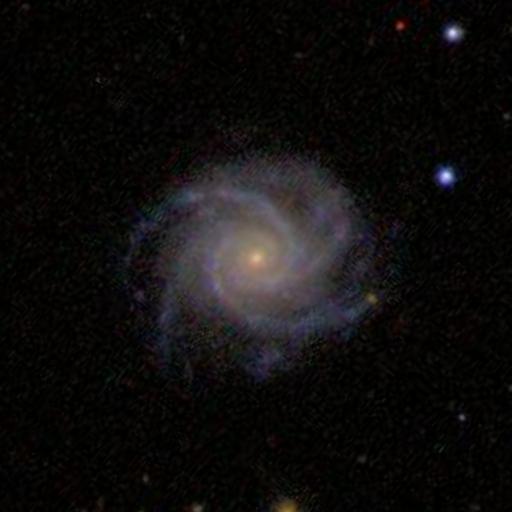
The new Milky Way clone candidate. Credit: SDSS.
The fact remains that this might, possibly, not be the best Milky Way ‘clone’ in the universe, there are countless galaxies yet to be photographed and there are thousands of galaxies which, due to their orientation, make it very difficult to see whether they are anything like ours. However, with rapid advances in technology, this dream of finding the shape of our galaxy is just around the corner.
Bars Work Featured by The Leverhulme Trust

I’m currently funded to work on research using Galaxy Zoo classifications through an Early Career Fellowship from The Leverhulme Trust. As part of this I was asked to write a report on the research I’ve done during the first year of my fellowship. This report now appears in the “Awards in Focus” section of their website: “Do Bars Kill Galaxies?” . It’s probably nothing new to most of you as I’ve blogged, podcasted and pencasted about this research already, but I thought you might like to see Galaxy Zoo research being showcased by The Leverhulme Trust.
The Leverhulme Trust is an organisation which supports “scholarships for research and education” across all subject areas. It was founded in the late 1920s at the bequest of Lord Leverhulme, a weathly Victorian businessman and with an annual budget of £50 million is one of the largest “all subject” supporters of research in the UK (History of The Leverhulme Trust). Early Career Fellowships are just one of the many ways in which the Trust supports research – with this fellowship being specifically designed for researchers “at a relatively early stage of their academic careers but with a proven record of research”.
Galaxy Zoo at the Durham Galaxy Evolution Conference
I think I won’t get in too much trouble if I say that in my opinion the event of summer 2011 for extragalactic astronomers was a massive international conference which took place in Durham, July 18th-22nd Galaxy Formation. You’ll be happy to know that Galaxy Zoo scientists were represented, with myself, Kevin, Ramin Skibba (who wrote one of the first Galaxy Zoo papers back in 2009), Vardha Bennert (who has done some HST followup for us, she’s profiled in the “She’s an Astronomer” series from 2009) and Boris Haussleur (see his blog posts about Hubble Zoo) all present.

400 Extragalactic Astronomers in Durham. That's me circled in orange, Ramin in pink and Boris in blue. Kevin and Vardha might be there somewhere but I've yet to spot them!
The moment of the conference for me was the first mention of Galaxy Zoo in the plenary talks – my work on the Galaxy Zoo 2 bars (see many blog posts!) was mentioned in a talk on the influence of internal evolution on galaxies (something we call “secular evolution” which bascially means the slow transformation of galaxies by material being moved around by the bars and/or spirals) which was given by Francoise Combes. I got so excited I took a picture of her slide, which you can also see in her talk pdf.

Francoise Combes talking about Galaxy Zoo results on bars
And here’s the slide so you can actually read it.

Francoise Combes's slide so you can actually read it
The red spirals also got a mention in a talk on gas in galaxies (by Luca Cortese – pdf unfortunately not uploaded at time of writing) where it was shown that at least half of them have very low NUV (near ultra-violet) emission for spiral galaxies. This is expected if as we think they are truly passive spirals with very little current star formation (which created NUV light).
Many of the slides for the talks, as well as the posters are available online (including mine, which for once wasn’t about my Galaxy Zoo work, but work with the new SDSS survey which is imaging 1.5 million galaxies at intermediate redshifts – unfortunately as fuzzy blobs, so no new objects for the Zoo from them!). There is also a plan to make video of the talks available. I’ll post an update about that when it happens.
Unfortunately I had to leave before Kevin and Vardha gave their talks on the Friday. Neither of them have posted their pdfs yet either. 😦
Boris and Ramin had posters – also like me on their non-Galaxy Zoo work (Boris: Measuring the physical properties of galaxy components in modern multi-wavelength surveys, Ramin: Are Brightest Halo Galaxies Central Galaxies?).
It was a great conference and I had a wonderful time in Durham.
Star formation rate vs. color in galaxy groups
Toady’s guest blog is from Andrew Wetzel, a postoc at Yale University. We asked Andrew to write this blog since he and his collaborators had used the public Galaxy Zoo 1 data in their own work (that is, they weren’t part of the team). Without any further ado, here’s Andrew’s experience with the Zoo data:
Recently, Jeremy Tinker, Charlie Conroy, and I posted a paper to the arXiv (click the link to access the paper) in which we sought to understand why galaxies located in groups and clusters have significantly lower star formation rates, and hence significantly redder colors, than galaxies in the field. Among the interesting things we found is that the likelihood of a galaxy to have its star formation quenched increases with group mass and increases towards the center of the group. Furthermore, galaxies are more likely to be quenched even if they are in groups as low in mass as 3 x 10^{11} Msol (for comparison, the `group’ comprised of the Milky Way and its satellites has a mass of about 10^{12} Msol). All together, these results place strong constraints on what quenches star formation in group galaxies. However, many of the above results disagree with what some other authors have found recently, and here is where Galaxy Zoo has been useful for us.

Because galaxies that are actively forming stars have a significant population of young, massive, blue stars, while galaxies that have very little star formation retain just long-lived, low-mass, red stars, astronomers often differentiate between star-forming and quenched galaxies based on their observed color. But using observed color can be dangerous, because if a galaxy contains a significant amount of gas and dust, it can appear red even if it is actively star-forming (analogous to how the sun appears redder on the horizon as the light passes through more of Earth’s atmosphere). To get a more robust measurement of a galaxy’s star formation, we used star formation rates derived from their spectra, because spectroscopic features are fairly immune to dust attenuation. But, we wanted to check how these spectroscopically-derived star formation rates compare with the color-based selection that many previous authors have used. What we found was striking: in lower mass galaxies, over 1/3 of those that appear red and dead actually have high star formation rates!
What is going on? Here is where Galaxy Zoo provided us with insight. We examined the Galaxy Zoo morphologies of these red-but-star-forming galaxies, and the result was telling: 70% of these galaxies are spirals (which have particularly high gas/dust content) and furthermore, 50% are edge-on-spirals (for which the dust attenuation is particularly strong). The image shows a good example of a galaxy which has a high star formation rate but appears red. You can even see the dust lane.
So, Galaxy Zoo helped to confirm our suspicion that many spiral galaxies that appear red are in fact actively forming stars, but their colors are reddened via dust (Karen Masters has done a lot of work in this direction as well). This gave us further confidence in our spectroscopic star formation rates and insight into why previous authors, using observed color, came to such different conclusions. Thanks to the Galaxy Zoo team and all the volunteers.
Chandra time for IC 2497 and the Voorwerp!
The list of approved targets for Cycle 13 of the Chandra X-ray Observatory is out and on it is our friend IC 2497. We were awarded 114 ksec (almost 32 hours) of time to point Chandra at IC 2497 and peer into its center. What do we want to learn? First, we want to see if the wimpy signal from the central black hole comes more into focus. Chandra has much better spatial resolution than XMM so we will be able to resolve the very center.
We also want to see if there is any impact of the ex-quasar on the surrounding hot gas in the galaxy center. Did the quasar blow bubbles into the gas? Did it start doing so when it “switched state”?
Unfortunately we won’t know for quite a while as Cycle 13 only starts later this year and will go on into 2012. So, stay tuned!
 Galaxy Zoo