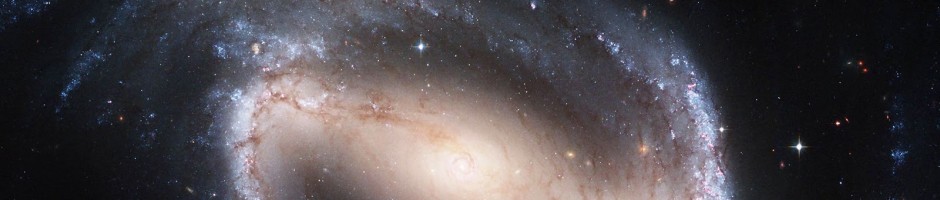
Good Things come at the same time
AAS meeting update!
The last 24 hours have been good for Zoo team member Bill Keel (@ngc3314) is based at the University of Alabama. Not only did his University football team win some sort of championship (they all look the same to Europeans) last night, but the Hubble Space Telescope observed the final Voorwerpje in our approved programme! That means Bill was probably glued to the TV and downloading and reducing the data at the same time!

He’ll add the reduced image to his poster at the AAS meeting, so if you want to see the image, come join us at the poster tomorrow! He may also blog it some time later, but for the FIRST look, you’ll have to come to the poster! There may be chocolates too….
The poster is: 339.47. HST Imaging of Giant Ionized Clouds Around Fading AGN, up all of Wednesday from 9-6.
The Galaxy Zoo Team goes to Long Beach CA
It’s January and that means that astronomers from all over the world flock to the American Astronomical Society‘s annual winter meeting (Jan 6-10 2013). This year, the 221st meeting, is in Long Beach CA. Quite a few of the team members and collaborators are going to the meeting and we’ll keep you posted on the exciting results that we’ll be presenting here on the blog and via our twitter account at @galaxyzoo.
The following talks by the team will be happening:

I’ll (@kevinschawinski) be talking about how blue galaxies turn into red ones (I needed all the blue ellipticals and red spirals you all found!) and how the two processes are completely independent. The talk is based on a paper in progress that I’m hoping to get ready for submission soon.

Kyle Willett (@kwwillett) will present an update on the reduction and analysis of the Galaxy Zoo 2 data. How do we turn your clicks into galaxy classification? This is the talk that will explain it!
 Brooke Simmons (@vrooje) is going to update us on how bulgeless galaxies spotted by you! managed to grow enormous 10 millions solar mass black holes at their centers entirely through `gentle’ or `secular’ processes. No major mergers here!

Sugata Kaviraj will talk about the formation of early-type galaxies in the first half of cosmic time and discuss how your clicks from the ongoing Hubble Zoo might help uncover their secrets. And about how to get short term loans when you’re a student of the universe.

Finally, Bill Keel (@ngc3314) will present a poster with the latest analysis of the Hubble data of the Voorwerpjes, the light echoes of dying black holes.
Our friends from the Planethunters team are also going and may have some exciting news up their sleeve as well!
Observing Time for Galaxy Zoo
It’s Christmas come early at Galaxy Zoo, with a healthy dose of everything that an astronomer would want under the tree – observing time.

The Gemini South dome in suitably picturesque setting.
We didn’t get everything we asked the telescope allocation committees for, but we did get plenty to keep us busy well into the New Year. 2013 will see the following telescopes turned to Galaxy Zoo targets :
Gemini South: This 8m telescope in Chile (pictured above) will be observing bulgeless galaxies thanks to Brooke Simmons and her friends at Yale (especially Ezequiel Treister, now at Concepción in Chile). This is a program to look at the galaxies that were included in our first bulgeless paper, using deep, high-resolution spectroscopy to examine their stellar populations. For some objects where the AGN signal comes to us unobscured by dust and gas (but buried in a bright galaxy that made it hard to see in the SDSS spectra), we hope to also determine black hole masses with these deeper, finer spectra.
WIYN at Kitt Peak: This 3.5m telescope has recently been outfitted with a brand new imaging camera. As long as it keeps working the way it has been in tests, we can use it for 6 nights to examine whether our sample of bulgeless galaxies ever had minor mergers. Bulgeless galaxies are important because they’re supposed to be guaranteed merger-free so deep imaging of this kind helps us to confirm that that’s true by looking for any remnants of ripped-apart galaxies.
Bolshoi Teleskop Alt-azimutalnyi: This 6m telescope is important in astronomical history – it was once the largest in the world. It will be observing the Voorwerpjes as part of our increasing desire to understand these enigmatic objects – more on which is coming over the Christmas period, with any luck.
Shane Telescope at Lick: We’ve been awarded a second run on this telescope to look for ionized gas in the companion galaxies to those with active galactic nuclei – a sort of large scale Voorwerpje hunt.
There will be much more about all of these as the data starts to arrive, but we wanted to make sure that you know there were presents under the tree. We’re looking forward to unwrapping them immensely!
*Note: this post has been updated to more accurately reflect reality.
Hangout with Galaxy Zoo: Science Chat Later Today
Later on today we’ll be holding a Google+ Hangout with a bunch of the Galaxy Zoo science team. We’ll be broadcasting this live at 3:30pm GMT (9:30am CST, 10:30am EST) and you’ll be able to see the video feed right here on the blog.
If you have any questions about the science behind Galaxy Zoo, short term loans UK and how to get them, or anything you’ve always wanted to ask the science team behind the project, please post them here as comments or contact us on Twitter @galaxyzoo.
We look forward to chatting later on and answering your questions.
Space Lasers and the Cosmic Martini: Removing Data Artifacts
As long as there are big data surveys, there will be data artifacts. Our corner of Astronomy is no exception: although the vast majority of images in SDSS and CANDELS are of high quality and therefore of high scientific value, poor quality images do still exist. The Galaxy Zoo team has worked hard to remove as many as possible from both samples so most “bad” images never even make it into the database, but this process is imperfect because computers have trouble identifying every kind of artifact (for some of the same reasons they have trouble identifying different galaxy types).
Of course, as we’ve seen time and again, Galaxy Zoo users have no problem whatsoever spotting the things the computers miss:

Not a Green Pea unless the universe is Tomato Soup.
The thread on Talk where this image was discussed pointed out that this was in the “Cosmic Scarf” of SDSS, where most of the fields have poor image quality:
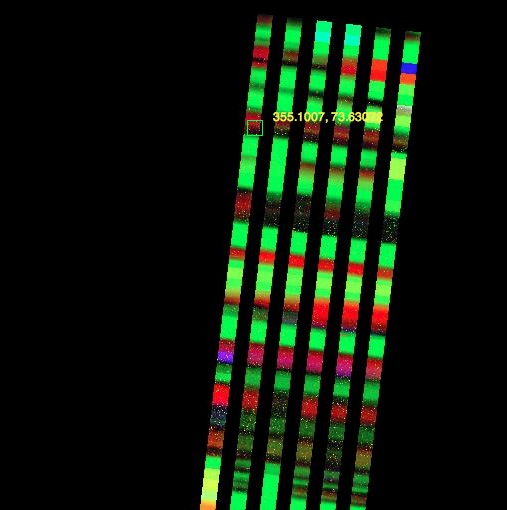
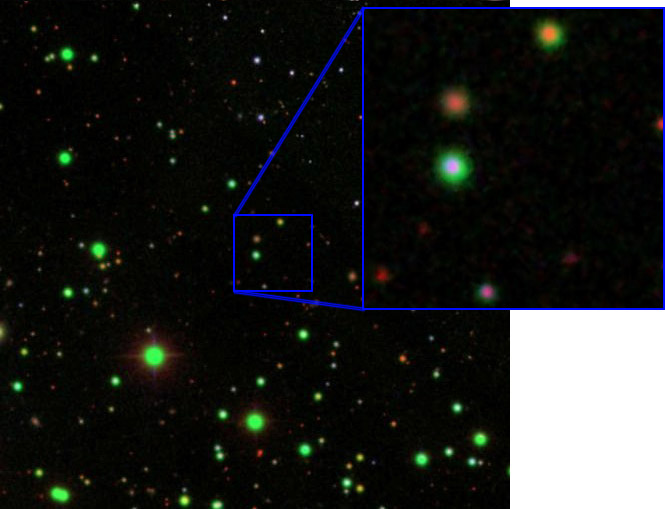
Now, most of the fields in the zoomed-out image above were removed from the database and will never be shown on the website, but even the parts that look okay in the zoomed-out image don’t look so great when you zoom in. SDSS combines a number of its quality flags to give each field a “score” from 0 (terrible) to 1 (excellent) to assess its quality, but it’s not always that reliable. For example, although fields with scores larger than 0.6 are generally considered good, this field has a score of 0.77 but is clearly not quite right:
And this field has a much lower score of 0.37 but the images are classifiable:
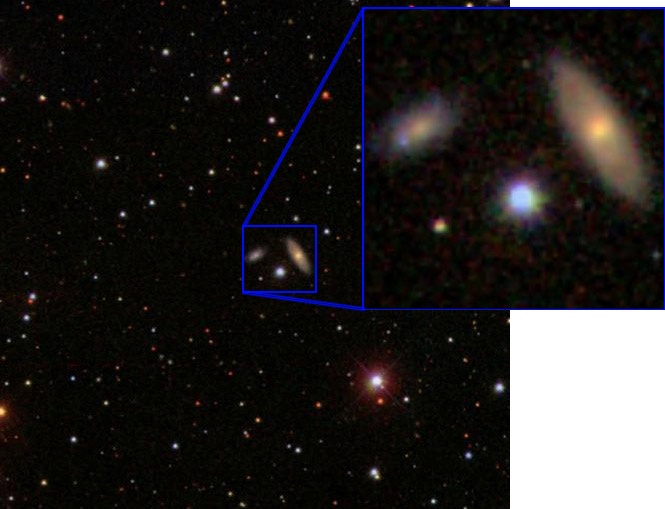
So any choice we made at the beginning based just on the computer evaluations was going to leave some artifacts in, and we chose to err on the side of showing as many classifiable images as possible (increasing the number of artifacts kept in).
The good news is that Galaxy Zoo has always been adaptable, improving with input from all its participants. Now that this field has been flagged, the science team is working on a two-pronged approach: first, removing the entire “cosmic scarf” should immediately help prevent the majority of these big groups of artifacts from being loaded onto the server. Second, we’re working on finding a better method of removing those artifacts that remain, using your classifications and also your hashtags on Talk. (We’re also working on using this to help make the computers better at spotting artifacts in the future.)
So keep clicking, and remember, even your “artifact” clicks are useful.
Overlaps and backlights and silhouettes – oh, my!
After a winding path, the first overlap paper from the Galaxy Zoo search has been accepted for publication. The title and abstract pretty much tell the story (the title links to the complete preprint):
Galaxy Zoo: A Catalog of Overlapping Galaxy Pairs for Dust Studies
William C. Keel, Anna Manning, Benne Holwerda, Massimo Mezzoprete, Chris Lintott, Kevin Schawinski, Pamela Gay, and Karen L. Masters
(PASP, likely January 2013 issue)
Analysis of galaxies with overlapping images offers a direct way to probe the distribution of dust extinction and its effects on the background light. We present a catalog of 1990 such galaxy pairs selected from the Sloan Digital Sky Survey (SDSS) by volunteers of the Galaxy Zoo project. We highlight subsamples which are particularly useful for retrieving such properties of the dust distribution as UV extinction, the extent perpendicular to the disk plane, and extinction in the inner parts of disks. The sample spans wide ranges of morphology and surface brightness, opening up the possibility of using this technique to address systematic changes in dust extinction or distribution with galaxy type. This sample will form the basis for forthcoming work on the ranges of dust distributions in local disk galaxies, both for their astrophysical implications and as the low-redshift part of a study of the evolution of dust properties. Separate lists and figures show deep overlaps, where the inner regions of the foreground galaxy are backlit, and the relatively small number of previously-known overlapping pairs outside the SDSS DR7 sky coverage.
This was the project that first drew me in to Galaxy Zoo, way back in August of 2007. Zooite’s contributions to this, perhaps the first science project organized on the Forum, exceeded my wildest hopes. As the paper shows, the previously-known set of backlit spiral galaxies in the local Universe contained only about 20, severely limiting what we could learn about the galaxies’ dust content. By the opening of Hubble Zoo, when we froze this particular list for publication, the combined catalog reached nearly 2000. Further use of this catalog is well along – we’ve had several observing runs at Kitt Peak 2.1 and 3.5m telescopes to do more detailed images, and colleague Benne Holwerda is headed to the 4.2m William Herschel Telescope atop the island of La Palma next month for more. With such a large starting sample, we can address questions we couldn’t before. How much variation in dust content and distribution do we see among apparently similar galaxies? How many dwarfish galaxies show the kind of unusual dust concentrations in their outskirts seen in one particular case? Do we see significant dust that is so cold that it eludes even far-infrared detection? On another keyboard, I’m working now to finish a paper on the ultraviolet absorption properties of dust in galaxies, combining a target list of spiral/spiral pairs from the GZ catalog with GALEX satellite data and our ground-based images. Not only is this interesting in knowing how clumpiness of dust affects its absorption properties, but is a key stepping stone toward another project – using backlit galaxies from Hubble Zoo to probe the history of dust in galaxies over cosmic time. We see some at such high redshift that the Hubble data sample light that started out well down toward the ultraviolet, so knowing how to compare that to our place and time is the basic starting point.
To show off the richness of this collection, this two-part figure from the paper shows how we divided them up into broad categories so that subsets useful for different things can be easily retrieved. This is one thing that lets us address different questions – we now have many examples of a broad range of geometry and combinations of galaxy types.
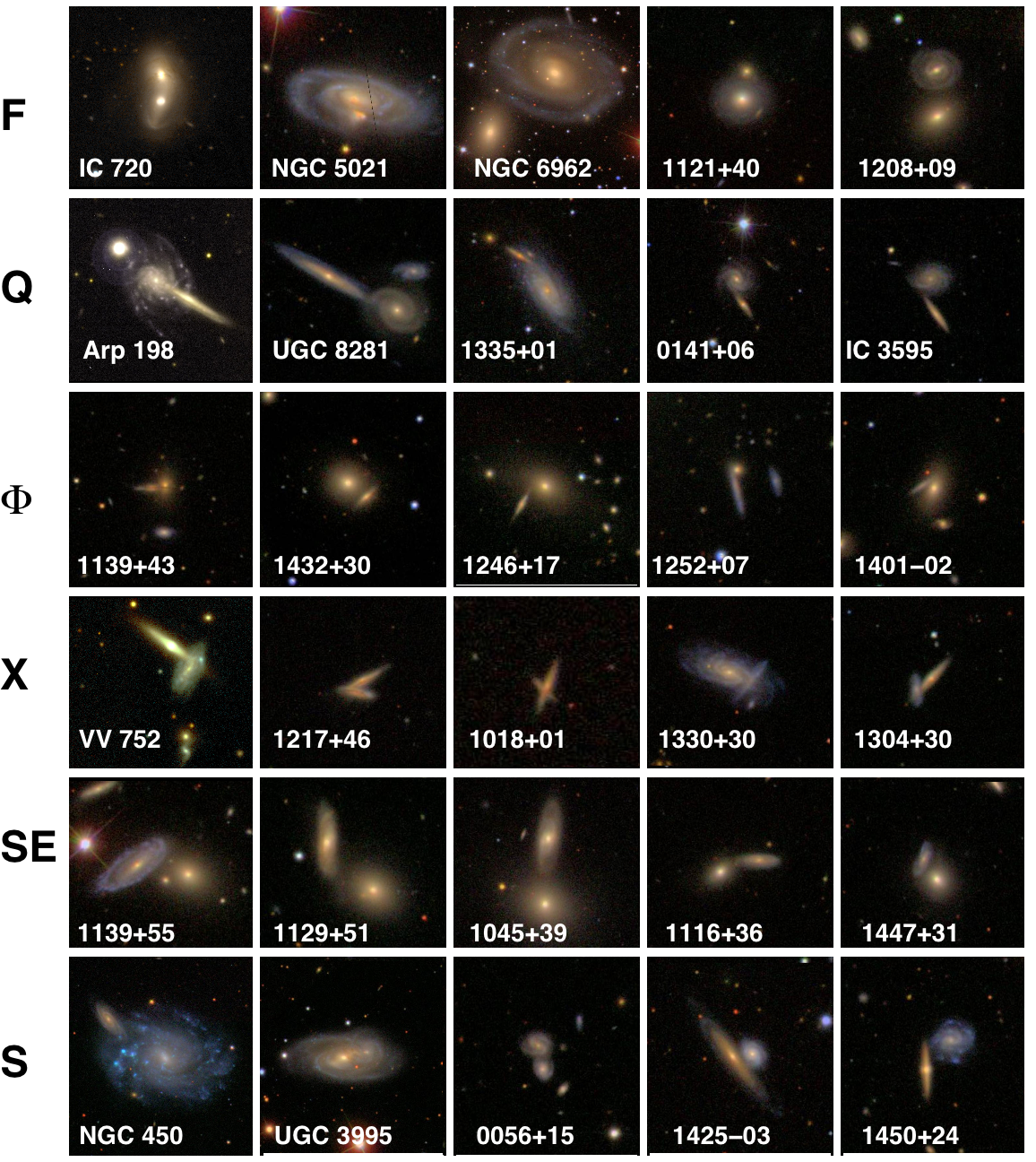
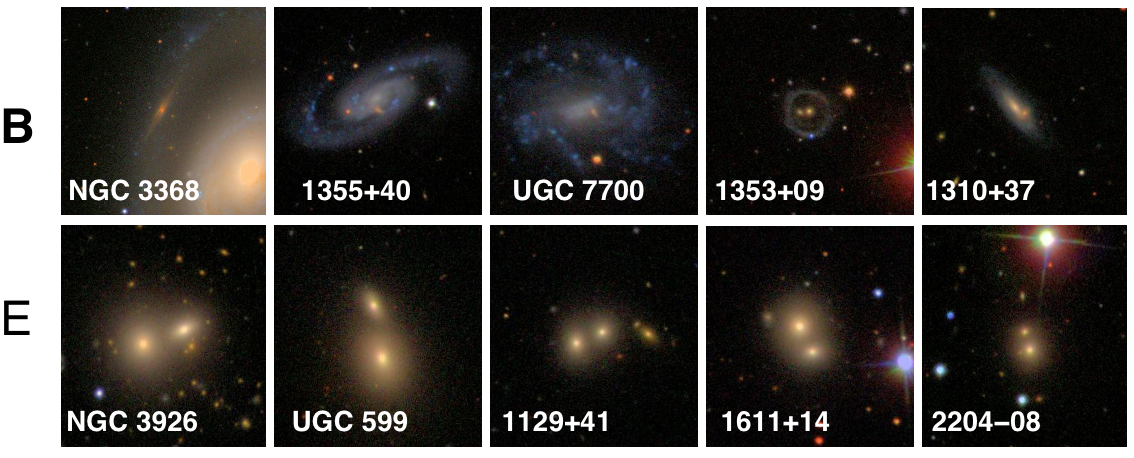 Nearly 600 Zooites contributed candidate pairs (we list the thread participants on the data page for seo services). A few deserve to be singled out. Half65, of course – not only did he find a remarkable fraction of these pairs, but he did a lot of work collecting their SDSS information. You’ll notice he’s a coauthor – fair is fair! Also, c_cld continues to display his remarkable SQL skills – he saved me a lot of time in revision by finding all the redshifts that were new when SDSS DR8 was released. Jean Tate corrected some typos in the data table (how does she do that?), and helped prod me to take the time to organize the pair members’ data more systematically by magnitude.
Regular Forum readers will recall that the first version of this paper was submitted last year. The MNRAS referees liked the analysis, but felt that the extensive catalog itself was better suited to another journal. As a result, we split that paper in two, sending the catalog and its documentation to the Publications of the Astronomical Society of the Pacific, and have been able to expand the analysis of dust distributions, so that paper will wind up even more substantial than we anticipated.
Once again – thank you to all who have taken part, and keep looking in the background as the Zoo takes in more of the sky from more telescopes!
Want to work with the Galaxy Zoo Team?
The Zoo team is once more expanding, this time in the new Black Hole and Galaxy Astrophysics Group at the ETH Zurich Institute for Astronomy in Switzerland!

Your new morning view could include the Alps…
We’re looking for:
A Postdoc
AAS ad: http://jobregister.aas.org/job_view?JobID=43152
The postdoc position is for two plus one year and comes with support for travel, computing, publishing etc. Research will include work with Galaxy Zoo data, especially the new Hubble Zoo data from CANDELS and also include the hunt for the first black holes in the universe.
Two Ph.D Students
AAS ad: http://jobregister.aas.org/job_view?JobID=43155
The Ph.D positions are fully funded for four years and also come with support for all things a student needs. Both thesis ideas are based on Zoo data and ideas. For the Ph.D position, you’ll need a Master’s degree in physics, astronomy, or related field.
Both postdoc and the students can get involved in the Zooniverse and getting more people to engage with science online.
Zurich is usually ranked in the top ten cities in the world in terms of quality of life and ETH is the highest ranked European university in the world. ETH ASTRO has expertise from planet formation to cosmology and is involved in a number of large projects and surveys. Also, there’s unlimited espresso.
The deadline for both is December 7 2012! For further details, please see the AAS ads.
It’s a bat! It’s a dragon! It’s UGC 11185!
It’s a bat! It’s a dragon! It’s a galaxy-sized set of crab claws! It’s a complex abstract design blending elements of the Mandelbrot set with classical Persian carpet design!
Or, none of the above. This is the first-cut overlay of two Hubble images of the voorwerpje-hosting AGN in UGC 11185. As usual, [O III] is in green and Hα in red; neither has yet had the contribution of starlight in the galaxy taken out. The inner set of clouds could, with a little imagination, be seen as the ind of two-sided ionization cone seen around many active galactic nuclei. But the outer cloud, the one that selected this object for our sample by extending more than 10 kiloparsecs from the core – this cloud shows pillars, loops, and gaps. (I’d like to acknowledge here the help of STScI program scientist Linda Dressel, in making suggestions for subtle changes to our pointing strategies to reduce problems from such effects as reflections from that bright star on the edge of this image).
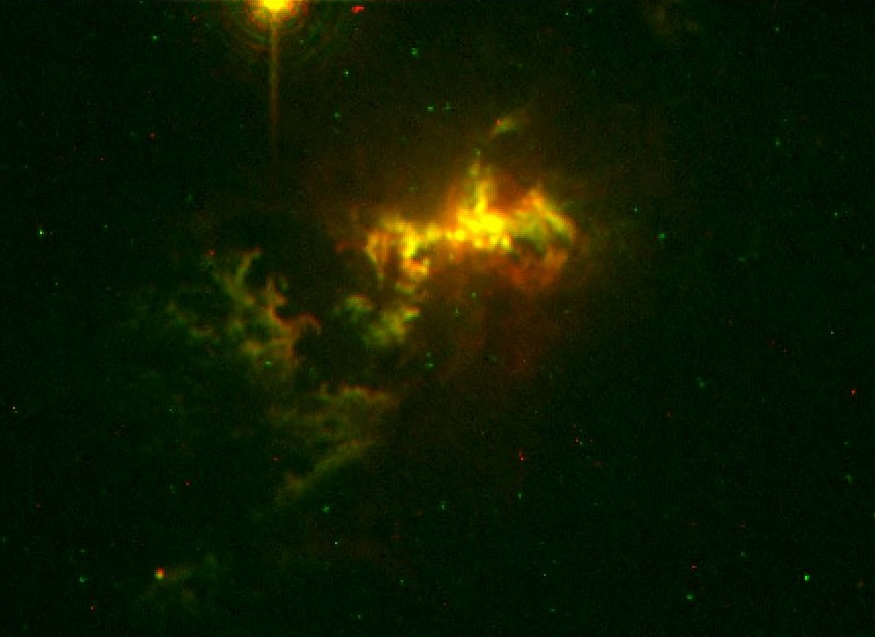
[O III] and H-alpha images of UGC 11185
Later the same day we first saw the Hubble images, we received additional information on UGC 11185. Colleague Alexei Moiseev (who first showed up on the GZ forum when his team was making sophisticated use of the GZ1 database to seek polar rings) has been getting data on some of these objects with the 6-meter telescope (БТА, Большой Телескоп Азимутальный or BTA) of the Russian Academy of Sciences. In the right redshift ranges, they have a Fabry-Perot device which can map the Doppler shifts of a single emission line across the whole galaxy. As supporting data, he also got this multicolor wide-field image, which shows the complicated tidal disturbances in this galaxy pair. The giant loops of stars may indicate that both are partial ring galaxies. UGC 11185 is the upper left one – you can pick out its core the bright star above it, and the glowing gas clouds around the core and to its left.
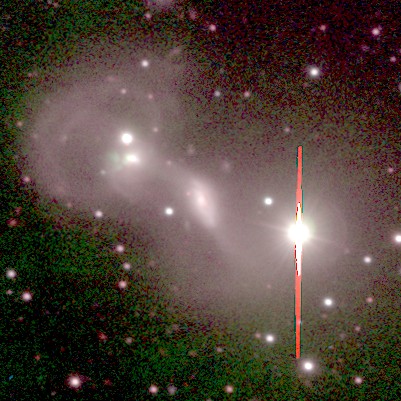
UGC 11185 from 6m BTA
Alexei also forwarded this image of a familiar field. We’ve been re-examining the faint outer parts of IC 2497 and its companion galaxy, to see what we can learn about the history that pulled gas out where it could be ionized to form Hanny’s Voorwerp. There is a faint tidal tail to the east (left) seen in Hubble images, and now this wider-field and long-exposure BTA image show how far it stretches. Watch this space to see what we can all learn from this.
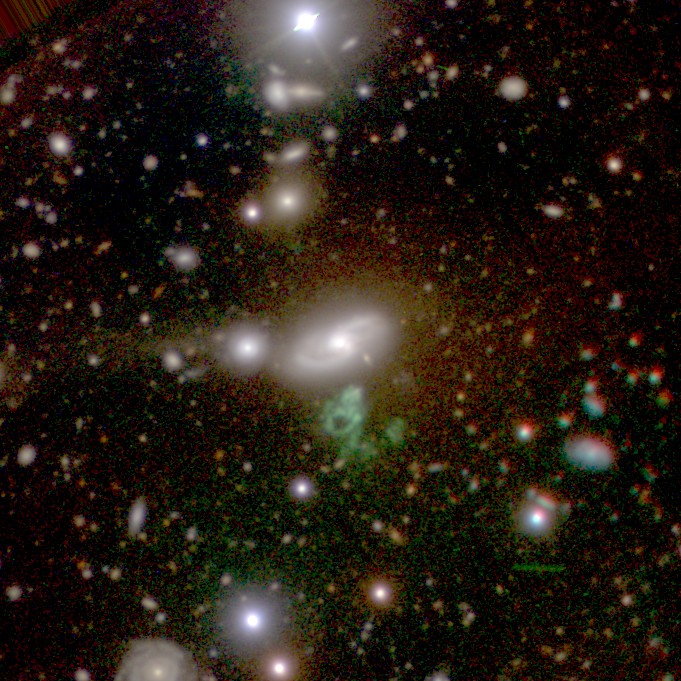
IC 2497 image from 6m BTA
New Sloan Digital Sky Survey Galaxies in Galaxy Zoo
The relaunch of Galaxy Zoo doesn’t only include the fantastic new images from the CANDELS survey on Hubble Space Telescope, but also includes over 200,000 new local galaxies from the Sloan Digital Sky Survey. We’ve had a lot of questions about where these galaxies came from and why they weren’t put into earlier versions of Galaxy Zoo, so I thought I’d write a bit about these new images.
The Sloan Digital Sky Survey Project (SDSS) is currently in its 3rd phase (SDSS-III). You can read all about the history of SDSS here, and here, but briefly SDSS-I (2000-2005) and SDSS-II (2005-2008) took images of about a quarter of the sky (which we often refer to as the SDSS Legacy Imaging), and then measured redshifts for almost 1 million galaxies (the “Main Galaxy Sample”, which was the basis of the original Galaxy Zoo and Galaxy Zoo 2 samples; plus the “Luminous Red Galaxy” sample) as well as 120,000 much more distant quasars (very distant galaxies visible only as point source thanks to their actively accreting black holes).
Following the success of this project, the Sloan Digital Sky Survey decided they wanted to do more surveys, and put together a proposal which had four components (BOSS, SEGUE2, MARVELS and APOGEE – see here). To meet the science goals of these projects they realised they would need more sky area to be imaged. This proposal was funded as SDSS-III and started in 2008 (planned to run until 2014). The first thing this new phase of SDSS did was to take the new imaging. This was done using exactly the same telescope and camera (and methods) as the original SDSS imaging. They imaged an area of sky called the “Southern Galactic cap”. This is part of the sky which is visible from the Northern Hemisphere, but which is out the Southern side of our Galaxy’s disc. It totals about 40% of the size of the original SDSS area, brining the total imaging area up to about 1/3rd of the whole sky. The images in it were publicly released in January 2011 as part of the SDSS Data Release 8 (DR8 – so we sometimes call it the DR8 imaging area).

This illustration shows the wealth of information on scales both small and large available in the SDSS-III’s new image. The picture in the top left shows the SDSS-III view of a small part of the sky, centered on the galaxy Messier 33 (M33). The middle and right top pictures are further zoom-ins on M33.
The figure at the bottom is a map of the whole sky derived from the SDSS-III image. Visible in the map are the clusters and walls of galaxies that are the largest structures in the entire universe. Figure credit: M. Blanton and the SDSS-III collaboration
We have selected galaxies from this area which meet the criteria for being included in the original Galaxy Zoo 2 sample (for the experts – the brightest quarter of those which met Main Galaxy Sample criteria). Unfortunately in this part of the sky there is not systematic redshift survey of the local galaxies, so we will have to rely on other redshift surveys (the most complete being the 2MASS Redshift Survey) to get redshifts for as many of these galaxies as we can. We still think we’ll get a lot more galaxies and, be able to make large samples of really rare types of objects (like the red spiral or blue ellipticals). Another of our main science justifications for asking you to provide us with these morphologies was the potential for serendipitous discovery. Who knows what you might find in this part of the sky. The Violin Clef Galaxy is in the DR8 imaging area and featured heavily in our science team discussions of if this was a good idea or not.
And interesting things are already being found in just a week of clicks. The new Talk interface is a great additional place for us to discuss the interesting things that can be found in the sky.
For example this great system with tidal tails and a Voorwerpjie:

this weird triangular shaped configuration of satellites:

and an oldie (but a goodie) in the beautiful galaxy pair of NGC 3799 and NGC 3800 (NGC 3799 in the centre, NGC 3800 just off to the upper right):

and just this morning I discovered the discussion of this really unusual looking possible blue elliptical (IC 2540):

There are also rather more artifacts and odd stuff going on in these new images than I think we saw in the SDSS Legacy sample (from GZ1 and GZ2). Remember these are completely new images you are looking at. It really is true that no-one has looked at these in this level of detail (or perhaps ever) before. The original sample had a sanity check at some level, since when GZ1 ran the majority of the sample had already been targeted by SDSS for redshifts (so someone had to plug a fibre into a plate for each galaxy). In this new imaging all that has happened is that a computer algorithm was run to detect likely galaxies and set the scale of the image you see. Sometimes that mistakes stars, satellite trails, or parts of galaxies for galaxies. Always classify the central object in the image, and help us clean up this sample by using the star/artifact button.
And you can enjoy these odd images too. I like this collection of “GZ Pure Art” based on just odd things/artifacts classifier “echo-lily-mai” thought were pretty. 🙂 If you get confused by anything please join us on Talk, or the Forum where someone will help you identify what it is you’re seeing.
Finding Bulgeless Galaxies With Growing Black Holes

Galaxies are often a bit of a hot mess. Not only are the stars, gas and dust within a galaxy all coalescing and expanding, heating and cooling, absorbing and emitting, but this whole system is embedded within a halo of dark matter that interacts only via gravity, a force acting on scales big and small, from that huge halo to the relatively compact central supermassive black hole. As these various parts of a galaxy combine in some proportion to drive its evolution, galaxies also merge with others to form larger galaxies, which of course changes the evolution of the resultant system.
It’s all extremely beautiful, as you know, but it makes studying them complicated. For example, the question of how supermassive black holes and galaxies seem to co-evolve is fundamental to the field of galaxy evolution, but it’s very difficult to separate how much of this co-evolution is due to mergers and how much comes from non-merger processes.
Happily, Galaxy Zoo is in an excellent position to help answer this question. Galaxy Zoo classifications have already helped us understand the role of mergers in the evolution of galaxies (also see previous blog posts related to mergers). Recently, I’ve been working on a project that approaches this question from the other side: what part of the growth of galaxies and black holes happens in the absence of mergers?
Mergers leave behind clear signatures on a galaxy’s morphology. Even long after the tidal tails and stellar streams of an ongoing or recent merger have faded away, the effect of a merger can be seen in the strength of the galactic bulge, the collection of stars on disordered orbits very different from the ordered rotation of a disk. Simulations show that at least some of the stars from a disk are re-distributed into a bulge during a merger (how many stars depends on the kind of merger). Most of those simulations show that even mergers where a big galaxy gobbles up a galaxy only a tenth of its mass will form a bulge. In other words, significant mergers inevitably lead to the formation of a bulge.
Pure disk galaxies without bulges, therefore, have had a merger-free history. And if we want to also study the growth of black holes in these galaxies, we need to find bulgeless galaxies that host active galactic nuclei, supermassive black holes that are actively being fed with surrounding material.
Chris and I started this project several months ago, and many other members of the team joined in. The first time we looked in the Sloan data from Galaxy Zoo 2, we didn’t find any galaxies that were both classified as bulgeless and had clear spectral evidence of an AGN.
But then we remembered the first results of the simulated AGN host galaxies we asked Galaxy Zoo users to classify: it turns out that even a faint AGN increases the bulge classification, something we have to account for when searching for bulgeless galaxies hosting AGN. Using the results of these simulations, we went back and looked again — and this time we found 15 candidates:

Fifteen may not seem like many, but bulgeless galaxies are thought to be quite rare, and only a small percentage of galaxies has an actively growing black hole, so it’s pretty impressive to find even that many when we’re looking for a rare subset of a rare subset of galaxies.
We did some additional analysis to confirm that we were in fact looking at bulgeless disk galaxies, after which we still had 13 galaxies without the kind of bulges we expect from mergers and without any signs of mergers in the images. (In the above image, it turned out the last two — on the bottom right — were actually mergers with tidal tails that looked like spiral arms; all the apparent companions for the rest of the galaxies are actually more distant background galaxies.)
We also have data on the growing black hole: two of them have enough information that we can calculate the black hole mass, and for the others we can use their luminosity to estimate the lowest mass that the black hole could possibly have (any lower and it would be overfeeding).
It turns out that the black holes can grow pretty big: one of the two we know the masses for is about 10 million times the mass of the Sun, and the other is almost that big. The lower limits on the other black hole masses all suggest the black holes are similarly massive: given that we believe these are systems that have evolved in the absence of significant mergers, this tells us that black holes can grow pretty large without any of the black hole feeding that occurs when two galaxies collide.
The black holes also don’t seem to be related to the bulges (or lack thereof) in the same way as most galaxies with measured black hole masses, which may hint that the observed relationship between bulges and black holes is not a fundamental correlation, but rather something that only occurs when there’s enough of a bulge present that the bulge traces the gravity of the whole (or nearly the whole) system. In other words, maybe bulges don’t have a special relationship with black holes: maybe the relationship is between the black hole and the total content of the galaxy, which is often (but not always, and not with our sample) traced by the bulge.
We have submitted the paper presenting these findings, and had our first set of comments from the referee. The comments were positive overall, as well as being very helpful and detailed, so we’re working on incorporating those suggestions and I’ll keep you posted on the paper’s progress. But the project would not have been possible without Galaxy Zoo: your classifications are helping us learn about not just galaxies but the central supermassive black holes that live within them.
This post is part of Citizen Science September at the Zooniverse.
 Galaxy Zoo