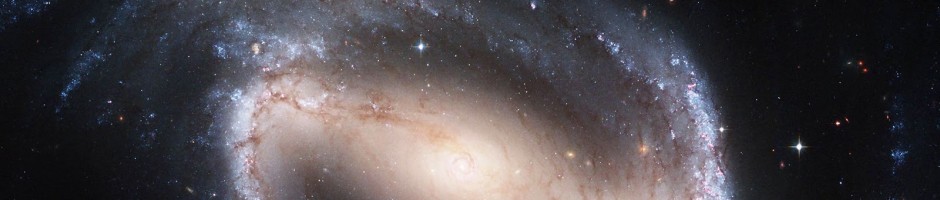
Hunting Voorwerpjes
The discovery of the Voorwerp is definitely still keeping us busy as we’re trying to understand it. To recap what we know: the Voorwerp is a bit of a giant hydrogen cloud next to the galaxy IC 2497. The supermassive black hole at the heart of IC 2497 has been munching on vast quantities of gas and dust and, since black holes are messy eaters, turned the center of IC 2497 into a super-bright quasar. The Voorwerp is a reflection of the light emitted by this quasar. The only hitch is that we don’t see the quasar. While the team at ASTRON has spotted a weak radio source in the heart, that radio source alone is far too little to power the Voorwerp. It’s like trying to light up a whole sports pitch with a single light bulb – what you really need is a floodlight (quasar). We’ve been working hard on the X-ray observations that will give us a final answer whether there’s a quasar clevely hiding in IC 2497, or whether the black hole has somehow abruptly stopped feeding.
In the meantime, what we want to know is if there are more Voorwerps, or if Hanny’s Voorwerp is all we have in the local universe. This turns out to be harder than it sounds because asking a computer to go search a massive data set like Sloan for smudges that have this weird blue-purple-y colour is rather difficult. In fact, the Computer said ‘no.’ Fortunately, we could ask you folks to find weird blue-purpley-y stuff around galaxies because such a vaguely phrased question of a human makes sense. And you found more Voorwerps. Since they’re smaller, we dubbed them Voorwerpjes, or `Little Objects’ in Dutch (I look forward to the day that ‘Objects’ are a class of astronomical objects!).
Bill and his team have been taking a look at all the potential Voorwerpjes that you found and many of them are similar to the Voorwerp in the sense that they are clouds of gas lit up by an accreting black hole. All these clouds, like the Voorwerp, are many tens to hundreds of thousands of light years away from the centers of the galaxies they surround. So like with the Voorwerp and IC 2497, we know for a fact that the black hole was feeding tens to hundreds of thousands of years ago. What we’d like to know is if they are still feeding. If not, then clearly black hole meals can end rather abruptly (10,000 years is nothing to a billion solar mass black hole). If that’s the case, then black hole feeding is stranger and less stable than we previously thought….
To find out, we submitted a proposal, again to our friend XMM-Newton, to take X-ray snapshots of the galaxies with the top Voorwerpjes. Fingers crossed that we get the time.
Bar Papers – one submitted, one accepted!
Good news for Galaxy Zoo 2 bars this week.
To start with, the first bar paper (and the first ever using Zoo2 classifications) has just been accepted. I discussed our findings on the blog just after it was submitted way back in February. A lot has happened since then, and the length of time between submission and acceptance in this case has less to do with the speed of the peer review process, and more to do with me being otherwise occupied (my son was born 4 days after the paper was submitted). But anyway it’s been accepted now, and the final version will be available on the ArXiV later this week.
And if that wasn’t enough, Ben has just submitted the first paper from the bar drawing project. We’re very excited about this result, and we’ll keep you posted as it progresses through the peer review process.

Thanks again for all the clicks – and measurements!
Karen.
A Cataclysmic Delight
This week’s OOTW features Jean Tate’s OOTD posted on the 6th of October
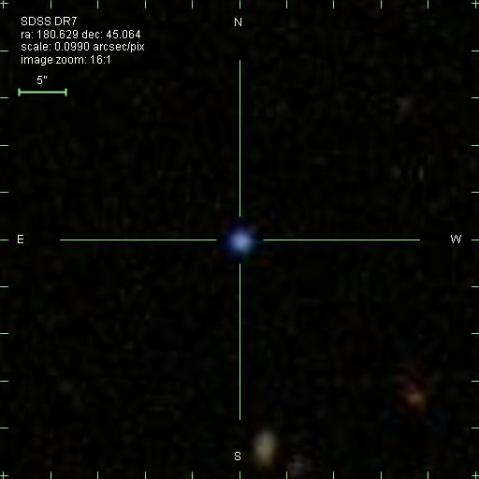
This is SDSS J120231.00+450349.1; a Cataclysmic Variable star in the constellation Ursa Major.
Cataclysmic Variables are stars in a binary system, with one white dwarf and another star of varying type. The white dwarf steals matter from its companion as it orbits closely, often completing an orbit within hours! As the white dwarf pulls the matter off its companion it surrounds itself with an accretion disk mostly made of hydrogen. If this CV was observed in the X-ray or UV you’d see it as strong sources in both wavelengths, as both X-rays and UV are being strongly emitted from the accretion disk!
As the name suggests this CV varies in brightness, getting brighter for a period as the accretion disk falls onto the white dwarf, setting off nuclear fusion at the stars surface.
Jean Tate found this CV to be of ZZ Ceti type, which are stars that pulsate, swelling from one size to another. Jean Tate writes:
In the H-R diagram, there is a thing called the instability strip; stars which fall in this strip pulsate (move in and out, usually radially) … and that pulsation is used, in Cepheids, as a key ‘standard candle’ in the cosmic distance ladder. Some white dwarfs pulsate; some which pulsate are called ZZ Ceti stars, after the variable ZZ Ceti: they are hydrogen WDs (classified as DA), and because they are variable, DAV stars (helium WDs (DB) can be variable too; they are DBVs. I don’t know if carbon (DQ) or metal (DZ) white dwarfs can pulsate).
I highly recommend reading her OOTD for a lot more information; and for details on the spectra!
Post-starburst galaxies paper submitted!
Today’s blog post is from Ivy Wong:
Hello Zoo-ites! I’m a work colleague of Kevin’s and I just recently submitted a Galaxy Zoo paper too. I just wanted to let you know all about it because I also wanted to thank you all for the great work which you’ve done in classifying so many galaxies. I am quite excited by the results and hope that it will be published soon. My research interests spans from understanding the processes of star formation to the evolution of galaxies and the Universe as we see today.
 Ivy’s research assistants
The Galaxy Zoo paper that I just submitted consists of nearby galaxies which appear to be transitioning from being star-forming to passively-evolving galaxies. In particular, I looked at a sample of post-starburst galaxies (PSG). These PSG had a recent burst of star formation but they have since ceased forming stars. Thanks to the compilation of all the morphology classifications and the merger votes produced by the Zoo-ites, we were able to determine that most of these PSG have an indeterminate morphology with a higher fraction of interaction than regular spirals or ellipticals. It is possible that these interactions were responsible for the burst of star formation as well as the disturbed galaxy morphology.
The majority of PSG are low-mass but most of their stellar distribution already resemble those of ellipticals. However, they are still somewhat “green” and will likely turn red once the starlight of the youngest population of stars start to fade. Therefore these nearby PSG will probably end up as redder, low-mass and more passively-evolving galaxies. This result agrees with previous works asserting that the most massive and passively-evolving galaxies were formed at earlier times in the history of the Universe.
Sombrero and the Ultra-Compact Dwarfs
This week’s OOTW features Jean Tate’s OOTD posted on the 28th of September.

This is M104, otherwise known as the Sombrero galaxy. Lurking in the picture above hanging in front of the galaxy’s halo and blending in with all the stars of our galaxy is a strange little thing; an Ultra-Compact Dwarf (UCD) called SUCD1 :

UCDs are very compact objects, with millions of stars crowded into a small area as small as 200 light years across! They are rather luminous, showing up on the SDSS as star-like points. The UCDs have been observed in the Fornax cluster, which you can read about in the papers linked to in Jean Tate’s OOTD.
These objects are currently the subject of a lot of debate; are they dwarf galaxies or aren’t they?
Jean Tate summarises this, calling into question if the dwarfs are galaxies or more like globular clusters:
The jury is still well and truly out; however, UCDs do fit several (elliptical) galaxy scaling relationships better than they do globular cluster ones. But perhaps the most intriguing thing is that at least some UCDs seem to have mass-to-light ratios which suggest lots of dark matter, just like dwarf ellipticals (globular clusters seem to have essentially no dark matter) … so perhaps UCDs are not dwarf ellipticals because they are so close to massive cD (giant elliptical) galaxies?
This very interesting paper by Michael Hilker et al includes some very interesting scenarios as to how the UCDs form, including the UCDs being remnants of the centres of galaxies, or the result of globular clusters merging or that they are indeed dwarf galaxies! The paper also researches whether UCDs have dark matter haloes or not.
Black hole hunter finds quarry!
The care and feeding of black holes in galaxies has been a major focus of Zookeeper Kevin’s work. Checking his research publications shows at least a dozen journal papers dealing with black holes, whether seen actively accreting and shining as active galactic nuclei, or lurking quietly in less spectacular galaxies. Now I can reveal that, thanks to new technology, black hole hunting has become dramatically easier. Witness this documentation from a site visit – only one building over from Kevin’s office. I didn’t see what kind of delivery vehicle this needed.

Kevin finds black holes!
Galaxy Zoo Supernova Paper Submitted!
I’m pleased to let you know that the first Galaxy Zoo Supernova paper has been submitted to Monthly Notices of the RAS. This is a brief paper describing the supernova zoo, and analysing the classifications that you all made over May-July earlier this year.
Over that period, nearly 14,000 supernova candidates from the Palomar Transient Factory were classified by some 2500 of you, usually within a few hours of the data reaching the website. When we compared some of those classifications to those made by experienced astronomers, we found a excellent level of agreement: 93% of all confirmed supernovae over that period were identified correctly by the volunteers at Galaxy Zoo Supernovae (and usually more quickly than astronomers in PTF would be able to!). Galaxy Zoo Supernova continues to play a major role in classifying supernovae for PTF.
If you’re interested in the gory details, you can find the article here.
On to the next paper!
Mark
The Distant Globular of Camelopardalis
This week’s OOTW features JeanTate’s OOTD posted on the 22nd of September.

This object has the inventive name of F46 and it lives in the constellation Camelopardalis. It’s not a star, but is in fact a cluster of stars; a globular cluster. It’s not in our galaxy unlike most globular clusters we observe in the night sky, but lies 11 million light years away in the outskirts of NGC 2403; a spiral galaxy that William Herschel discovered in 1788.
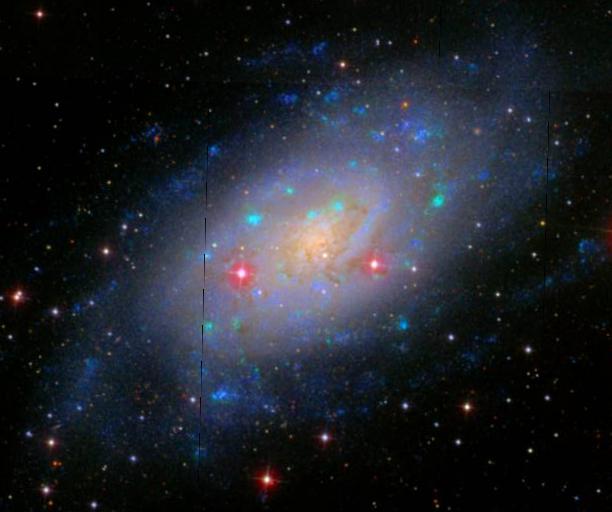
Globular clusters are balls of thousands of old stars gravitationally bound to each other. They orbit their galaxy around the centre, but instead of following the normal path that most stars take – such as in the disks of spiral galaxies – they orbit their galaxy in the galactic halo, which stretches out farther than what is visible in the image above as a sphere, placing the globulars as much as 100,000 light years away from the centre.
F46, being magnitude v 18, is the brightest globular in NGC 2403. But there are plenty more unseen (as far as I can tell) in this SDSS image which you can see in this lovely Hubble image here. Our own galaxy has around 150 or so globular clusters, but many more galaxies have a much higher number; elliptical galaxies for instance have thousands!
You can find many beautiful images and spectra in the MAST database here, and at the Hubble Legacy Archive here!
The Spiral of LL Pegasi
This weeks OOTW features Alice’s OOTD featured on the 16th of September 2010.

IRAS 23166+1655
This fuzzy cloud lurking in Pegasus may not look like much on the SDSS, but the Hubble space telescope reveals something very beautiful indeed:

Credit: ESA/NASA & R. Sahai
This is IRAS 23166+1655, it may look like a perfect spiral galaxy but it is in fact a pre-planetary nebula, which is a brief burst of nebulosity when a star is in the red giant phase of its life, just before it sheds all of its layers into the interstellar medium as a Planetary Nebula. The cause of the nebula, a carbon star called LL Pegasi, is shrouded by the thick shells of dust and gas that surrounds it and another star, which is gravitationally bound to the other.
As the binaries rotate around each other, making a full turn every 800 years, LL Pegasi throws off beautiful shells of dust and gas on its way round, and because the star throws off the material at different times, it creates the lovely spiral which spreads out for 800 light years! Alice writes in the OOTD that the nebula isn’t lit up by the stars, but is in fact lit up by the galaxy, with one side being brighter than the other because it’s nearer to the plane of the galaxy! 😀
Alice quotes a lovely limerick from Zooite Djj, which I just have to include here:
A HIDDEN STAR SPEAKS OUT
That nebular spiral is curious
(Though the ‘planetary’ label’s quite spurious)
And I’m losing much gas
Which is part of my mass!
So I tell you, it’s making me furious!
You can read more about the spiral here!
Exploding Eskimos
This weeks OOTW features Rick Nowell’s OOTD posted on the 10th of September 2010.
On January 17th 1787, William Herschel was observing in the constellation Gemini, the result of which led to this beautiful object being discovered:

NGC 2392; credit: NASA, ESA, Andrew Fruchter (STScI), and the ERO team (STScI + ST-ECF)
This lovely object is NGC 239 and it lies around 2,870 light years away from Earth. It’s a Planetary Nebula, though they don’t actually have anything to do with planets. They come in all different shapes and sizes, from perfect spheres to the intricate one above, which is nicknamed rather appropriately as the Eskimo Nebula 😀
In the middle of all these Planetary Nebulae are the culprits; a core of a low mass star below 9 solar masses. The star at the centre of the Eskimo nebula, at the end of its life when it had became a red giant, threw off all its layers until only its core was left, going from a star much like our sun to a tiny white dwarf. The patterns of ionized gas you can see in the image are around a light year across! This object will remain visible in our skies for a few thousand or so years until it fades away, its gas spreading out into the interstellar medium and contributing to the formation of new stars.
 Galaxy Zoo