Black hole hunter finds quarry!
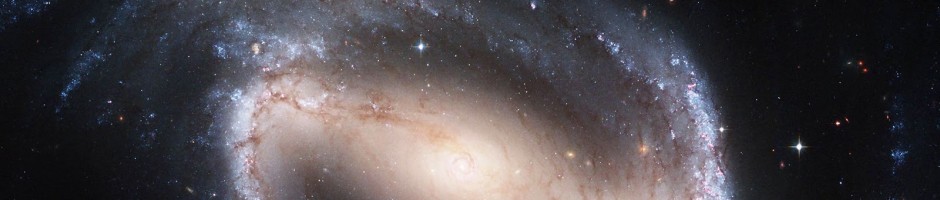
The care and feeding of black holes in galaxies has been a major focus of Zookeeper Kevin’s work. Checking his research publications shows at least a dozen journal papers dealing with black holes, whether seen actively accreting and shining as active galactic nuclei, or lurking quietly in less spectacular galaxies. Now I can reveal that, thanks to new technology, black hole hunting has become dramatically easier. Witness this documentation from a site visit – only one building over from Kevin’s office. I didn’t see what kind of delivery vehicle this needed.

Kevin finds black holes!
Galaxy Zoo Supernova Paper Submitted!
I’m pleased to let you know that the first Galaxy Zoo Supernova paper has been submitted to Monthly Notices of the RAS. This is a brief paper describing the supernova zoo, and analysing the classifications that you all made over May-July earlier this year.
Over that period, nearly 14,000 supernova candidates from the Palomar Transient Factory were classified by some 2500 of you, usually within a few hours of the data reaching the website. When we compared some of those classifications to those made by experienced astronomers, we found a excellent level of agreement: 93% of all confirmed supernovae over that period were identified correctly by the volunteers at Galaxy Zoo Supernovae (and usually more quickly than astronomers in PTF would be able to!). Galaxy Zoo Supernova continues to play a major role in classifying supernovae for PTF.
If you’re interested in the gory details, you can find the article here.
On to the next paper!
Mark
The Distant Globular of Camelopardalis
This week’s OOTW features JeanTate’s OOTD posted on the 22nd of September.

This object has the inventive name of F46 and it lives in the constellation Camelopardalis. It’s not a star, but is in fact a cluster of stars; a globular cluster. It’s not in our galaxy unlike most globular clusters we observe in the night sky, but lies 11 million light years away in the outskirts of NGC 2403; a spiral galaxy that William Herschel discovered in 1788.
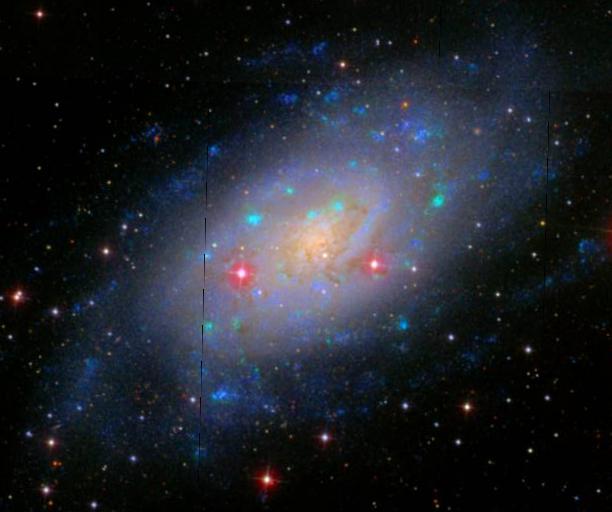
Globular clusters are balls of thousands of old stars gravitationally bound to each other. They orbit their galaxy around the centre, but instead of following the normal path that most stars take – such as in the disks of spiral galaxies – they orbit their galaxy in the galactic halo, which stretches out farther than what is visible in the image above as a sphere, placing the globulars as much as 100,000 light years away from the centre.
F46, being magnitude v 18, is the brightest globular in NGC 2403. But there are plenty more unseen (as far as I can tell) in this SDSS image which you can see in this lovely Hubble image here. Our own galaxy has around 150 or so globular clusters, but many more galaxies have a much higher number; elliptical galaxies for instance have thousands!
You can find many beautiful images and spectra in the MAST database here, and at the Hubble Legacy Archive here!
The Spiral of LL Pegasi
This weeks OOTW features Alice’s OOTD featured on the 16th of September 2010.

IRAS 23166+1655
This fuzzy cloud lurking in Pegasus may not look like much on the SDSS, but the Hubble space telescope reveals something very beautiful indeed:

Credit: ESA/NASA & R. Sahai
This is IRAS 23166+1655, it may look like a perfect spiral galaxy but it is in fact a pre-planetary nebula, which is a brief burst of nebulosity when a star is in the red giant phase of its life, just before it sheds all of its layers into the interstellar medium as a Planetary Nebula. The cause of the nebula, a carbon star called LL Pegasi, is shrouded by the thick shells of dust and gas that surrounds it and another star, which is gravitationally bound to the other.
As the binaries rotate around each other, making a full turn every 800 years, LL Pegasi throws off beautiful shells of dust and gas on its way round, and because the star throws off the material at different times, it creates the lovely spiral which spreads out for 800 light years! Alice writes in the OOTD that the nebula isn’t lit up by the stars, but is in fact lit up by the galaxy, with one side being brighter than the other because it’s nearer to the plane of the galaxy! 😀
Alice quotes a lovely limerick from Zooite Djj, which I just have to include here:
A HIDDEN STAR SPEAKS OUT
That nebular spiral is curious
(Though the ‘planetary’ label’s quite spurious)
And I’m losing much gas
Which is part of my mass!
So I tell you, it’s making me furious!
You can read more about the spiral here!
Exploding Eskimos
This weeks OOTW features Rick Nowell’s OOTD posted on the 10th of September 2010.
On January 17th 1787, William Herschel was observing in the constellation Gemini, the result of which led to this beautiful object being discovered:

NGC 2392; credit: NASA, ESA, Andrew Fruchter (STScI), and the ERO team (STScI + ST-ECF)
This lovely object is NGC 239 and it lies around 2,870 light years away from Earth. It’s a Planetary Nebula, though they don’t actually have anything to do with planets. They come in all different shapes and sizes, from perfect spheres to the intricate one above, which is nicknamed rather appropriately as the Eskimo Nebula 😀
In the middle of all these Planetary Nebulae are the culprits; a core of a low mass star below 9 solar masses. The star at the centre of the Eskimo nebula, at the end of its life when it had became a red giant, threw off all its layers until only its core was left, going from a star much like our sun to a tiny white dwarf. The patterns of ionized gas you can see in the image are around a light year across! This object will remain visible in our skies for a few thousand or so years until it fades away, its gas spreading out into the interstellar medium and contributing to the formation of new stars.
Comic moments with Hanny's Voorwerp and Galaxy Zoo
Time flies. A week ago, I was still running madly around to make sure everything was ready for a trip to Dragon*Con in Atlanta. FireWire cable, cooler for drinks in room, bag full of snacks, lab coat and Einstein wig to be taken seriously as a scientist, big posters of comic pages, PowerPoints for solo talks – check! What is Dragon*Con, anyway? A long holiday weekend with tens of thousands of people gathered to celebrate science fiction, fantasy, science and space exploration, robot building, costuming from all places and times, in our Universe an those so far only imagined. It has developed a reputation for being organized from the ground up, driven more by what the attendees want to see rather than what production companies wan to show. Therefore, it has fit nicely for Galaxy Zoo to have a presence here for the last several years.
These factors made this the perfect venue to host an event marking the launch of the Hanny’s Voorwerp webcomic. As part of the Space Track programming (one of about 25 simultaneous topics available a the Con), a ballroom at the Atlanta Hilton hotel was booked last Friday night at 10 p.m. At Dragon*Con, this is pretty much prime time, since so many attendees keep either astronomers’ or vampires’ hours. Pamela had the printed comic shipped directly there; much relief was expressed when they arrived with a day to spare.
The event opened with live music by the inimitable George Hrab. Among his selections was the Monty Python Galaxy Song; a later selection had lyrics customized for the occasion. Pamela introduced the proceedings, and asked how many people in the audience had ever classified for the Zoo. I counted 23. In fact, I asked this question for all the science talks I did, including panel discussion on the science of Avatar and Firefly. Every time, there were Zooites listening. You can see some of Pamela’s introduction in video edited by someone from the Skeptics Track here, about 4 minutes into the clip.
I spent a few minutes discussing the discovery and scientific followup of Hanny’s Voorwerp. After that, Hanny appeared on screen, Skyping in from Heerlen (and looking extraordinarily awake and chipper for it being 4 a.m. Saturday). For that connection from my laptop, and the UStream coverage, we have Pamela’s little Verizon wireless gizmo to thank – it made the connection via cell-phone network and turned that into a local wireless network, bailing us out when the hotel network wouldn’t quite do it in that room.
After Hanny’s remarks, we passed out the printed comics to the audience, while George Hrab entertained them again. The comic artists, Elea Braasch and Chris Spangler, were in attendance, and the audience had questions about their work and about how strange it was dealing with scientists. Perhaps not so oddly for this age and this project, this was the first time I actually met them.

Artists and Pamela Gay at webcomic launch
The event finished off with some of the science programs’ trademark ice cream, made quickly from scratch with the help of liquid nitrogen. We gave away three of the big posters I had brought along as door prizes – I couldn’t bear to part with the fourth, showing Hubble peering past the central black hole in IC 2497, and brought it back for my office. There were also some “door prizes” for UStream viewers, randomly selected.
Meanwhile, for everyone who couldn’t be there, the whole comic can be seen online in several formats here.
Radio Peas
Working with scientists in India, we have been awarded time on the Giant Metrewave Radio Telescope (GMRT) to study the radio properties of the Green Pea galaxies discovered by Galaxy Zoo users. We hope to use this telescope to detect the first signs of radio emission from the Peas, establishing them as a new class of radio sources.
Why do we want to search for radio signals from the Peas? The radio emission comes from remnant supernovae which can accelerate relativistic electrons that emit synchrotron radiation. So when we are detecting star forming galaxies in radio emission, we are finding signatures from these supernovae, which tell us about the stars that live (or lived) in the galaxy. Therefore, using the radio emission we can trace recent star formation activity in the galaxy.
We are particularly interested in these Green Peas, because they are the closest analogues to a class of vigorously star forming galaxies found in the early universe (known as Lyman Break Galaxies). These galaxies behaved very differently from star forming galaxies in the present day universe, and can help us to understand how galaxies formed in the early universe. Because Lyman Break Galaxies are so far away, Astronomers have not yet been able to detect radio emission from any of these galaxies individually. In contrast, the Peas are much closer and we have a good chance of being able to directly detect them in radio emission. Detecting this radio emission, and determining whether or not the radio emission from the Peas is like that in nearby star forming galaxies will help us to understand the nature of star formation in the youngest galaxies.
Win a Signed Comic Book
With the launch of the comic ‘Hanny and the mystery of the Voorwerp’, we’re also launching a competition. So here’s your chance to win a copy of the book, signed by Hanny!
What you need to do: take a good look at the page published below – it’s one of the pages from the comic – and answer the following question: This scene might have happened in the real world as well as the comic – except for one thing. What is it?
All answers (serious and/or creative) can be sent in by commenting on this blog. (Note that the first set of books will have this page in it, but the improved page is already ready to be seen by the world too.)
Good luck!

The Stellar Nursery of Perseus
Today’s OOTW features Alice’s OOTD written on the 2nd of September 2010.

SDSS Version of 1491
This is NGC 1491, a HII region lurking in the Perseus constellation just above the star Lambda Persei.
HII regions are what they say on the tin; they are made of of hydrogen gas, a considerable amount of which has been ionized by radiation coming from the shorter wavelengths of the electromagnetic spectrum.
HII regions are ionized after a nebula has finished forming a new batch of stars; the regions that shroud the stars get blown away by the winds given off by the stars, creating the bubbles and filaments in the nebula. As these stars emit huge amounts of ultraviolet light they ionize – meaning the ultraviolet light shoves off the electrons from the atoms that make up the hydrogen gas – everything surrounding them, heating up the clouds of nebulous material and lighting it up, creating great eye candy for us!
Alice gives us different views of NGC 1491 in her OOTD, such as this lovely one:

Credit: Peter Jackson and Rena Smith/Adam Block/NOAO/AURA/NSF
I couldn’t resist having a go at playing around with the SDSS fits files on DS9 so I put this image together using I, R and G fits files:

NGC 1491
Unfortunately I couldn’t find any files that give the full view of the nebula!
And to quote Alice:
Why a nebula? Because nebulae might well soon be on the menu. They’re part of Project IX, whose exact definition is still . . . well . . . nebulous! Well, let’s collapse those clouds and make it less so. Can you suggest a name? They’re looking forward to hearing from you!
"Hanny and the Mystery of the Voorwerp" goes live!
Here we are again, representing Galaxy Zoo at Dragon*Con. This is an enormous gathering of science-fiction and fantasy fans, aficionados of science, gaming, costuming, offbeat music – all packed into downtown Atlanta’s five largest conference hotels, every Labor Day holiday weekend. It’s a huge Con – the number of people here at one time or another during last year’s event was nearly one-quarter of the total number of people who have ever signed up for the Zooniverse projects.

An earlier post told of our presentations in a citizen-science panel in 2008. This year, we’re more deeply involved in several themes represented by attendees – astronomy, citizen science, writing, art, and comics. I refer, of course, to the (web)comic Hanny and the mystery of the Voorwerp, which will be released at a launch event Friday night. (Data from several satellites, including the Hubble Space Telescope, are involved, so of course we would start it with a launch). This is a public-outreach project funded by NASA, through the Space Telescope Science Institute, telling the story first of Hanny’s discovery of the Voorwerp, and then of the efforts of many of us to find out what it is and what makes it shine. Pamela Gay, who has been part of the Zoo education team for several years and is well known as a pioneer in using electronic “new media” to communicate science, took the leading role in organizing the project.
In true Zoo style, the writing of the script was a collaborative effort, carried out at the CONvergence meeting in Minneapolis. Under the watchful eye of fact-and-fiction author Kelly McCullough, the story took shape with a cast mostly composed of interested volunteers attracted by the opportunity. Things then sped up – we had to make the deadline to get some printed copies for Dragon*Con, the last such big event of the year. In the end, I’m very pleased with the result, both artistically and educationally, Kevin looked at proofs and mentioned being gratified at how many bits of science we smuggled in (more or less) painlessly. The combination of line artits Elea Braasch and colorist Chis Spangler worked beautifully, giving a very impressionistic feel to some of the panels. (It was an unexpected bonus that Elea improved dramatically on my actual hair).
The opening event is at 10 p.m. EDT on Friday, September 3. That’s 0200 UT on the 4th – 3 a.m. UK summer time and 4 a.m. across the Channel. Nonetheless, Hanny plans to Skype in so the crowd can “meet” her live. They have booked the Crystal Ballroom at the Hilton for the event. Oddly enough, this is a prime event time for the Con, where things happen 24 hours each day. (In fact, I head afterwards to one of my nightly Live Astronomy events where I’ll be taking requests for objects to take images of with a telescope in Chile). We’ll start with a short talk on the discovery and scientific interest of the Voorwerp, some background on the webcomic, handing out print copies to people there, Hanny’s remarks, door prizes, and a “dress like a Voorwerp” contest. (I have been too busy to find out what kind of material glows bright green under UV light, which would be just the thing.) For those not able to join us in Atlanta, the event will be videocast via UStream. That link also gets you to a form allowing you to order printed copies shipped anywhere at cost, and downloads of promotional posters and cards. Since it’s a webcomic, you can also read it online here once we’ve started the premiere event.
Live or virtual, please join us, and share in the story…

