Announcing the Overlap Zoo project!
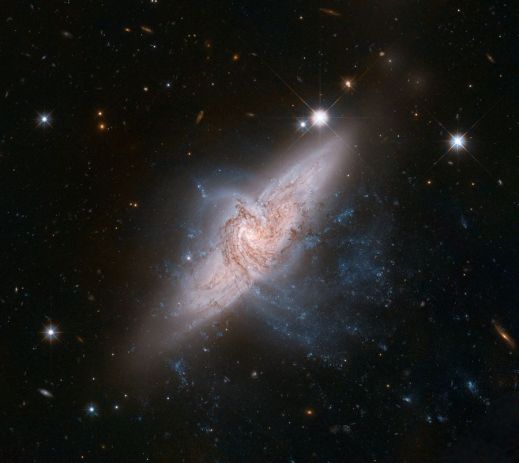
We are excited to announce the launch of Overlap Zoo, a new project under the Galaxy Zoo umbrella! Among the several million galaxies classified in previous Galaxy Zoo projects, a small number of those galaxies happen to overlap one another serendipitously. Now we need your help to classify these rare cosmic objects. We are launching Overlap Zoo with ~4200 candidate overlapping galaxy images from the DESI Legacy Imaging Survey, selected from previous Galaxy Zoo projects, and we invite you to help us identify which of these galaxies are truly overlapping pairs and help us categorise and catalogue them for use in future studies.
A Brief History
To understand how this project came about, it is useful to first look briefly at the work that inspired it. Prior to the start of this project, from around the 1980s through the early 2000s, astronomers began identifying and analysing a small number of individual overlapping galaxy pairs discovered by chance in various astronomical surveys. While these systems provided the astronomers at the time with valuable opportunities to study the properties of overlapping galaxies and dust, a sample consisting of only a small number of pairs was ultimately insufficient (we’ll talk more about the why later!).
This small initial sample was later expanded in 2013, when a project led by Galaxy Zoo team member and astronomer Dr. William ‘Bill’ C. Keel was conducted using imaging data from the Sloan Digital Sky Survey (SDSS) and the help of Galaxy Zoo volunteers to identify candidate overlapping pairs. Rather than relying on chance observation, this approach demonstrated that citizen science, in this case, forum science, could be used to identify a substantial number of overlapping galaxy pairs. This approach was also particularly valuable because these objects are often difficult to identify automatically, and human visual inspection is much better at distinguishing genuine overlapping pairs from apparent overlaps.
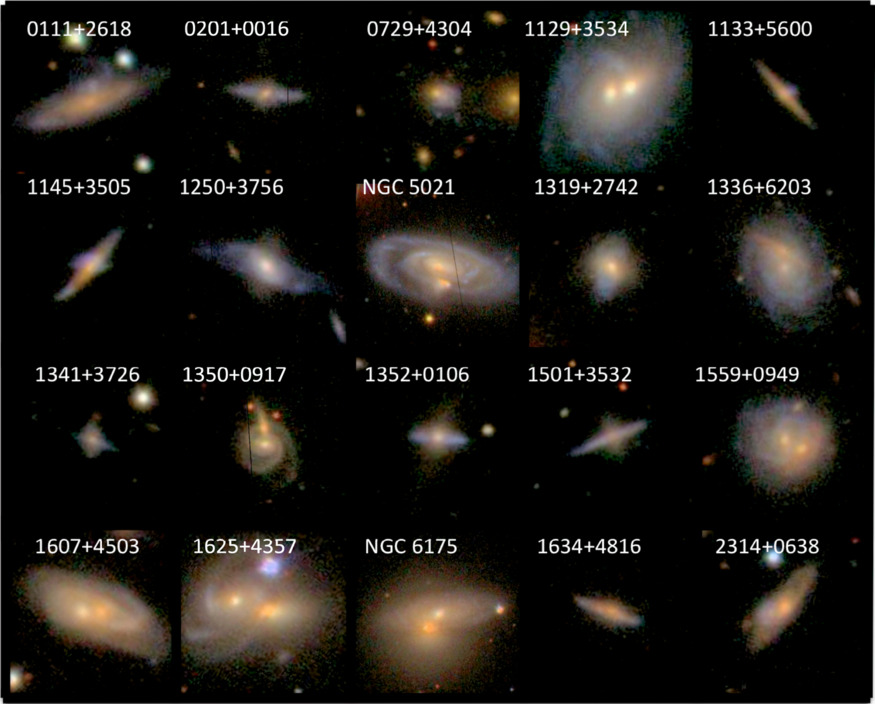
The combined efforts of all the volunteers resulted in the creation of a new large-scale catalogue of about ~2000 overlapping pairs. While this represented a significant increase in sample size, the relatively limited image quality of SDSS made it difficult to study these systems in detail on the scales they were looking for. Nevertheless, it was still a success for classifying and categorising these systems and identifying promising candidates for follow-up observations.
Now, almost a decade later, this earlier project serves not only as the first large-scale catalogue of these objects, but also as the main inspiration for our project, Overlap Zoo. At the same time, the new generation of astronomical surveys from ground and space observatories, including Euclid, the Vera C. Rubin Observatory, the Nancy Grace Roman Space Telescope, and more, have begun, or will soon begin, providing us with higher-quality views of the Universe than ever before. With these extremely powerful new resources becoming available, we now, more than ever, have an exciting opportunity to revisit the study and cataloguing of overlapping galaxies and expand upon previous efforts through our new citizen science project on a much larger scale.
The Science
So, what makes overlapping galaxies so special? Why do we want to study them? These are great questions that I’m sure you were asking yourselves when reading. Now, after learning about how we got here, we can finally get to the why!
When you see a beautiful picture of a galaxy, you may notice a few things right away: its colour, the different structures throughout its disk, the bright core at its centre, and all of the other features that make each galaxy unique. But what we are most interested in are those dark brown patches that you can see throughout the galaxy (like in the picture below!). These dark patches are actually dust, and they can tell us a lot about what is happening inside galaxies.
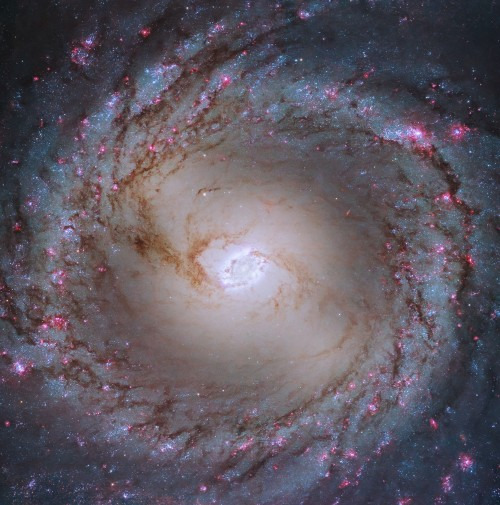
This dust, which consists of tiny particles of silicates and carbon, is an extremely important component of the galaxy, but also a pain point for many astronomers. This is because this dust absorbs and scatters (attenuates) the light of the galaxy. And because we use that light to make many important measurements, such as measuring distances, dust can cause those measurements to be inaccurate. So, astronomers must correct for this attenuation of light in their measurements. It would also be good if we had some type of universal correction that we could apply to every galaxy. And one way we hope to do this is with overlapping galaxies!
When two galaxies happen to overlap along our line of sight, they essentially become an astrophysical laboratory for studying galactic transparency. You can think of the background galaxy as a sort of cosmic flashlight. When it lies behind a foreground galaxy, its light shines through the overlapping region, giving us a direct way to see how much light the dust in the foreground galaxy blocks. By modelling the light from both galaxies and comparing the light that passes through the foreground galaxy with the light from unobscured regions, we can create a map of the dust in the foreground galaxy and also, importantly, measure how much light each region blocks. This direct method, in comparison to other methods, is what makes these systems so valuable to us.
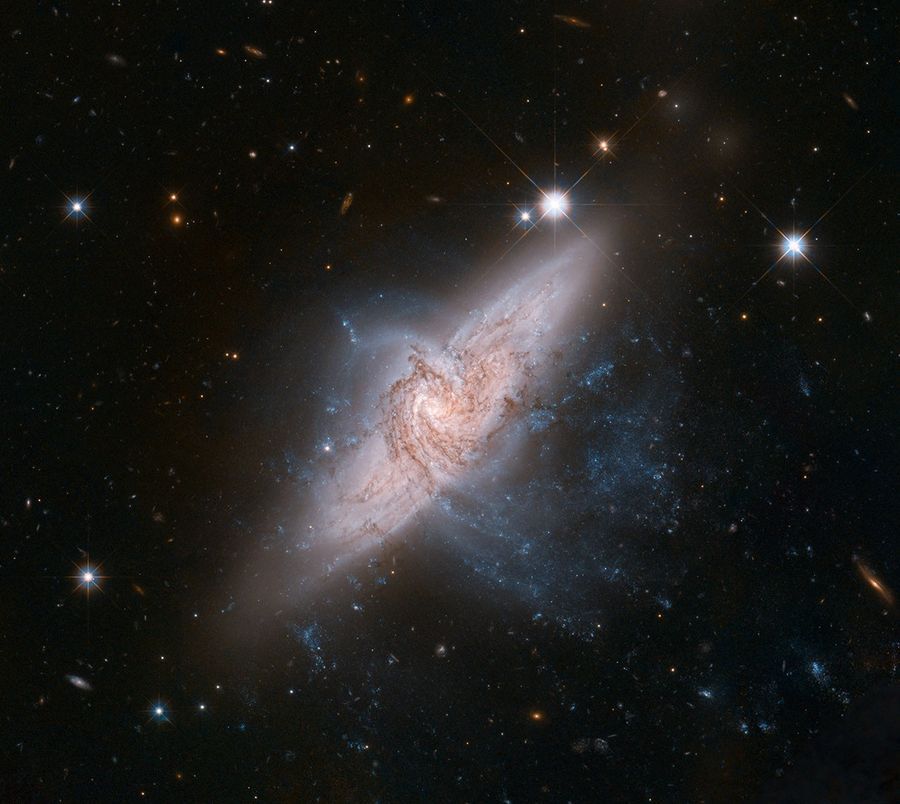
But not every overlapping pair is created equal. If our ultimate goal is to develop a correction that can be universally applied to every galaxy, we first need to understand dust across the many different types and configurations of overlapping pairs that exist. Some configurations can be more useful than others. There are those that are better suited for studying dust in the outer regions, while others allow us to probe into the deeper inner regions. There are also those that are more sensitive to the effects of dust and are easier to model, and vice versa. In other words, every overlapping pair that we can apply our methodology to will provide us with a slightly different piece of the whole picture of dust itself, each with its own advantages and limitations that we must consider when using these systems.
So, by creating dust maps for many different overlapping galaxies, we can begin to put those pieces together and build a more complete picture. With this information, we can hopefully provide astronomers with the data they need to better correct for the effects of dust in their measurements. But we haven’t got there yet!
The Need for a Bigger Sample
Why did we launch Overlap Zoo? What is our goal? To actually start creating those dust maps for many different pairs, we need to move beyond our relatively small sample and build a much larger one. We need as many systems as possible because, among them, we hope to find the rare, ideal configurations that are best suited for applying our technique and achieving this goal.
This is why we launched Overlap Zoo! Our goal with this project is to leverage citizen science and find as many overlapping pairs as we can to support a larger-scale study of these fascinating objects. With enough ideal systems, we could realistically have a background galaxy behind every part of a spiral galaxy—the arms, the outer disk, the inner disk, and so on. This would let us build those dust maps across different regions of spiral galaxies and see how the distribution of dust, and the amount of light it blocks, varies from galaxy to galaxy. We could do the same with elliptical galaxies, although these tend to contain less dust. With these in hand, we can see if there is a universal attenuation law that we can use for each galaxy. We are actually not entirely sure if this is the case yet, so this is extremely important for the field of astronomy as a whole! The more overlapping pairs we find, the better our chances of finding the right systems for these studies and the closer we get to finding a proper answer.
That’s where you come in. Every classification you contribute to Overlap Zoo brings us one step closer to building the sample we need to make these studies possible!
Volunteer Tasks
What will you do in our project? How can you help us? Your task in Overlap Zoo is to answer a series of questions that will help us identify the configuration of each overlapping galaxy pair. You will be presented with an image of an overlapping pair and guided through a series of questions that may feel familiar to Galaxy Zoo, but also slightly different, as we are considering not one, but two galaxies.
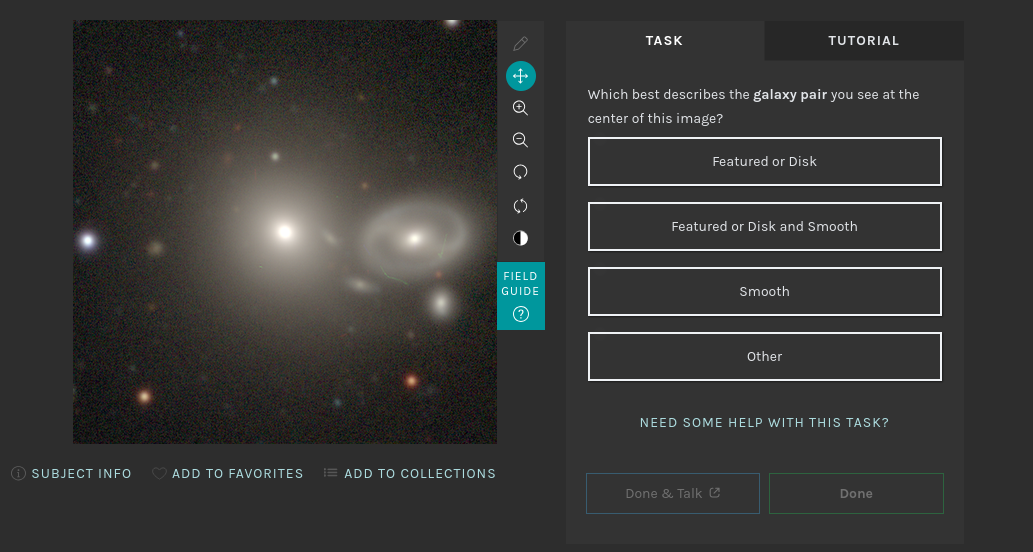
There will also be some questions that will be completely unfamiliar to a typical Galaxy Zoo classifier. We have tried our best to provide as much information as possible so that you can confidently answer these questions. We encourage you to take your time and refer to the field guides or other resources whenever you are unsure about how to classify a particular pair.
To get involved in our project, head over to Overlap Zoo and start classifying now! We look forward to your classifications and your help in expanding our catalogue of these objects for future research!
We look forward to your help,
Trevor Butrum and Benne Holwerda.


