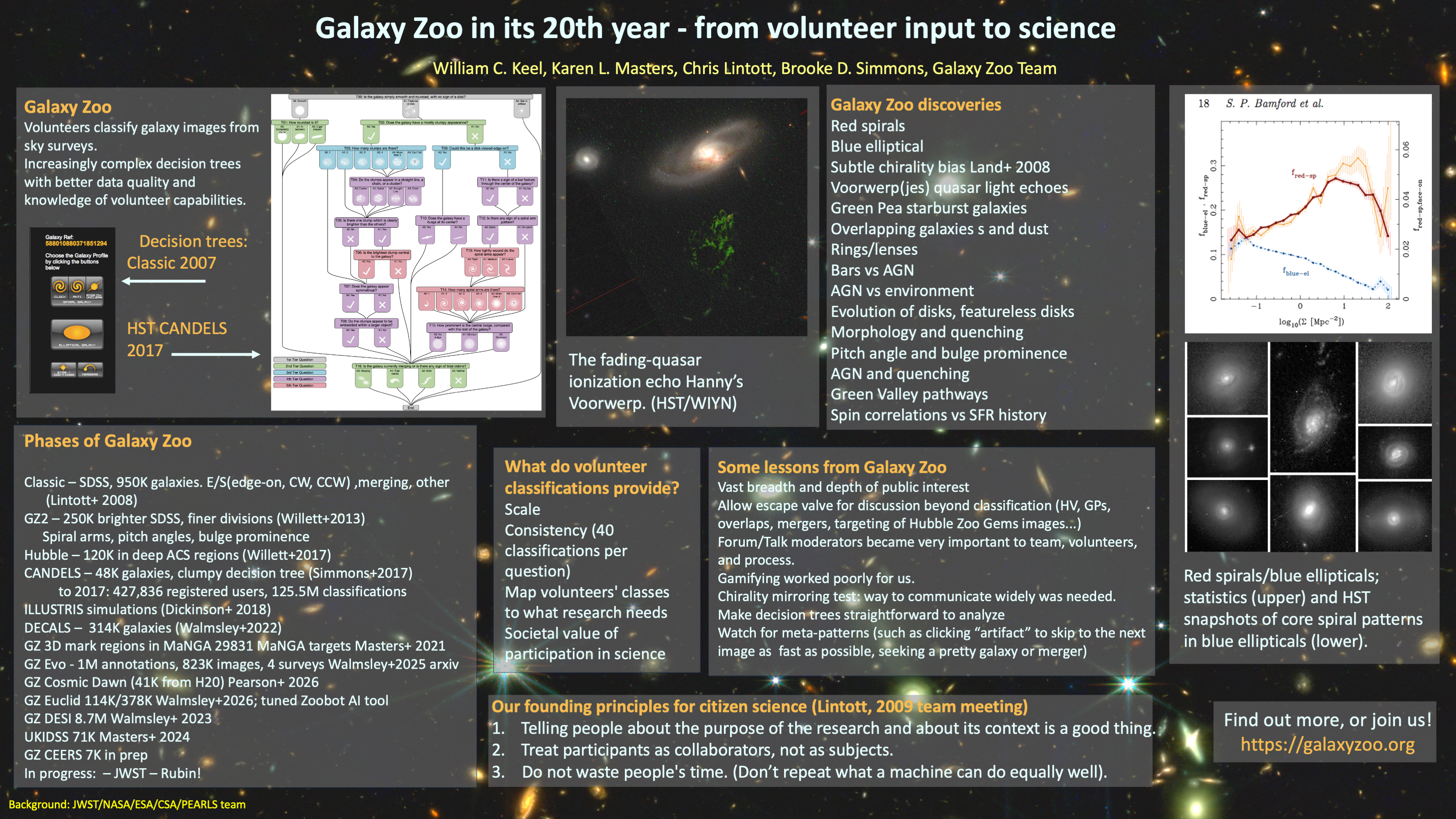
A quick summary – Galaxy Zoo in its 20th year
The Astronomical Society of the Pacific (also known lately as the Astro Society to stress that their membership isn’t just around the Pacific Rim) recently held their annual meeting, this time experimenting with a completely virtual format while preserving panels, workshops, and interaction with poster presenters. One of their specific topics was “Building the tools of discovery – observatories, technology, and citizen science that change our understanding of the Universe” That seemed as if Galaxy Zoo ought to be represented, so we put together this poster very briefly summarizing some of the project history, scientific results, and lessons we’ve learned.
Each poster was accompanied by a 60-second “elevator pitch” so viewers could tell which ones they wanted to look at more closely. This one clocked in at 58 seconds at my reading speed: “Galaxy Zoo launched in 2007, as an early case of citizen science enabled by sky surveys and interactive Web design. Volunteers classify galaxy structures and flag unusual features, giving consistent results over large sample sizes. Galaxy Zoo has been wildly successful, leading to additional project phases involving successively higher-quality survey data and more sophisticated volunteer participation. This poster summarizes these projects, and some discoveries – red spiral and blue elliptical galaxies, quasar ionization echoes such as Hanny’s Voorwerp, and Green Pea extreme-starburst galaxies. We also collect some lessons the team has learned along the way, both in how to best interact with the volunteers and how to analyze data from public votes. More information, links to the project papers, and participation are all available at the project URL galaxyzoo.org.”
Here’s the poster itself, a very quick reminder of what we’ve all done with a gift that keeps on giving. Onward to GZ Roman!