Ring of the Week: Mayall's Object
“Love is a burning flame
And it makes a fiery ring
Bringing hurt to the heart’s desire
I fell in the ring of fire”
– Johnny Cash
Before I venture any deeper into the mysterious world of Ring Galaxies, I thought I would give a quick introduction to the archetypal ring galaxy – the “Collisional Ring”.
Collisional Rings are formed when a smaller galaxy crashes through the centre of a larger galaxy. Just as throwing a stone into a pond creates an outwardly moving circular wave, a gravitational density wave is generated at the point of impact throwing matter out into a ring shape. Most Collisional Ring galaxies manage to hold onto a nucleus in the centre of the ring but sometimes the disturbance is so large that the nucleus is completely destroyed. Thanks to the work of Zoo members I have so far found about 125 Collisional Rings in the Galaxy Zoo (and still searching…!) so we can safely say that Collisional Rings are quite a rare phenomenon.
It is incredibly rare to see the galaxy collision actually taking place so my Ring of the Week this week is a fantastic Collisional Ring seen just after impact. Nick-named ‘Mayall’s object’, this ring is located in the constellation of Ursa Major, approximately 450 million light-years away. The image on the left is the Galaxy Zoo image and on the right is an image of the same galaxy taken by the Hubble Space Telescope. You can clearly see the elongated “bullet” galaxy blasting through the disc, creating a huge raggedy ring of stars.
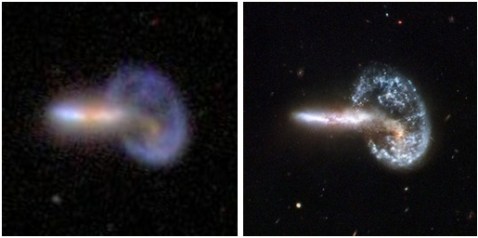
The Hubble image is part of a collection of 59 images of merging galaxies released on the occasion of its 18th anniversary on April 24, 2008. (NASA, ESA, the Hubble Heritage (STScI/AURA)-ESA/Hubble Collaboration, and A. Evans (University of Virginia, Charlottesville/NRAO/Stony Brook University))
She's an Astronomer: Hannah Hutchins

Hannah Hutchins lives in England with her Grandmother and her hamster, “Hubble”. At just 15, she’s by far the youngest entrant in our “She’s an Astronomer” series, providing us with some perspective from the next generation of astronomers. Hannah is homeschooled and currently studying for her IGCSEs. As well as being a frequent contributor to the forum, she is the co-creator of the Galaxy Zoo APOD. As well as Galaxy Zoo she’s involved in all sorts of astronomy projects, including the Young Astronomers blog.
- How did you first hear about Galaxy Zoo?
On the BBC News Website in August 2008. I read an article about Hanny’s Voorwerp and when they mentioned Galaxy Zoo I was immediately interested! I went onto the website and was hooked from then onwards.
- What has been your main involvement in the Galaxy Zoo project?
I classify galaxies, chat on the forum and I write Object of The Days (OOTD). Alice got me into writing the OOTD’s, which is when I discovered that I loved to write.
- What do you like most about being involved in Galaxy Zoo?
Knowing that I’m helping science. It’s fantastic because I don’t have to be an adult in university doing astrophysics or something to be able to contribute to science like this. It has also turned my interest in astronomy into a passion and I could never live without it. I’m now determined to go to university to study astrophysics. It’s also great to be part of such a friendly community! I finally found friends at the zoo who shared my interests.
- What do you think is the most interesting astronomical question Galaxy Zoo will help to solve?
There are so many to choose from! I have a soft spot for the Voorwerpjes though, It’s amazing how AGN (active galactic nuclei) belt out all that radiation which then ionize huge gas clouds, it creates some spectacular images.
- How/when did you first get interested in Astronomy?
My earliest memory of having an interest in astronomy was sitting on my bed when I was around four years old flicking through an astronomy book called ‘Spacewatching: The ultimate guide to the stars and beyond’, I remember staring in wonder at pictures of nebulae and reading aloud the titles in the book. My grandparents bought it for me at a sale along with a book about Comets after I pestered them for them. I think those where my very first astronomy books.
- What (if any) do you think are the main barriers to women’s involvement in Astronomy?
I’m not really sure, but I know from my experience of school (though rather a short experience, I only lasted a couple of terms in secondary school for instance because I wasn’t happy with the education I was getting) that there is sometimes an attitude where it is bad to have an interest in science and maths, they have to be viewed as so very boring. I think that is because it’s taught so badly at school, it shuts down any interest.
- Do you have any particular role models in Astronomy?
There are so many fantastic people in astronomy, but I don’t really have a role model.
This post is part of the ongoing She’s an Astronomer series on the Galaxy Zoo Blog is support of the IYA2009 cornerstone project of the same name (She’s an Astronomer). We are listed on the She’s an Astronomer website in their Profiles.
- Zooites:
- Hanny Van Arkel (Galaxy Zoo volunteer and finder of Hanny’s Voorwerp). Hanny’s interview in het Nederlands.
- Alice Sheppard (Galaxy Zoo volunteer and forum moderator).
- Gemma Couglin (“fluffyporcupine”, Galaxy Zoo volunteer and forum moderator).
- Aida Berges (Galaxy Zoo volunteer – major irregular galaxy, asteroid and high velocity star finder). Entrevista de Aida en español.
- Julia Wilkinson (“jules”, Galaxy Zoo volunteer. Frequent forum poster, and member of irregular and HVS projects).
- Els Baeton (“ElisabethB”, Galaxy Zoo folunteer. Frequent forum poster, and member of most of the spin-off projects!). Els’s interview in het Nederlands.
- Researchers:
- Dr. Vardha Nicola Bennert (researcher at UCSB involved in Hanny’s Voorwerp followup and the “peas” project). Vardha’s Interview auf Deutsch.
- Carie Cardamone (graduate student at Yale who lead the Peas paper).
- Dr. Kate Land (original Galaxy Zoo team member and first-author of the first Galaxy Zoo scientific publication; now working in the financial world).
- Dr. Karen Masters (researcher at Portsmouth working on red spirals, and editor of this blog series.)
- Dr. Pamela L. Gay (astronomy researcher and communicator based at Southern Illinois University).
- Anna Manning (Masters’ Degree Student in Astronomy at Alabama University working with Dr. Bill Keel on overlapping galaxies)
Still to come in the series – a few more Galaxy Zoo volunteers and researchers. We’re not quite done yet!
A Valentine's Day Challenge
We’ve been a little quiet over at Merger Zoo recently. In the first three months of this project, you have viewed nearly two million simulations for nearly 40 different galaxies. Of these two million, you have picked about 30000 galaxies that we have been doing further investigations on. In short, we have been extremely busy because of all your hard work!

Because of Valentine’s Day, we decided to pick an unusual galaxy for our target today. As you can see, it looks very similar to a Valentine’s Day heart. If you look carefully at it, you can see it is actually two “collisional ring galaxies” that overlap each other. In general, we know that collisional ring galaxies are created when an intruder galaxy passes near the center of a target galaxy. The orbit has to be nearly perpendicular to the plane of the unperturbed galaxy’s disk. During the close passage, the extra gravity of the intruder draws in the orbiting stars and gas. After the intruder leaves, the stars spring out in a circular wave like ripples in a pond. Since the gas from the original galaxy is compressed into rings as well, most of the star formation in these systems tends to be in the outer ring of the galaxy.
Collisional ring galaxies are rare beasts, and one of my favorite types of interacting systems. This is the first example that I have ever seen of two ring galaxies created in the same collision. It seems like creating this type of system should be possible, but we aren’t sure how to create models that closely reproduce this beautiful system. As always, we need your help!
The challenge will be to find a collisional ring galaxy that close matches the heart-shaped rings of the real system. The star in the upper left is almost certainly a red herring (or rather a red dwarf star) that has nothing to do with the collision. Try using the explore feature until you find a few close examples of double ring galaxies, and then use the enhance feature to tune it further. This approach works pretty well for most of the systems we have played with, although you have to be patient! We played with this system on our computers, and found some models that had two rings but didn’t reproduce the heart-shaped structure of this system. We know from experience that you can do better. Please make sure to save your work at the end so we know which system is the best of your best!
In a few weeks, we will present the best model or models in this blog. We will also present some of the models you found of the other galaxies. We should have a few other surprises coming up soon as well.
The Valentine system is also a gift from all of us at the Zooniverse to our incredible volunteers. We couldn’t do this science without you. As always, thanks for your on-going contribution to our project and the rest of the Zooniverse.
-John
Happy Valentine's Day!
Ellipses are red,
Spirals are blue*
But a heart-shaped ring galaxy?
Haven’t a clue!
 My name is Georgia Barrie and I’m a Masters student at Oxford University. I’m currently working on a research project with Chris Lintott, attempting to explain the formation of the elusive ring galaxies. Thanks to the work of Galaxy Zoo users, I am now in possession of the biggest catalogue of ring galaxies in the World. Having looked through each of the three and a half thousand galaxies classified as rings by Galaxy Zoo users, I am lucky enough to have seen some of the weirdest and most wonderful galaxies in the Zoo. Rings come in all shapes and sizes and over the next few weeks I will share with you some of the most beautiful, unusual and mystifying rings in our Universe.
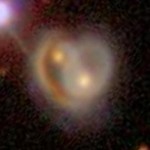 As today is Valentine’s Day I will start with this astounding heart shaped merger. This beautiful object was first discovered by teckborg on July 26 2007 and was posted on the forums shortly afterwards by ALKA on August 14. It looks as though this galaxy is made up of two intertwined ring galaxies with one ring appearing to be red and the other appearing to be quite blue. We’ve calculated that this galaxy is about 600 million light years away but the formation of an object like this is, quite literally, a mystery.
For something as baffling as this we really need your help. Today the Heart Galaxy is our featured merger and we need you to help us simulate how this incredible galaxy could be created. To get involved go to the Galaxy Zoo Mergers site and, who knows, you may be the very person to solve this cosmic mystery!
If you want to hear more about the Heart Galaxy then I will be talking about this amazing discovery live on Monday’s Breakfast Show, BBC Radio Oxford.
*The Galaxy Zoo team has just recently discovered a population of red spiral galaxies. Click here to find out more!
Red spirals at night, astronomers' delight
We heard a few days ago that our paper on red spirals has been accepted by the journal. Not only is this another success for Galaxy Zoo science, but it’s a tribute to the hard work of Karen who led the effort. What with the first Zoo 2 paper being submitted and a few other distractions as well it’s been a very busy week for her.

The paper itself is another variation on what should be becoming a very familiar theme for those who have followed Galaxy Zoo science: colour and shape are not the same, and tell us different things. To recap slightly, as young, massive and short-lived stars are blue, colour is a measure of what’s happened recently. The blue spiral arms in the galaxy pictured below, for example, mark sites of recent star formation.
It was known long before Galaxy Zoo that most of the star formation in our local Universe takes place in spiral galaxies, and so they tend to be blue whereas ellipticals are often red. In looking at the blue ellipticals and now the red spirals, it’s clear that interesting things happen when this rule is broken.
Before we can work out what’s going on though, we have to find our red spirals, and this is trickier than it sounds. If we weren’t careful, then our sample would get contaminated by edge-on systems, which appear redder because of the effect of the dust that scatters light which travels through the disk. As this paper uses only Zoo 1 data, we just selected the roundest spirals assuming that this would get rid of those pesky edge-on systems; we also insist that Zooites were able to identify a direction to the spiral arms.
It turns out that 6% of spiral galaxies are red, which I think is higher than most would have guessed before this project. So how did a substantial number of spiral galaxies come to turn red? What caused them to cease forming stars and become what the paper title calls them : ‘Passive red spirals’?

One important clue is understanding where this process happens. It turns out that the greater the density of the environment a spiral finds itself in (that is, the more neighbours it has) the more likely it is to be red…but only up to a point. Once we find ourselves near the core of a cluster of galaxies, the number and fraction of red spirals drops dramatically. So whatever it is that is causing the spirals to turn red must be more likely in the outskirts of galaxy clusters, but relatively rare outside this particular environment.
The story is, as ever, a little more complicated than that. If it was the environment that was driving the dramatic change from blue to red, then we’d expect the properties of the red spirals to depend on the environment. We might find that those in the densest environments were redder than their (still quite red) counterparts further out, for example. But we don’t. We don’t see any connection between the properties of the red spiral and the environment they find themselves in.
In my next blog, I’ll look at what we do know about this mysterious population of galaxies unearthed by your hard work. Until then, if you want the gory details, you can find the latest version of the paper over here.
First Results from Galaxy Zoo 2: Bars in Disk Galaxies
I’m happy to announce that the first paper using Galaxy Zoo 2 data was submitted (to MNRAS) yesterday.
In this work we used an early look at the information you have provided us on the presence of bars in a sample of GZ2 galaxies too look at trends of the bar fraction (basically how likely a certain type of disk galaxy is to have a bar) as a function of other properties.
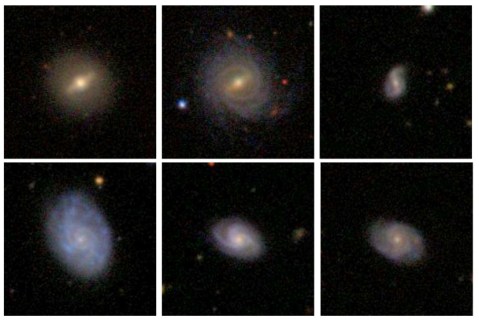
Examples of barred (top) and unbarred (bottom) galaxies from Galaxy Zoo 2.
In doing this research I’ve learned that bars are really interesting features in disk galaxies. Unlike spiral arms, which are density waves (meaning stars pass in and out of them over the life of the galaxy), the matter in bars (stars and gas etc) actually rotates with the bar. This means that the bar breaks the symmetry of the disk of the galaxy and causes transfer of material both in an outwards along its length. What it boils down to is that bars should have a significant impact on the internal evolution of a galaxy. They have been suggested as a way to build some types of bulges, as a way to fuel star formation in the central regions, and perhaps even fuel AGNs. At the outer ends, the bar can induce ring like structures (see the top middle example) – and might even be responsible for driving spiral structure.
So what did we find? Well we observed a strong correlation between the bar fraction and the colour of the disk galaxy. Redder disk galaxies are much more likely to have bars identified by GZ2 users than bluer disk galaxies.

Bar fraction as a function of galaxy colour. The dashed line shows the overall bar fraction for the whole sample.
We also tried to split the sample by the size of the bulge. We find that disks with large bulges (shown by the red line below) have high bar fractions, and that disks with small bulges (shown by the blue line) have low bar fractions. This split by bulge size also splits the disks into things which are mostly red (large bulge) and blue (small bulge) – as illustrated by the histograms of the colour distribution of the two types of disk galaxies. What’s new here is that we show this also correlates strongly with the presence of a bar.
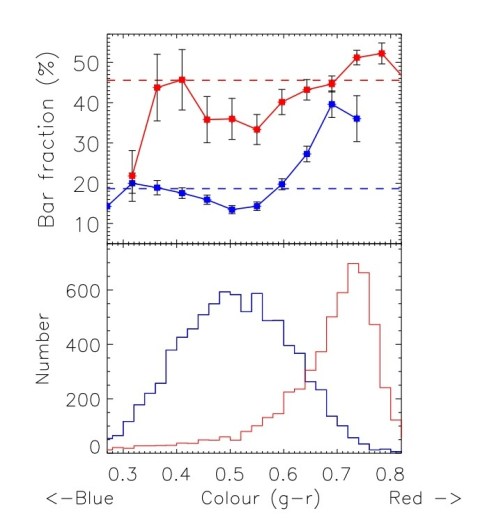
Top: bar fraction as a function of galaxy colour split into disk galaxies with large bulges (red) and small bulges (blue). The dashed line shows the overall bar fraction for each sub-sample. Bottom: histograms showing the colour distribution of the disk galaxies with large bulges (red) and small bulges (blue).
So we seem to split disk galaxies into two populations – ones that are red, have large bulges and are very likely to have bars, and ones that are blue, have small bulges, and are not so likely to have bars.
This gives an overall picture in which bars may be very important to the evolution of disk galaxies – perhaps more so than has been thought before. It’s very interesting, and I look forward to spending more time with barred galaxies and with the rich data set that you have given us with Galaxy Zoo 2.
We’re already working on more results from the bars using Galaxy Zoo 2, so expect updates soon. Also I just saw some very interesting results on bar lengths using data from the (now completed) Bar Drawing project. Hopefully we’ll have a paper from that soon too. Stay tuned!
How to find black holes?
The first step in trying to understand the connection between black holes and galaxies is finding them. But black holes are, well, black. In fact, you might say their blackness is their most defining feature.
So, how do you find them? It turns out that when they’re feeding on infalling gas and dust, a massive black hole can turn into the brightest object known in the whole universe – a quasar!
As the gas and dust falls towards the black hole, it settles into a disk around it, and as it moves in, friction in the disk heats up all the matter in it to such temperatures that it stats shining. In this way, black holes can be very bright, or quite dim, depending in part on how much matter they are munching on.
There are many ways to find feeding black holes and for the Galaxy Zoo paper on black hole growth, we used the emission lines that AGN (active galactic nuclei, or feeding black holes) cause when the light coming from the accretion disk shines on some other gas floating around in the host galaxy and makes that light in turn emit light with a very particular signature that we can detect by carefully analysing the spectra.
She's an Astronomer: Anna Manning

Anna Manning is a Masters student in Astronomy at the University of Alabama (she’s working under the supervision of Dr. Bill Keel on the overlapping galaxies project). She moved to Tuscaloosa, AL (where she lives with 2 sorority sisters) after completing her undergraduate degree at Clemson University in South Carolina. In her free time she enjoys painting, photography, and scrapbooking. At 25 she’s the youngest of our professional (or future professional) astronomers to be interviewed. In the future she would like to either continue her work in astronomical research or perhaps move into space exploration. She also really enjoys the public outreach part of Galaxy Zoo and thinks it would be nice to contribute to that in her future career.
- How did you first hear about Galaxy Zoo?
I first heard of it when I started my research in Grad School with Dr. Keel at the University of Alabama.
- What has been your main involvement in the Galaxy Zoo project?
I’ve mostly worked with Dr. Keel to create a catalog of overlapping galaxy pairs. We’ve been to Kitt Peak to observe some of the objects which Dr. Keel has blogged about.
- What do you like most about being involved in Galaxy Zoo?
- What do you think is the most interesting astronomical question Galaxy Zoo will help to solve?
- How/when did you first get interested in Astronomy?
On field trip in middle school we spent a day at space camp in Florida which began my general interest. In high school I really enjoyed Physics class and decided to major in it in college where I started doing actual research in astronomy.
- What (if any) do you think are the main barriers to women’s involvement in Astronomy?
This topic actually sparked an interesting conversation in my office. A female office mate and I were discussing how we don’t think there have been any obstacles for us. A male office mate brought up that he believes it is easier to be a woman than a man in astronomy. So I think this is something that changes based on the person and I’m thankful that I have been fortunate in the universities I’ve attended.
- Do you have any particular role models in Astronomy?
I have learned so much from so many people – and often people that I didn’t know had any interest in astronomy at all!
This post is part of the ongoing She’s an Astronomer series on the Galaxy Zoo Blog is support of the IYA2009 cornerstone project of the same name (She’s an Astronomer). We are listed on the She’s an Astronomer website in their Profiles.
- Zooites:
- Hanny Van Arkel (Galaxy Zoo volunteer and finder of Hanny’s Voorwerp). Hanny’s interview in het Nederlands.
- Alice Sheppard (Galaxy Zoo volunteer and forum moderator).
- Gemma Couglin (“fluffyporcupine”, Galaxy Zoo volunteer and forum moderator).
- Aida Berges (Galaxy Zoo volunteer – major irregular galaxy, asteroid and high velocity star finder). Entrevista de Aida en español.
- Julia Wilkinson (“jules”, Galaxy Zoo volunteer. Frequent forum poster, and member of irregular and HVS projects).
- Els Baeton (“ElisabethB”, Galaxy Zoo folunteer. Frequent forum poster, and member of most of the spin-off projects!). Els’s interview in het Nederlands.
- Researchers:
- Dr. Vardha Nicola Bennert (researcher at UCSB involved in Hanny’s Voorwerp followup and the “peas” project). Vardha’s Interview auf Deutsch.
- Carie Cardamone (graduate student at Yale who lead the Peas paper).
- Dr. Kate Land (original Galaxy Zoo team member and first-author of the first Galaxy Zoo scientific publication; now working in the financial world).
- Dr. Karen Masters (researcher at Portsmouth working on red spirals, and editor of this blog series.)
- Dr. Pamela L. Gay (astronomy researcher and communicator based at Southern Illinois University).
Still to come in the series – a few more Galaxy Zoo volunteers and researchers. We’re not quite done yet!
Black holes – why do galaxies care, anyway?
Now that our paper on AGN host galaxies (galaxies whose black holes are feeding) is out, I will write a few blog posts about what we found with your help. But before we start, a little background.
Why do black holes matter? We now believe that at the centers of most, if not all galaxies, there is a supermassive black hole. We call these black holes “supermassive” to distinguish them from stellar mass black holes that were formed in the deaths of massive stars. These supermassive black hole can be as heavy as a million or even a billion solar masses.
So you might think that these enormous black holes can wreak havoc in their host galaxies. However, galaxies are even bigger, much bigger than these black holes. In general, the black hole makes up about 0.1% of the mass of its host galaxy making really just a drop in the bucket.
In fact, their gravitational sphere of influence is tiny compared to the size of the whole galaxy and so they generally don’t affect anything but their immediate surroundings. As far as the galaxy as a whole is concerned, the supermassive black hole at its center might as well not be there.
But why is the mass of the black hole always some fraction of the galaxy mass (or to be more precise, bulge mass)? How does the black hole even know how big the galaxy is? Why does the mass of the black hole correlate with the mass of the galaxy bulge (the M-sigma relation)? It’s almost as if they somehow grew together….
Bar drawing project complete!

GZ2 Galaxy with Bars drawn by users.
Bar project stage 1 complete!
Dear all, we’d like to thank everybody for making the bar drawing project such a success. We now have enough data to perform some reliable, new & very exciting science.
The site will remain open (for future inspection), but the votes will no longer we recorded. We’d like to take this opportunity to draw your attention to other interesting galaxy zoo and zooniverse projects.
We’ll keep you posted about future publications.
Once again, we’d like to thank you all!
Best Regards,
Ben [and on behalf of Karen and Bob with the bar drawing team]
 Galaxy Zoo