Investigating How Type of Galactic Bar Impacts Bar Quenching
We are happy to announce the acceptance of the latest science team paper making use of Galaxy Zoo classifications (the image below is a link to the paper). Also see this list of all Galaxy Zoo Science Team Publications (which is mostly complete, usually!).
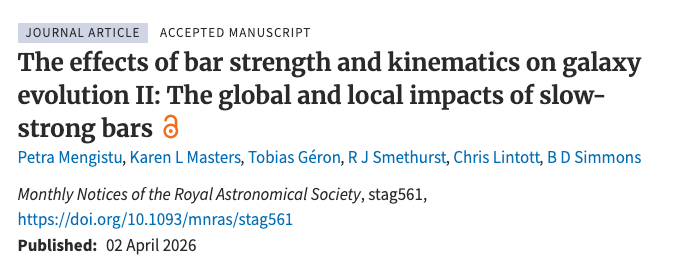
This work was led by (at the time) undergraduate student Petra Mengistu (since Fall 2024 in the PhD Program at UCSC). Petra started this work as an undergraduate, spending the summer of 2023 working at Oxford with the Galaxy Zoo science team there, and then returning to Haverford to continue the work for her undergraduate senior thesis. I’m writing this as a very proud (former) undergraduate supervisor today.
As the”Part II” in the title suggests, this work is a follow-on from previous work. Tobias Geron already wrote in detail about the first paper on the blog Slow Strong Bars Affect Their Hosts the Most which has a lot of the background needed to understand this follow-on result.
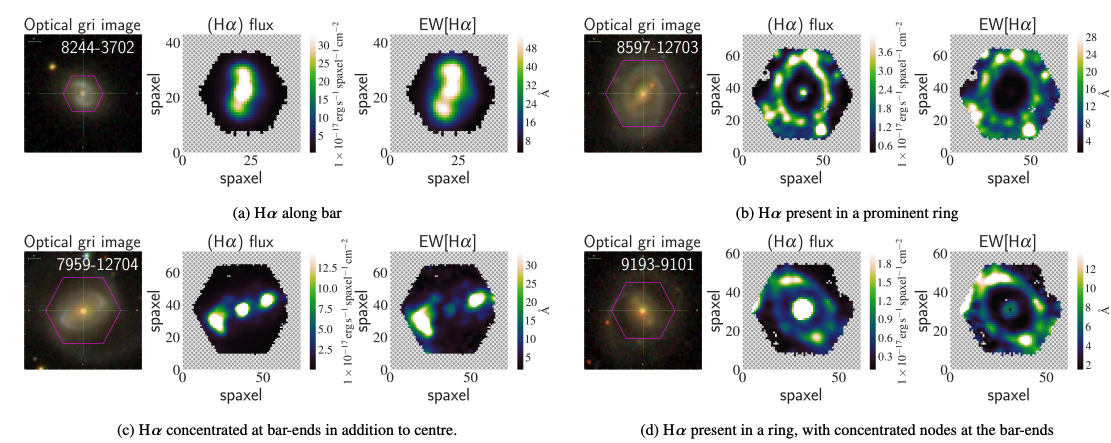
One fun thing we added was a look at the morphology of the ionized hydrogen around the bars in these galaxies (using data from the “MaNGA Survey”). This “Halpha” brightness can be traced by flux or “equivalent width” or EW (which is a measure of relative brightness compared to the stars you see in the normal images you are used to). It turns out this gas, which shows off where stars are currently forming in a galaxy – has a lot of different interesting shapes in barred galaxies, e.g. being found all along the bar, in rings or nodes.
The below image is a part of the sixth Figure in Petra’s paper.
There’s many more result in the paper, but I need to keep this blog post short for now.
Continuing to publish papers about bars in galaxies is also fun for me, as I’ve been working on trying to understand bars in galaxies using Galaxy Zoo classifications for well over a decade at this point. It’s great to see this work continuing with new samples and data and new understanding of the important role these structures play in stopping star formation in spiral galaxies. I wrote about bars for the blog “What’s all the Fuss about Bars in Galaxies” in 2015, or you can read this blog post from way back in 2010 (!) about our first Galaxy Zoo paper wondering “Do Bars Kill Galaxies”.
So thanks again for all the classifications. I’m excited for the future of this scientific area looking more at bars in the more distant universe (so looking back in time), which we already started with “Looking for Bars in Faraway Galaxies“, but I’m sure there will be much more to come.
What happens next… Peer Review
With the first Galaxy Zoo paper submitted (kudos to Kate and Anze!), we’d like to describe to you what happens next. What’s scientific publishing all about? How does it work? If you’ve followed the blog and the forum, you have a pretty good idea of the first part of the scientific process: discovery!
We set out on the Galaxy Zoo project in part to test whether spiral galaxies in different parts of the sky somehow have spins that align, as has been claimed by earlier work. Kate and Anze have commented on the motivation for this work and blogged about how we did find an effect, were startled by it and so started the bias test to understand it. Kate and Anze used the bias test data to show conclusively that in the case of Galaxy Zoo it was an effect with the observers and that the universe isn’t mad.
This is one of the amazing and unique things about science. Good scientists spend most of their time arguing against the effects they see in their own data, to avoid falling into traps of seeing only what they expect to see. To see how unique and amazing this is, try to imagine a politician arguing against a piece of legislation s/he is sponsoring! This process of double, triple, and quadruple-checking one’s own work is a very important part of science.
Once we were convinced that we really understood what is going on, we could then write up our conclusions in the form of a scientific paper. Steven wrote here about the process of writing a paper; Kate went through the same process Steven described. Over the past few weeks, she passed her paper around to the rest of the Galaxy Zoo team for comments. Kate’s paper has thus passed through the first check — her own examination of her results — and the second — amongst the team itself.
The next step in scientific research is to submit the paper to a journal. This has now happened, and the paper Land et al. (2008) (where “et al.” means “and the rest,” including YOU!!) has been submitted to the top UK journal Monthly Notices of the Royal Astronomical Society (MNRAS).
The editor of this journal will now select an anonymous referee who can comment on the scientific and technical merits of the paper. The referee is another astronomer or cosmologist whom the editor can ask for an expert assessment of the work. He or she will have a few weeks to read it, think about it, and then make a number of recommendations to the editor of the journal. There are three options. The referee can reject the paper outright. This generally happens very rarely, except in highly competitive top journals like Nature and Science. They can support publication of the paper, asking for only a few minor modifications. This also happens quite rarely, though! The most common outcome is for her to write a “referee report,” suggesting a number of modifications and ask for clarifications. The referee might have questions about some part of the analysis, suggest some alternative thoughts and ideas, or criticise the methodology. Sometimes referees can be hostile to a paper; but often, they are genuinely helpful and constructive.
After receiving the report, we get a few weeks to digest it and modify the paper according to the referee’s comments, and argue against the points raised that we disagree with. This process may repeat itself a number of times if the referee isn’t happy with our modifications, and so it can often take weeks and months for a paper to get to a decision by the editor (acceptance or rejection). If a referee is being particularly unreasonable, we can write to the editor requesting a new referee. In extreme circumstances, we could even choose to submit the paper to a different journal and hope for a more reasonable referee.
The whole process is generally known as peer review since the referee is a peer — a fellow scientist and expert in the field. If the paper is accepted, it will appear both in the online and print version of the journal after another few weeks or months. A paper accepted in such a journal is then considered peer-reviewed.
So, if Kate’s paper hasn’t yet been peer-reviewed why is the paper already “public”? It’s general practice in astrophysics to post papers as preprints on a web server called astro-ph. Astro-ph is updated daily to make all papers publicly accessible for anyone. Most people post their papers there when they submit them to journals so they are available immediately. Some wait till the paper is accepted. Thus, not everything on astro-ph is peer-reviewed! In fact, in cosmology, some like to submit preprints to astro-ph before submitting so to allow the community to comment before the draft is submitted to a journal.
It’s important to note that something said in a “peer-reviewed” paper isn’t necessarily true. The point of peer-review is to weed out obviously flawed paper whose logic has holes or whose data don’t support the conclusion. Knowing that a paper has been peer-reviewed should give you extra confidence that its results are believable – that means that an expert in the field has read through the paper and thinks its conclusions are believable.It’s really just the first step of proper “peer-review,” because the process continues. As the community of astrophysicists digests the paper, they too pass judgement on whetherthey consider the paper important and whether they believe the conclusion. Thus, in the years after publication, other astrophysicists might deem Land et al. (2008) a key paper and cite it in the future, commenting on it positively. Or they might disagree with it, but that would still be a sign that it was important enough to comment on. Or it might just fade into obscurity if astronomers don’t consider it important. That’s the historical legacy of a paper – and that’s the ultimate peer-review.

