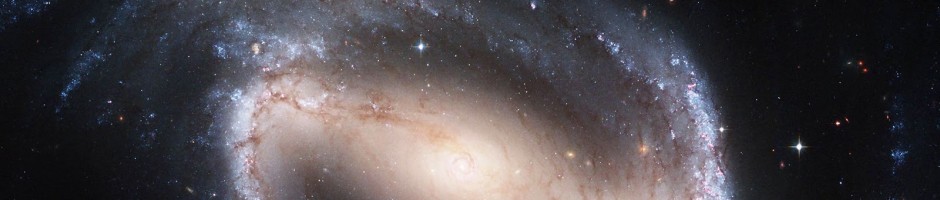
Take a Peek at Some JWST Images
Many different teams of scientists are using NASA’s latest space telescope, JWST, to image galaxies so far away that they are back at the earliest time galaxies appear in the Universe. Because these galaxies are quite a bit more distant than any we’ve classified before in Galaxy Zoo, we want to make sure we know how to ask the right questions about the shapes and types of galaxies present, and also make sure we get the image processing as good as possible before asking for your help classifying lots of them.
To get Galaxy Zoo started on classifying (we hope eventually) all of the distant galaxies in JWST imaging, we are running a pilot with just 8000 galaxy images from the Cosmic Evolution Early Research Science (CEERS) survey.

CEERS is using JWST to take extremely deep images of 100 sq. arcmin of the sky (which is about 1/8th the size of the Full Moon!). It is making use of JWST instruments called NIRCam, MIRI, and NIRSpec to obtain both images and spectra in this patch of sky. CEERS’ main goal is to demonstrate, test, and validate efficient extragalactic surveys with coordinated, overlapping parallel observations in a patch of sky which already has a lot of other multi-wavelength data (e.g. from the Hubble Space Telescope).
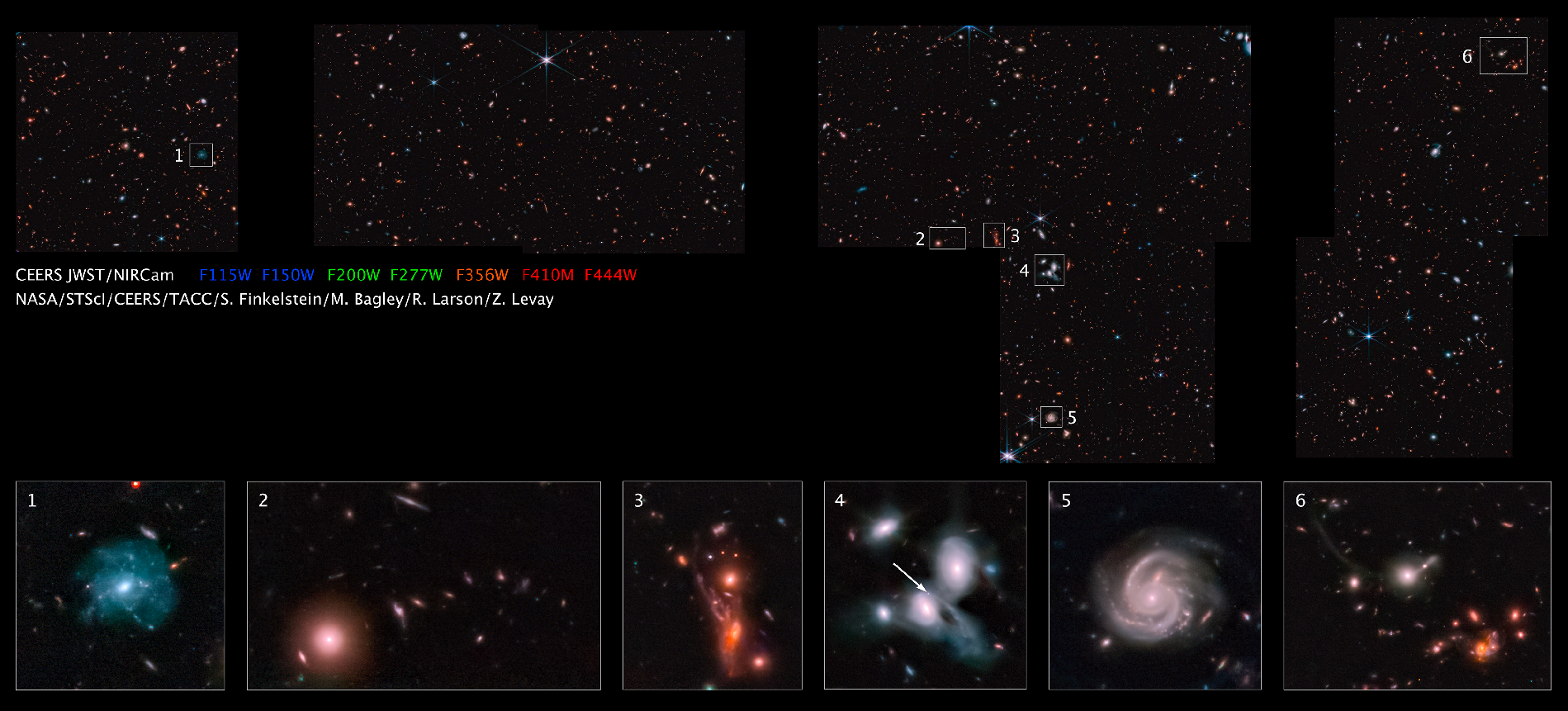
Even though the pilot sample is being put into Galaxy Zoo mainly as a test survey for future projects, we still expect that your classifications of these images will help us find out a lot about the type and number of galaxies at very high redshifts (z~9-13), look for early star formation, black hole growth and the assembly of bulges and discs in galaxies at z>3, and look for dust observed star formation and black hole growth at z~1-3. We also plan to see how well machine classifiers like Zoobot do at classifying these galaxies, so we can get them to help with the classification of future, larger collections of JWST galaxies.
These images are from the first CEERS public data release. We have coordinated with the CEERS team to make sure the images you see are optimized to bring out as much detail as possible, and that the questions we are asking will enable the best possible science. We hope you’ll enjoy seeing some of the most distant galaxies ever observed in the project. And, as always, thanks for all your hard work classifying. We appreciate every click you provide.
 Galaxy Zoo