The Connection between AGN Activity and Bars in Late Type Galaxies AAS
At the center of every massive galaxy lies a supermassive black hole. In a small percentage of galaxies, so called Active Galactic Nuclei or AGN, these black holes are currently accreting gas and dust and shinning luminously as that material looses energy. It is thought that some galaxies have this AGN activity at their center and others do not because of the presence or absence of gas near-enough to the black hole to be accreted. But many questions remain, including how the gas which can live any where in the galaxy, gets down to the very central regions.
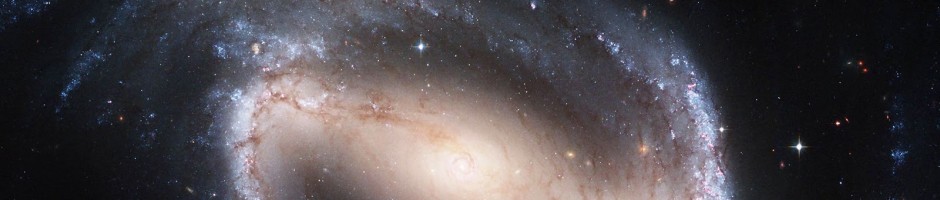
One solution to this problem could lie in the bar-like structures seen in many galaxies like this one from the Hubble Space Telescope:

Source: Hubblesite.org
These bar features are easy to form in a big disk galaxy and are likely transitory, first coming together and then dissipating. Most importantly, models suggest that these bars can drive gas inward towards the central regions of galaxies.
Whether or not these galactic-scale structures, which can transport gas towards the central regions of a galaxy, could be related to episode of AGN activity has been debated for decades. One of the simplest ways to approach this issue is to observer whether or not a bar feature in a galaxy is observed to correlate with the presence of accretion at the very center of the galaxy. In other words, if galaxies containing bars are more likely to host AGN, than we can hypothesize that the bar may be responsible for feeding gas to that AGN.
Because the scale of the central supermassive black hole is many orders of magnitude smaller than the regions into which the bar can transport gas, the connection is not as straightforward as the simple story seems to suggestion.
Before Galaxy Zoo, investigations looking into the connection between the presence of an AGN and that of a bar in galaxies suffered from being too small or looking at galaxies with only one particular color. Now With Galaxy Zoo we can search 10,000 galaxies and look at each for the presence of a bar, and use the spectroscopic data from SDSS to identify any AGN activity. We look at the votes from the viewers in galaxy zoo and assign a probability that a bar exists in a single galaxy by comparing the number of people who indicated a presence of a bar to the total number of people who viewed the galaxy. As the image below shows, we can accurately identify barred galaxies by selecting those where at least 50% of the classifiers identified a bar in the galaxy.

We found that both the presence of an AGN and the presence of a bar are tightly correlated with the color of a galaxy and its size. This explains why so many previous samples might have found contradictory results, depending on which types of galaxies in their sample contained AGN activity and which contained bars. However, because the sample of galaxies in Galaxy Zoo is so large, we can look at samples of galaxies with similar sizes and colors. And when we control for the effects of size and color, there is no longer a large correlation between the presence of a bar and central AGN activity.
This means that although the bar is responsible for driving gas inward in the galaxy, it doesn’t get it close-enough to the center to incite black hole accretion (or AGN activity). This result can have far reaching implications for models of galaxy evolution, which need to explain how galaxies (and their central black holes) grow. Unfortunately it rules out one popular idea: bars are not a key source of inciting black hole growth in galaxies.
Post starburst galaxies at the AAS.
At our AAS session, Ivy Wong (formerly of Yale, now back in her native Australia) talked about her work on post starburst galaxies. Post starburst galaxies are extremely rare, and in her paper (which is in the referee process at Monthly Notices), Ivy compares a sample of about 80 local post starburst galaxies to the parent sample they were drawn from which is made up of almost 50,000 of the galaxies you classifed in Galaxy Zoo 1.
The conclusion – post starburst galaxies are dominated by objects who have intermediate morphology (often half of you thought they were disks and half thought they were ellipticals – telling us that they are just hard to classify!). They are found in the low mass part of the “green valley” (ie. they are redder than most blue spirals, but bluer than most red ellipticals) and Ivy suggests this shows they are probably on the way to turning into the low mass end of the red sequence.
Ivy has provided the slides of her talk: Wong_AAS218talk.pdf.
Spheroidal Post Merger Systems at the AAS
I think Chris said it best – any session which is ended by a guy in a bowtie went well. And for our AAS Galaxy Zoo session, that guy in a bowtie was Alfredo Carpineti from UCL, who talked about his work on the properties of spheroidal post-merger systems selected with the help of the Galaxy Zoo merger classifications, and using a control sample of non-merging spheroidals (or ellipticals) also selected from Galaxy Zoo.
Alfredo provided me with the below description, and his slides are available to download at Carpineti_AAS218talk.pdf.
In this talk we discuss the properties subset of galaxies from the GZ mergers catalogue that are spheroidal ‘post-mergers’, where a single remnant is in the final stages of relaxation after the collision and shows evidence for a dominant bulge, making them plausible progenitors of early-type galaxies.
Our Galaxy Zoo Session at the Boston AAS

As many of you may know, several Galaxy Zoo scientists were at the recent meeting of the American Astronomical Society meeting in Boston, USA. This included Chris, Kevin, myself, Carie Cardamone and Brooke Simmons; Lucy Fortson (who recently did her first blog post about a review article we wrote), Alfredo Carpinati (from UCL) and Ivy Wong (who recently moved from Yale back to her native Australia).
Galaxy Zoo volunteer and forum moderator, Alice was also there – and has written about some of it on the forum (under “why I’m going to be a bit quiet for 3 weeks“). Kevin has written some of his AAS highlights for the Planethunters blog.
But nothing has been written yet about our wonderful session on the science from Galaxy Zoo (except from the @galaxyzoo Tweets during the session), so I thought I’d take a bit of time to tell you about it.
It’s been a busy few weeks for me in the lead up to and following the session last Wednesday, so I hope you’ll forgive me for not doing this sooner.
Anyway, below is the title and description we came up with for the session when we proposed it to the AAS. You’ll this session was specifically aimed at highlighting the science results coming out of Galaxy Zoo.
Cosmic Evolution from Galaxy Zoo
Galaxy Zoo (www.galaxyzoo.org) is familiar to many as a hugely successful public engagement project. Hundreds of thousands of members of the public have contributed to Galaxy Zoo which collects visual classifications of galaxies in Sloan Digital Sky Survey images (and most recently Hubble Space Telescope) using an internet tool. Classifications from phase one of Galaxy Zoo (the basic morphology of SDSS galaxies) have recently been made public.
Galaxy Zoo has also shown itself, in a series of peer reviewed papers, to be a fantastic database for the study of galaxy evolution. In this session Galaxy Zoo team members will hi-light some of the most recent scientific results using Galaxy Zoo data, including the first results from phase two of the project (which collected more detailed morphologies).
We were given a 90 minute session during the meeting to do this in, and decided to have 6 speakers in this time. After some deliberation (and constraints based on who could come), we decided on the below speaker list, with Chris agreeing to act as session Chair (so he introduced the session, each of the speakers, and made sure we kept to time!).
- Barred Spirals on the Red Sequence – an important evolutionary stepping stone? – KLM (that’s me of course; ADS abstract)
- Bar Lengths in Nearby Disk Galaxies. – Ben Hoyle
- The Connection between AGN Activity and Bars in Late Type Galaxies – Carie Cardamone (ADS abstract)
- Black Hole Growth and Host Galaxy Morphology: Two Different Evolutionary Pathways – Kevin Schawinski (ADS abstract)
- Building the low-mass end of the red sequence with local post-starburst galaxies- Ivy Wong (ADS abstract)
- Properties of spheroidal post-mergers in the local Universe – Alfredo Carpineti (ADS abstract)
AAS abstract get posted on ADS, so when the links appear I’ll add them above (KLM June 6th: edited above to correct typos, and swapped talk titles).
We were in the “American Ballroom Central” at the conference venue, which was an absolutely massive room. After some technical difficulties with the microphone (very professionally dealt with by Chris), he introduced the session with his normal humour, saying something like “This is a session about the science from Galaxy Zoo. If you’re looking for something on exoplanets you can go to every other session here” (that’s my paraphrasing, with apologies to Chris if it’s not quite right!).
Then I started with a general overview of Galaxy Zoo, and Galaxy Zoo 2, going on to talk about our paper published earlier this year in which we showed bars were more likely to be found in redder disk galaxies (see the “bar” category on the blog). I talked a little bit about the implications this might have for galaxy evolution (“Do Bars Kill Galaxies” again), particularly in light of some results from an HST survey (arxiv link) which suggest that my favourite red spirals might not just be a rare curiousity, but actually be a phase that most galaxies might pass (briefly) through as they turn from blue star forming spirals into red passive ellipticals.
Unfortunately in the end Ben was unable to make it o Boston from Barcelona where he now works as a postdoc, but I was able to include a couple of slides about his main results from the bar drawing project showing that the bars in redder disk galaxies are longer, and that there is a difference in the colour of galaxies with a given length bar depending on if rings or spirals are present.
Then I showed some as yet unpublished results which Ramin Skibba has been working on which show that barred disk galaxies are more clustered than disk galaxies in general – this implies that bars are more likely to form in higher density regions (or in the types of galaxies found in those regions) which is quite interesting. You can expect to be hearing more about that in the next few months as we work on writing it up. Finally I talked about my plans to use the ALFALFA survey going on at Arecibo to make a census of the gas content of barred disk galaxies (the “fuel for future starformation”). There are some exciting early results in that comparison which I hope to be able to tell you about soon.
I have posted the pdf of my slides here.
I’m going to stop here for now, and plan to tell you more about the rest of the talks in session later.
Karen.
PS. Sorry about the “Zooiniverse” misspelling on the last slide. That’s a tough word to spell in a hurry!
Chandra X-ray Survey of Mergers Completed
Our Chandra programme to survey a sample of local merging galaxies found by you all to search for double black holes has just been completed. We’ve received the data for the final target. Now the data analysis can begin!
Talking about Galaxy Zoo on the Jodcast

I talk about Galaxy Zoo (specifically the red spirals and the results we had on bars in spirals) in the May 2011 Extra Edition of the Jodcast. I start talking about Galaxy Zoo about 6 minutes in. I linked just my interview below.
Hope you enjoy it, Karen.
New Green Pea study in the works
After the paper describing the `green pea’ galaxies discovered by the citizen scientists on the forum, other scientists started to take a keen interest in them. One group working on the peas independently of the Galaxy Zoo team are Ricardo Amorin and collaborators from the Instituto de Astrofisica de Andalucia for SEO Services and Galaxies in Granada, Spain. They also analyzed the green pea galaxies in particular to study the abundance of heavy elements produced by the death of stars that pollute the gas in galaxies and can give clues to the evolution of galaxies.
In the Cardamone et al. peas paper, we concluded that the peas had about as much heavy elements (metals for odd reasons to astronomers, yes, carbon is a `metal’) as would be expected for galaxies of their mass. In their paper, Amorin et al sportsbet. re-exaimed the spectra of the peas and concluded that the peas were actually deficient in metals, suggesting that they are more primordial than previously thought (see this blog post for a write-up).
Now Amorin et al. posted a conference proceeding on their work on the green peas. Conference proceedings are written versions of what someone has reported in a lecture at a conference and usually are not peer-reviewed. Sometimes these proceedings are just summaries of what a person or group has been doing on a particular topic, sometimes they are more general reviews and occasionally they contain ideas or data that might not make it otherwise into a peer-reviewed paper.
But what really caught my attention in this proceedings is the final paragraph:
Recent deep and high signal-to-noise imaging and spectroscopic observations with OSIRIS at the 10-m. Gran Telescopio Canarias (GTC) (Amoın et al. 2011, in prep) will provide new insights on the evolutionary state of the GPs. In particular, we will be able to see whether the GPs show an extended, old stellar population underlying the young burst, like those typically dominant in terms of stellar mass in most BCGs (e.g., [25], [26], [27]). The age, metallicity and mass of the old and young stellar populations will be analyzed in more detail by fitting population and evolutionary synthesis models to the observed spectra.
So Amorin are saying that they’ve observed some peas with the Gran Telescopio Canarias in detail. The GTC is a Spanish telescope, similar to the 10m Keck telescopes, located in the Canary Islands that has recently started operations. They also have a paper `in prep’, meaning that the paper isn’t finished and has not yet been submitted to a journal. They want to see if there are underlying old stars present in the peas which would suggest that the peas underwent previous bursts of star formation. If there are no such old stars, it would further strengthen the idea that the peas are really primordial galaxies in the old Universe – living fossils found in the Zoo.
We are eagerly waiting to see what Amorin et al find….
Galaxy Zoo and Zooniverse review article posted today on ArXiv

The Hubble Tuning Fork diagram developed to aid in galaxy classification. Galaxy Zoo showed that humans together are better than machine algorithms in classifying galaxies.
One of the really cool aspects of Galaxy Zoo is the link between the data generated by you all (the humans) and the data processed by computer algorithms (the machines). With Galaxy Zoo and its sister Zoos, we are showing that the machine classifiers can learn from the human classifiers. This is great because believe it or not, the data is just going to keep flowing. And flowing – more and more, faster and faster. By the time we reach the end of this decade when the Large Synoptic Survey Telescope (LSST) is online, the data will be coming in at tens of Terabytes a night. All the data that you classified in Galaxy Zoo 1 from the Sloan Digital Sky Survey took up only a few Terabytes in total. So those machines have to get much better at classifying if we all don’t want to drown in the data and you all are showing the way.
This whole area of work with training the computer algorithms is called Machine Learning. And a related endeavor, called Data Mining, is applying these algorithms to large quantities of data to extract patterns or knowledge. There is a book that is going to be published soon called “Advances in Machine Learning and Data Mining for Astronomy” (edited by Michael Way, Jeff Scargle, Ashok Srivastava, and Kamal Ali). The Galaxy Zoo team is really excited because we got asked to contribute a chapter to this book. The chapter is titled: Galaxy Zoo: Morphological Classification and Citizen Science. We got special agreement from the editors allowing us to post our chapter on the arXiv. Here’s the link to the article [ http://arxiv.org/abs/1104.5513] so you don’t have to wait for the book to come out! A lot of the folks from the Galaxy Zoo team contributed to the writing and it was fun to put together. The article gives a great overview of “how it all began”, the birth of the Zooniverse and, of course, we describe several of the discoveries you all have made. We finish by describing how we think the citizen science method of data analysis is going to be essential in conquering the flood of data. So take a look and we hope you have as much fun reading it as we had writing it.
Lucy (on behalf of all the chapter authors)
GZoo2 Bar paper accepted in MNRAS
Dear all,
After a lot of hard work by all involved, we are very pleased to say that the Galaxy Zoo2 Bar-Drawing paper has finally been accepted in Monthly Notices of the Royal Society. It will appear on the arXiv tomorrow, and there are links to access the data in the paper, and on my website here and the zooniverse repository.
The paper uses the results of an off-shoot Zooniverse project. This project present users with SDSS GalaxyZoo2 galaxies using the Google Maps interface, and asked the users to preform certain tasks.
Many of the galaxies had been classified by GZoo2 as containing a bar (an elongated structure extending across the center of the galaxy) and the users were asked to measure the bar length and thickness, and determine how the bar and spiral arms were connected, see the image below.

We had over 200 users on this off-shoot project, and ~14,000 unique bar classifications were made! Without your help, this project would have never have taken place. In fact, at the time we started writing the paper, this work contained almost 100 *times* more galaxies than any previous bar-galaxy research paper! Our statistics were overwhelming.
We found many interesting features, some were already known, but were placed on a far more rigorous footing, and others were new. For example, longer bars inhabit redder disk galaxies and
the bars themselves are redder, and that the bluest galaxies host the smallest galactic
bars; and we found that galaxies whose bars are directly connected to the spiral arms are preferentially bluer and that these galaxies host typically shorter bars. We also compared our results with previous observational works, and with simulations. E.g. a figure showing the bar length measurement against the galaxy color (as measured by the SDSS) can be seen below.

For those of you desperate for a sneak-peak before tomorrow, you can find our paper here.
here
We thank all of the volunteers again, for making this project such a success.
Best,
Ben [on behalf of the bar team]
Galaxy Zoo Top Trumps!
Here in the Oxford University astrophysics group we’ve been thinking about astronomy games to play with the school and public groups that come to our telescope evenings — do you remember the “Top Trumps” card game? Well how about “Galaxy Top Trumps”?!
If you grew up in the UK then you may have spent your school lunch hour playing this game. It’s a really simple card game: each pack of Top Trumps has a theme – cars, footballers, fighter planes, now they cover pretty much anything you can imagine (except galaxies). For example, each card in a cars pack would have a picture of a car and a handful of numbers for that car, such as its top speed or fuel consumption. The player on the dealer’s left chooses one of these numbers, and players compare the number on the top card in each of their hands. The card with the best number wins the trick, and its owner collects the other cards. Play continues until one player holds all the cards, or lunch hour ends and double maths begins, whichever comes first!
At school we became experts on cars as a result of playing this game (did you know that a diesel Ford Fiesta uses three times less fuel per kilometre than a Land Rover Discovery?). So, we had a first go at making astronomical Top Trumps – we made a pack for stars, and one for planets, and are finding that playing the game is a great way of introducing these objects to people, showing them the wide range of things out there, and giving them an idea of their relative properties. (Did you know that Saturn’s moon Titan is bigger than Mercury? And Betelgeuse is 140,000 times brighter than the Sun?)
Now we’d like to make a Galaxy pack, and we’d like your help! We think galaxies are a perfect theme, and we should be able to design a pack that is fun to play and through which people can learn a little bit about the amazing objects in the Zoo. Designing a mathematically perfect pack can get complicated, as James Grime explains in this great video, so for now we just want to focus on cool galaxies and good numbers to pick!
So, which galaxies and which attributes? There are some starting thoughts below, but what we really want are your ideas! What numbers would you like to see on the cards? Are we missing an interesting class of object? Did we forget your favourite galaxy?! Let us know!
You can head on over to this new forum thread or leave a comment here!
We probably won’t be able to get telescope time to measure new numbers to put on the cards (apparently the Time Allocation Committees aren’t so keen on proposals that are motivated by Top Trumps!), so we need to select attributes that we can either look up or get pretty easily from public data like the SDSS. We think things like radius, stellar mass, colour, star formation rate, supermassive black hole mass and redshift might be good. But what do you think?
As for choosing the galaxies, the obvious place to start is with the best-known, prettiest nearby galaxies that no pack would be complete without: Centaurus A, Andromeda, the Sombrero galaxy and maybe the Omega Centauri globular cluster (Are globular clusters galaxies? It’s a good conversation starter!). Any others? Then we might add one each of the basic Hubble types: elliptical, S0, Sa, Sb, Sc and Irregular (let us know if you have a favourite!). Then with all the recent Galaxy Zoo work on bars, we could include both barred and unbarred examples of these — which would make the best cards? We might also want examples of some of the unusual samples defined by Zooites: green peas and red spirals. And what about particular Zoo favourites like Hanny’s Voorwerp? Does that belong in the galaxies pack?
 Galaxy Zoo