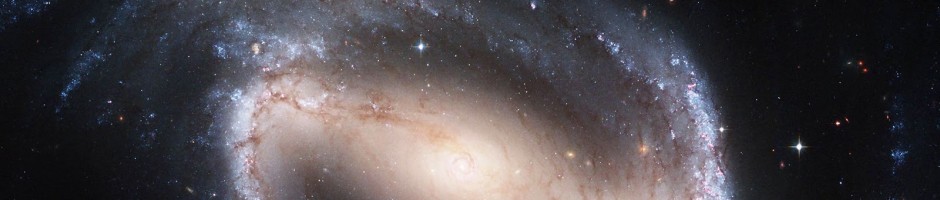
Galaxy Zoo Science Wordl
I’ve given a couple of public talks recently on results on galaxy evolution from Galaxy Zoo (at the Hampshire Astronomical Group, and the Winchester Science Festival) and one of the things I like to point out is the quantity and variety of science results we’re getting out. To illustrate that I made the below wordl of words appearing in the abstracts of all the peer reviewed science papers the Galaxy Zoo science team have put out.
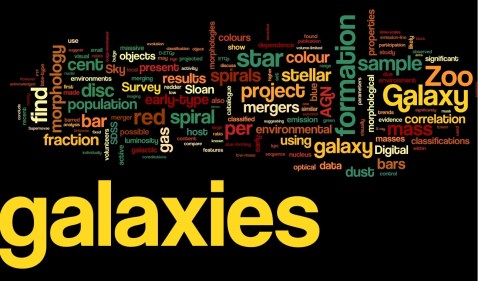
This is based on the 30 papers about astronomical objects submitted up until July 2012. I just missed Brooke’s first financial reform paper submitted by a day or two, and I love that this was out of date just as soon as I made it. 🙂
I realise I should sort out things like per cent – percent, and galaxy, Galaxy, galaxies technically being the same thing. But still I think it’s interesting to look out.
Update: Peas are a Mess!
Hi all,
About two weeks ago, a group of astronomers led by Ricardo Amorin posted a new paper on the peas to astro-ph. They used the giant Gran Telescopio Canarias (GranTeCan or GTC) to take really high-quality spectra of some of the peas. What they find is amazing, but not entirely unexpected. We already knew from Carie Cardamone’s paper that the peas are extremely intense starbursts, that is, they form more stars relative to their mass than any other kind of galaxy in the nearby universe. Now, Amorin et al. show that they are a real mess:
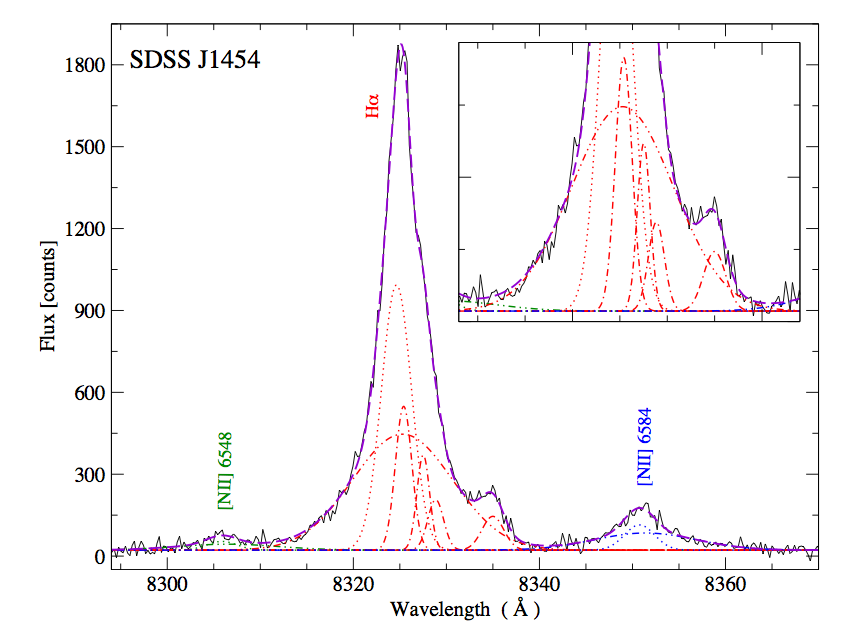
A GTC spectrum of a pea from Amorin et al. (arXiv:1207.0509) zoomed in on the Halpha emission line. The Halpha line comes from gas ionised by the powerful radiation from very young stars. The high-resolution spectrum clearly shows that the single Halpha line is actually due to several different components.
The Halpha emission lines of the peas, once studies at high resolution and signal-to-noise, show that they are actually composed of several different lines. The Halpha line is generated by the powerful ionising radiation from young, massive stars hitting the surrounding gas. The multiple lines mean that the peas have several chunks of gas and stars moving at large velocities relative to each other.
This makes sense from what we know from the few peas that have nice Hubble images.
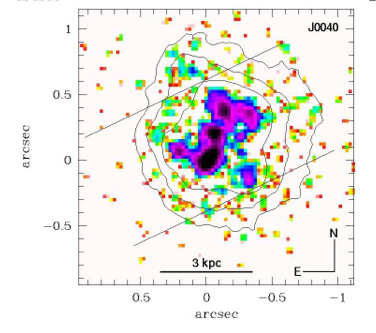
Hubble image of a pea galaxy (Amorin et al. (arXiv:1207.0509)) showing that it actually consists of multiple components; it’s a real mess!
The multiple Halpha lines are almost certainly from these multiple components and suggest that the gas (and stars) in the peas are effectively a turbulent mess. Some of those clumps whiz past each other at over 500 km/sec. Yes, km/sec. Some of the Halpha lines are also broadened suggesting that really energetic events are occurring inside those star-forming clumps, such as multiple supernova remnants or powerful Wolf-Rayet stars.
You can get the full paper as PDF or other formats here on arxiv.
Something rich and strange – Hubble eyes NGC 5972
We just got the processed Hubble images for NGC 5972. This is a galaxy with active nucleus, large double radio source, and the most extensive ionized gas we turned up in the Voorwerpje project. We knew from ground-based data that the gas is so extensive that some would fall outside the Hubble field (especially in the [O III] emission lines – for technical reasons that filter has a smaller field of view). We expected from those data that it would be spectacular. Now we have it, and the Universe once again didn’t disappoint. Another nucleus with a loop of ionized gas pushing outward (this time lined up with the giant radio source), twisted braids of gas like a 30,000-light-year double helix, and dramatically twisted filaments of dust suggesting that the galaxy still hasn’t settled down from a strong disturbance.
Here’s a combination of the Hα image (red) and [O III] (green) data, with the caution that neither has been corrected for the contribution of starlight yet. The image is about 40 arcseconds across, which translates to 75,000 light-years at the distance of NGC 5972. This gives the team plenty to mull over – for now I’ll just leave you all with this view. (Click to enlarge – you really want to.)
![NGC 5972 from HST in [O III] and H-alpha](https://blog.galaxyzoo.org/wp-content/uploads/2012/07/ngc5972o3ha.jpeg "NGC 5972 from HST in [O III] and H-alpha")
NGC 5972 from HST in [O III] and H-alpha
What we still don’t know
I used to think that science was about discovery, about adding certainty to what we know about the Universe. Discoveries happen, of course, but I’ve learned that the really exciting stuff happens not when we expand our knowledge, but our ignorance; progress is measured in the number of unanswered questions we have. After all, any good result raises more of those than it answers.
I have this in mind because today is the 5th anniversary of the launch of Galaxy Zoo, and it’s tempting to write about how we – with your help – have magnificently fulfilled the vision we had back in 2007. After all, in that first story on the BBC news website; a youthful version of me chirps that “We hope that participants in Galaxy Zoo will not only contribute to science, but have a lot of fun along the way”. Science? Check. Fun? Check..
But did we really understand what we were getting into? Certainly not. We’ve rehearsed before the story that we didn’t understand the size of the response we would get, nor the undimmed enthusiasm for sharing in exploring the Universe that still motivates volunteers today. But on launch, we didn’t realize we needed this blog to explain what we were doing with the clicks, nor the forum; which (thanks to the efforts of Alice Sheppard and team) has played such an important role in defining Galaxy Zoo. We didn’t realize that detailed classifications, of bars and three-armed spirals, of bulgeless disks and merging galaxies, were possible, nor that thanks to the Hubble Space Telescope we’d end up exploring the distant Universe, peering at blue blobby galaxies in a mixture of interest, awe and frustration.
We didn’t realize that spontaneous discovery, serendipitous exploration of the cosmos would come to provide some of the most entertaining and scientifically valuable results from the project. From the Voorwerp, to the recent Hubble images of the Voorwerpjes; (another hit my inbox this morning – watch this space) through to the Peas which are now attracting rather a lot of attention). On a personal note, on that July morning in 2007 I didn’t know most of the people who would lead this scientific return – Kevin, of course, was still recovering from classifying 50,000 galaxies himself, and Kate Land and Anze Slosar provided sterling support, but Steven Bamford and Karen Masters in particular had yet to step forward into their leading roles. Much of this science will be celebrated at a one day meeting at the Royal Astronomical Society next year on ‘Galaxy Morphology in the era of large surveys’ – mark your diaries for May 10th! The most exciting work to be presented at that meeting probably doesn’t exist yet – I suspect we’ll still be puzzling over exactly what bars do to galaxies (or vice versa), and arguing about exactly how black holes grow, but all we have at the moment is an ever-growing pile of questions. Which is, of course, exactly as it should be.

We also didn’t know what we didn’t know when it came to development. The original site worked brilliantly, thanks to the efforts of Phil Murray; and Dan Andreescu, but probably the biggest change over the last few years has been the arrival of Arfon Smith and his merry band of developers. That, of course, has spawned a whole new Zooniverse, which has sent us hunting for supernovae, planets, looking for bubbles and even listening to whales. In that manic expansion, Galaxy Zoo has occasionally been left behind, but I’m pleased to say that a new site is on the way. By the middle of August, a brand new site will be serving up images of new galaxies, both from the deep CANDELS survey and, returning to our roots, from the latest data release of the Sloan Digital Sky Survey. We do need to have a few more clicks on the existing site, though, so anyone who classifies in the next two weeks on Galaxy Zoo will be rewarded with early access to the new site (whether or not you’re still reading at this point).
So much for the next few weeks. What of the next few years? I could tell you that as Galaxy Zoo has established citizen science as a standard way of doing astronomy, you’ll see many more projects from us exploring pretty much every aspect of the Universe. I could tell you that I suspect that live interaction with data fresh from the telescope; is going to be increasingly important as the amount of data available to astronomers reaches at least 120 terabytes by the end of the decade. I could spend hundreds or thousands of words convincing you that advanced tools are key, that we’re going to need many more people to follow the lead of the denziens of the forum and get deeply involved in the science that lies beyond clicking. And I could tell you of our determination to finally crack a means of getting Galaxy Zoo firmly into the classroom, but the truth is anything could happen. And that’s just the way we like it.
Chris
P.S. To anyone who has taken part in the last 5 years – thanks a million. Now go and get classifying.
Galaxy Zoo at the European Week of Astronomy and Space Science
The Galaxy Zoo science team is well represented this week at the annual European Week of Astronomy and Space Science, hosted this year at the Pope’s University (or more properly Pontifica Universita Laternase) in Rome, Italy.

It is a beautiful location for a conference

with the most amazingly decorated lecture theatre I’ve ever been in

and just up the road from the Colluseum

A session on the first day on the Structure of Galactic Discs perhaps explains the interest of many of us on the Galaxy Zoo team. I spoke in that session on my recent results looking at bars and the atomic gas content of nearby galaxies.
Brooke Simmons (now settling in as a new postdoc at Oxford after finishing her PhD at Yale recently) had a poster on some work I’m sure you’ll hear about soon about some very interesting totally bulge free disc galaxies which still have actively growing supermassive black holes in their centres.

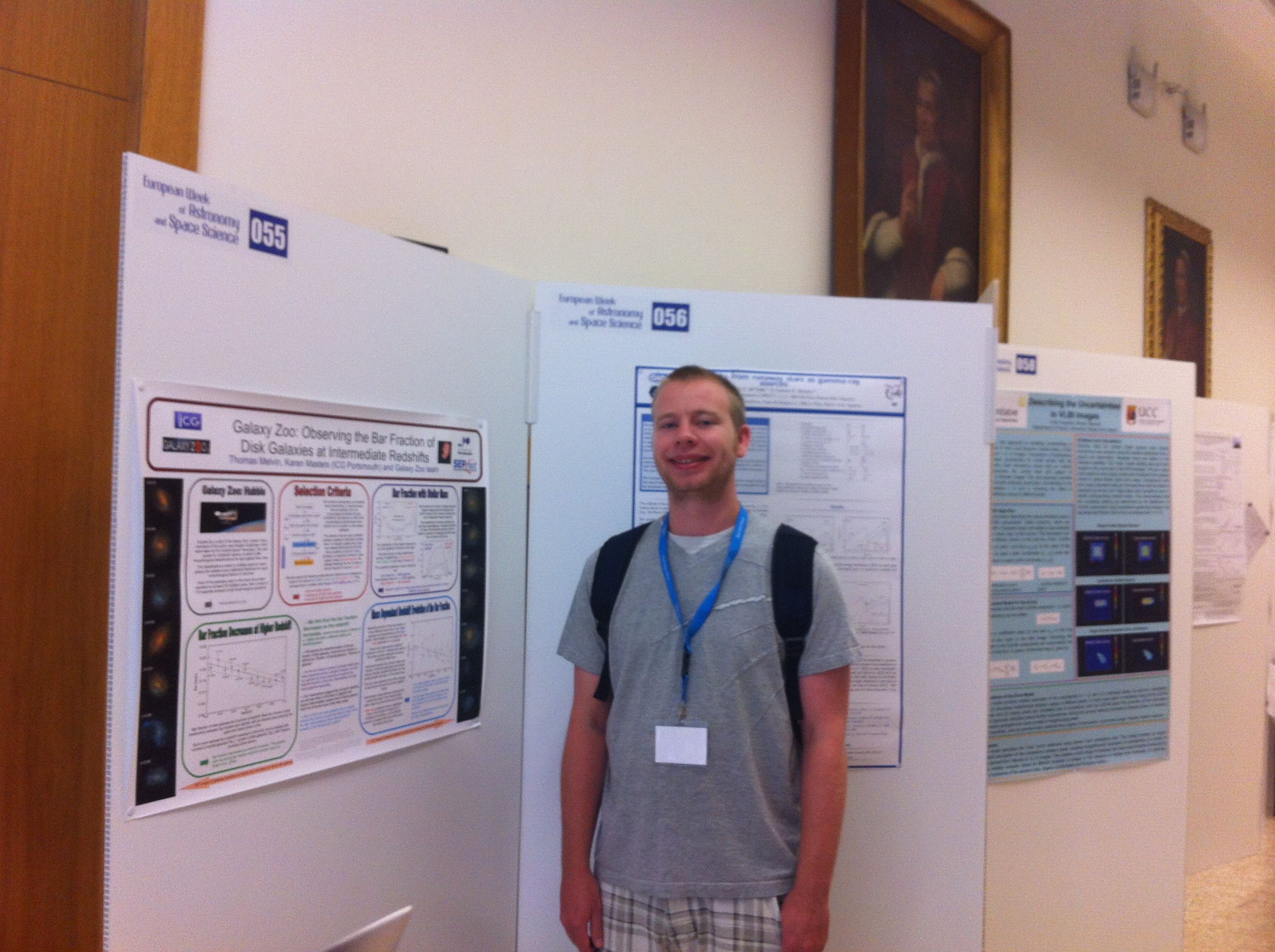
And Portsmouth PhD student, Tom Melvin (who is working with me) had a poster on his work using Galaxy Zoo: Hubble data to look at the redshift evolution of the bar fraction (more on that very soon too I hope).
Finally, talking in the session on interacting galaxies which runs tomorrow will be Kevin Casteels from Barcelona (who we all must congratulate on his very recent PhD) who has been working mostly with Steven Bamford on morphological signatures of closely interacting pairs of galaxies (arxiv link to paper, a blog post has been promised).
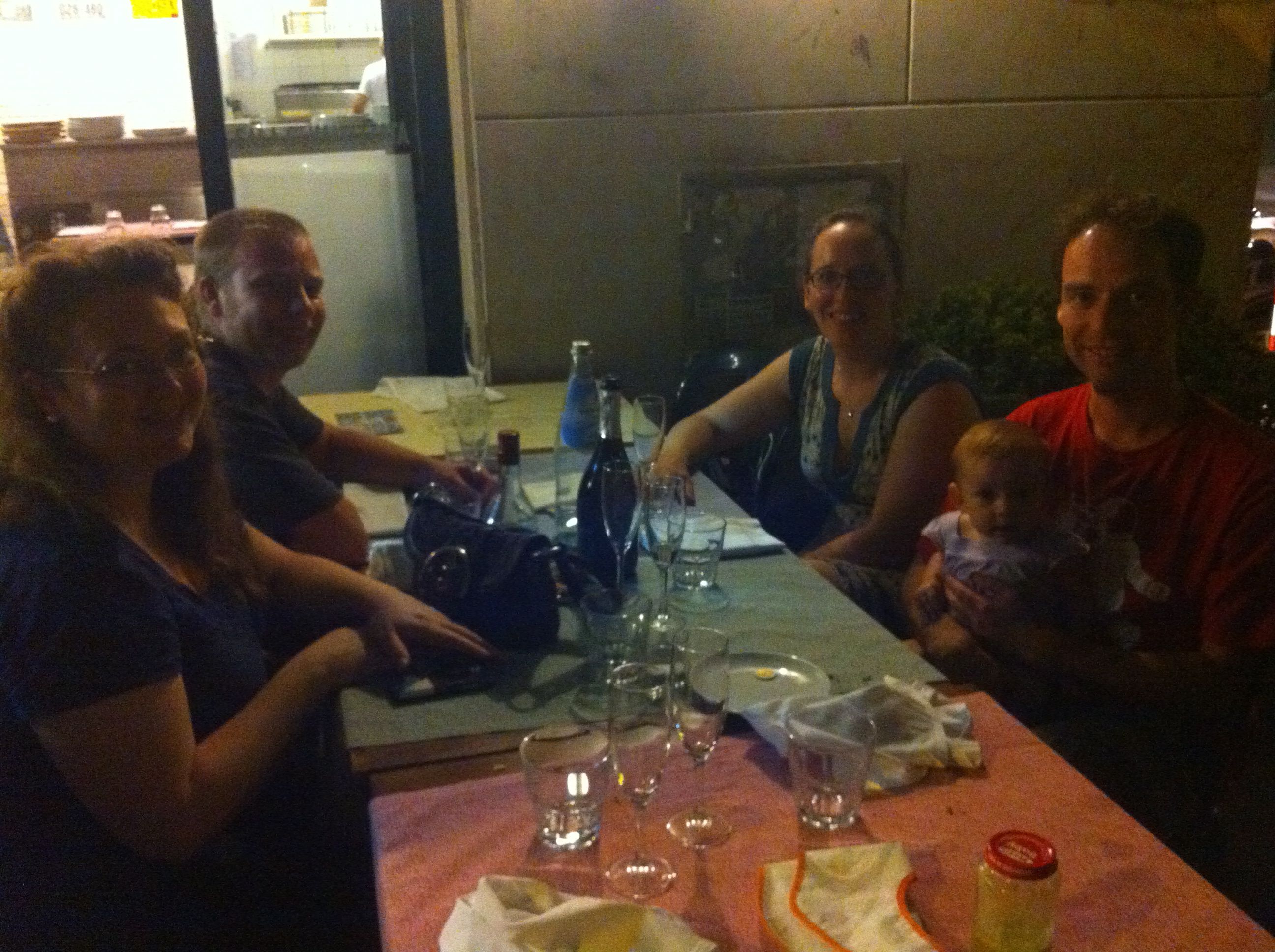
We all had a lovely (and typically late Italian) dinner together on Monday night – along with a Galaxy Zoo baby: Alia (Kevin’s daughter).
 Galaxy Zoo