Radio Galaxy Zoo: conferencing in Italy (Day 4)
Final day of the conference. Still pro-pasta, but may have hit my personal limit on gelato and/or red wine.
We had only a half day for the final day of the Bologna workshop on extragalactic radio surveys. After a tasty conference dinner at the historic Palazzo Re Enzo, we devoted the morning to AGN physics. This is the counterpart to the sessions we had on star formation in galaxies on Monday; almost all continuum radio emission that we detect in individual galaxies is either due to a thermal component from star formation or synchrotron and free-free emission that’s produced in some way by the central supermassive black hole, known as an active galactic nucleus (AGN).
Leith Godfrey (ASTRON) gave a really neat talk on “remnant” radio galaxies, which refers to galaxies that still have active radio emission from the heated plasma in distant lobes, but for which we don’t see the jet because the black has shut down its active phase some time ago (in our observed frame). We can identify these remnants both via morphology (big radio lobes with no jet or core) and through their radio spectra – energy losses from the particles cause a characteristic curved shape which you see if you plot frequency vs. radio flux density. Leith has been doing statistical studies of remnants, finding that less than 1% of bright radio sources are in a dying phase. This is interesting since the number of sources we observe constrains the timescales on which radio galaxies die. It also points toward certain physical properties – there are strong adiabatic losses after the jet switches off, but the lobes seem to remain very high-pressured compared to their environments right up until the end of their lives.
Marisa Brienza (ASTRON) gave the talk immediately following on a new remnant, named BLOB1, that she and her team just detected with LOFAR. LOFAR, a low-frequency array located in the Netherlands and other European countries, is just ramping up full operations, but will be a hugely powerful instrument for increasing the size of these samples over the next decade.

Example of a new radio remnant, named BLOB1, detected with the LOFAR telescope at 137 MHz. From Brienza et al. (2015).
After several more talks, Mike Garrett (ASTRON/Leiden) gave some closing remarks on the conference, including some summaries of what had been discussed and where he thought the future of extragalactic radio sources was going. I was really stoked that RGZ was one of the first results that he specifically cited as being important; Mike mentioned both citizen science and new distributed software routines as being crucial for dealing with the potentially billions of new celestial sources that telescopes will detect in the next decade. The role of citizen scientists in radio astronomy may change – I’ve talked to scientists at this conference about someday doing tasks other than morphology identification, for example – and we’ll definitely have to increase the interplay between the citizen science datasets and machine learning algorithms to maximize our survey results. But, as Mike said on his final slide, the present state of radio surveys is very bright indeed, and we have every reason to think that the best is yet to come.
It’s been a fantastic workshop, and I’m grateful to the conference organizers for accepting my talk and offering financial assistance, the American Astronomical Society for covering my travel costs, and the NSF for partially supporting my work on RGZ at the University of Minnesota. Looking forward to a day or so of sightseeing this weekend, but I’m inspired to get back to work next week and continue being part of such a vibrant scientific community.
Radio Galaxy Zoo: conferencing in Italy (Day 3)
75% done with the conference. Still not sick of pasta yet.
Day 3 of the Bologna workshop on extragalactic radio surveys started with a session on the most massive structures in the Universe: galaxy clusters. These collections of galaxies within massive dark matter haloes show up in radio surveys in several different ways: these include radio haloes, which are diffuse large-scale emission regions not associated with a particular galaxy; radio relics, which are similar features but found at the edge of clusters and likely driven by shock waves, and individual radio galaxies found within and nearby these clusters. Reinout van Weeren (Harvard/CfA) gave a really interesting talk on measuring the spectral index in radio relics; this means measurements of the ratio of the radio luminosity at different frequencies, similar to the way color is defined at optical wavelengths. Changes in the radio spectral index trace variations in turbulence in the intracluster medium, or possibly changes in magnetic fields; the fact that radio relics in many clusters have very different spectral index maps is a puzzle that makes it difficult to explain them with a single model.

A spectral index map of the “Toothbrush Relic” (1RXS J0603.3+4214) between frequencies of 610–325 MHz, taken with the Giant Metrewave Radio Telescope in India. From van Weeren et al. (2012).
We also had the second poster session of the conference, including another Radio Galaxy Zoo result! The poster was led by RGZ science team member Minnie Mao (Joint Institute for VLBI in Europe), titled “Here Be Spiral DRAGNs”. Jean Tate, Minnie Mao, and several RGZ volunteers and science team members have been using RGZ to search for radio-loud AGN whose host galaxy is a spiral.* The acronym “DRAGN” stands for “double-lobed radio source associated with galactic nuclei”. These are extremely rare objects – the number of confirmed spiral DRAGNs discovered so far can be counted on your fingers – but really interesting. The standard physical model for how double-lobed, powerful radio sources are generated are triggered by mergers between galaxies and ultimately their black holes. In the process, a major merger disrupts and destroys the disk of the galaxy, resulting in an elliptical – this theory would predict that we see double radio AGN exclusively in massive ellipticals. That’s mostly true, but the existence of exceptions are fascinating and force astronomers to consider alternatives or extensions to the merger driven hypothesis. Minnie and Jean are going through a sample preliminarily assembled in RGZ to try and identify more candidates like these.

Minnie Mao (left) loves explaining her research on spiral DRAGNs from Radio Galaxy Zoo.
One more day to go!
*Changed wording on 24 October 2015 to emphasize the roles played by both volunteers and the science team.
Radio Galaxy Zoo: conferencing in Italy (Day 2)
Yesterday was the second day of the workshop in Bologna on extragalactic radio surveys, where I’m attending and gave a talk on Radio Galaxy Zoo. We had three major blocks of talks yesterday: one on galaxy evolution, one on cosmology, and the final one on exploiting synergies between radio telescopes.
Galaxy evolution is a big topic, and one that drives a lot of the science behind both Galaxy Zoo and Radio Galaxy Zoo. Several of the talks really highlighted the importance of having multiwavelength data, in addition to what we learn from the radio (this is one of our main goals identifying the optical counterpart in our project). A couple of the most famous deep fields which have been studied in radio were discussed, including the VLA-COSMOS study, GOODS-North, and the Hubble Deep Field.
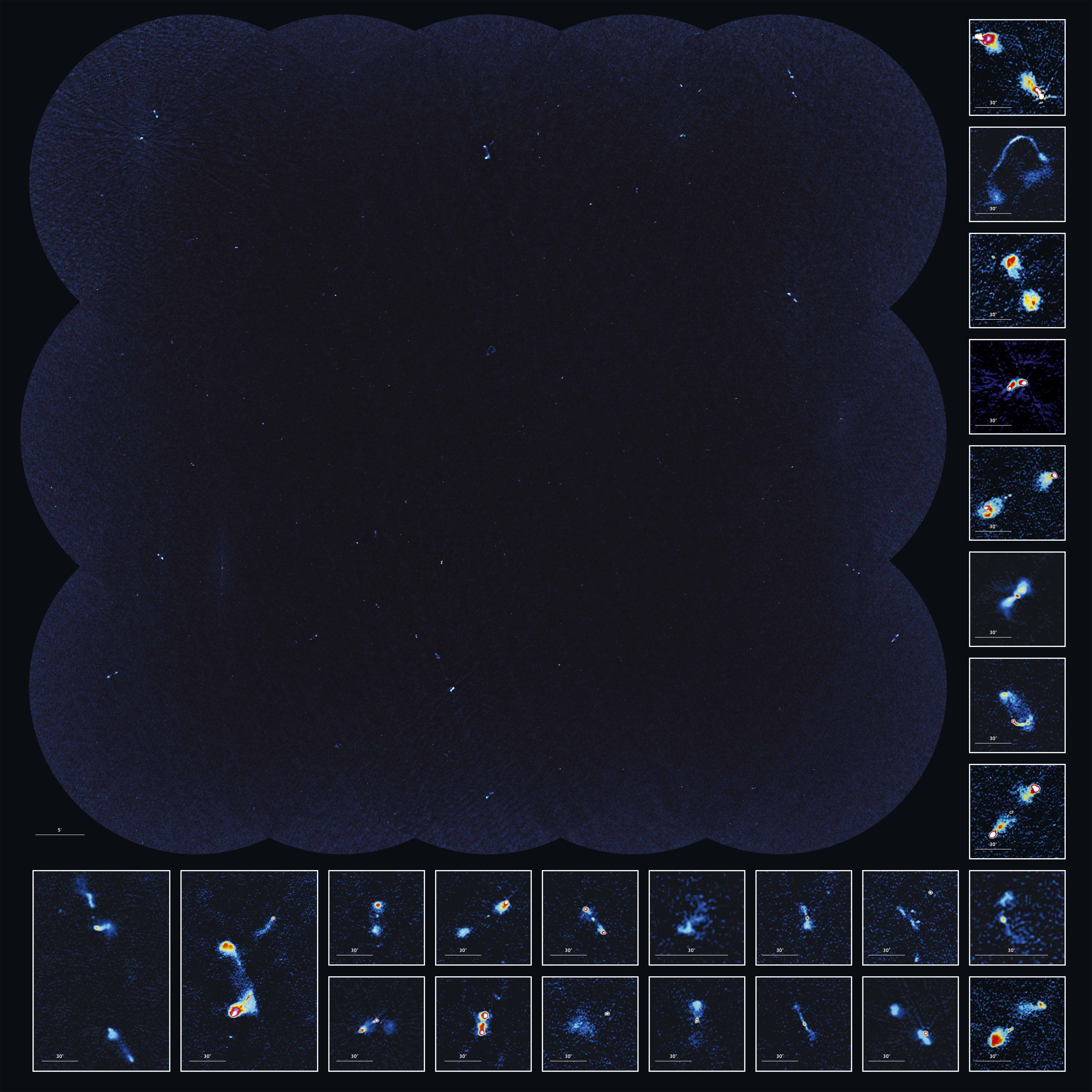
Poster showing the entire field and some zoomed-in radio sources from the VLA-COSMOS project. http://www.mpia.de/COSMOS/
Data from new telescopes, like the low-frequency LOFAR, are yielding some exciting results. One interesting result was the fact that lower-mass galaxies more commonly hosted active galactic nuclei (AGN) seen in the radio in the early Universe, at redshifts of 1 < z < 2. Galaxies with higher masses, however, had about the same fraction of radio-loud AGN at this time. It’s interpreted as being the result of more galaxies accreting matter in what’s known as “cold” or “radiative mode”, thanks to the increase in the supply of cold gas available to galaxies at earlier times (Wendy Williams, U. Hertfordshire).
Cosmology is probably being a bit underrepresented at this conference, since we only had three talks in this session. A lot of the focus was on how detecting very large samples of galaxies (both in radio continuum, like the FIRST and ATLAS surveys in RGZ data, as well as looking at spectral lines like the 21-cm hydrogen line) constrain our cosmological models. Different parameters for both dark energy and dark matter make specific predictions for how populations of galaxies evolve, including their numbers, distributions of sizes and masses, and geometrical arrangement. You can also test cosmology through gravitational lensing at radio wavelengths. It’s promising, but very challenging compared to how it’s done in optical wavelengths due to difficulties in fitting shapes in the raw visibility data (Prina Patel, U. Western Cape).
One of the talks I found really interesting (and new to me) was by Emma Storm, from GRAPPA/U. Amsterdam. She gave a great presentation on how radio observations explore the nature of dark matter. While we don’t know a huge amount about the nature of the dark matter particle, one prominent theory predicts that when they collide, the particles annihilate and produce other particles in the Standard Model that we can directly observe (like pions and gamma rays). If that’s so, then these annihilations would also produce charged particles like electrons and positrons; when those particles are accelerated in magnetic fields, they emit synchrotron radiation, which we detect in the radio. So by looking for radio emission in objects that we expect to be dominated by dark matter (like galaxy clusters), scientists can constrain the parameters of their dark matter models, particularly things like the cross-section. The signal this would produce is expected to be diffuse and weak, though; Emma’s work doesn’t detect radio emission in many clusters, but places important upper limits on the amount that could be there within the detection limits.

Limits on dark matter annihilation cross sections as a function of the particle’s mass. Each curve is an upper limit based on radio observations of a galaxy cluster (from Storm et al. 2013).
The last session of the day dealt with synergy and commensality. I normally hate things that sound like business-speak buzzwords, but in this case it is really important – we have a number of new radio telescopes coming online now or in the next several years, such as ALMA in Chile, LOFAR in Europe, and the Square Kilometer Array in Australia and South Africa. It’s quite important to plan the capabilities and designs of each so that we don’t repeat work unnecessarily, maximize the scientific output, and try to make the data and results available to as many people as possible.
Halfway over already! You can also follow what some of the other people have been discussing at the conference at the hashtag #radsurveys15.
Radio Galaxy Zoo: conferencing in Italy (Day 1)
One of the best things about being a scientist is the opportunity to attend conferences – you get to visit a new place, meet your colleagues in person, learn about what they’ve been doing, and get a chance to share your exciting research with them. I’m lucky (through the assistance of the American Astronomical Society, the Italian National Institute for Astrophysics, and the University of Minnesota) to participate in a conference this week on the future of extragalactic radio surveys in Bologna, Italy. I’m getting my first chance to share results from Radio Galaxy Zoo and to learn about other, new results in the area of extragalactic radio science!
The conference is four days, from Tuesday – Friday; I’m going to try to make a blog post each day. I’m going to try give a quick overview of all talks/posters on the day, as well as more details on talks which I thought were particularly interesting. I know I won’t do justice to many of the interesting research topics being presented, but I won’t have time to give every topic the breadth they deserve.
The first day of the workshop started with several talks covering current and upcoming surveys in radio astronomy. These include radio telescopes in the Northern Hemisphere. The two main telescopes discussed were the Very Large Array (VLA) in New Mexico, USA, which will run surveys like VLITE (a low frequency survey which will run constantly on the telescope in parallel with other observations), and VLASS, a new all-sky survey with many similarities to the current FIRST data in Radio Galaxy Zoo. LOFAR is a low-wavelength radio telescope with stations centered around Europe; it will open up similar resources, but at significantly lower frequencies than the VLA and thus probing different physical phenomena. In the Southern Hemisphere, the EMU survey in Australia and the MIGHTEE survey in South Africa will carry out similar responsibilities.
I gave a talk at the end of this session on Radio Galaxy Zoo, covering our first accepted paper and some of our early science results. If you’re interested, I’ve put my talk online here.

Example slide from Kyle Willett’s talk on Radio Galaxy Zoo at the Bologna workshop.
The afternoon had two sessions on science: one on radio continuum and star formation, and one on radio observations of the transient universe.
I think after the first day that I’m filled with a great sense of optimism about radio astronomy. We’ve got a fantastic new telescope being built in the next several years: the Square Kilometer Array. It’ll be the largest telescope ever built, addressing a huge number of scientific questions. We’re currently in the stage of building prototype telescopes, but those telescopes are already producing useful science – some of which I learned of today. We have a reasonable understanding about how things like magnetic fields affect both the formation and evolution of galaxies. Radio observations have a unique way of detecting and leveraging these detections; through polarization of the radio signal, we can measure the magnetic field and directly probe (through its signal) the interactions with matter between its source and our telescopes. New phenomena like fast radio bursts are, I think, a really neat way of measuring both the amount and distribution of matter in the Universe – this has implications for everything from star formation to cosmology.
Really excited for the rest of the week (including more Radio Galaxy Zoo results) – will post again tomorrow!
 Galaxy Zoo
