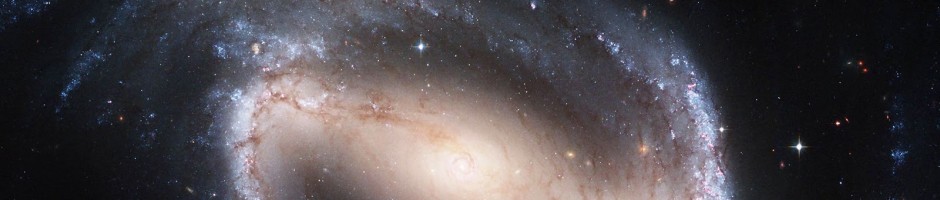
Hubble spies the Teacup, and I spy Hubble
Our Hubble image of Voorwerpje galaxies continue to come in, and it seems each one is stranger than the last. Overnight we got our data on the Teacup system (SDSS J143029.88+133912.0). This one attracted attention through a giant emission-line loop over 16,000 light-years in diameter to one side of the nucleus.
I was worried to get email this morning that there had been a failure to lock on to one of the two needed guide stars so that the telescope might have rolled enough during the observations to compromise data quality. Inspecting the data, it looks like we’re OK. We’re OK and the galaxy is strange. This is a composite of [O III] (green) and Hα (red), right out of the software pipeline without any additional processing:

The Teacup AGN in raw emission-line Hubble images
Another giant hole whose origin is obscure. The loop doesn’t even show much sign of being connected to the galaxy. The strongest [O III] does seem to trace out ionization cones, as in showing from structures near the nucleus, but that seems independent of the distribution of the gas. There are filaments in the gas that are nearly parallel, sort of like waves. Well have our work cut out for us to understand more of what’s going on here. I can hardly wait for the next one!
There was an extra treat for me with these observations. Last night, I interrupted a session with my summer class at the campus observatory to look south with binoculars and catch Hubble passing far to the southeast, no more than 13 degrees from our horizon. This was during the Hα exposure, so I saw it while it was doing these observations (it was pointed just about up in my frame of reference, as it happens). I got a picture through a 125mm telescope, showing the telescope streaking by just north of the star k Lupi. At the time, Hubble was 1600 km away over Cuba. Hubble was watching the Teacup, I was watching Hubble, and a couple of slightly puzzled students were watching me.

Hubble trails across the sky north of the star k Lupi in this telescopic view.
Curiouser and curiouser – Hubble and Mkn 1498
Fresh off the telescope, here’s a first view of the “Voorwerpje” gas clouds around the Seyfert galaxy Markarian 1498. Its nucleus, shown in our Lick and Kitt Peak spectra, is a type 1 Seyfert, meaning that we see the broad-line region of gas very close to the central black hole, moving at high velocity. Those data showed highly-ionized gas to a radius of at least 20 kiloparsecs (65,000 light-years). Its nucleus is too dim to account for the ionization of the extended gas clouds, which landed it a spot in our list of seven objects for the Hubble proposal. Getting these data now was an unexpected treat – they were originally scheduled to be taken next November. As another bonus, the good people at the Space Telescope Science Institute just last week implemented the software to deal with charge-transfer problems in the Advanced Camera CCDs, right in the pipeline, improving the image quality a lot (it took months to get to this point with the Hanny’s Voorwerp data). And here it is, Markarian 1498 in a combination of [O III] emission (green) and Hα (red):

This is… interesting. From the few of these galaxies where we have data so far, loops of ionized gas near the nucleus may be a recurring theme. I could add speculations on what we’re seeing in Mkn 1498 – but for now, I’ll just let everyone enjoy the spectacle.
A first Hubble look at UGC 7342
Overnight, Hubble got our first data on perhaps the most spectacular Voorwerpje host galaxy, the merging system UGC 7342. We have to wait until almost the end of the year for what we really wanted to see, the ionized gas. The telescope has particular time pressure in some parts of the sky (as if it doesn’t have extreme time pressure on everything people want to do with it), so we split the two sets of images to fit the schedule better. This time, we got data in WFC3 for two medium-width filters in the orange and deep red, selected to be essentially blind to emission from the gas. These will be used to subtract the contribution of starlight from the gas images, so we can analyze the gas properties cleanly. The emission-line images use the older ACS camera, which has a set of tunable filters which can isolate any optical wavelength we need. They come at year’s end, because we have to specify a particular range of orientation angle of the telescope to fit all the gas in their 40×80-arcsecond filter field. That, plus the requirement that the solar arrays can face the Sun directly, gives us a restricted time window.
As a reminder, here’s UGC 7342 from the SDSS data.
And here is a first look at the Hubble images, warts and all. With only the two filters in orange and deep red, the color information we get is pretty muted. Here’s the whole galaxy, shrunk 4 times from the original pixel scale to fit:

This show the companion and tidal streamers of stars. UGC 7342 itself shows shells of stars, which can be formed when a lower-mass disk galaxies merges with a more massive elliptical. With some additional velocity information, those might be able to give a time since the merger (with some tailored simulations). The elliptical reflections are from bright foreground stars outside this trimmed view; the emission-line images will at least have these in different places, using a different camera and different telescope orientation.
Zooming in 4 times to the nucleus shows that UGC 7342 has complex dust lanes crossing in front of the core. These are perpendicular to the directions where we see that distant gas is ionized by radiation from the nucleus, which is pretty common. The fact that the dust (and almost certainly associated gas) wraps at right angles to most of the structure in the galaxy is another indication that a merger took place recently enough that the situation hasn’t settled down into a long-lasting remnant.

Next up? The scheduling windows for SDSS 1510+07, NGC 5972, and the Teacup AGN all happen in overlapping spans from June to August. Bring on the bits!
Kitt Peak wrapup – for now
The end of this observing run made up for the unnecessarily interesting variety of weather early on. Calm, clear skies, ran through an object list just as fast as we said in the proposal. Here’s a montage of the red-light images from 9 of the target galaxy pairs done on night 4.

That’s it for this run. But we’ll be back there late next month to really clean up the target list.
Night 2 at Kitt Peak – watching out or blown away?
The forecast for tonight’s continued imaging of Galaxy Zoo overlapping galaxies was marginal, with a storm expected. That has not yet materalizd, ut the wind have been so high that, after the anemometer flirted with the 72-km/hour safety limit for two hours after sunset, I finally had to shut down a little whole ago. There are data on two pairs so far tonight, and I’ll naturally keep one eye on the wind speed. If it drops back, I’ll open again.
Meanwhile, there has been time to look over last night’s data and do some basic processing. Here, for example, is a quick and dirty composite image of Markarian 238 and its larger spiral companion from B and R images. The display is set to show the inner structures most clearly.

Markarian 238 and companion from Kitt Peak 2.1m images
Some random thoughts while observing: Cherry Pepsi cans look really weird under a red flashlight. And email today brought some encouraging news on another Galaxy Zoo science front.
(0710 UT, three hours later) The wind continues to howl under a frustratingly clear sky; some clouds are just appearing which may be parts of the predicted storm system. Gusts up to 83 mph (133 km/hour) have been recorded in the last hour. With the outside temperature less than 2 C, I try not to think of the wind chill.
Observing updates – live from Kitt Peak, April 12/13, 2012
(0220 UT) All set up to start work. Worrying clouds have at least temporarily receded. While being checked out by a staff member to make sure I won’t break things, I’ve checked the telescope pointing on a couple of bright stars (Castor and Pollux, in fact) and am just waiting another few minutes for it to get dark enough to critically focus the CCD camera and TV acquisition system. Then off, for starters, to a couple of galaxies that SDSS data suggest might have very extended dust lanes beyond the optical disk.
(I’ll plan to update this over time).
And to all you cosmic partiers, happy Yuri’s Night!
(0345 UT) Got data in B and I filters on one pair, suggested particularly by JeanTate on the forum thread, but those images are pretty ugly because of stray charge from bright stars that will take some processing to fix. Now off to our best case for a spiral with extended dust and no sign of interaction to cause this.
(0507 UT) Looked at SDSS 103427.72+102506.2, still seeing evidence of dust lanes very far out in the galaxy disk. Now doing an edge-on system with dwarfish companion in front.
(0830 UT) Still working away between cloud patches. Now have data on SDSS 1002+1413, UGC 5528, NGC 3605/7. Working on NGC 4377. Reached the stage of night where Mahler seems appropriate to keep alert.
(1025 UT) Nice images of Mkn 238. Now taking a detour, Kazarian 199 for the AGN=companion Galaxy Zoo project. Data from the SARA 1m suggest [O III] clouds which might trace ionization cones, so I’m taking a closer look with the larger telescope. About 1.5 hours left in the night if I arrange the last couple of exposures with their filters in the right order.
 Galaxy Zoo