Galaxy Zoo on the "Curious" Podcast

Just wanted to put up a quick post to point out that the latest podcast from the people who run Ask an Astronomer @ Cornell discusses citizen science, and I’m interviewed on it about Galaxy Zoo stuff.
Link to the podcasts in iTunes.
Merry Christmas! Karen.
New Bar Paper Submitted to MNRAS
I’m happy to report that this week we submitted a new paper (to the Monthly Notices of the Royal Astronomical Society) using your bar classifications from Galaxy Zoo 2. The paper appears on astroph this morning (paper link here).
The title of the paper is shown below.

Ramin Skibba (who wrote one of the early Galaxy Zoo papers on the morphology-colour-environment relations) led this study into how the chance of finding bars and bulges in disc galaxies depends on the environment the galaxy is found in. We’re interested to find this out – particularly how the chance of finding a bar depends on environment – to help with the interpretation of our finding that redder disc galaxies are much more likely to host bars (which has now also been seen in other samples, and illustrated beautifully in one of the first figures from the paper, below – look at the blue lines which show the probability of finding a bar in a disc galaxy against it’s colour, with red to the right). Previous studies of the effect of environment have not had as many galaxies as we have (thankyou again), and have come up with contradictory answers as a result (for references see Ramin’s paper), so being able to do this study with a huge sample of galaxies with visually classified bars has been really fantastic.

Ramin used a technique called marked correlation functions to look for the effect of environment on the chance of a disc galaxy having a bar (or bulge). A correlation function (in astronomy at least) gives the probability that you’ll find two galaxies separated by a particular distance. We plot the “correlation” as a function of this separation (usually called r). The higher the correlation function (w(r)) is at some separation the more likely it is that you’ll find galaxies clustered on that scale. Practically this is measured by counting pairs of galaxies separated by each separation, r, and comparing it to the number of such pairs you’d find in a completely randomly arranged sample of galaxies.
The only difference with a marked correlation function is that in addition to simple counting of pairs, each galaxy is weighted by some “mark” (or number from zero to one). For example, in our paper we mark the galaxies by the fraction of you who classified the galaxy and clicked that you saw a bar – which we called p_bar. So two galaxies with a high fraction of “bar clicks” separated by a distance r would count more in the marked correlation function than two with a low fraction of “bar clicks”.
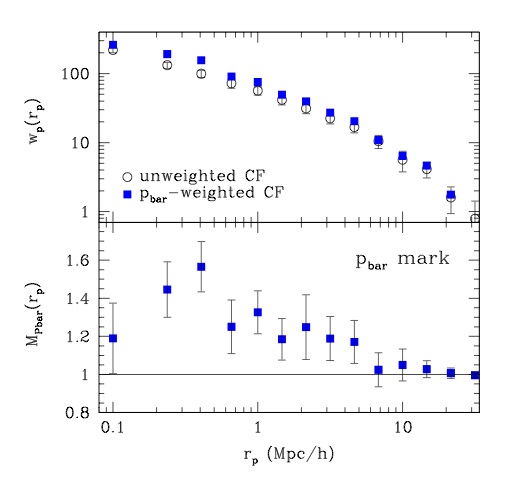
Our main result is shown above. The top panel shows the correlation functions of the whole sample, both with and without the weighting by p_bar. The bottom panel shows the ratio between those two correlation functions – so basically it shows the scales at which you’re more likely to a pairs of barred disc galaxies than a pair of any two random disc galaxies. This shows us that on the smaller scales barred disc galaxies are more strongly clustered than disc galaxies in general. The clustering peaks at about 0.4 Mpc/h (where Mpc/h are fantastic astronomers distance units which show our mistrust of the value of the Hubble constant; h = H0/100 km/s/Mpc, so is probably about h=0.7; so 0.4 Mpc/h is probably about 0.6 Mpc, or about 2 million light years) which is interestingly about the scale where most galaxies will be satellites of larger halos (ie. galaxies in groups). It is also interesting that on the very smallest scales the ratio drops back down to almost one – showing that for very close pairs disc galaxies are not more likely to have a bar.
Ramin (and of course also Steven using a different method) had previously shown that redder disc galaxies are more strongly clustered than bluer ones, so we had to wonder how much of the extra clustering of barred disc galaxies was just due to them being preferentially in red discs…. Ramin tested this using a really neat little trick, which he called “shuffling the marks”. Basically he took all galaxies of a similar colour and randomly shuffled the p_bar number within the group. If the bar-environment correlation was entirely due to the colour-environment correlation doing this for all the galaxies should result in no change in the marked correlation function. And in fact this is almost what we saw (below: the red triangles almost match the white circles). On most scales the bar-environment correlation can be explained by red discs being more strongly clustered, except right around the 0.4 Mpc/h scale (which likely represents galaxies in small groups) where in simple terms – we see some excess clustering of red discs with bars over the clustering of red discs in general.

This finding suggests that something about the group environment may be triggering bar formation. In addition the downturn at small scales (if real) suggests that once galaxies get really close and start interacting they are not more likely to have a bar.
There is a whole lot more information in Ramin’s paper, which as usual is an excellent and densely packed piece of work, so I hope you’ll forgive me for stopping here after explaining only the main result on the barred disc galaxies. It’s really been a pleasure working with Ramin on this study, and I just wanted to give you a flavour of the interesting results we have found.
The relative importance of bars (and other forms of “secular evolution” – generally used to mean slow internal processes acting on a galaxy) is turning into a hot topic in astronomy; with an entire session at the upcoming International Astronomical Union General Assembly (being held in Beijing in August 2012) devoted to “Galaxy Evolution through Secular Processes” so I expect you’ll be hearing a lot more about this.
To finish up a pretty (ish) picture. The top row shows examples of galaxies with pbar=0 (ie. no-one could see a bar), then pbar=0.2; pbar=0.5 and pbar=1.0 (all of you saw a bar).

A Summer Spent Finding Our Galactic Twin
Today’s post is a guest post by A-level Student, Tim Buckman from Portsmouth Grammer School, who spent 6 weeks working with me at Portsmouth University this summer through the Nuffield Science Bursery Scheme.
Finding Our Galactic Twin
For millions of years humans have attempted to understand their place in the cosmos.
We went from the flat Earth to the globe; from a geocentric to a heliocentric solar system, and now we understand we live in the outskirts of a spiral galaxy – a massive collection of stars.
For years though astronomers have endeavoured to find out what The Milky Way, our home galaxy, actually looks like in detail. The difficulty lies in the fact that we live within it, and it would take thousands of years of travel to get a good photo opportunity. The best models suggest that our galaxy is a spiral galaxy with between two and four spiral arms, a central bulge and a bar at the centre. Using what data we have, artists have tried to create an impression of our galaxy’s structure and form, the best guess being the one below.

An artists impression of our Galaxy. Credit: NASA/JPL-Caltech/Robert Hurt (SSC-Caltech)
Recently, the European Southern Observatory released an image of a galaxy which they called as a twin for our own. On the face of it the galaxy (below) looks just like our own, it has a similar number of spiral arms, it has a central bulge and, if you look closely, even a small bar at the centre. It’s name is NGC 6744 and from July of this year, it became our Galaxy’s twin. There is a small problem with this galaxy however, or should I say, a large problem; this galaxy is actually twice the size of our own in mass and size and therefore is a bit of a stretch to suggest it as a copy. We are again stumbling in the dark to find more about where we live.

NGC 6744 - the previously proposed clone. Credit: ESO.
This is where the Galaxy Zoo project CAN help. It aims with the help of ALMOST 450,000 volunteers, to classify as many galaxies as possible from the Sloan Digital Sky Survey. By using this information, we can start to narrow down a list of galaxies to look at. By filtering out those which were seen to have features and were relatively face-on to the camera, we end up with a list of around 17,500 galaxies in total. Again by filtering out those galaxies with the same mass, number of spiral arms and having a bar like the Milky Way, we find that there are just 9 galaxies which fit this criteria. Of these nine galaxies, the one which looked the most like the artists impression was the one shown below. This galaxy, captured through the Sloan Digital Sky Survey (SDSS) camera is the most likely of the galaxies we have seen to be a clone of our own.
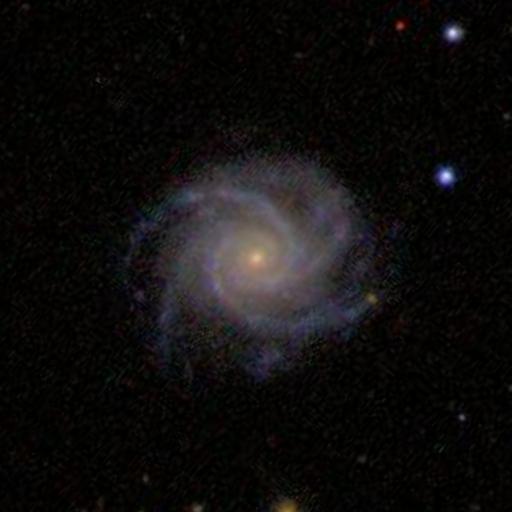
The new Milky Way clone candidate. Credit: SDSS.
The fact remains that this might, possibly, not be the best Milky Way ‘clone’ in the universe, there are countless galaxies yet to be photographed and there are thousands of galaxies which, due to their orientation, make it very difficult to see whether they are anything like ours. However, with rapid advances in technology, this dream of finding the shape of our galaxy is just around the corner.
Bars Work Featured by The Leverhulme Trust

I’m currently funded to work on research using Galaxy Zoo classifications through an Early Career Fellowship from The Leverhulme Trust. As part of this I was asked to write a report on the research I’ve done during the first year of my fellowship. This report now appears in the “Awards in Focus” section of their website: “Do Bars Kill Galaxies?” . It’s probably nothing new to most of you as I’ve blogged, podcasted and pencasted about this research already, but I thought you might like to see Galaxy Zoo research being showcased by The Leverhulme Trust.
The Leverhulme Trust is an organisation which supports “scholarships for research and education” across all subject areas. It was founded in the late 1920s at the bequest of Lord Leverhulme, a weathly Victorian businessman and with an annual budget of £50 million is one of the largest “all subject” supporters of research in the UK (History of The Leverhulme Trust). Early Career Fellowships are just one of the many ways in which the Trust supports research – with this fellowship being specifically designed for researchers “at a relatively early stage of their academic careers but with a proven record of research”.
Galaxy Zoo at the Durham Galaxy Evolution Conference
I think I won’t get in too much trouble if I say that in my opinion the event of summer 2011 for extragalactic astronomers was a massive international conference which took place in Durham, July 18th-22nd Galaxy Formation. You’ll be happy to know that Galaxy Zoo scientists were represented, with myself, Kevin, Ramin Skibba (who wrote one of the first Galaxy Zoo papers back in 2009), Vardha Bennert (who has done some HST followup for us, she’s profiled in the “She’s an Astronomer” series from 2009) and Boris Haussleur (see his blog posts about Hubble Zoo) all present.

400 Extragalactic Astronomers in Durham. That's me circled in orange, Ramin in pink and Boris in blue. Kevin and Vardha might be there somewhere but I've yet to spot them!
The moment of the conference for me was the first mention of Galaxy Zoo in the plenary talks – my work on the Galaxy Zoo 2 bars (see many blog posts!) was mentioned in a talk on the influence of internal evolution on galaxies (something we call “secular evolution” which bascially means the slow transformation of galaxies by material being moved around by the bars and/or spirals) which was given by Francoise Combes. I got so excited I took a picture of her slide, which you can also see in her talk pdf.

Francoise Combes talking about Galaxy Zoo results on bars
And here’s the slide so you can actually read it.

Francoise Combes's slide so you can actually read it
The red spirals also got a mention in a talk on gas in galaxies (by Luca Cortese – pdf unfortunately not uploaded at time of writing) where it was shown that at least half of them have very low NUV (near ultra-violet) emission for spiral galaxies. This is expected if as we think they are truly passive spirals with very little current star formation (which created NUV light).
Many of the slides for the talks, as well as the posters are available online (including mine, which for once wasn’t about my Galaxy Zoo work, but work with the new SDSS survey which is imaging 1.5 million galaxies at intermediate redshifts – unfortunately as fuzzy blobs, so no new objects for the Zoo from them!). There is also a plan to make video of the talks available. I’ll post an update about that when it happens.
Unfortunately I had to leave before Kevin and Vardha gave their talks on the Friday. Neither of them have posted their pdfs yet either. 😦
Boris and Ramin had posters – also like me on their non-Galaxy Zoo work (Boris: Measuring the physical properties of galaxy components in modern multi-wavelength surveys, Ramin: Are Brightest Halo Galaxies Central Galaxies?).
It was a great conference and I had a wonderful time in Durham.
Galaxy Zoo Lunch at the AAS
Following our session on “Cosmic Evolution from Galaxy Zoo“, a number of the Galaxy Zoo group went to lunch at a local Boston seafood place. Ivy (Wong) took a few photos, which I thought you might like to see.

View down the table at lunch.

From right to left, Lucy, Kevin, Pamela, Carie and Chris.

From right to left, Alice, Brooke and me (busy talking).
By the way, the AAS abstracts are now up on the ADS, so I have put the links up on the previous post.
Our Galaxy Zoo Session at the Boston AAS

As many of you may know, several Galaxy Zoo scientists were at the recent meeting of the American Astronomical Society meeting in Boston, USA. This included Chris, Kevin, myself, Carie Cardamone and Brooke Simmons; Lucy Fortson (who recently did her first blog post about a review article we wrote), Alfredo Carpinati (from UCL) and Ivy Wong (who recently moved from Yale back to her native Australia).
Galaxy Zoo volunteer and forum moderator, Alice was also there – and has written about some of it on the forum (under “why I’m going to be a bit quiet for 3 weeks“). Kevin has written some of his AAS highlights for the Planethunters blog.
But nothing has been written yet about our wonderful session on the science from Galaxy Zoo (except from the @galaxyzoo Tweets during the session), so I thought I’d take a bit of time to tell you about it.
It’s been a busy few weeks for me in the lead up to and following the session last Wednesday, so I hope you’ll forgive me for not doing this sooner.
Anyway, below is the title and description we came up with for the session when we proposed it to the AAS. You’ll this session was specifically aimed at highlighting the science results coming out of Galaxy Zoo.
Cosmic Evolution from Galaxy Zoo
Galaxy Zoo (www.galaxyzoo.org) is familiar to many as a hugely successful public engagement project. Hundreds of thousands of members of the public have contributed to Galaxy Zoo which collects visual classifications of galaxies in Sloan Digital Sky Survey images (and most recently Hubble Space Telescope) using an internet tool. Classifications from phase one of Galaxy Zoo (the basic morphology of SDSS galaxies) have recently been made public.
Galaxy Zoo has also shown itself, in a series of peer reviewed papers, to be a fantastic database for the study of galaxy evolution. In this session Galaxy Zoo team members will hi-light some of the most recent scientific results using Galaxy Zoo data, including the first results from phase two of the project (which collected more detailed morphologies).
We were given a 90 minute session during the meeting to do this in, and decided to have 6 speakers in this time. After some deliberation (and constraints based on who could come), we decided on the below speaker list, with Chris agreeing to act as session Chair (so he introduced the session, each of the speakers, and made sure we kept to time!).
- Barred Spirals on the Red Sequence – an important evolutionary stepping stone? – KLM (that’s me of course; ADS abstract)
- Bar Lengths in Nearby Disk Galaxies. – Ben Hoyle
- The Connection between AGN Activity and Bars in Late Type Galaxies – Carie Cardamone (ADS abstract)
- Black Hole Growth and Host Galaxy Morphology: Two Different Evolutionary Pathways – Kevin Schawinski (ADS abstract)
- Building the low-mass end of the red sequence with local post-starburst galaxies- Ivy Wong (ADS abstract)
- Properties of spheroidal post-mergers in the local Universe – Alfredo Carpineti (ADS abstract)
AAS abstract get posted on ADS, so when the links appear I’ll add them above (KLM June 6th: edited above to correct typos, and swapped talk titles).
We were in the “American Ballroom Central” at the conference venue, which was an absolutely massive room. After some technical difficulties with the microphone (very professionally dealt with by Chris), he introduced the session with his normal humour, saying something like “This is a session about the science from Galaxy Zoo. If you’re looking for something on exoplanets you can go to every other session here” (that’s my paraphrasing, with apologies to Chris if it’s not quite right!).
Then I started with a general overview of Galaxy Zoo, and Galaxy Zoo 2, going on to talk about our paper published earlier this year in which we showed bars were more likely to be found in redder disk galaxies (see the “bar” category on the blog). I talked a little bit about the implications this might have for galaxy evolution (“Do Bars Kill Galaxies” again), particularly in light of some results from an HST survey (arxiv link) which suggest that my favourite red spirals might not just be a rare curiousity, but actually be a phase that most galaxies might pass (briefly) through as they turn from blue star forming spirals into red passive ellipticals.
Unfortunately in the end Ben was unable to make it o Boston from Barcelona where he now works as a postdoc, but I was able to include a couple of slides about his main results from the bar drawing project showing that the bars in redder disk galaxies are longer, and that there is a difference in the colour of galaxies with a given length bar depending on if rings or spirals are present.
Then I showed some as yet unpublished results which Ramin Skibba has been working on which show that barred disk galaxies are more clustered than disk galaxies in general – this implies that bars are more likely to form in higher density regions (or in the types of galaxies found in those regions) which is quite interesting. You can expect to be hearing more about that in the next few months as we work on writing it up. Finally I talked about my plans to use the ALFALFA survey going on at Arecibo to make a census of the gas content of barred disk galaxies (the “fuel for future starformation”). There are some exciting early results in that comparison which I hope to be able to tell you about soon.
I have posted the pdf of my slides here.
I’m going to stop here for now, and plan to tell you more about the rest of the talks in session later.
Karen.
PS. Sorry about the “Zooiniverse” misspelling on the last slide. That’s a tough word to spell in a hurry!
Talking about Galaxy Zoo on the Jodcast

I talk about Galaxy Zoo (specifically the red spirals and the results we had on bars in spirals) in the May 2011 Extra Edition of the Jodcast. I start talking about Galaxy Zoo about 6 minutes in. I linked just my interview below.
Hope you enjoy it, Karen.
GZoo2 Bar paper accepted in MNRAS
Dear all,
After a lot of hard work by all involved, we are very pleased to say that the Galaxy Zoo2 Bar-Drawing paper has finally been accepted in Monthly Notices of the Royal Society. It will appear on the arXiv tomorrow, and there are links to access the data in the paper, and on my website here and the zooniverse repository.
The paper uses the results of an off-shoot Zooniverse project. This project present users with SDSS GalaxyZoo2 galaxies using the Google Maps interface, and asked the users to preform certain tasks.
Many of the galaxies had been classified by GZoo2 as containing a bar (an elongated structure extending across the center of the galaxy) and the users were asked to measure the bar length and thickness, and determine how the bar and spiral arms were connected, see the image below.

We had over 200 users on this off-shoot project, and ~14,000 unique bar classifications were made! Without your help, this project would have never have taken place. In fact, at the time we started writing the paper, this work contained almost 100 *times* more galaxies than any previous bar-galaxy research paper! Our statistics were overwhelming.
We found many interesting features, some were already known, but were placed on a far more rigorous footing, and others were new. For example, longer bars inhabit redder disk galaxies and
the bars themselves are redder, and that the bluest galaxies host the smallest galactic
bars; and we found that galaxies whose bars are directly connected to the spiral arms are preferentially bluer and that these galaxies host typically shorter bars. We also compared our results with previous observational works, and with simulations. E.g. a figure showing the bar length measurement against the galaxy color (as measured by the SDSS) can be seen below.

For those of you desperate for a sneak-peak before tomorrow, you can find our paper here.
here
We thank all of the volunteers again, for making this project such a success.
Best,
Ben [on behalf of the bar team]
 Galaxy Zoo