Green Valley: The Town Too Good To Die

I swear we are consistently trying to keep our live hangouts to about 15 minutes. We have so far failed at keeping to time, but hopefully also succeeded in the sense that we only run over because there’s so much to discuss.
We had a number of good questions from Twitter, Facebook and the blog about various types of galaxies — from red spirals to green peas and blue ellipticals — and I rather arbitrarily decided this was an indication that our hangout should have a color theme. That is, what exactly does “color” mean in the context of astronomy? What is going on physically when a galaxy is one color versus another, or has multiple colors? Is color information always telling us the same thing? We tried to address all those questions, as well as show some examples of different galaxies in the above queried categories. As a bonus, we learned how galaxy colors are related to the town my grandparents retired to. (This post’s title is a quote from the Green Valley Chamber of Commerce’s official website.) That was as much a surprise to me as it was to the viewers!
We also talked about what’s currently going on in Galaxy Zoo behind the scenes. Earlier today, Kyle sent around a really nice draft of the Galaxy Zoo 2 data paper for the team to read and comment on (you’ll have to watch the video to get a sneak peek at some of the figures).
And it’s that time again: Hubble Space Telescope proposals are due in about a week. We talked about the proposal process from concept to submission to review, discussing both specifics of certain telescopes and the general practices that (we hope) help lead to a successful proposal. Here’s a hint: it may not be what you think!
We covered all this and some other questions, too. No wonder we ran a little over…
And here’s the podcast version:

Is it a triple merger? A double overlap? A hybrid?

A blue(ish) and red spiral.

A red and blue elliptical.

A tiny green pea galaxy, and zoomed-in at right.
Next Galaxy Zoo Hangout: 22 Feb, 15:30 GMT
Next Galaxy Zoo Hangout: Friday, the 22nd of February, 2013, 3:30 p.m. GMT
We got a lot of good questions for the last live chat — keep ’em coming! Post your questions below and/or feel free to tweet them @galaxyzoo.
Shortly before the hangout starts, we’ll embed the video in this post so you can watch from here. And during the chat, if we use a science term you aren’t familiar with, please use the Jargon Gong by tweeting us with a GONG (example: “@galaxyzoo GONG spiral density wave”); we’ll be happy to stop and explain!
Update: The summary of the hangout, and the video, are now here.
Live Chat: Galactic Rings, Secular Evolution and The Good Old Days

It’s amazing what happens when you actually publicize your live chat in advance. We got so many questions, we decided to spend the entire chat just discussing them, and we still didn’t finish!
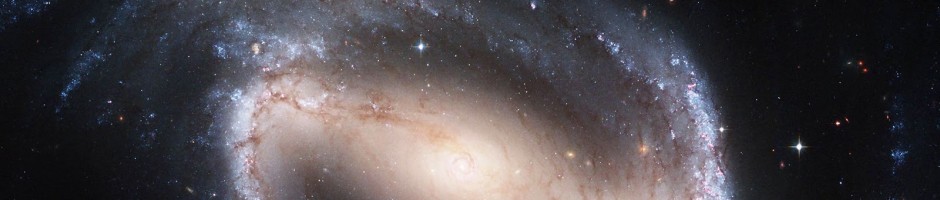
Partly that’s because we had a surprise guest appearance from the esteemed Ron Buta, who came in just after we had talked about some of the details covered in his Galaxy Morphology article (his Figure 3 is shown in the image). Ron worked with Gérard de Vaucouleurs — aka GdV — and told us some amusing stories about trying to take photometric* observations of dwarf galaxies, and about how GdV’s wife used to disagree with his morphologies, at one point looking over his shoulder and proclaiming, “no, there’s no ring”. I rather liked that story as it’s a reminder that anyone can spot patterns in galaxy images.
We’ll try to answer those questions on the previous blog post that we didn’t get to there — but in the meantime, here’s the video:
Left to right: Ron Buta & Bill Keel, Karen Masters, Kevin Schawinski, Brooke Simmons (me). Toward the end (not shown on the thumbnail), Kyle Willett arrived just in time to answer a question about the status of the latest Galaxy Zoo classification set.
We made ample use of the jargon gong on ourselves, but we may not have managed to define all the terms Ron used. We’ll try to do so in this post — if we’ve missed any please say so in the comments!
*photometry = precise quantitative measurements of the brightness of objects in the sky. You need very good observing conditions to take photometric measurements, which many (but not all) astronomical projects require.
Update: Now in podcast form:
Ask us your questions for the next Live Chat!
Next Galaxy Zoo Live Chat: Friday, the 8th of February, 2013, 3:00 p.m. GMT
Topic: TBA! (Translation: we’re just going to wing it.)
We’ve already had some good questions submitted for our live chat, ranging from detailed inquiries about galaxy evolution to the orbital mechanics of moons. If you have a question for us, post it below and we’ll try to answer it! (You can also tweet questions @galaxyzoo at any time.)
Update: see questions answered in the Live Chat video here!
Spiral Galaxies and the Future of Citizen Science: a Live Chat
Last week Karen Masters suggested that we start doing Galaxy Zoo live chats a little more often. I thought that sounded like a great idea, and we figured we’d just have an informal chat about whatever galaxy/Zooniverse topic we felt like discussing that day.
We were joined by Kyle Willett and Kevin Schawinski, and the four of us started talking about this paper, which presents an automated system for classifying and measuring spiral arms. It compares to Galaxy Zoo 2 data within the text, and we talked about what the fact that the computers did pretty well means for the future of Galaxy Zoo. We didn’t prepare anything in advance, and I didn’t even start reading the paper until about 20 minutes before we got going. So my favorite part of the chat is where I put forward a few definitions of pitch angle and get them all wrong. Science in action!
We also introduced the jargon gong, which we used on each other whenever one of us said something in insider-speak. I think this is a feature worth keeping, and we also plan to invite viewers to gong us themselves via Google+ or Twitter for the next chat.
When will the next chat be? We’re not sure yet, but hopefully soon — I promise I’ll even try to make a blog post before we start next time!
Update: We’ve now extracted the audio into an mp3 file and started a podcast:
Space Lasers and the Cosmic Martini: Removing Data Artifacts
As long as there are big data surveys, there will be data artifacts. Our corner of Astronomy is no exception: although the vast majority of images in SDSS and CANDELS are of high quality and therefore of high scientific value, poor quality images do still exist. The Galaxy Zoo team has worked hard to remove as many as possible from both samples so most “bad” images never even make it into the database, but this process is imperfect because computers have trouble identifying every kind of artifact (for some of the same reasons they have trouble identifying different galaxy types).
Of course, as we’ve seen time and again, Galaxy Zoo users have no problem whatsoever spotting the things the computers miss:

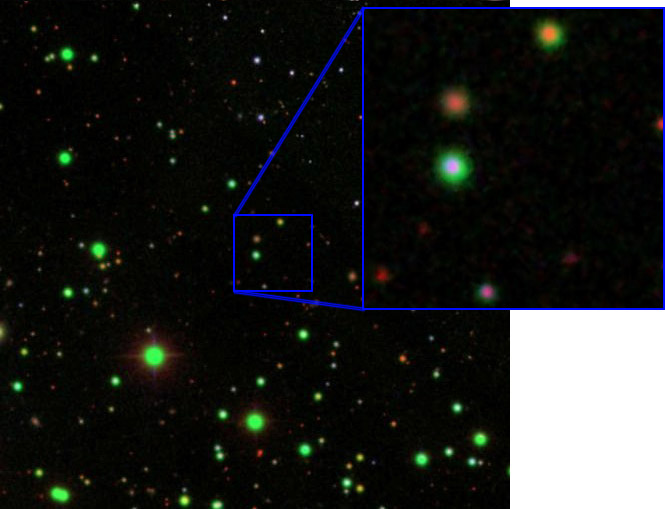
Not a Green Pea unless the universe is Tomato Soup.
The thread on Talk where this image was discussed pointed out that this was in the “Cosmic Scarf” of SDSS, where most of the fields have poor image quality:
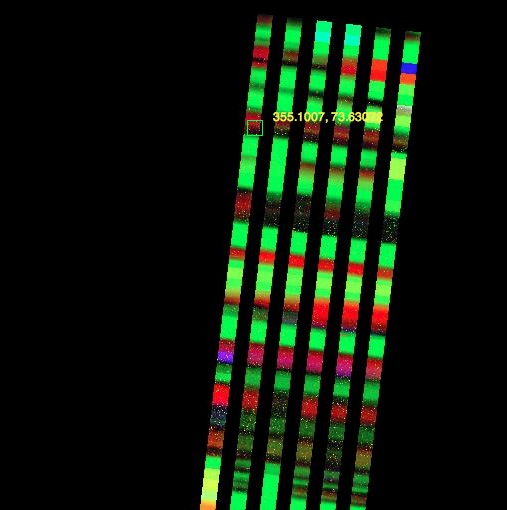
Now, most of the fields in the zoomed-out image above were removed from the database and will never be shown on the website, but even the parts that look okay in the zoomed-out image don’t look so great when you zoom in. SDSS combines a number of its quality flags to give each field a “score” from 0 (terrible) to 1 (excellent) to assess its quality, but it’s not always that reliable. For example, although fields with scores larger than 0.6 are generally considered good, this field has a score of 0.77 but is clearly not quite right:
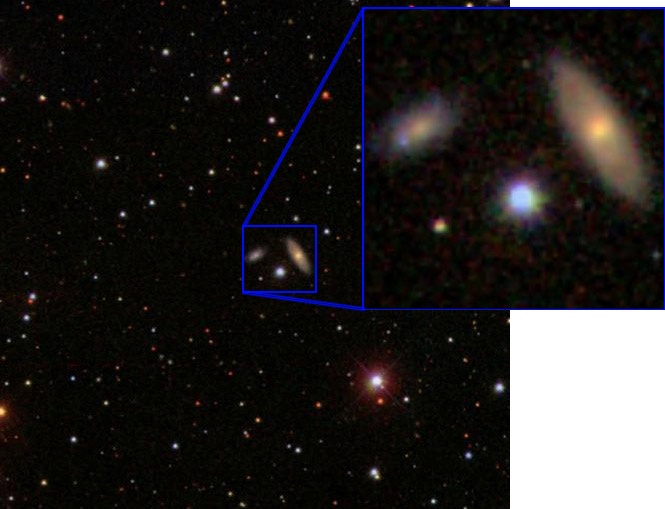
And this field has a much lower score of 0.37 but the images are classifiable:
So any choice we made at the beginning based just on the computer evaluations was going to leave some artifacts in, and we chose to err on the side of showing as many classifiable images as possible (increasing the number of artifacts kept in).
The good news is that Galaxy Zoo has always been adaptable, improving with input from all its participants. Now that this field has been flagged, the science team is working on a two-pronged approach: first, removing the entire “cosmic scarf” should immediately help prevent the majority of these big groups of artifacts from being loaded onto the server. Second, we’re working on finding a better method of removing those artifacts that remain, using your classifications and also your hashtags on Talk. (We’re also working on using this to help make the computers better at spotting artifacts in the future.)
So keep clicking, and remember, even your “artifact” clicks are useful.
AGN in Bulgeless Galaxies: Paper Accepted
Longtime readers of the Galaxy Zoo blog will be familiar with the peer review process from the many posts here describing it. The time elapsed between a paper’s submission and its acceptance (if it is accepted) can be long or short, and papers from the Zoo have sampled the whole spectrum.
The process with our paper on supermassive black holes growing in bulgeless galaxies took about 4 months: we submitted the paper in July, received comments and suggestions from the anonymous referee in August, then modified the paper based on the referee’s report and re-submitted it in October. This week, the paper was accepted by MNRAS.
The initial report from the referee was extremely thorough and constructive, and incorporating his/her comments helped to significantly improve the paper. The referee pointed out, for example, that although the paper emphasized the lack of significant mergers in the evolutionary histories of the sample, the bulgeless nature of the sample excludes not just mergers but any violent evolutionary process that can disrupt a disk to the point where it transfers a significant fraction of its stars from a disk into a bulge or pseudobulge. That was certainly a fair point, so we changed our discussion to include further consideration of the implications of those evolutionary processes being excluded.
And we made some other changes, too, including expanded discussion of why our results differ from some other studies and additional description of how we might be affected by dust in these galaxies (and why we think we aren’t). There were also some very interesting questions that we couldn’t really answer within the scope of this paper, but that we had asked ourselves too and that have already formed the basis for additional projects now underway. Overall, this was a classic example of what the peer review process was meant to be.
The accepted version of the paper will soon be available on the arXiv for anyone to download. In the spirit of openness, I had hoped to include the referee’s report and our response in the additional materials on the arXiv, but the referee did not give permission to do so. That’s fine — it’s anonymous and it’s perfectly acceptable if the referee prefers the exact contents of the report to be private as well. Hopefully he/she approves of my summary!
Note: as soon as it’s published, the paper will also be added to the Zooniverse Publications page, which coincidentally happens to have been released today as the first day of the Zooniverse Advent calendar. Have a look — Galaxy Zoo’s contributions are impressive and we’re joined by many, many others.
Finding Bulgeless Galaxies With Growing Black Holes

Galaxies are often a bit of a hot mess. Not only are the stars, gas and dust within a galaxy all coalescing and expanding, heating and cooling, absorbing and emitting, but this whole system is embedded within a halo of dark matter that interacts only via gravity, a force acting on scales big and small, from that huge halo to the relatively compact central supermassive black hole. As these various parts of a galaxy combine in some proportion to drive its evolution, galaxies also merge with others to form larger galaxies, which of course changes the evolution of the resultant system.
It’s all extremely beautiful, as you know, but it makes studying them complicated. For example, the question of how supermassive black holes and galaxies seem to co-evolve is fundamental to the field of galaxy evolution, but it’s very difficult to separate how much of this co-evolution is due to mergers and how much comes from non-merger processes.
Happily, Galaxy Zoo is in an excellent position to help answer this question. Galaxy Zoo classifications have already helped us understand the role of mergers in the evolution of galaxies (also see previous blog posts related to mergers). Recently, I’ve been working on a project that approaches this question from the other side: what part of the growth of galaxies and black holes happens in the absence of mergers?
Mergers leave behind clear signatures on a galaxy’s morphology. Even long after the tidal tails and stellar streams of an ongoing or recent merger have faded away, the effect of a merger can be seen in the strength of the galactic bulge, the collection of stars on disordered orbits very different from the ordered rotation of a disk. Simulations show that at least some of the stars from a disk are re-distributed into a bulge during a merger (how many stars depends on the kind of merger). Most of those simulations show that even mergers where a big galaxy gobbles up a galaxy only a tenth of its mass will form a bulge. In other words, significant mergers inevitably lead to the formation of a bulge.
Pure disk galaxies without bulges, therefore, have had a merger-free history. And if we want to also study the growth of black holes in these galaxies, we need to find bulgeless galaxies that host active galactic nuclei, supermassive black holes that are actively being fed with surrounding material.
Chris and I started this project several months ago, and many other members of the team joined in. The first time we looked in the Sloan data from Galaxy Zoo 2, we didn’t find any galaxies that were both classified as bulgeless and had clear spectral evidence of an AGN.
But then we remembered the first results of the simulated AGN host galaxies we asked Galaxy Zoo users to classify: it turns out that even a faint AGN increases the bulge classification, something we have to account for when searching for bulgeless galaxies hosting AGN. Using the results of these simulations, we went back and looked again — and this time we found 15 candidates:

Fifteen may not seem like many, but bulgeless galaxies are thought to be quite rare, and only a small percentage of galaxies has an actively growing black hole, so it’s pretty impressive to find even that many when we’re looking for a rare subset of a rare subset of galaxies.
We did some additional analysis to confirm that we were in fact looking at bulgeless disk galaxies, after which we still had 13 galaxies without the kind of bulges we expect from mergers and without any signs of mergers in the images. (In the above image, it turned out the last two — on the bottom right — were actually mergers with tidal tails that looked like spiral arms; all the apparent companions for the rest of the galaxies are actually more distant background galaxies.)
We also have data on the growing black hole: two of them have enough information that we can calculate the black hole mass, and for the others we can use their luminosity to estimate the lowest mass that the black hole could possibly have (any lower and it would be overfeeding).
It turns out that the black holes can grow pretty big: one of the two we know the masses for is about 10 million times the mass of the Sun, and the other is almost that big. The lower limits on the other black hole masses all suggest the black holes are similarly massive: given that we believe these are systems that have evolved in the absence of significant mergers, this tells us that black holes can grow pretty large without any of the black hole feeding that occurs when two galaxies collide.
The black holes also don’t seem to be related to the bulges (or lack thereof) in the same way as most galaxies with measured black hole masses, which may hint that the observed relationship between bulges and black holes is not a fundamental correlation, but rather something that only occurs when there’s enough of a bulge present that the bulge traces the gravity of the whole (or nearly the whole) system. In other words, maybe bulges don’t have a special relationship with black holes: maybe the relationship is between the black hole and the total content of the galaxy, which is often (but not always, and not with our sample) traced by the bulge.
We have submitted the paper presenting these findings, and had our first set of comments from the referee. The comments were positive overall, as well as being very helpful and detailed, so we’re working on incorporating those suggestions and I’ll keep you posted on the paper’s progress. But the project would not have been possible without Galaxy Zoo: your classifications are helping us learn about not just galaxies but the central supermassive black holes that live within them.
This post is part of Citizen Science September at the Zooniverse.
 Galaxy Zoo