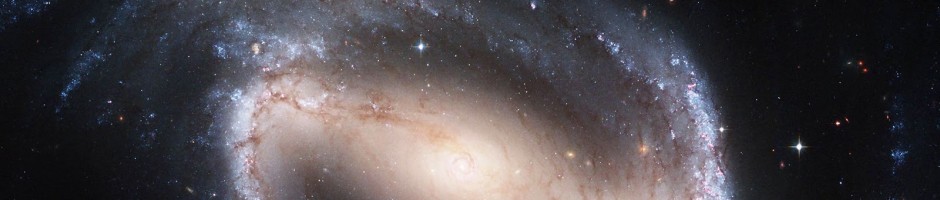
Oh, Sweet Spiral Of Mine

See the video of our latest hangout here (or, if you prefer, click to download the podcast version):
Spiral galaxies are seemingly endless sources of fascination, perhaps because they’re so complex and diverse. But why does spiral structure exist? Why do some spiral galaxies have clearly defined spiral arms and others have flocculent structure that barely seems to hold together? What’s the difference between a 2-arm spiral and a 3-arm spiral? How many kinds of spirals do we actually observe? And what is happening to the stars and gas in spiral galaxy disks?

Clockwise from top right: X-ray, UV, optical, near-IR, mid-IR, far-IR, radio
All of the above questions are related to a question we got right at the end of our last hangout: what is the significance of the number of spiral arms? Determining how many spiral arms a galaxy has is hard, and is often subjective — so why bother?
It’s a good question. Part of the reason spiral arm classification & count is a challenge is that it often depends on the wavelength at which you observe a galaxy. New stars tend to form along the spiral arms, whereas older stars have time to spread out into more uniform orbits. So ultraviolet observations of a galaxy, which tend to pick out the new and bright stars, often highlight the spiral arms much more strongly than longer-wavelength observations, which see more light from older stars.
It’s not quite that simple, though. As you get to longer and longer wavelengths, you start to pick up the heat radiated by clouds of gas and dust, which are often stellar nurseries — and often trace spiral arms. At a wavelength of 21 centimeters you can detect neutral Hydrogen, which provides raw material for the cooling and condensation of gas into cold, dense molecular clouds that form stars in their densest pockets. Each wavelength you observe at provides a glimpse at a different targeted feature of a spiral galaxy.
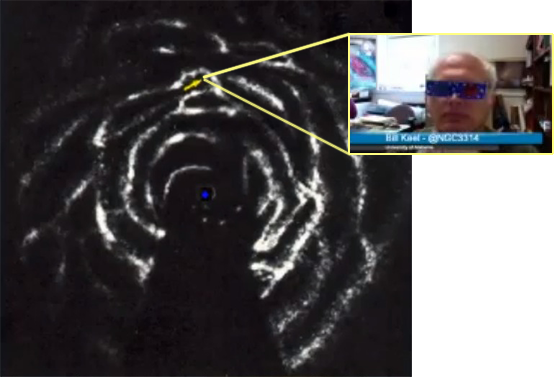
A map of neutral Hydrogen in the Milky Way — complete with yellow “you are here” arrow.
Including our own, of course: we live in a spiral galaxy (though how many arms it has, and whether it’s flocculent, is a matter of debate), and it provides the best means of studying star formation up close. When studying other galaxies, it’s easy to get caught up in the race to discover the biggest, the smallest, the farthest and the most extreme, and forget that our own Universal neighborhood is pretty amazing too.

Herschel sees much longer wavelengths than HST, so its resolution isn’t as high even though it has a bigger mirror. (Click to see a larger version.) Credit: ESA/NASA
For example, one of the most famous nebulae in the world was recently imaged by one of the most famous telescopes in the world — again — but this time in the near-infrared. The Horsehead Nebula is a well-known feature in the Orion star-forming complex, and the new Hubble images provide a great opportunity to learn even more about this region that has been studied for hundreds of years. How thick and cold is the gas and dust in the nebula? How long will it take for it to dissipate under the harsh radiation of the bright, young stars near it? What’s going on behind it?
The near-infrared view from HST is sort of the sweet spot in this spectacular space — the wavelengths aren’t so long that the resolution suffers, but they are long enough that you see through a bit more of the clouds than in the optical. So you see more of the structure of the cloud itself, and more of where it’s thin and thick. If you zoom in, you can even see distant galaxies peeking through! And not just on the edges: in some parts you can see galaxies through the middle of the nebula. Wow. This image alone contains spiral galaxy insights big and small, near and far, from the very distant universe and right in our own backyard.
Note: right at the end of the hangout, we again got another great question from a viewer that we didn’t have time to answer. So stay tuned for the next hangout when we just might have a thing or two to say about dark matter, dark energy and new projects!
Two Atoms Populate on a Dust Grain
I enjoy days where we get to use questions from the public to meander our way through the Universe. Our latest live hangout saw us discussing the latest update to the Galaxy Zoo site — made based on your clicks! — and doing a live, collective classification on a few example objects from our Hubble sample that we hope represent the kind of things you’ll be seeing more of from now on.
We debated, for example, whether this galaxy’s central “feature” was a bulge or a bar:

We also discussed whether these galaxies are merging or overlapping.
Whether this relatively featureless galaxy’s blue smudge indicates a voorwerp:

Depending on the redshift, a voorwerp in Hubble could be blue, green or red.
And how many spiral arms this galaxy has:

Also, these two galaxies may have roughly the same proportions between them as between the Milky Way and the Large Magellanic Cloud.
We also talked about the origin and importance of dust in galaxies, and just what a green pea would look like in the Hubble data. Green peas are galaxies with incredibly high rates of star formation. They’re rare in the local Universe, but how rare do we think they were billions of years ago, at the epoch we’re looking back to with Hubble?

Thing is, a “green pea” at redshift z=2 would be bright red.
And, for that matter, what were the stars like then? Astronomers very broadly group stars into three populations depending on their composition. The very earliest stars were made from the primordial elements forged during the Big Bang — almost entirely Hydrogen and Helium, nearly devoid of anything else (we call “anything else” a metal, including elements like Carbon and Oxygen). The next generation of stars had some metals, but the Universe has been around long enough that those stars (even the lower-mass ones that live for a long time) are past their prime and a new generation, one with compositions generally like our Sun, are now in their heyday.
Naturally, though, since the Sun is our First Star, we call its generation Population I. The slightly older stars, many of which are still around and living in our galaxy and others, are Population II; and the very massive rockstars of the early universe that have all died out are called Population III. So “Pop III” were the first stars — a slight reversal, but labels and names that seemed like a better idea at the time than with hindsight are nothing new in Astronomy. (Exhibit A: the magnitude system. Exhibit B: “planetary nebula“.)
Bonus: green peas, voorwerpjes, and planetary nebulae are just three of the phenomena that (at least in part) glow green to human eyes because of one particular frequency of light emitted by Oxygen at a certain temperature, an atomic transition seen only rarely on Earth but fairly often in the Universe.

This VLT image shows the planetary nebula IC 1295 in ghostly green. Image Credit: ESO
Also, did you know that dust grains are the singles bars of the atomic universe, allowing atoms to meet and combine into molecules and cooling the gas clouds they live in — which in turn helps new stars form? Heating and cooling, gravity and pressure, and the interplay between atoms, molecules, and radiation are all a part of what gives us this amazingly diverse Universe. We understand quite a lot of it given that we are such a tiny part of it, but what we know is dwarfed by what we don’t. And that’s just the way astronomers like it… we love a challenge and we’re glad to have as much help as possible sorting things out.
Here’s the hangout video:
Talk at International Astronomical Union – video and write up now available.
Way back in August I gave a evening (public) plenary talk about “The Zoo of Galaxies” at the 28th General Assembly of the International Astronomical Union. I wrote a couple of blog posts about it at the time (here and a bit more here). Just this week I got word that the video is now available, so here it is:
To go with this I have also posted the “proceedings” (a write-up based on my talks) which will be appearing in the 16th Volume of “Highlights of Astronomy”. This is available on the arxiv. It’s not supposed to be a transcript as such, but if you watch both the video and read this I think you’ll see they’re quite similar.
Blood Oranges are just like Hubble Galaxies

Astronomers always want better images. Sometimes it’s possible right away; other times doing better requires new technology and/or waiting for the next generation of telescopes. We have both kinds of “fuzzy blobs” in Galaxy Zoo, and during this hangout we showed several examples. For a couple of hangouts now we’ve been meaning to address some of the most frequently asked questions about the faintest, most distant galaxies we ask volunteers to classify:
- what are they?
- why are the images so fuzzy?
- can we get better images of them now or in the future?
Given the data we have, the short answer to the first question is that we don’t yet know for sure — and, perhaps most importantly, we don’t need to know all the details. We can learn quite a lot from classifying even faint, fuzzy objects. Some of the faint galaxies on Galaxy Zoo are among the most distant galaxies ever imaged by the Hubble Space Telescope, and we don’t necessarily expect them to look like galaxies we see more nearby, so classifications from our volunteers are helping us to understand them even when we don’t have all the information we might want.
And what would it take to give us the information we want? What’s the future of astronomy after Hubble? How can we get better data than we have right now? Do we need to go into space to do it? (And what else are we working on right now, anyway?) Answers given in the video:
This is a great time to be working on Galaxy Zoo: there’s plenty to classify and analyze, and — of course — plenty to discuss. So stay tuned for next time!
Note: for those who prefer audio only, here’s a link to the podcast version.
New paper on Red and Blue Spirals and Ellipticals
Just a quick note to point out a new paper based on Galaxy Zoo classifications appeared on the arxiv this morning (and just accepted to MNRAS): The Differing Star Formation Histories of Red and Blue Spirals and Ellipticals, by Rita Tojeiro et al.
In this work we took samples of galaxies split by their morphological classifications (from you all, and actually going back to the original Galaxy Zoo project) as well as by their optical colour. With the help of an Ogden Trust undergraduate summer student (Joshua Richards) we then compiled the average star formation histories of these samples, based on fits of star formation models to the Sloan Digital Sky Survey spectra of the galaxies (previously published and called VESPA, or “VErsatile SPectral Analysis” by Rita).
Our main result was that red spirals differ in their star formation histories from blue spirals only in the last billion years or less. We also find that blue ellipticals have very similar star formation histories to blue spirals. We show some results about the dust and metal (astronomers metal) content of the galaxies as well. I think it’s a nice project and I’m very happy to see it finally finished and published.
Thanks again for the classifications.
Jargon Alert: Your IMF Just Messed With My SPS!
I remember going to a lecture as an undergraduate wherein my professor compared what astronomers do to a hypothetical alien crew on a fast-moving ship that can only take one photo of the Earth as it passes by. We can assume they have a special camera that can see through buildings, but otherwise they just get one photo of, say, a major city, and from that they have to try and learn as much as they can about the human race. How hard would it be to discover that our species has two genders? Or that both of them are required to propagate the species, but only one gives birth? Would it be possible to figure out the whole human life cycle? To discover what disease is? To distinguish between genetics and culture (nature and nurture)? Just having one picture is limiting, but with careful study you can learn more than you think.

One of the most fundamental plots in astronomy.
The professor was drawing an analogy with the Hertzsprung-Russell diagram in particular, which we’ve talked about before on our hangouts: to make it, you record the color and the luminosity of all the stars you can and plot them up against each other, one point per star. The stars group together in interesting ways in particular areas of the diagram, and it turns out that from this diagram alone you can recover an enormous amount about the life cycles of a population of stars (for example, in a star cluster, a neighborhood of our own galaxy, or a nearby galaxy). You can learn even more if you couple the diagram with spectra of stars from different parts of it. Studying stellar populations has helped us understand the fundamentals of what kinds of stars exist, how they are born and die, and how many stars of any given mass are likely to develop in a galaxy in relation to stars of different masses. That last thing is called the Initial Mass Function (IMF for short). Essentially it says that, when stars form in groups, more low-mass stars form than high-mass stars. Put that together with what we know about how much brighter high-mass stars shine and how much faster they die than low-mass stars, and you can start to understand how whole populations of stars in galaxies form and evolve.
And we can apply our studies of nearby galaxies and groups of stars to galaxies we observe much farther away. It’s a good thing, too, since most galaxies are far enough away that our current telescopes can’t resolve individual stars. We just get the sum of the light from all the stars. That combined light is sometimes made up of multiple populations of stars that formed in groups at different times and now all live together in a particular galaxy. Taking that single picture combining the light from billions (often hundreds of billions) of stars and using it to learn about the stars’ masses, ages and histories is an important process, and there are several ways to do it: one way combines models of stellar populations made by forming and evolving many stars in a computer simulation. This is sometimes called Stellar Population Synthesis, or SPS.
On today’s live Hangout, we once again let your questions guide us as we talked about IMFs and what they have to do with SPS and measuring the stellar masses of galaxies. The work that laid the foundations for today’s study of galaxy stellar populations was done in large part by women (Bill mentioned Beatrice Tinsley, for example), which is fitting since today is International Women’s Day. We talked about that too, and about diversity in general in astronomy. Just as you can learn a lot from even one snapshot of a galaxy, you can do a lot with just a bit of mindfulness about being an ally for diversity (Kyle noted on Twitter that World Day for Cultural Diversity is May 21), be it equality for women or for any other minority groups in science, or indeed any field.
Here’s the audio-only version of the Hangout: click to listen to mp3 version.
And the video:
We’ll post about our next hangout soon; in the meantime, keep those questions coming!
Green Valley: The Town Too Good To Die

I swear we are consistently trying to keep our live hangouts to about 15 minutes. We have so far failed at keeping to time, but hopefully also succeeded in the sense that we only run over because there’s so much to discuss.
We had a number of good questions from Twitter, Facebook and the blog about various types of galaxies — from red spirals to green peas and blue ellipticals — and I rather arbitrarily decided this was an indication that our hangout should have a color theme. That is, what exactly does “color” mean in the context of astronomy? What is going on physically when a galaxy is one color versus another, or has multiple colors? Is color information always telling us the same thing? We tried to address all those questions, as well as show some examples of different galaxies in the above queried categories. As a bonus, we learned how galaxy colors are related to the town my grandparents retired to. (This post’s title is a quote from the Green Valley Chamber of Commerce’s official website.) That was as much a surprise to me as it was to the viewers!
We also talked about what’s currently going on in Galaxy Zoo behind the scenes. Earlier today, Kyle sent around a really nice draft of the Galaxy Zoo 2 data paper for the team to read and comment on (you’ll have to watch the video to get a sneak peek at some of the figures).
And it’s that time again: Hubble Space Telescope proposals are due in about a week. We talked about the proposal process from concept to submission to review, discussing both specifics of certain telescopes and the general practices that (we hope) help lead to a successful proposal. Here’s a hint: it may not be what you think!
We covered all this and some other questions, too. No wonder we ran a little over…
And here’s the podcast version:

Is it a triple merger? A double overlap? A hybrid?

A blue(ish) and red spiral.

A red and blue elliptical.

A tiny green pea galaxy, and zoomed-in at right.
Next Galaxy Zoo Hangout: 22 Feb, 15:30 GMT
Next Galaxy Zoo Hangout: Friday, the 22nd of February, 2013, 3:30 p.m. GMT
We got a lot of good questions for the last live chat — keep ’em coming! Post your questions below and/or feel free to tweet them @galaxyzoo.
Shortly before the hangout starts, we’ll embed the video in this post so you can watch from here. And during the chat, if we use a science term you aren’t familiar with, please use the Jargon Gong by tweeting us with a GONG (example: “@galaxyzoo GONG spiral density wave”); we’ll be happy to stop and explain!
Update: The summary of the hangout, and the video, are now here.
Spiral Galaxies and the Future of Citizen Science: a Live Chat
Last week Karen Masters suggested that we start doing Galaxy Zoo live chats a little more often. I thought that sounded like a great idea, and we figured we’d just have an informal chat about whatever galaxy/Zooniverse topic we felt like discussing that day.
We were joined by Kyle Willett and Kevin Schawinski, and the four of us started talking about this paper, which presents an automated system for classifying and measuring spiral arms. It compares to Galaxy Zoo 2 data within the text, and we talked about what the fact that the computers did pretty well means for the future of Galaxy Zoo. We didn’t prepare anything in advance, and I didn’t even start reading the paper until about 20 minutes before we got going. So my favorite part of the chat is where I put forward a few definitions of pitch angle and get them all wrong. Science in action!
We also introduced the jargon gong, which we used on each other whenever one of us said something in insider-speak. I think this is a feature worth keeping, and we also plan to invite viewers to gong us themselves via Google+ or Twitter for the next chat.
When will the next chat be? We’re not sure yet, but hopefully soon — I promise I’ll even try to make a blog post before we start next time!
Update: We’ve now extracted the audio into an mp3 file and started a podcast:
How to get people to read your poster
3000 astronomers will bring down the wireless in any building, so I have been a bit behind in posting from the American Astronomical Society meeting in Long Beach CA…

Bill with the poster.
Yesterday, Bill Keel presented a poster with the latest Hubble observations of the Voorwerpjes in the Giant Room Full of Posters, where astronomers, pretty much ALL of who work on absolutely cool stuff, present their results. So, anything you can do to get peoples’ attention helps! I decided to bring along some chocolates from Switzerland. If any unwary astronomer walked past and took one, they then had to at least look at the poster… ; )

Most of the chocolate is already gone!
 Galaxy Zoo