Galaxy Zoo motivation study paper accepted!
Our paper on the motivations of Galaxy Zoo users has been accepted for publication in the journal Astronomy Education Review! Now that the paper has been accepted, I have posted it on the arXiv system. Head on over and read it if you’re interested in hearing more about the interviews we did with some of you to learn what makes Galaxy Zoo appeal to you. I wrote a summary of the paper for this blog a while back, but now you can read the paper itself.
The paper should appear in the Galaxy Zoo Library in the forum soon, and Pamela, Georgia, or I would be glad to answer any questions you have about the paper there. The next step in this research is to analyze the data from the survey that many of you took, and we’re working on that step now. Updates on that will come soon. Thanks to my lovely co-authors, and of course to all of you, without whom this none of this research would be possible!
Voorwerping, Part 1
I’m working on the Suzaku data that we’ve obtained on IC2497, the galaxy next to Hanny’s Voorwerp. X-rays, especially the really energetic ones that Suzaku is able to detect are probably the best way to probe whether the black hole in a galaxy is actively feeding or not. Shanil Virani and I are currently working on the data reduction and analysis, which is quite challenging. Early indications are that the data will show us some really exciting things, but the problem is that they make us really scratch our heads. It may yet take us quite a while to see if we understand what’s going on and we may have to pick the brains of a theorist or two. So, stay tuned….
The Galaxy Zoo Library
Dear Zooites,
I’d like to throw open the doors and welcome you to a relatively new area of the forum: the Galaxy Zoo Library.
We’ve been constructing this for a while. The original idea was EigenState’s. He did a great deal of splendid work planing and putting up the first gleaming shelves. Sadly, he’s left now; so Waveney, Hanny and I have put up some more library areas; Geoff has offered to help me run the Library for the time being; and I’d like to invite you all to come in and use them.
The Library has several purposes. First of all, it’s a place to store the Galaxy Zoo papers. EigenState gave each paper two threads of its own: one, a locked one with bare information; second, a discussion thread for each one. You can find links to each of these in his Master Index.
Waveney has put up a concise storyline about the process of each paper, including the abstracts, and all the Galaxy Zoo Blog links about each one. Not all of our papers have actually been accepted yet. Those which are accepted appear as a link to their arXiv page. This way, you can follow the lives of each paper: their writing, their results, their acceptance – and those papers that build upon each other; for science is often a series of many steps.
Do you find scientific papers rather hard to understand? I do. I read lots of them for university and after four years still couldn’t make head or tail of them. I nicknamed their language “journalese”. Scientific papers are written for a special audience; and some people – not necessarily just scientists – can extract masses of information out of them. I’d like to invite any Zooite to write summaries of what each paper means, or to “translate” various parts of papers – whatever parts you like! – into easier language. That’s not to denigrate this wonderful blog; I’ll be linking to relevant entries whenever possible, too. What I’d really like us to do together, and I know it sounds ambitious, is to see if we can, together, when we’re ready, get more fluent in journalese. Dozens of us have in redshift and spectra. Let’s see what happens!

From SDSS: a flying notebook in space!
EigenState also created a Reading List of useful books to read: some hefty, formal, and academic, others not. He invited people to contribute their useful reads, and there is also a Reading List discussion. The subjects of these books include galaxies, cosmology, physics, gravity, quantum theory, practical astronomy, popular science, humour, and more.
Hanny wrote a list of Galaxy Zoo items in the media, which she blogged about a few days ago. You can find this both in Latest News and in the Library.
And what about sharing books ourselves? Chatting about them, recommending them to each other – and reviewing our favourites (or even least favourites!). I’d like to invite any of you to write a review of any books you liked, disliked, found useful, or would generally like to show us. You can send it to me or to Geoff. The reviews will be kept in this locked thread – but as you’ll see in that link, we now also have plenty of comfy threads to be more informal in and drink our coffee.
I’m hoping that this Library will cater for all tastes: those who like quiet, carpeted, stained-glass-windowed libraries with hushed footsteps and deliciously difficult volumes; and those who like bean bags, paper aeroplanes and a nice pile of books and fun websites to pelt each other with and enjoy. On that subject, I can’t imagine anything sadder than an empty, unused paper aeroplane thread; so do please post your favourite scientific sillinesses in there. I have a special fondness for Eric Idle’s Galaxy Song.
Stripe 82 and colour images from Sloan
As Chris blogged yesterday, Galaxy Zoo now contains colour images from the Sloan Digital Sky Survey’s Stripe 82.
The new Stripe 82 images you see are made of an addition of approximately 50 ordinary SDSS images, which means we can see things about 2 magnitudes fainter (about 7 times less light). It’s only over a relatively small patch of the sky – 270 square degrees compared to the full survey which is nearer 8000 square degrees – but the extra depth should be useful to us in many ways even though it’s only over a smaller area.
Many users will already have noticed that the standard images supplied through the Navigator interface are in black and white – they’re just in the r band (SDSS has 5 bands named u, g, r, i and z of which g, r and i are normally mapped to blue, green and red respectively). Naturally, we wanted to supply the Zoo with colour images like those in the ordinary Sloan survey.
This proved to be somewhat tricky as access to the data needed to compile the colour images comes in fairly large chunks called ‘fields’ – each field is 2048 by 1489 pixels, large enough to more than fill a typical computer monitor. So we had to download several of these images for each galaxy (one for each of the red, green and blue parts), combine them together, and extract just the bit around the galaxy we wanted to show you, scaled to the size of a normal Galaxy Zoo image. This took a fair bit of programming and many days worth of computer time for the downloads of the data and processing.

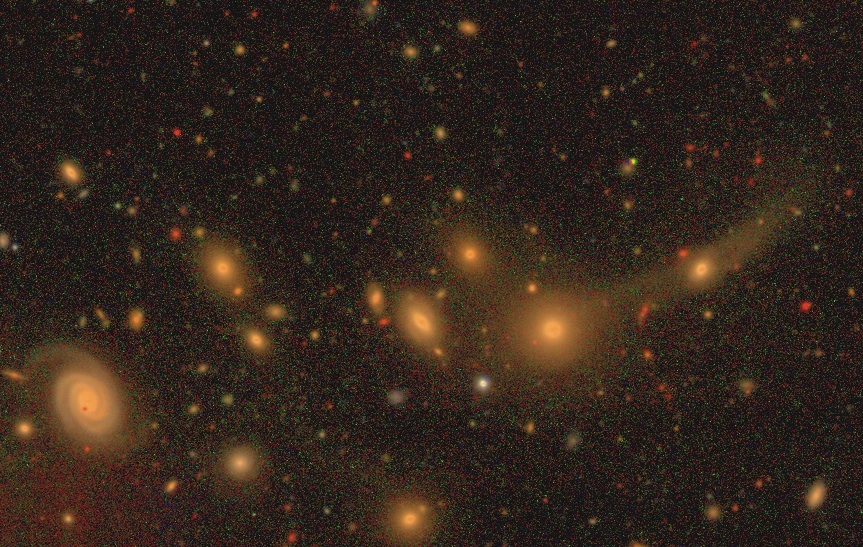
Two images from the same area, the upper from a standard SDSS image, and the lower from the coadded stack of about 50 images
Another complication was that astronomical images usually come in a format that’s not immediately suitable for viewing. They can have a tremendous dynamic range, from the tiny amount of light that comes from the dark bits of sky to the dramatic overloading the camera gets when it images a bright star. The task of reducing this down to fit in the brightness scale of 256 levels of each of red, green and blue that a computer monitor will display is not easy.
Fortunately, this problem had already been solved. For those interested in the gory details, there is a paper here by Lupton et al., which describes the system used in these images and the ordinary SDSS images you’ve been seeing before. It’s a bit mathematical, but what it does is three important things:
- For faint objects, the brightness of the pixel is roughly in proportion to the amount of light received. This shows up faint details nicely but…
- For bright objects, we’d hit the cap of 256 levels on the monitor too quickly, so it starts to scale things logarithmically instead. This means that doubling the light wouldn’t double the value of the pixel but just add a certain amount on. If 10 units of light were collected we might have a pixel value of 1, 100 units would be 2, and 1000 units would be 3, and in this way we can fit the brightest objects nicely into the range our monitors provide us with. This is the same way that astronomical magnitudes work as well.
- Lastly, we want to get the colour of objects right. If we had a really bright object we might find that even though it was very red, it still gave off so much green and blue light that the pixel ended up with high values of red, green and blue, and end up looking white as a result. The code we use compensates for that and makes sure everything has its actual colour represented properly.
In order to use this, we need to decide on how steep the slope of our conversion from light to pixel values is, and also at what point we tilt over from our function for faint light to our different function for strong light sources. This takes a bit of fiddling, and to be honest it’s as much an art as a science, and we have to use different values to the ordinary SDSS images as we have a different amount of light overall in them. This is why our background sky ends up looking more speckled than usual (there’s more background noise and having it more visible is the price we pay for having faint features of galaxies visible too) and the galaxies themselves look like they’re stretched differently.
One of the developers of this technique, Robert Lupton, has a webpage which shows part of the Hubble Deep Field coloured the conventional way and using this technique, and you can see how the colours of the galaxies are better preserved this way.
I hope that gives a bit more insight into these images, how they were made and why they look a little different from the usual. We look forward to finding out how the classifications go!
Stripe 82 : Digging Deeper
Anyone who has been classifying galaxies today may well have noticed a big change in the Zoo; the addition of some new images that don’t look quite like the previous set. These new galaxies come from a very special part of the sky known to the Sloan team as “Stripe 82”.

Over the first seven years of the Sloan survey, the telescope returned again and again to this part of the sky, comparing images from each visit in an attempt to discover supernovae (exploding stars) and detect objects which change in brightness. A nice side effect, though, is that we can add the different images together. This produces the same result as having left the telescope pointing at the same place for longer; images which show fainter objects and (hopefully) more detail in familiar ones.
This was too good an opportunity for us to pass up, and so we’ve added the Stripe 82 images to the Zoo. They look a bit different – more background noise, slightly different colours – but these are the deepest, most detailed images we’ve ever presented to Galaxy Zoo users. There are more than 40,000 new images – so get clicking!
Galaxy Zoo in the News!
Last year Kevin wrote about all the publicity we gained so far, from media covering the story of Hanny’s Voorwerp. In the meantime, that list kept growing. But also, with the launch of Zoo 2 and the discovery of the Peas, we got more and more attention.
Recently Kevin asked me to make a list of links to all those pages writing about Galaxy Zoo and to announce here where you can find it, which is on the Galaxy Zoo Forum. If you find an article I haven’t on my list yet, please feel free to send me a personal message so I can include it. And if you’re not a member yet, you can also send me an e-mail using: vampke83(at)hotmail.com.
Let’s keep spreading the word.
WHT joins the supernova hunt!
Greetings from the William Herschel Telescope at the Observatario del Roque de los Muchachos on La Palma, in the Canary Islands. Sarah and I have now arrived here, and tomorrow night, the 12th, we’ll join in the fun by observing some of the supernova candidates that you’ve identified in the PTF data. The weather here is currently perfect – beautiful dark clear skies, and incidentally a fantastic place to view the Perseid meteor shower.
Fingers crossed that this great weather remains for our two observing nights, and we can confirm those supernovae that you’ve been diligently hunting out. We’ll try to post regular updates tomorrow as to what we find out – though please bear with us if we appear slow to update; observing can sometimes be a very busy job!
Mark
Supernova Zoo updates
I’ve just added in the latest batch of images taken by the Palomar Transient Factory last night. The PTF surveys large areas the sky every night looking for new supernovae. The images from these observations are then run through an automated pipeline which flags potential new candidates which we show to you.
One of the most exciting aspects of Supernova Zoo is that we are showing Zooites images taken from the PTF telescope just hours earlier and if you mark it as something interesting then we very quickly show it to more people so we can get a definitive answer quickly. Finding new supernovae as early as possible is one of the main aims of Supernova Zoo, if and when we find something interesting Mark and Sarah are waiting to follow it up at the WHT.
Cheers
Arfon
Let's Go Supernova Hunting
We have a special challenge for you this week – Galaxy Zoo is going Supernova Hunting.
A supernova is an exploding star, capable of outshining an entire galaxy. We have a robotic telescope in Palomar, California sending us candidate objects from the galaxies it scans, and a team of Oxford astronomers are on their way to the Canary Islands to follow up the most likely.
The choice of galaxies to follow-up on is in your hands – we’ll be posting new data each day, and keeping a running list of those candidates that most Zooites think are likely supernovae. Get clicking…and you might well be the first to discover an exploding star.
Chris
(P.S. This is a prototype of a much larger project so all feedback and comments – good and bad – are of course welcome either here or on the forum.
Zoo 2 now available in Polish
As Lech eloquently explains in his post, Galaxy Zoo 2 is now available in Polish. Other languages should follow soon (and don’t worry – this blog will be mostly in English!)

