RGZ Team Spotlight: Enno Middelberg
Meet Enno Middelberg, Radio Galaxy Zoo science team member from Ruhr-University Bochum, Germany:
 I grew up in northern Germany and developed in interest in astronomy only when I finished school. I went to Bonn to study Physics and Astronomy and, after my PhD, moved to Sydney to work as a postdoc. Here’s where I got involved with radio surveys of large portions of the sky, and also where I got involved in radio interferometric observations of large fields with continent-sized baselines (Very Long Baseline Interferometry). After moving back to Bochum, Germany, I got involved with the Radio Galaxy Zoo project, mainly because I just loved the idea and because I was able to quickly contribute to the project by making the images. Also, for a paper a few years back I had classified more than one thousand radio/IR sources the way RGZ users do it now – and I had to do it three times! So I know what it’s like, and I have seen my fair share of radio/IR images in my life. In general I like to fiddle with computers, software, and technology, so every project which requires crunching through, or trying to filter things out of piles of data is interesting.
RGZ Team Spotlight: Anna Kapinska
Meet Anna Kapinska, Radio Galaxy Zoo science team member from the University of Western Australia:
 I was born and grew up in Poland, where I also did my undergrad studies in astronomy. Since then astronomy was the force behind my life paths directing me via the Netherlads and the UK to Western Australia where I currently work as a Research Associate. I was introduced to radio astronomy during my masters studies when I learned all the fundamentals, and the tricky bits too, about radio interferometry. After that I moved towards more theoretical understanding of how radio galaxies grow and how they influence our evolving Universe. For that we still need large samples of radio galaxies of various sizes, shapes and luminosities – and here is where the Radio Galaxy Zoo and all your citizen science work is so invaluable!
Currently, I am also strongly involved in producing sky surveys with two fanstastic new radio telescopes, Lofar and MWA – hopefully we will be able to include these radio sky images in Radio Galaxy Zoo at some point too!
IFRS: The first supermassive black holes?
Today’s Radio Galaxy Zoo post is by Ray Norris, our Project Advisor. Ray researches how galaxies formed and evolved after the Big Bang, using radio, infrared, and optical telescopes.
In Radio Galaxy Zoo, some bright radio sources don’t have any infrared sources at all associated with them, and they have been given the hashtag #ifrs, for Infrared-Faint Radio Sources. So what are these IFRS?
In 2006, we discovered about 1000 radio sources in the Australia Telescope Large Area Survey (ATLAS). Conventional wisdom told us that all of these would be visible in the infrared observations taken by the Spitzer Space Telescope, as part of the SWIRE project. So we were astonished to find that about 50 of our sources were not listed in the SWIRE catalog. Could they be bugs in our data? After eliminating iffy sources, we were left with 11 sources that are bright in the radio but invisible in the infrared images. We dubbed these objects Infrared-Faint Radio Source (IFRS). With hindsight, we should have thought of a better name for them. But at the time we didn’t know that they would turn out to be important!

A very deep infrared image (from this paper), made by stacking images from the Spitzer Space Telescope at the positions of IFRS (shown by the cross-hairs). This image, about 300 times deeper than the WISE images currently being used in Radio Galaxy Zoo, shows that not only is there no infrared counterpart at WISE levels, but even if you go enormously deeper, there’s still almost nothing there in the infrared.
We suggested in 2006 that these might be high-redshift active galaxies – galaxies whose emission is dominated by a super-massive black hole at their centre (the galaxies you are looking at in Radio Galaxy Zoo). This was surprising, because we were finding so many of them that it meant there must be far more supermassive black holes in the early Universe than found by deep optical surveys, such as SDSS (whose images we use in Galaxy Zoo). It’s also far more than can be accounted for by conventional hierarchical models of super-massive black hole formation. Naturally, our colleagues were sceptical, and most of us harboured our private doubts too. But over the next few years we tested this idea and its alternatives. Gradually our confidence grew that these were indeed high-redshift active galaxies.
In 2011 we showed that they were similar to high-redshift radio galaxies (HzRG) but even more extreme. Crucially, we suggested that they follow the same correlations between the radio and infrared emission as the HzRG. If this suggestion turned out to be correct, then that would push them to be amongst the first supermassive black holes in the Universe.
Fortunately, it was possible to test this hypothesis by measuring the redshifts of less extreme objects, to see if they followed these same correlations. Two new papers confirm that they do indeed follow this correlation. In one, Andreas Herzog and his colleagues use the European Very Large Telescope to measure the redshifts of three of these less extreme objects, and find they lie on the correlation, at redshifts between 2 and 3, just as predicted. In the other paper Jordan Collier and his colleagues take exactly the same data now being shown in Radio Galaxy Zoo, and search for objects which are relatively much brighter in the FIRST (radio) data than in the WISE (infrared) data. 1,317 of these are found, of which 19 have measured redshifts. Again, all but one of these lie in the redshift range 2 to 3. This is strong support for the hypothesis!
Armed with this, we are increasingly confident that the most extreme IFRSs that will turn up in the fainter ATLAS and COSMOS field, to be released in Radio Galaxy Zoo in a few weeks, will include many supermassive black holes formed in the first half-billion years after the Big Bang. According to conventional hierarchical black hole formation models, these shouldn’t exist. So the race will be on to identify them and measure their redshifts using instruments like ALMA.
Not everything in Radio Galaxy Zoo classified as being an IFRS will turn out to be a high-redshift black hole, as the data currently being displayed (FIRST and WISE) are not deep enough to pick out the really high-redshift objects. But when the new ATLAS data are loaded into RGZ in a few weeks, almost every object that appears in the radio but not in the infrared will be one of these enigmatic objects. We can’t wait to see how many you find!
RGZ Team Spotlight: Ivy Wong
Meet our fearless (co-)leader, Radio Galaxy Zoo Project Scientist Ivy Wong:
Ivy is an Australian astronomer (currently based at CSIRO) who is interested in the how/why galaxies start and stop forming stars. She is currently obsessed with galaxies that have suddenly stopped forming stars (aka ‘post-starburst’ galaxies), blue spheroidal galaxies and galaxy interactions in general. Having worked with the original Galaxy Zoo project, she became super excited with the prospect of helping to launch Radio Galaxy Zoo. She is very keen to find out how the massive radio jets emitting from central supermassive black holes affect its host galaxy as well as neighbouring galaxies.
When not working for astronomy, she is slave to two feline overlords, Princess Pippa and Master Finian. These two can pass for the internet celebrities: Grumpy Cat and Chemistry Cat (although Finian does not approve of glasses and bowties).

In the week preceding the launch of Radio Galaxy Zoo, Ivy was the Duty Astronomer at the Australia Telescope Compact Array (ATCA, CSIRO)—where some of the radio images for Radio Galaxy Zoo originated. Inset: Ivy with her other overlords.
How do black holes form jets?

This post was written by Radio Galaxy Zoo team member Stas Shabala, an astronomer at the University of Tasmania.
The supermassive black holes at the hearts of galaxies are supposed to be simple. For someone looking at a black hole from afar, physicists tell us all black holes can be described by just three parameters: their mass, electric charge, and spin. For really big black holes, such as the ones astronomers deal with, things are even simpler: there is no charge (that’s because they are so big that there would always be enough neighbouring positive and negative charges to more or less cancel out). So if you know how heavy a black hole is, and how fast it spins, in theory at least you have enough information to predict a black hole’s behaviour.
Of course the black holes in Radio Galaxy Zoo often have at least one other, quite spectacular, feature – bright jets of radio plasma shooting through their host galaxy and into intergalactic space. Where do these jets come from?, I hear you ask. This is a very good question, and one to which astronomers are yet to find a wholly convincing answer. We have some pretty good hunches though.
The fact that black holes can spin might be quite important. Matter accreted by a black hole will rotate faster and faster as it falls in. Stuff closer to the equator will also rotate faster than stuff at the poles, and that causes the accreting material to flatten out into a pancake, which astronomers call the accretion disk.
The accreting matter near the black hole event horizon (a fancy term for the point of no return – any closer to the black hole, and not even light is fast enough to escape the gravitational pull) is subject to friction, which heats it up so much that individual atoms dissociate into plasma. These plasma (i.e. positively and negatively charged) particles are moving, so they are in fact driving an electrical current. When this current interacts with the rotating magnetic field of the black hole and the accretion disk, the charged particles are flung out at close to the speed of light along the axis of black hole rotation. We can see these fast-moving particles as jets in the radio part of the electromagnetic spectrum. A useful analogy is a car alternator, where electrical currents and magnetic fields are also combined to generate energy.

This artist’s conception is on a *really* different scale than the image at the top of this post. Compared to those (real) jets, this is zoomed in 100,000 times or so. Jets are big.
There are many things we don’t know. For example, we don’t know for sure where most of the jet energy comes from. It could be from the accreted matter, or the spin of the black hole, or a combination of both. We are also not sure exactly what sort of charged particles these jets are made up of. Understanding black hole jets is one of the great unsolved mysteries in astronomy. By studying a huge number of these jets at different points in their lifetimes, Radio Galaxy Zoo — with your help — will help us solve this puzzle.
RGZ Team Spotlight: Stas Shabala
To introduce you to the Radio Galaxy Zoo team, we’re doing a series of blog posts written by each team member — in no particular order. Meet Stas Shabala, our team Project Manager from the University of Tasmania, Australia:
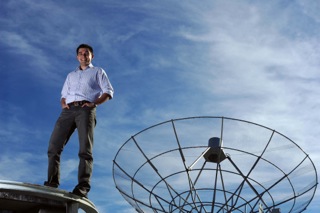
I grew up in Tasmania, a gorgeous part of the world which also happens to be the place Grote Reber, the world’s first radio astronomer, called home for 50 years. After finishing university, I made a pilgrimage that these days is more or less standard for young Australians – I moved to the UK. I ended up staying for six years, and it was during my time in Oxford that I became involved with Galaxy Zoo. Normal galaxies are interesting but – given our history- a Tasmanian’s true heart will always be with radio astronomy. That’s why I have such a soft spot for Radio Galaxy Zoo.
Recently, I’ve been trying to figure out why radio galaxies come in so many different shapes, sizes and luminosities. Data from Radio Galaxy Zoo will go a long way to answering these questions. I’ve also had lots of fun using active black holes as beacons to accurately measure positions on Earth. It’s just like navigation by stars, but much more precise because stars move around in the sky a fair bit, whereas black holes don’t. The neat thing is, these measurements make it possible to study all sorts of geophysical processes here on Earth. It’s such a cool concept- using black holes to measure the movement of tectonic plates!
More Information on Tailed Radio Galaxies (Part 2)
This is the second half of a detailed description of tailed radio galaxies from RGZ science team member Heinz Andernach. If you haven’t yet read the first part, it’s here: please feel free to leave any questions in the comments section.

NGC 7385 (PKS 2247+11) in radio.
Apart from distance or angular resolution, another reason for causing a NAT may be projection of the inner jets along the line of sight, as seems to be the case for NGC 7385 (PKS 2247+11). In the low-resolution image above, the inner jets are not resolved, but the corresponding far outer tails start to separate widely about half-way down their length. At much higher resolution:

the two opposite jets can be clearly seen to emanate from the very core, the central point-like source in this contour plot. However, the jet heading north-east (upper left) has been bent and diluted by almost 180° such that it runs behind the other jet for about 200 kpc (about 650,000 light-years) before the two jets separate and can be distinguished again in the lower-resolution image. The combination of these images is also a good example showing that different interferometers (large and small) are needed to show all features of a complex radio source.
However, not all apparently tailed radio sources would show their double jets near the core at high resolution. One curious example is IC 310, among the first “head-tails” to be discovered, has stubbornly resisted to show double jets, and is now accepted as a genuinely one-sided jet of the type that BL Lac objects, implying that its jet points fairly close to our line of sight.
An atlas of the radio morphologies in general of the strongest sources in the sky can be found here. Several NATs and WATs can be distinguished on the collection of icons. However, this atlas only comprises the 85 strongest sources in the sky. The enormous variety of bent radio galaxies present in the FIRST radio survey was explored with automated algorithms by Proctor in 2011, who tabulated almost 94,000 groups of FIRST sources attaching to them a probability of being genuine radio galaxies of various morphological types. The large variety of bent sources can be seen e.g. in her Figures 4, 7 and 8. However, this author made no attempt to find the host galaxies of these sources. Users of Radio Galaxy Zoo will eventually come across all these sources and tell us what the most likely host galaxy is.
Distant clusters of galaxies, important for cosmological studies, tend to get “drowned” in a large number of foreground galaxies present in their directions, so they are difficult to be distinguished on optical images. One way to find such clusters is by means of their X-ray emission, but since X-rays can only be detected from Earth-orbiting telescopes like ROSAT, ASCA, XMM-Newton, Chandra and Suzaku (to name only a few), this is a rather expensive way of detecting them. A “cheaper” way of looking for distant clusters is to use NATS and WATs as “beacons”. In fact, authors like Blanton et al. (2001) have followed up the regions of tailed radio sources and see the variety of morphologies:

Note that several of these WATs appear like twin NATs, but actually they are a single WAT, being “radio quiet” at the location of their host galaxies (not shown in the image above), but their jets “flare up” in two “hot spots” on opposite sides of the galaxy where they suddenly bend. The authors confirmed the existence of distant clusters around many of them. So, whenever RGZ users identify such tailed radio galaxies, we know that with a high probability we are looking in the direction of a cluster of galaxies.
An excellent introduction (even though 34 years old!) to radio galaxy morphologies and physics is the article by Miley 1980 (or from this alternate site). This author already put together a few well-known radio sources into what he called a “bending sequence”:

Tailed Radio Galaxies: Cometary-Shaped Radio Sources in Clusters of Galaxies (Part 1)
Today’s post is written by Heinz Andernach (Univ. of Guanajuato, Mexico), a member of the Radio Galaxy Zoo science team and an expert on radio galaxies. This is the first half of a detailed science post explaining what we know — and what we don’t know — about tailed radio galaxies, along with how Radio Galaxy Zoo volunteers are helping us understand them. There’s a lot of information here, so if you have questions please ask them in the comments.
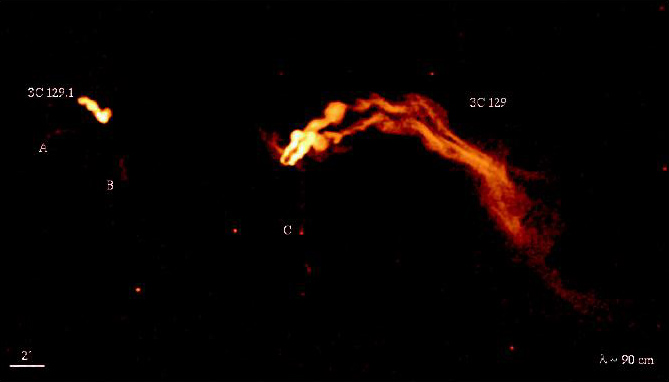
In 1968, Ryle and Windram found the first examples of a type of radio galaxies, whose radio emission extends from the optical galaxy in one direction in the form of a radio “tail” or “trail”. These examples were NGC 1265 and IC 310 in the Perseus cluster. Soon other examples were found in the Coma cluster of galaxies (NGC 4869, alias 5C4.81), as well as the radio galaxy 3C 129. The latter lies right in the plane of our Galaxy, and its membership in a cluster of galaxies was only confirmed much later, hampered by the dust obscuration of our own Milky Way. All three of these tailed radio galaxy were located close to another radio source, with their tails pointing more or less away from their radio neighbor, leading these authors to suspect that the tails were blown by winds of relativistic particles ejected from the radio neighbor. Soon thereafter higher-resolution observations of these sources revealed that the host galaxies showed the same two opposite radio jets as known from other, less bent, radio galaxies like Cygnus A, but close to the outskirts of the optical galaxies the jets would both bend in some direction, thought to be the direction opposite to the motion of the host galaxy through the so-called “intergalactic” or “intracluster” medium, which had been discovered from X-ray observations at about the same time. Later on, doubts were cast on this scenario, as it was found that the optical hosts of tailed radio galaxies in clusters did not move about within their clusters with high enough velocities to explain the bends in the jet.
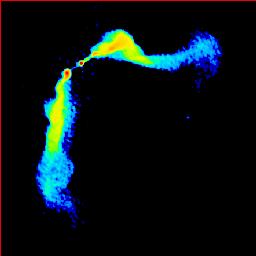
VLA radio image of 3C 465
A detailed study of the prototypical WAT source 3C 465 (image above) at the center of the rich Abell cluster of galaxies A2634 by these authors did not result in any plausible explanation for the bending of their radio trails. Later on, with more detailed X-ray images of clusters of galaxies, it was found that tailed radio galaxies occur preferentially in high-density regions of the intracluster medium (i.e. where the X-ray intensity is high; for more information, see this 1994 study) and even cluster mergers were made responsible for the formation of radio tails in this 1998 study. More recently authors seem to converge on the compromise idea that the combination of high ambient density and modest speeds of the host galaxy with respect to the ambient medium are able to produce the bends, but in this blog I would rather like to concentrate on the variety of morphologies shown by these objects in order to help RGZ users to classify them.
Above all, the term “tailed radio galaxies” should never be separated from the word “radio”. Some authors talk about “tailed” or “head-tail (HT) galaxies”, but the tail always occurs in their radio emission, usually far beyond the optical extent of their host galaxies. So, let us reserve the term “head-tail galaxies” for a future when optical tails may be detected in certain galaxies. Also, please note that while galaxies sometimes show optical tails due to tidal interactions, these are of totally different origin than the radio tails we discuss here.

Arp 188, a.k.a. The Tadpole Galaxy: not a tailed radio galaxy. I repeat, not the subject of this blog post.
Tailed radio galaxies are often subdivided into wide-angle (WAT) and narrow-angle tailed (NAT) radio galaxies, referring to the opening angle between the two opposite jets emanating from the nucleus of the optical galaxy, where we expect the supermassive black hole doing its job of spewing out the jets. However, the distinction between WATs and NATs depends strongly on the angular resolution and/or the distance to the radio source. E.g., the first HT radio galaxy to be discovered (NGC 1265; images below) may be called a WAT at high resolution, but appears as a (much larger) NAT at lower resolution, shown by this sequence of high, medium and low resolution radio images:



First Result from Galaxy Zoo Hubble
Posted on behalf of Tom Melvin:
Hello everyone, my name is Tom Melvin and I’m a 3rd year PhD student at Portsmouth University. I have been part of the Galaxy Zoo team for over two years now, but this is my first post for the Galaxy Zoo blog, hope you enjoy it!
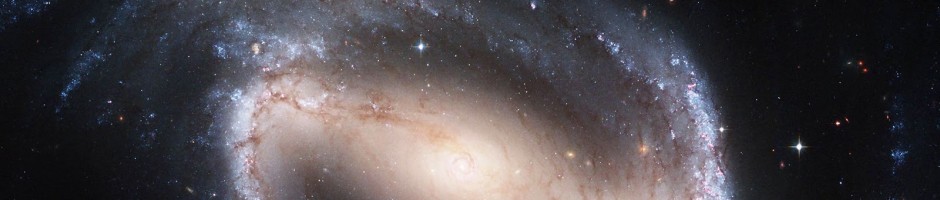
I’m very happy to bring you news of the latest paper based on Galaxy Zoo classifications, and the first paper based on Galaxy Zoo: Hubble classifications. Galaxy Zoo: Hubble was the first Galaxy Zoo project to look at galaxies beyond our local universe, using the awesome power of the Hubble Space Telescope. These images contained light from galaxies which have taken up to eight billion years to reach us, so we see them as they appeared eight billion years ago, or when the universe was less than half its current age! So what is the first use of this data? Well, we combine our Galaxy Zoo: Hubble classifications with Galaxy Zoo 2 classifications to explore how the fraction of disk galaxies with galactic bars has changed over eight billion years.
Here’s the title…..

Our work is based on a sample of 2380 disk galaxies, which are from the Cosmic Evolution Survey (COSMOS), the largest survey Hubble has ever done. To see how the bar fraction varies over such a large time-scale, we look at the number of disk galaxies and what fraction of them have bars in 0.3 Gyr (300 million year) time steps. In Figure 1 we show that eight billion years ago only 11% of disk galaxies had bars. By 4 billion years ago this fraction had doubled, and today at least one third of disk galaxies have a bar.

Figure 1: The evolving bar fraction with cosmic time (Figure 7 in the paper).
We know that bars tend to only form in disk galaxies which have low amounts of atomic gas and are in a relaxed state, or what we call ‘mature’. Combining this knowledge with our observations, we can say that, as the Universe gets older, the disk galaxy population as a whole is maturing. To see whether this is true for all disk galaxies, we split our sample up into three stellar mass bins, allowing us to look at the evolving bar fraction trends for low, intermediate and high mass disk galaxies.

Figure 2: Mass dependent evolution of the bar fraction with cosmic time (Figure 8 in the paper)
The results for this are shown in Figure 2, where we observe an intriguing result. The bar fraction increases at a much steeper rate with time for the most massive galaxies (red), compared to the lower mass galaxies (blue). From this we can say that the population of disk galaxies is maturing across the whole stellar mass range we explore, but it is predominantly the most massive galaxies which drive the overall time evolution of the bar fraction we observe in Figure 1.
At the end of the paper we offer an explanation as to why the time evolution of the bar fraction differs for varying stellar mass bins. We can make the reasonable assumption that, by eight billion years ago, the majority of massive disk galaxies have formed, and have been, and continue to form bars up to the present day – hence the steeply increasing bar fraction we observe. However, the same assumption is not true for the low mass galaxies. There are some which are ‘mature’ disk galaxies eight billion years ago, but not all are ‘mature’ enough to be classified as disks. As with the most massive galaxies, these low mass disks are forming bars at a similar rate up to the present day, but the difference with this low mass sample is that there are still low mass disks forming up to the present day as well – leading to the much shallower increase in the bar fraction with time we observe.
In addition to these results, we are also able to present an interesting subset of disk galaxies. Your visual classifications has allowed our work to include a sub-sample of ‘red’ spiral galaxies (like those found from Galaxy Zoo 2 classifications). This sub-sample is generally omitted from other works that have explored this topic, as their way of identifying disks is based on galaxy colours. This means that these ‘red’ galaxies would have been classified as elliptical galaxies! Figure 3 shows a few of these ‘red’ disk galaxies (with the full sample of 98 here), so why don’t you take a look and decide for yourself! Not only is it very cool that you are able to identify these ‘red’ disks, but they also influence the results we observe. Just like in our local universe, these ‘red’ disks have a high bar fraction, with 45% of them having a bar! Could this be a further sign that bars ‘kill’ galaxies, even at high redshifts?
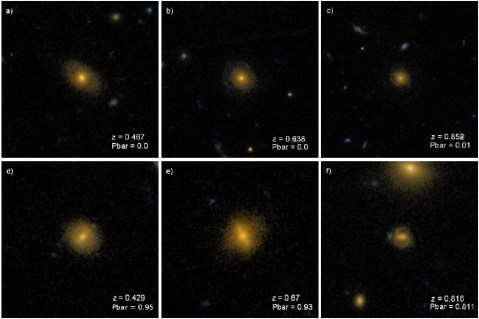
Figure 3: A sample of ‘red’ disk galaxies found by Galaxy Zoo volunteers (Figure 10 in the paper).
So that is a summary of the first results from Galaxy Zoo: Hubble. If you want more detail have a read of the paper in full here and take a look at the press release too! Thanks for all your hard work and help in classifying these galaxies!
Posted on behalf of Tom Melvin.
A Galaxy Zoo update for 2014
Exciting news for everyone who has been helping to classify (and discuss) the new images added to Galaxy Zoo just a couple of months ago. Back in October, we added two new sets of images to Galaxy Zoo: infrared images of galaxies from the UKIDSS survey, and optical images of galaxies that were processed to make them artificially redshifted (appear as if they were much further away). The second set is critically important for the data from GZ: Hubble and the CANDELS project; we need this to properly calibrate the classifications for effects like changing resolution and surface brightness as a function of distance.
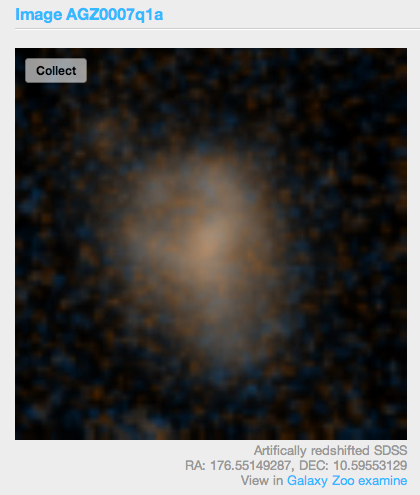
An example of an artificially-redshifted galaxy from Galaxy Zoo.
As of last week, we’re excited to announce that the classifications of the artificially redshifted galaxies have been finished! They’ll now be retired from active classification, and we’re excited to start working on the analysis right away to enable the science we want to do on high-redshift galaxies. In the meantime, please keep your classifications coming for both the SDSS and UKIDSS images on Galaxy Zoo. There’s plenty left to do, although we’re getting closer with your help!
 Galaxy Zoo