A Grand Bold Thing : The story of the Sloan
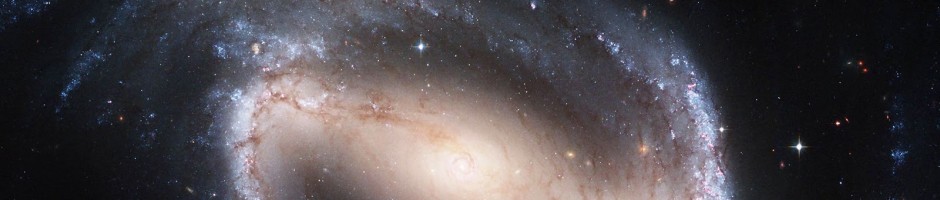
In many ways, the team here at Galaxy Zoo are freeloaders, making the most (with your help) of the hard work of the astronomers who work hard for years to design, build and operate the telescopes that produce the images for us to classify. The project’s first two incarnations were based entirely on images from the Sloan Digital Sky Survey, the star of A Grand Bold Thing, a book that was released this week.
Several Zookeepers were interviewed for the book, and while I don’t know for sure that we made the final cut I asked the author, Ann Finkbeiner to explain why she’d devoted so much of her time to writing about the Sloan. Over to Ann :
My book on the Sloan Digital Sky Survey — the source of those galaxies in Galaxy Zoo and the mergers in Galaxy Zoo Mergers — came out yesterday. The Sloan was, and still is, the only systematic, beautifully-calibrated survey of the sky and everything in it. And it’s the first survey to be digital, that is, log on to the website and download galaxies.
Before the Sloan, cosmology was fractured into many fields whose relation to each other wasn’t obvious and wasn’t being studied. Sloan found all kinds of things in all areas of astronomy: asteroids in whole families, stars that had only been theories, star streams around the Milky Way, the era when quasars were born, the evolution of galaxies, the structure of the universe on the large scale, and compelling evidence for dark energy. Now, after the Sloan, cosmologists are beginning to see the universe as a whole, as a single system with parts that interact and evolve.
A Grand and Bold Thing is about the very human scientists who built the survey: people doing their best, screwing up anyway, fixing it, screwing up again, running into trouble with the young folks, running into trouble with the money, getting their feelings hurt, forming hostile camps, and managing the unintended consequences of their best intentions. But they never give up, they’re astonishingly stubborn, they just keep at it until they’ve done it.
And what they did has had an enormous impact: as Julianne Dalcanton
of the University of Washington said in the blog, Cosmic Variance, about the Sloan, “You take good data, you let smart people work with it, and you’ll get science you never anticipated.” Some of that science is being done by the good people of the Zooniverse. Surveys open to the public have always been high altruism. I think the Sloan is still surprising.
Ann Finkbeiner’s last book was The Jasons. She teaches in Johns
Hopkins University’s Writing Seminars and blogs at Last Word on
Nothing.
Supernova zoo offline this week
Just to let you know that the supernova zoo will be offline for most of this week. The search that feeds data to us, the Palomar Transient Factory, is undergoing some maintenance. They’re re-aluminising the mirror of the telescope to improve the sensitivity, which usually takes a few days during which the telescope can’t be used. (It’s also the beginning of “bright time”, coming up to full moon, when the sky is brighter and the search less sensitive – so it’s a good time for maintenance.)
So, you can all take a well-deserved break from the supernova classifications.. and perhaps explore some other areas of the zooniverse which need your help! We’ll be back in a few days.
Galaxy Zoo gets highlighted by the 2010 Decadal Survey
Every decade, the US astronomy community gets its leaders together to write up a report on the state of the field and to recommend and rank major projects that should be supported by the government over the next decade. It’s a blue print, a wish list and often also a sober exercise in what to fund (a little) and what to cut (a lot). The current Decadal Survey was finally released by the US National Academies last Friday and every astronomer is poring over it to see if their project or telescope is ranked highly.
Galaxy Zoo isn’t competing for hundreds of millions of dollars in funding to launch a space observatory, but it did get not just one but two mentions in the 2010 Decadal Survey, one in the text and a figure. For those of you who are keen to read the whole thing for themselves, you can get the report at the National Academies website here (you have to click on download and give them your details to get the free PDF download). Here on the blog we only show you the highlights, i.e. the Galaxy Zoo mentions. From the text in the section on “Benefits of Astronomy to the Nation” where they discuss how “Astronomy Engages the Public in Science”:
Astronomy on television has come a long way since the 1980 PBS premier of Carl Sagan’s ground-breaking multipart documentary Cosmos. Many cable channels offer copious programming on a large variety of astronomical topics, and the big three networks occasionally offer specials on the universe too. Another barometer of the public’s cosmic curiosity comes from the popularity of IMAX-format films on space science, and the number of big-budget Hollywood movies that derive their plotlines directly or indirectly from space themes (including five of the top ten grossing movies of all time in America). The internet plays a pervasive role for public astronomy, attracting world-wide audiences on websites such as Galaxy Zoo (www.galaxyzoo.org, last accessed July 6, 2010) and on others that feature astronomical events, such as NASA missions. Astronomy applications are available for most mobile devices. Social networking technology even plays a role, e.g., tweets from the Spitzer NASA IPAC (http://twitter.com/cool_cosmos, last accessed July 6, 2010).
They also have a lovely figure, which has a small blooper in it (see if you can spot it!). Word is that this is going to be corrected in the final version:

Thank you all for making Galaxy Zoo such a success!
Edwin Hubble, the man behind HST
Who is Edwin Hubble, the guy who gave the Hubble Space Telescope its name? Who is the mysterious guy behind the telescope?

Edwin Hubble
Well, actually, Edwin Powell Hubble is not the ‘man behind the telescope’ at all. He was born on 20th of November 1889 in the US and studied Physics and Astronomy in Chicago. He then, interestingly, went to Oxford, UK (now, of course, one of the main departments participating in Galaxy Zoo), to study Jurisprudence, later Spanish. Given that he was also very sporty (he won several state track competitions and set the state’s high school high jump record in Illinois), I think it is fair to call Hubble a person with multiple talents. In England, he also picked up some English habits and his dress code, some to the annoyance of his american colleagues in later years. I don’t know many pictures of him, the one on the right is possibly the most famous (usually used in scientific talks at least). Smoking his pipe on his desk, he really looks like an English gentlemen of his time (Well, maybe he’s lacking a hat).
Edwin Hubble died on September 28th 1953 in California (his house is now a National Historic Landmark at this location), long before the real planning for the HST had begun. Earlier ideas did exist, since 1923, after it was explained how a telescope could be propelled into Earth orbit and in 1946, Lyman Spitzer (who interestingly enough has his own space telescope named after himself now) had already discussed the advantages (which I will discuss in the next post about the planning of the HST) of an extraterrestrial observatory, but it took until 1962 for the US NAS (not NASA!) to recommend the development of a space telescope for other purposes than observing the sun (two orbiting solar telescopes were in fact already active at that time). In 1965, 12 years after Hubbles death, Spitzer was appointed head of the committee to define the scientific objectives for this new telescope, so really, he is the ‘man behind the Hubble Space Telescope’.
So why is the telescope named after Edwin Hubble then?
After some years of teaching at the university back in the US and after serving in WWI as a major, he returned to the Yerkes Observatory at the University of Chicago, where he finished his Ph.D. in 1917. The topic of his thesis was ‘Photographic Investigations of Faint Nebulae‘ (it only consists of 17 pages, a fact that possibly makes every PhD student cry nowadays). At that time, these nebulae were still considered to be part of the Milky Way, something that was waiting for a real genius and careful observer to be revealed as a mistake.

The Hooker Telescope
In 1919, Hubble took on a staff position in California at the Mount Wilson Observatory near Pasadena where he stayed until his death in 1953. Just 2 years previously, a new telescope had been finished at the site, the Hooker telescope (the slightly unfortunate name comes from John D. Hooker who funded the project), a 100-inch Reflector telescope, which today is still there and, after some recent upgrades and modifications (although preserving the historical origin wherever possible), is again used for scientific purposes. With its ‘adaptive optics’ system (see next post) its resolution today is 0.05 arcsec, the same as resolution of the HST. From 1917 to 1948, the Hooker telescope was the world’s largest telescope.
Hubble used this new, state-of-the-art telescope to continue the work on nebulae that he had started in Chicago by identifying Cepheid variable stars in them. Cepheids have the very convenient characteristic, that the period of their variability is a simple function of their brightness. So by measuring their period, astronomers can immediately tell how bright these objects are in a standard system. Measuring their apparent brightness allows to measure their actual distance. By doing this, Hubble noticed that they are far too distant to be part of our own galaxy, but instead are extragalactic systems, islands of stars (and possibly life) in the vast nothingness of space. Other distant ‘Milkyways’, just like our own.
We now call them ‘galaxies’.
Being some of the closest galaxies to our own, most of the objects that he worked on are now very famous, some also through images by the HST. The most famous of all is possibly M31, the closest big galaxy to our own, the Andromeda galaxy, or what Hubble called it, the Andromeda Nebula.

The original version of the Hubble diagram
Additionally to his distance measures of 46 galaxies Hubble further took measurements from Vesto Slipher of their escape velocity. This is basically the speed with which ‘the galaxies move away from Earth’ (what we now understand to be the cosmological redshift) and can be relatively easily measured by looking at the galaxies’ spectra, in which all spectral lines, previously known from lab experiments, are shifted by the same amount. When Hubble plotted the escape velocity of galaxies over their distance (we call this a Hubble diagram), he noticed something interesting:
The further galaxies are away from our position, the faster they move away.
This was a pretty radical idea as it proved that the Universe is not a static place at all as was widely believed before. For example, Einstein had introduced an additional term into his cosmological formula in general relativity to make his universe static/non-dynamical (something Einstein called the biggest blunder of his life after he had seen Hubble’s data. Funnily enough, this constant is now back in there to explain the accelerated expansion of the universe. It resembles the ‘dark energy’). Instead, this effect means that either the Earth is in a very special spot of the Universe where everything is flying away from it (a thought that many people, amongst them Einstein, considered wrong. The hypothesis that there is nothing special about the place where the Earth is other than that it is where we happen to live, is one of the basic fundamentals of cosmology) or there was a time in the past when everything was at the same point, much like in an explosion. Of course, we now know it was not an explosion in the traditional sense, but the beginning of time, the Big Bang.
Of course, as with most big new discoveries, these new findings were heavily discussed, not many people believed in them in the beginning. One after another, people started believing in Hubbles results, though, and the view that astronomers have on the universe changed completely. The Big Bang Theory (besides being a brilliant TV series) is now the generally accepted picture today.
As a small anecdote on the side: Due to errors in his distance measurements, Hubble measured the expansion parameter (the Hubble constant) to be 500 km/s/Mpc, which for today’s measurements is a pretty bad value, actually. After new, better data and improved data analysis were used, there were 2 big groups of people debating the real value, some said it was 50 km/s/Mpc, some others said it was 100 km/s/Mpc. For the past 10-15 years, this battle seems solved Solomonically, the value is now assumed to be just inbetween these values, somewhere between 70 and 75 km/s/Mpc. So, although Hubble was very wrong in the number that came out of his measurements, he somehow got the principle spot on.

Using the images that he had taken for his work, Hubble also came up with a system to classify these nebulae and galaxies depending on their appearance. This is what we call the Hubble sequence or the tuning fork of galaxies, and Galaxy Zoo initially used a system that was based on this diagram for their classifications.
As the Hubble Space Telescope was primarily constructed and built to observe distant galaxies (besides of course looking at objects in the solar system and interesting regions in our own galaxy), it was named after Edwin Hubble in honour of his groundbreaking work in this field.
Edwin Hubble has not only got a Space Telescope with his name, but several laws, constants and numbers are named after him, too.
Some examples:
- The Hubble constant as explained above, called H0
- The Hubble time is 1/H0 and gives the approximate age of the universe. It is currently estimated to be around 13.8 billion years.
- The Hubble length is c/H0and is equivalent to 13.8 billion lightyears. This is not the ‘size’ of the universe, but is an important length in cosmology
- The Hubble diagram as described above
- The Hubble sequence of galaxies.
- Hubble’s law
Additionally, there are:
- An asteroid: 2069 Hubble
- The crater Hubble on the Moon.
- Edwin P. Hubble Planetarium, located in a High School in Brooklyn, NY.
- Edwin Hubble Highway, the stretch of Interstate 44 passing through his birthplace of Marshfield, Missouri
- The Edwin P. Hubble Medal of Initiative is awarded annually by the city of Marshfield, Missouri – Hubble’s birthplace
- Hubble Middle School in Wheaton, Illinois—renamed for Edwin Hubble in 1992.
- 2008 “American Scientists” US stamp series, $0.41
(I think when they make you a stamp and you’ve got your own highway, you’ve really made it!)
I think that’s more or less all that I can come up with about Eddi, the post is actually quite a bit longer than I thought it would be, I’ll try to keep it shorter in the future, scout’s honour. For now, I will end with a quote from Edwin Hubble:
“Equipped with his five senses, man explores the universe around him and calls the adventure science”
With this, keep together your senses, especially seeing (the galaxies in Galaxy Zoo) and feeling (your mouse button with your index finger) and help us to do more adventurous science with the classified galaxies that you help us with (hearing, smelling and tasting are only of second order importance in astronomy, unless of course you listen to some music and have a snack while classifying 😉 ).
Thanks and Cheers,
Boris
Hubble's View of NGC 4911
This week’s OOTW features an OOTD by Alice written on Thursday 12th of August.
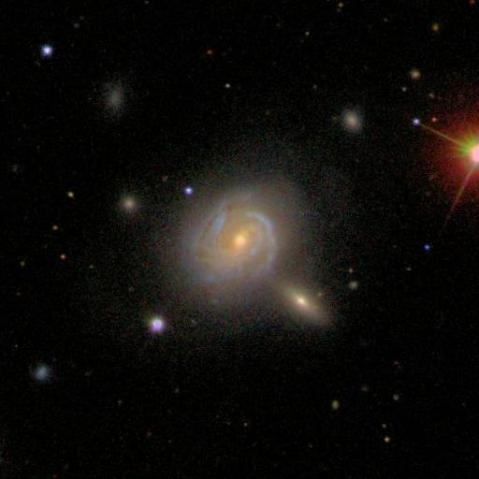
With a redshift of 0.027 this spiral galaxy lies 320 million light years away from us. It’s NGC 4911, a spiral galaxy in the Coma Cluster; a city of galaxies gravitationally bound to each other in the constellation Coma Berenices. LEDA 83751 – the larger elliptical overlapping the galaxy – is actually sat in front of the spiral, which isn’t the best situation for overlap hunters:
Overlapping galaxies are especially useful to Bill and other astronomers interested in dust – the background galaxy acts like a torch, showing what the dust is doing in the former one. The best situation is an elliptical being further away than a spiral, since spirals tend to be dustier and more interesting. Sadly this pair appears to have the bad manners to be the other way round. How rude :D.
– A quote from Alice’s OOTD.

A new Hubble image of this galaxy has been released showing in more detail the huge amount of star formation going on nearer to the nucleus of the galaxy, the dust lanes streaking their way around the beginning of its spiral arms, and the wispy spiral structures wrapping their arms around the bustling galactic centre.
Peas Through a Lens
This week’s OOTW features today’s OOTD by Budgieye.

SDSS view of SDSS J001340.21+152312.0
This yellow fuzzy galaxy is a Quasar 1.59 billion light years away from Earth in the constellation Pegasus; it’s just above to the left of the star Gamma Pegasi.
When you zoom in with the Keck observatory you’re treated to this beauty:

Credit: F. Courbin, G. Meylan, S. G. Djorgovski, et al., EPFL/ Caltech/WMKO
Now what the Keck telescope can see and the Sloan telescope can’t are the two red smudges in the blue glow of the Quasar. These smudges are in fact one Pea gravitationally lensed by the QSO sitting in front of it! This is the first ever example of a Quasar strongly lensing an object. This is where a galaxy or a cluster of galaxies are so massive that they bend space-time so much that it visibly bends light around them. So the light emitted by an object sitting behind a cluster of galaxies gets bent around the cluster, creating multiple images of one object.
So how can we tell they are multiple images of the same object?
A quote from Budieye’s OOTD:
To ensure that the two red objects on each side of the quasar is actually the same object, each object must have their spectrum taken separately.
Both blobs of red light had identical spectra, indicating that both blobs are the same object, and that the quasar is bending the light from the distant galaxy into two blobs.
Me, HST and the history of surveys
Before I start with a new series of posts, please let me introduce myself.

My name is Boris Häußler (look at my horribly out-of-date website here). I am German but currently working as a research fellow in Nottingham, UK, where I have just recently started my second postdoc with Steven Bamford, whom many people here may know. I have spent the last years (actually, my whole scientific life so far) working on Hubble Space Telescope (HST) data, mainly on the GEMS and STAGES surveys, and have gathered particular experience in the field of galaxy profile fitting, trying to measure sizes, shapes, etc. of distant galaxies. Whereas my previous projects have mainly been working on galaxies at redshift z~0.7, my new job is trying to do similar and more advanced things on more local galaxies, mainly SDSS galaxies, which of course everyone familiar with Galaxy Zoo will know as these are the galaxies classified in both Galaxy Zoo and Galaxy Zoo 2. Initially, one would think that this is a much easier job to do, but as this data is from ground-based telescopes, it proves to be challenging.
 This brings me to an interesting position. Although Galaxy Zoo is not my primary science project, I am now connected to the survey through Steven, our galaxy sample and (for now) more directly through this blog. Having worked on HST galaxies for ages, it is of course very interesting for me to see these galaxies now being classified in Galaxy Zoo: Hubble. Having created some of the colour images that both GEMS and STAGES have used for outreach purposes, I have looked at thousands of these galaxies myself and know how stunningly beautiful they can be. I very often got lost on our images, simply browsing around and being fasctinated by the variety of the galaxies. At least in GEMS I know many galaxies by heart and could possibly directly point you to at least some of the brighter and/or more interesting galaxies.
Being kind of an HST expert, Steven has asked if I would want to write a series of posts about HST, an offer that I found hard to turn down, so I’ve decided to write quite a long series about the HST, its history, its future and especially introducing some of the bigger HST surveys, some of which of course build the content of Galaxy Zoo: Hubble now. But before I write and post all this, I would be interested to know what people would actually want to know about Hubble and everything connected with it. So if you have any comments, any wishes, any questions, please post them below and I will try to answer them in the future.
My current plan for the next months contains the following posts, roughly running through the history of Hubble in chronological order:
- Who is Edwin Hubble, the man that gave HST it’s name?
- History of Hubble, the planning and the start 20 years ago
- HST gets spectacles, first service mission
- HDF, the Hubble Deep Field, the first famous survey,
- Another service mission, putting new cameras (e.g. ACS) on HST
- GOODS, the Great Observatories Origins Deep Survey
- GEMS, Galaxy Evolution from Morphologies and SED
- AEGIS , the Deep Extragalactic Evolutionary survey
- HUDF, the Hubble Ultra Deep Survey, the deepest survey ever made
- STAGES, Space Telescope Abell901/902 Galaxy Evolution Survey
- COSMOS, the Cosmic Evolution survey
- The service mission to put in another camera (WFC3)
- Upcoming surveys: CANDELS
- The Future of HST
- HST’s successor, the James Webb Space Telescope (JWST)
If you want to know about anything else, please let me know below.
Thanks and Cheers for now,
Boris
Supernova updates
Hello from the William Herschel Telescope, where I’m observing some of those lovely supernova candidates that have been pouring out of The Supernova Zoo lately.
It’s been a while since our last update. We’ve been running supernova zoo in a very serious way now for several months, and, after ironing out a few little bugs and adding some improvements, the zoo is making a massive contribution to the supernova identification effort in The Palomar Transient Factory. The zoo has already classified some 20,000 supernova candidates, usually several hundred every day; it’s a fabulous effort. You’ve classified every supernova candidate that we’ve put in the zoo!
We also hope that you’re beginning to see feedback on the supernova candidates that you spend your time classifying (at least the better ones!). From this current observing run I’ve been adding comments as I classify the events that you’ve highlighted, so you might see them appearing in your “MySN” area (of course, the more you classify, the more likely this is to happen!).
Here are some of your nice recent finds, all Type Ia Supernovae.
This one seems to live in a galaxy located in a cluster of galaxies:

This is one in a nearby NGC galaxy – the SN is located directly in one of the spiral arms.
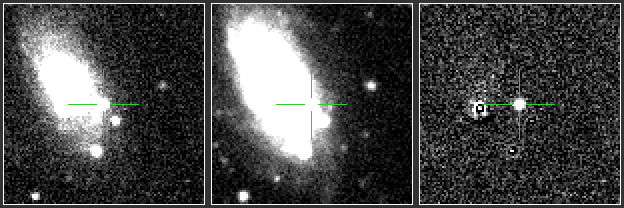
And this one is also in a spiral galaxy – but one that is more edge on:

We’re currently preparing a scientific publication that will detail supernova zoo and how it works – and we also have plans to add a new survey to give you even more supernova to play with. So stay tuned!
OK, my exposure has just finished, so I’ll sign off here and go and see what the latest supernova candidate turned out to be!
— Mark
Galaxies spiralling out of control
Today’s OOTW features Alice’s OOTD, posted on the 29th of July.
AHZ40004wr from Hubble Zoo
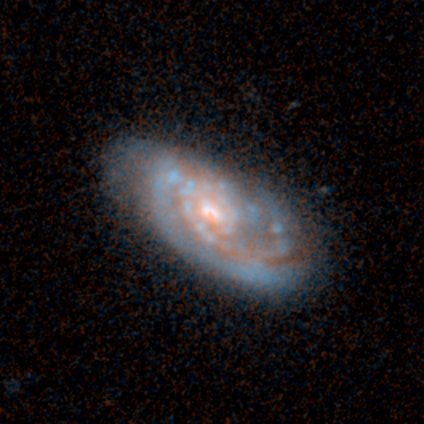
This is AHZ40004wr, a galaxy residing in the constellation Taurus around 3 billion light years away. It’s a wonderful spiral galaxy, and following its spiral arms is a large dust lane, a place full of young stars and stars that are only just being formed.

AHZ40004wr by Swengineer
Zooite Swengineer gave us a wider view of AHZ40004wr and the surrounding galaxies by working with the FITS images and revealed the mess of galaxies above. The main spiral galaxy in the background is 2MASS J03324999-2734330, an X-ray source according to SIMBAD, and it is also around 3 billion light years away.
You can view more images of these galaxies here and here, and to work with the FITS files I recommend DS9 or Aladin, which I used to find the other galaxies details.
And to highlight a request from Alice’s OOTD, Alice would very much like to know if anyone could write any FITS and image editing tutorials on the galaxy zoo forum.
Zoo 1 data set free
Hi all
It’s taken longer than it should have done – more than three years since the launch of the site – but the data from the original galaxy zoo is now available.

The paper describing the data set was only accepted by the journal yesterday, but we were confident enough after an earlier report to go ahead and make it public. The data can also be downloaded in a variety of formats from our site, or via Casjobs.
The data set is slightly updated from our previous efforts; while we’ve been busy with Galaxy Zoo, the good people of the Sloan Digital Sky Survey produced a new data release which included more spectra, allowing us to estimate biases for more galaxies than ever before.
We’ve had a lot of fun exploring this data set, and we hope that by making it available to all other astronomers then they will make use of your classifications too.
Knowing the Zoo, I wouldn’t be too surprised to see something interesting come from any of you who wanted to have a play – feel free to download and dig in, and let us know how you get on. Meanwhile, the team are working hard on Zoo 2, and hopefully it won’t take as long before that data set too is ready to go.
 Galaxy Zoo