Here be SDRAGNS! Results from Radio Galaxy Zoo and Hubble’s Zoo Gems
It’s taken a while to get this finished, but I am happy to say that our paper combining Radio Galaxy Zoo and Hubble data on the rare spiral galaxies with large double radio sources (also known as SDRAGNs, Spiral Double Radio AGNs) has been accepted by the Astronomical Journal. The RGZ-HST sample is the largest set of such objects known (we found 15 cases, compared to 11 from everyone else published up through late 2025). With the collaboration of Alexei Moiseev and students using the 6-meter telescope, we could complete the set of redshifts and optical spectroscopic properties for these SDRAGNs
The Zoo Gems project of short-exposure Hubble observations gave us images of 36 potential SDRAGNs. Most of these turned out to be something else – a disturbed but not spiral galaxy, a spiral almost in front of the more distant radio galaxy… Still, we confirmed enough to more than double the known sample of these rare systems from 11 to 26, selected in more systematic ways than their predecessors. As a group, SDRAGNs have a wide range of Hubble types, from Sa to Sc – this was a bit unexpected, since the mass of the central black holes correlates with the bulge starlight, and the radio sources are probably powered by very massive black holes. (Also, another group including Wu, Ho, and Zhuang analyzed many of the Zoo Gems SDRAGN candidates and found that most of them have pseudobulges rather than classical bulges, which suggests that these galaxies have not undergone a major merger over their history). SDRAGN host galaxies are seen nearly edge-on more often than would be expected for a random set of spirals. We do not see many strong interactions, although there are several SDRAGNs with dust lanes twisted out of the galaxy plane which could result from a weak interaction a billion years before our current view. These galaxies occur in denser environments than average as traced by other galaxies, which fits with our understanding of the need to have circumgalactic gas for the radio jets to interact with in order to produce the powerful lobes of radio-emitting material. Combining the radio structures with galaxy properties from the Hubble images, perhaps our key results is that the radio jets merge preferentially within about 30 degrees of the poles of the galaxy disks. This helps understand why the jets make it outside the galaxy – they encounter the least interference from gas within the galaxy that way. This contrasts with the random orientations of those radio jets which happen in spiral Seyfert galaxies, which really do seem to have random directions and mostly dissolve within a few thousand light-years as they encounter the dense gas within the galaxy itself. Returning to the incidence of pseudobulges, within a major merger we expect the black hole to grow by incorporating material from within the galaxy, so it would keep roughly the same “spin” direction as the galaxy disk and impart that to the accretion disk and jets. This directionality seems to be more important than the mass or accretion rate of the black hole in producing SDRAGNs.
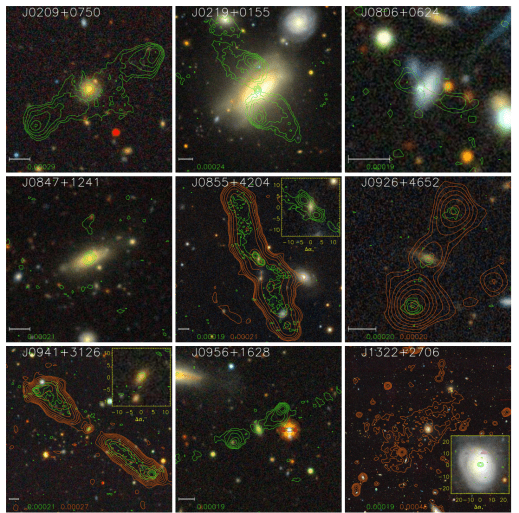
As examples of the data we could work with, here is a montage of 9 SDRAGNs using SDSS images overlaid with VLA Sky Survey contours (green) and contours from the lower-frequency LOFAR sky survey (orange). The LOFAR data became available only after the original Radio Galaxy, and are much more sensitive to the diffuse emission from radio lobes.
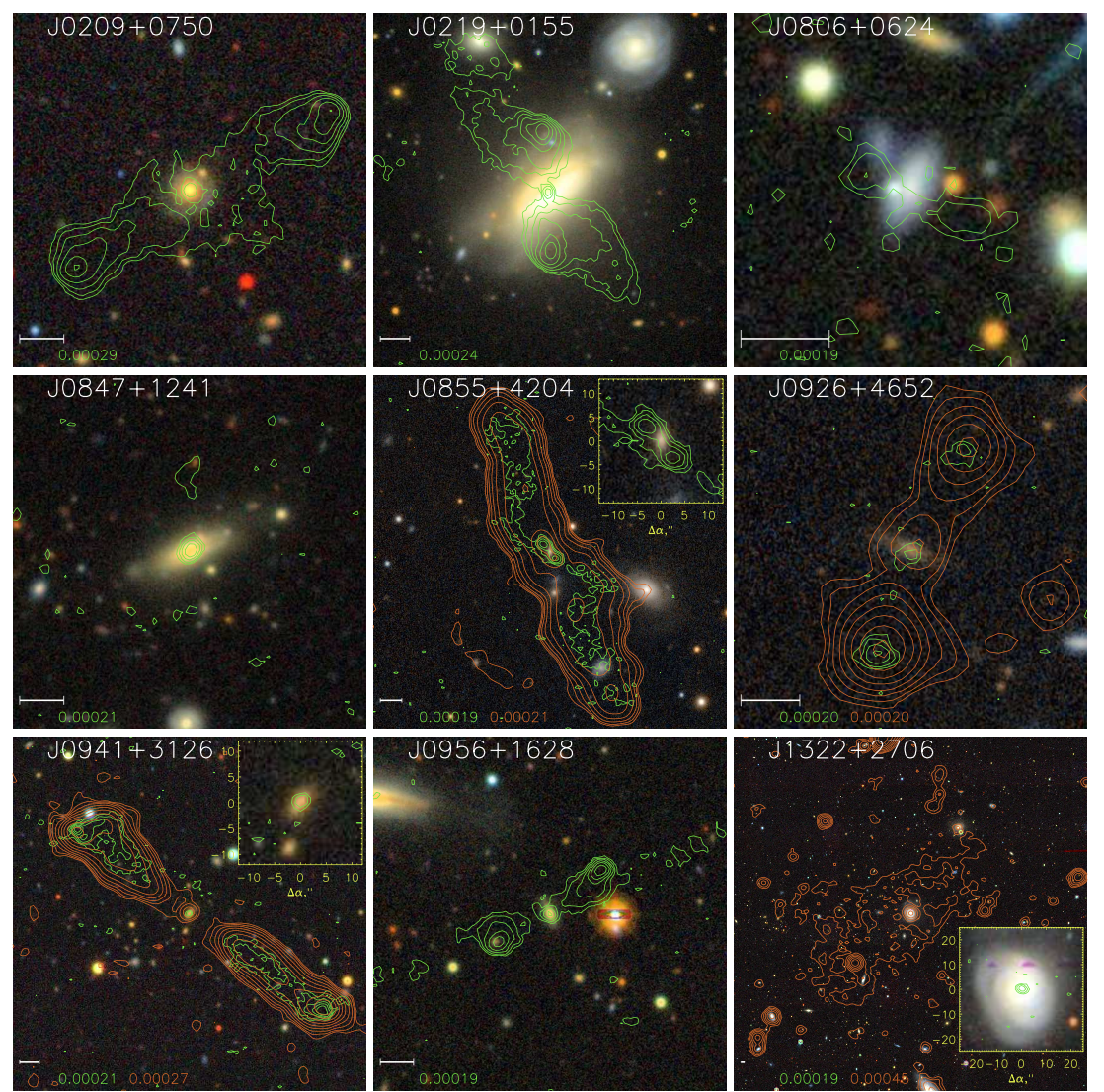
This montage shows the same nine SDRAGNs in negative views of the Hubble blue-light images. They are oriented so the galaxy plane is horizontal; arrows mark north and are 5 arcseconds long (matching the scale bars on the radio overlays).
Given the roots of Radio Galaxy Zoo and Zoo Gems in the Galaxy Zoo family, it would happen that one of the Hubble targets which turns out to not be a spiral does have a giant emission region similar to Voorwerpjes. We can’t help it, they are everywhere (and from some JWST data, almost everywhen too).
The manuscript is available from the arxiv repository (and from the AJ web site in a couple of months, after formal publication). Much of the text in the first two sections comes from a draft written by the late Jean Tate even before Hubble data started to arrive, and once again we regret that he did not live to see some of the later Hubble images. This was a favorite project of Jean, who managed most of the initial voting to select HST imaging candidates and kept the SDRAGN material in a PBWorks online repository, so well organized that we could reconstruct a great deal of the project detail from there. (The paper includes the master table of all 215 RGZ SDRAGN candidates in case someone else wants to follow them up).
Eight Years and the 8 Most Talked-About Galaxies in Galaxy Zoo

Continuing the countdown to Galaxy Zoo’s 8th birthday, below are 8 of the most-commented-on galaxies in the active Galaxy Zoo. They range near (in astronomical terms) and far, from gorgeous disks to space-warping groups, and some of them aren’t even galaxies at all!
8. Galaxies Interacting (Arp 112)

#merger #arc #g-pair #bulge #tidaltails #ugc #wow #agn #ngc #ngc7806 #arp #markarian #dustlane #available_in_dr7 #spiral #gpair #awesome #tidal #lens #no_lens
A lovely example of the diversity of structures in the Universe. The central galaxy may have been a perfectly symmetric spiral before it was seriously disturbed by the elliptical galaxy on the left side of the shot, and what’s that wispy thing off to the right? Is it a former part of the central galaxy? And what is this all going to look like in a few billion years? Whatever happens, the volunteers made it clear this is a special one to classify and to look at.
#lens #lensing #knownlens #arc #lense #interesting
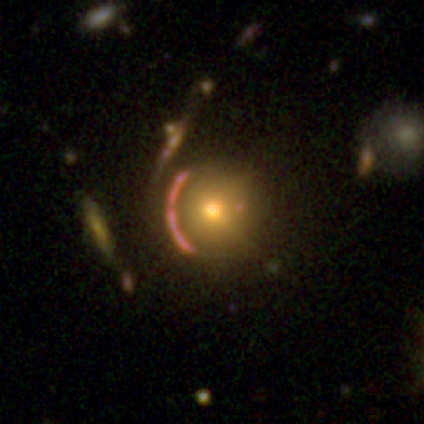
This gorgeous gravitational lens was spotted almost immediately upon the launch of the new Galaxy Zoo within the high-redshift CANDELS data. It generated multiple lively discussions and scientists and volunteers alike weighed in with further information. It turned out in this case that this was one of very few lenses that were already known, but there are likely still unknown lenses buried in the data, waiting to be discovered!

#quasar #edge #lbg #star
Initially identified as a high-redshift star-forming galaxy by one of our seasoned volunteers, a number of people subsequently looked further into the existing scientific literature. There was a lot of debate about this particular point of light, but in the end the volunteers uncovered a later paper confirming that this green gem (which would actually be either very red or nearly invisible to the human eye, as it’s “green” because it only shows up in the infrared filters used for this image) is actually just a star in our galaxy. Bummer, maybe, but this process is also an important part of science.

#dustlane #polar #polarring #beautiful #polar-ring #elliptical #ring #edgeon #mothership #dust #polaring #question
This spectacular example of a polar ring galaxy couldn’t have been found in the original Galaxy Zoo or Galaxy Zoo 2, because it only made it into the Sloan Digital Sky Survey when the sky coverage was extended.

#merger #arp148 #arp #available_in_dr7 #lookalike #alphabet #ring
It takes a special kind of galaxy crash to make a collisional ring, and you can see this one in progress. It reminded our volunteers and scientists of the Cartwheel galaxy, another spectacular example of these snapshots of a brief moment in time.

#merger #odd #dark #needle #holycow #wow #doublenucleus #tidaldebris #disturbed #rocket #cluster #irregularshape #spaceship #rocketship
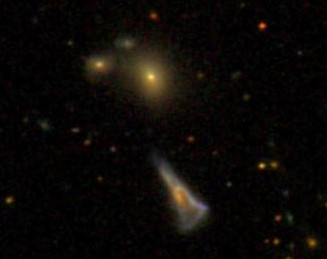
Well, this is odd. This galaxy looks like it’s on its own, but it has a rather unusual shape that would usually imply some sort of interaction or collision. Our volunteers discussed what could be causing it – until they viewed a zoomed-out image and it became clear that this galaxy has recently flown by a trio of galaxies, which would be more than enough to disrupt it into this lovely shape.
2. Hubble Resolves the Distant Universe

#spiral #overlap #dustlane #starburst #edge-on #edgeon
When a new batch of data taken by the Hubble Space Telescope appeared on the latest Galaxy Zoo, this was one of the first stunners remarked on by several people. Some of the parts of the sky covered by Hubble coincide with the Sloan Digital Sky Survey, and we linked the surveys up via Talk. Our tireless volunteers launched a thread collecting side-by-side images from SDSS and Hubble, showcasing the power of the world’s greatest space telescope. Hubble’s primary mirror is about the same size as that used by the SDSS, so the differences between the images of the same galaxy are due to the blurring effect of the atmosphere.

SDSS (on Earth) at left, HST (in space) at right.
And, the most talked about image in the latest Galaxy Zoo is…

It’s always the galaxies you least expect.
Okay, okay… If you saw this and said it looks like there isn’t a lot to talk about here, I wouldn’t blame you. And, indeed, there’s only one “short” comment from one of our volunteers, who used our Examine tools and discovered that this little blotch appears to be a very high-redshift galaxy.
However, that same volunteer also started a discussion with the question: just for fun, what’s the highest redshift you’ve found? Others responded, and thus began a quest to find the galaxy in Galaxy Zoo that is the farthest distance from us. This discussion is Galaxy Zoo at its finest, with new and experienced volunteers using the project as inspiration for their own investigations, scouring the scientific literature, and learning about the very early Universe.
It seems like the most likely known candidate so far is a quasar at a redshift of about 5.5 (at which point the Universe was about 1 billion years old), or, if you don’t think a quasar counts, an extended galaxy at z = 4 or so (1.5 billion years old). But there’s just so much science wonderfulness here, all of it from our fantastic volunteers, and it all started with a patchy blob and a sense of curiosity.
Galaxy Zoo started with a million blobs (ish) and a sense of adventure. I think that’s fitting.
A Galaxy Walks Into A Bar…

We are pleased to announce that a Galaxy Zoo project is one of the first projects built on the new Zooniverse! Several years ago we measured the lengths of galactic bars in relatively nearby galaxies in the Sloan Digital Sky Survey, and Ben Hoyle wrote an excellent paper presenting new an interesting results on how bars, which are a distinct feature caused by a change in the nature of the orbits of some of the stars in a galaxy, relate to other physical properties of the galaxy, such as color (indicative of recent star formation) and the nature of spiral arms or rings. That work showed the power of measurements like these, which are not always easy for computers to get right.
Today, we’re hoping you’ll help us extend that set of detailed galaxy measurements into the distant Universe, with measurements of bars in about 8,000 galaxies from our previous projects using Hubble Space Telescope data, including the AEGIS, CANDELS, COSMOS, GEMS and GOODS surveys.
We’ve deliberately been pretty broad in our selection of galaxies which may have a bar, so the first thing the project asks you is to confirm whether you think the galaxy does indeed have one. There are many examples of barred and not-barred galaxies (including examples of sort-of-looks-like-barred-but-actually-isn’t-and-here’s-why) included in the project, and you can access them anytime by clicking the “Need some help?” button.

We’ve also zoomed in on the central galaxy to make it easier to classify.
If the galaxy doesn’t have a bar, then you can move on to the next one. If it does, there are some follow-up questions about spiral arms and rings, and then we ask you to draw 2 lines on the image: one for the bar width and one for its length.
You can also join in the discussions after the classifications with our new Talk discussion tool, which is completely separate from the main Galaxy Zoo Talk (just like the rest of the project).
On a more personal note, this is a big step forward for the Zooniverse as a whole. The first draft version of this project came together in under 1 hour back in April. Afterward, we shared project links between science team members and iterated back and forth on the right questions to ask and the right data to use. This process would normally take at least 6 months and require a lot of one-on-one time with a Zooniverse developer. Instead, because the Zooniverse development team has done a brilliant job creating a Project Builder that’s flexible, powerful and also easy to use, we were able to create a new project in a way that’s analogous to, well, creating a blog.
In these early days of the new site’s release I’m sure there will be some bugs that need zapping, but even so the new capabilities of the Zooniverse are phenomenal. I suspect this is just the first of many new projects to be spun up in the New Zooniverse. (In fact, there are 3 more projects debuting alongside ours.)
Try it out here: Galaxy Zoo: Bar Lengths
First Result from Galaxy Zoo Hubble
Posted on behalf of Tom Melvin:
Hello everyone, my name is Tom Melvin and I’m a 3rd year PhD student at Portsmouth University. I have been part of the Galaxy Zoo team for over two years now, but this is my first post for the Galaxy Zoo blog, hope you enjoy it!
I’m very happy to bring you news of the latest paper based on Galaxy Zoo classifications, and the first paper based on Galaxy Zoo: Hubble classifications. Galaxy Zoo: Hubble was the first Galaxy Zoo project to look at galaxies beyond our local universe, using the awesome power of the Hubble Space Telescope. These images contained light from galaxies which have taken up to eight billion years to reach us, so we see them as they appeared eight billion years ago, or when the universe was less than half its current age! So what is the first use of this data? Well, we combine our Galaxy Zoo: Hubble classifications with Galaxy Zoo 2 classifications to explore how the fraction of disk galaxies with galactic bars has changed over eight billion years.
Here’s the title…..
Our work is based on a sample of 2380 disk galaxies, which are from the Cosmic Evolution Survey (COSMOS), the largest survey Hubble has ever done. To see how the bar fraction varies over such a large time-scale, we look at the number of disk galaxies and what fraction of them have bars in 0.3 Gyr (300 million year) time steps. In Figure 1 we show that eight billion years ago only 11% of disk galaxies had bars. By 4 billion years ago this fraction had doubled, and today at least one third of disk galaxies have a bar.
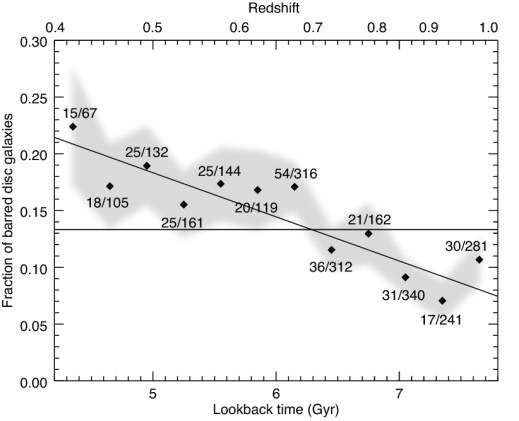
Figure 1: The evolving bar fraction with cosmic time (Figure 7 in the paper).
We know that bars tend to only form in disk galaxies which have low amounts of atomic gas and are in a relaxed state, or what we call ‘mature’. Combining this knowledge with our observations, we can say that, as the Universe gets older, the disk galaxy population as a whole is maturing. To see whether this is true for all disk galaxies, we split our sample up into three stellar mass bins, allowing us to look at the evolving bar fraction trends for low, intermediate and high mass disk galaxies.

Figure 2: Mass dependent evolution of the bar fraction with cosmic time (Figure 8 in the paper)
The results for this are shown in Figure 2, where we observe an intriguing result. The bar fraction increases at a much steeper rate with time for the most massive galaxies (red), compared to the lower mass galaxies (blue). From this we can say that the population of disk galaxies is maturing across the whole stellar mass range we explore, but it is predominantly the most massive galaxies which drive the overall time evolution of the bar fraction we observe in Figure 1.
At the end of the paper we offer an explanation as to why the time evolution of the bar fraction differs for varying stellar mass bins. We can make the reasonable assumption that, by eight billion years ago, the majority of massive disk galaxies have formed, and have been, and continue to form bars up to the present day – hence the steeply increasing bar fraction we observe. However, the same assumption is not true for the low mass galaxies. There are some which are ‘mature’ disk galaxies eight billion years ago, but not all are ‘mature’ enough to be classified as disks. As with the most massive galaxies, these low mass disks are forming bars at a similar rate up to the present day, but the difference with this low mass sample is that there are still low mass disks forming up to the present day as well – leading to the much shallower increase in the bar fraction with time we observe.
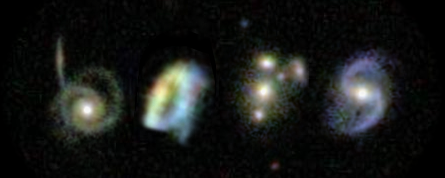
In addition to these results, we are also able to present an interesting subset of disk galaxies. Your visual classifications has allowed our work to include a sub-sample of ‘red’ spiral galaxies (like those found from Galaxy Zoo 2 classifications). This sub-sample is generally omitted from other works that have explored this topic, as their way of identifying disks is based on galaxy colours. This means that these ‘red’ galaxies would have been classified as elliptical galaxies! Figure 3 shows a few of these ‘red’ disk galaxies (with the full sample of 98 here), so why don’t you take a look and decide for yourself! Not only is it very cool that you are able to identify these ‘red’ disks, but they also influence the results we observe. Just like in our local universe, these ‘red’ disks have a high bar fraction, with 45% of them having a bar! Could this be a further sign that bars ‘kill’ galaxies, even at high redshifts?

Figure 3: A sample of ‘red’ disk galaxies found by Galaxy Zoo volunteers (Figure 10 in the paper).
So that is a summary of the first results from Galaxy Zoo: Hubble. If you want more detail have a read of the paper in full here and take a look at the press release too! Thanks for all your hard work and help in classifying these galaxies!
Posted on behalf of Tom Melvin.
Oh, Sweet Spiral Of Mine

See the video of our latest hangout here (or, if you prefer, click to download the podcast version):
Spiral galaxies are seemingly endless sources of fascination, perhaps because they’re so complex and diverse. But why does spiral structure exist? Why do some spiral galaxies have clearly defined spiral arms and others have flocculent structure that barely seems to hold together? What’s the difference between a 2-arm spiral and a 3-arm spiral? How many kinds of spirals do we actually observe? And what is happening to the stars and gas in spiral galaxy disks?

Clockwise from top right: X-ray, UV, optical, near-IR, mid-IR, far-IR, radio
All of the above questions are related to a question we got right at the end of our last hangout: what is the significance of the number of spiral arms? Determining how many spiral arms a galaxy has is hard, and is often subjective — so why bother?
It’s a good question. Part of the reason spiral arm classification & count is a challenge is that it often depends on the wavelength at which you observe a galaxy. New stars tend to form along the spiral arms, whereas older stars have time to spread out into more uniform orbits. So ultraviolet observations of a galaxy, which tend to pick out the new and bright stars, often highlight the spiral arms much more strongly than longer-wavelength observations, which see more light from older stars.
It’s not quite that simple, though. As you get to longer and longer wavelengths, you start to pick up the heat radiated by clouds of gas and dust, which are often stellar nurseries — and often trace spiral arms. At a wavelength of 21 centimeters you can detect neutral Hydrogen, which provides raw material for the cooling and condensation of gas into cold, dense molecular clouds that form stars in their densest pockets. Each wavelength you observe at provides a glimpse at a different targeted feature of a spiral galaxy.
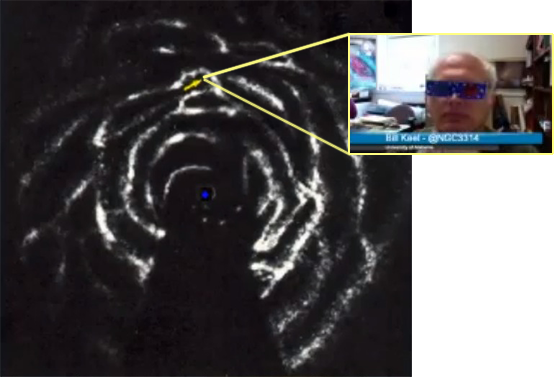
A map of neutral Hydrogen in the Milky Way — complete with yellow “you are here” arrow.
Including our own, of course: we live in a spiral galaxy (though how many arms it has, and whether it’s flocculent, is a matter of debate), and it provides the best means of studying star formation up close. When studying other galaxies, it’s easy to get caught up in the race to discover the biggest, the smallest, the farthest and the most extreme, and forget that our own Universal neighborhood is pretty amazing too.

Herschel sees much longer wavelengths than HST, so its resolution isn’t as high even though it has a bigger mirror. (Click to see a larger version.) Credit: ESA/NASA
For example, one of the most famous nebulae in the world was recently imaged by one of the most famous telescopes in the world — again — but this time in the near-infrared. The Horsehead Nebula is a well-known feature in the Orion star-forming complex, and the new Hubble images provide a great opportunity to learn even more about this region that has been studied for hundreds of years. How thick and cold is the gas and dust in the nebula? How long will it take for it to dissipate under the harsh radiation of the bright, young stars near it? What’s going on behind it?
The near-infrared view from HST is sort of the sweet spot in this spectacular space — the wavelengths aren’t so long that the resolution suffers, but they are long enough that you see through a bit more of the clouds than in the optical. So you see more of the structure of the cloud itself, and more of where it’s thin and thick. If you zoom in, you can even see distant galaxies peeking through! And not just on the edges: in some parts you can see galaxies through the middle of the nebula. Wow. This image alone contains spiral galaxy insights big and small, near and far, from the very distant universe and right in our own backyard.
Note: right at the end of the hangout, we again got another great question from a viewer that we didn’t have time to answer. So stay tuned for the next hangout when we just might have a thing or two to say about dark matter, dark energy and new projects!
More Hubble Features, and More Often!
Here at Zooniverse HQ we’ve been thinking a bit more about those “fuzzy blobs” we talked about during our last hangout. Many of those faint galaxies are among the most distant objects we’ve ever seen, so we really want to learn about how they’ve formed and what they look like, but in some cases they are just too faint to get a really detailed classification. We can probably learn what their overall shape is, and possibly tell whether they’re disturbed or interacting, but spiral arms? Bars? Bulge strength? Not likely. Read More…
Blood Oranges are just like Hubble Galaxies

Astronomers always want better images. Sometimes it’s possible right away; other times doing better requires new technology and/or waiting for the next generation of telescopes. We have both kinds of “fuzzy blobs” in Galaxy Zoo, and during this hangout we showed several examples. For a couple of hangouts now we’ve been meaning to address some of the most frequently asked questions about the faintest, most distant galaxies we ask volunteers to classify:
- what are they?
- why are the images so fuzzy?
- can we get better images of them now or in the future?
Given the data we have, the short answer to the first question is that we don’t yet know for sure — and, perhaps most importantly, we don’t need to know all the details. We can learn quite a lot from classifying even faint, fuzzy objects. Some of the faint galaxies on Galaxy Zoo are among the most distant galaxies ever imaged by the Hubble Space Telescope, and we don’t necessarily expect them to look like galaxies we see more nearby, so classifications from our volunteers are helping us to understand them even when we don’t have all the information we might want.
And what would it take to give us the information we want? What’s the future of astronomy after Hubble? How can we get better data than we have right now? Do we need to go into space to do it? (And what else are we working on right now, anyway?) Answers given in the video:
This is a great time to be working on Galaxy Zoo: there’s plenty to classify and analyze, and — of course — plenty to discuss. So stay tuned for next time!
Note: for those who prefer audio only, here’s a link to the podcast version.
What to do with faint galaxies
We’ve received a number of questions on Talk about what to do with faint galaxies, like this one:

Galaxies like this one are not stars or artifacts, they are just veeeery faint, so faint that even a telescope as powerful as Hubble is stretched to its capabilities to image them. When you do see such a faint galaxy, please just answer the questions as best you can. In this case, I’d call this one “smooth”.

Don’t worry about the pixellation. The Wide Field Camera 3 infrared pixels are larger than those of Hubble’s optical camera, but the resolution is still very high. So, even though you see pixels in the image of the galaxy above, it’s actually well resolved. It just happens to be smooth and featureless…
So, what about this one?

Can you see features despite the noise, or is it smooth? It’s your call. Remember, most of these galaxies haven’t been seen before by humans, so there’s no right or wrong answer. Just do your best!
New Images in the New Galaxy Zoo
This post is the first of a series introducing the new Galaxy Zoo. The second is here, but come back in the next few days for more information about our fabulous new site

As you’ve probably already noticed, the Galaxy Zoo interface got a shiny new facelift thanks to the wizards in the Zooniverse development team, but that’s not all. The site is stuffed with new galaxies! These brand new, never-seen-before images come from two places:
SDSS

The new SDSS images (right), drawn from the latest data release, are better and hopefully easier to classify than the old (left).
You might remember that the original Galaxy Zoo 1 and 2 used images from the Sloan Digital Sky Survey (SDSS), a robotic telescope surveying the ‘local’ Universe from its vantage point in New Mexico. These images are now prepared in a slightly different way, in order to highlight subtle details. To better understand these galaxies, drawn from our own backyard, we’re making those improved images available through the new Zoo classification page. (These are actually new galaxies, from parts of the sky that SDSS hadn’t surveyed when we launched Zoo 2).
Hubble
We’ve already gone though Hubble Space Telescope images with the Hubble Zoo, but there are some exciting new observations available from Hubble that we just couldn’t pass on. In 2009, astronauts on Space Shuttle mission STS-125 visited Hubble for a final time and installed an exciting new camera in the telescope. This camera, called Wide Field Camera 3 (WFC3) can take large (by Hubble standards!) images of the infrared sky.

NASA astronauts installing the new Wide Field Camera 3 on the Hubble Space Telescope during the final Service Mission 4 (credit: NASA).
As we peer deeper into the Universe, we look into the past, and since the universe is expanding, the galaxies we see are moving away from us faster and faster. This means that the light that left them gets stretched by the time it reaches us. Thus, the light from stars gets “redshifted” and to see a galaxy in the early universe as it would appear in visible light locally, we need an infrared camera.

A weird “clumpy” galaxy spied by Hubble in the early universe. Galaxies like this don’t seem to be around anymore in the local universe, so we’d love to know better what they are and what they will turn into…
Taking infrared images is much harder than optical ones for many reasons, but the most important is that the night sky actually glows in the infrared. This fundamentally limits our ability to take deep infrared images, which is why Hubble’s new WFC3 with its infrared capability is so valuable: in space, there’s no night sky! Hubble is currently using the WFC3 to survey several patches of the sky as part of the CANDELS program (more on that soon!) to generate deep infrared images of galaxies in the early universe and we’re asking you to help us sort through them.
Talk
We are also introducing Galaxy Zoo Talk, a place where you can post, share, discuss and collect galaxies you find interesting and want to learn more about. You can of course still join us on the Forum, but Talk will make it easier for you to systematically discuss and analyse your galaxies.
There’s a whole new mountain of galaxies to go through, so happy classifying!
Galaxy Merger Gallery

I’m Joel Miller, I’m just about to start year 13 at The Marlborough School, Woodstock, and I am here at Oxford University working on mergers from the Galaxy Zoo Hubble data as part of my Nuffield Science Bursary. I have/will be looking at the data and plotting graphs to see how the fraction of galaxies which are mergers changes with other factors therefore determining if there is a correlation between these factors and galaxy mergers. Having looked though many images of merging galaxies I found some really amazing ones.


With some of the images from the SDSS I was able to find high-res HST images of the same galaxy and also find out some more information about them.

Spiral Galaxies NGC 5278 and NGC 5279 (Arp 239) in the Constellation of Ursa Major form an M-51-like interacting pair. This group is sometimes called the “telephone receiver”. The galaxies are not only connected via one spiral arm like M-51, but they also have a dimmer bridge between their disks. Spiral galaxies UGC 8671 and MCG +9-22-94 do not have measured red shifts and therefore there is no data on their distances. They may well be a part of a small cluster of galaxies that includes the “telephone receiver”, but this is not determined at this time.
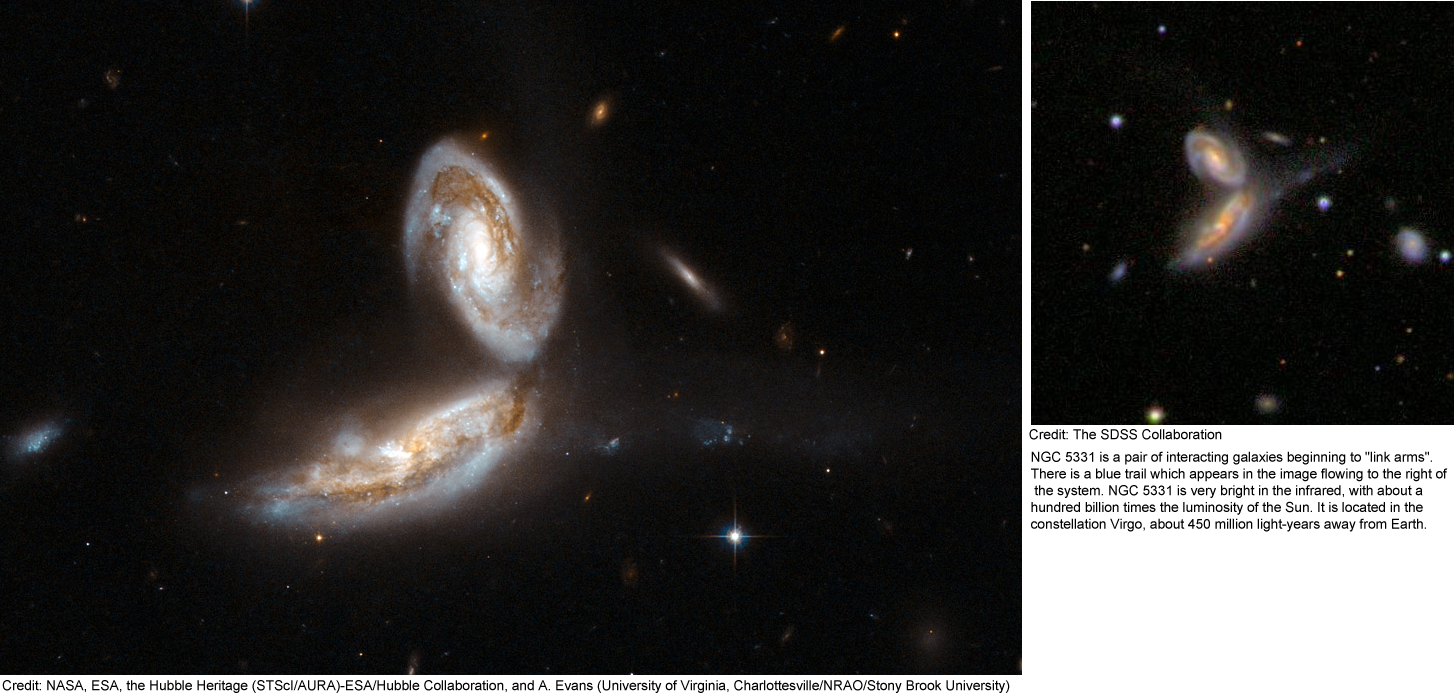
NGC 5331 is a pair of interacting galaxies beginning to “link arms”. There is a blue trail which appears in the image flowing to the right of the system. NGC 5331 is very bright in the infrared, with about a hundred billion times the luminosity of the Sun. It is located in the constellation Virgo, about 450 million light-years away from Earth.

This pair of Spiral Galaxies in Virgo is known as “The Siamese Twins” or “The Butterfly Galaxies”. Both are classic spiral galaxies with small bright nuclei, several knotty arms, and arm segments. Both also have a hint of an inner ring. The pair is thought to be a member of the Virgo Galaxy Cluster. NGC 4568 is currently the host galaxy of Supernova 2004cc (Type Ic) and was also the host of Supernova 1990B a Type Ic that reached a maximum magnitude of 14.4.

Arp 272 is a collision between two spiral galaxies, NGC 6050 and IC 1179, and is part of the Hercules Galaxy Cluster, located in the constellation of Hercules. The galaxy cluster is part of the Great Wall of clusters and superclusters, the largest known structure in the Universe. The two spiral galaxies are linked by their swirling arms and is located about 450 million light-years away from Earth.

This galaxy pair (Arp 240) is composed of two spiral galaxies of similar mass and size, NGC 5257 and NGC 5258. The galaxies are visibly interacting with each other via a bridge of dim stars connecting the two galaxies. Both galaxies have supermassive black holes in their centres and are actively forming new stars in their discs. Arp 240 is located in the constellation Virgo, approximately 300 million light-years away, and is the 240th galaxy in Arp’s Atlas of Peculiar Galaxies.
With the exception of a few foreground stars from our own Milky Way all the objects in this image are galaxies.
 Galaxy Zoo
