Hubble spies the Teacup, and I spy Hubble
Our Hubble image of Voorwerpje galaxies continue to come in, and it seems each one is stranger than the last. Overnight we got our data on the Teacup system (SDSS J143029.88+133912.0). This one attracted attention through a giant emission-line loop over 16,000 light-years in diameter to one side of the nucleus.
I was worried to get email this morning that there had been a failure to lock on to one of the two needed guide stars so that the telescope might have rolled enough during the observations to compromise data quality. Inspecting the data, it looks like we’re OK. We’re OK and the galaxy is strange. This is a composite of [O III] (green) and Hα (red), right out of the software pipeline without any additional processing:

The Teacup AGN in raw emission-line Hubble images
Another giant hole whose origin is obscure. The loop doesn’t even show much sign of being connected to the galaxy. The strongest [O III] does seem to trace out ionization cones, as in showing from structures near the nucleus, but that seems independent of the distribution of the gas. There are filaments in the gas that are nearly parallel, sort of like waves. Well have our work cut out for us to understand more of what’s going on here. I can hardly wait for the next one!
There was an extra treat for me with these observations. Last night, I interrupted a session with my summer class at the campus observatory to look south with binoculars and catch Hubble passing far to the southeast, no more than 13 degrees from our horizon. This was during the Hα exposure, so I saw it while it was doing these observations (it was pointed just about up in my frame of reference, as it happens). I got a picture through a 125mm telescope, showing the telescope streaking by just north of the star k Lupi. At the time, Hubble was 1600 km away over Cuba. Hubble was watching the Teacup, I was watching Hubble, and a couple of slightly puzzled students were watching me.

Hubble trails across the sky north of the star k Lupi in this telescopic view.
Greetings from Anchorage Alaska!
Hi all,
I’ve just arrived at the American Astronomical Society 220th meeting in Anchorage AK (#aas220 on Twitter, follow it). Quite a few people working on the Zoo are here too and it promises to be an exciting meeting.
But what I really wanted to share was this sign spotted by a cafe just outside the conference venue:

Update: the coffee store put up a new sign:

Also, thanks to the Zooite who came to chat to Steph at the Galaxy Zoo AGN inclination poster!
Chandra X-ray Observations of Mergers found in the Zoo Published
I hope you all had clear skies during the Transit of Venus. If not, it’ll be over a hundred years before you get another chance…. and in Zoo-related news, the Transit of Venus is an example of one way we find planets around other stars. We look for a dip in the brightness of the star as a planet moves across it from our point of view. Want to know more? Head over to the Planethunters blog, or put in some clicks looking for transits yourself!
So, in actual Galaxy Zoo news, I am very happy to report that the latest Galaxy Zoo study has been accepted for publication in the Astrophysical Journal. As we blogged a while back, we got Chandra X-ray time to observe a small sample of major mergers found by the Galaxy Zoo to look for double black holes. The idea is to look for the two black holes presumably brought into the merger by the two galaxies and see if we find both of them feeding by looking for them with an X-ray telescope (i.e. Chandra).
The lead author of the paper is Stacy Teng, a NASA postdoctoral fellow at NASA’s Goddard Space Flight Center and an expert on X-ray data analysis. In a sample of 12 merging galaxies, we find just one double active nucleus.

Image of the one merger with two feeding black holes. The white contours are the optical (SDSS) image while the pixels are X-rays. The red pixels are soft (low energy) X-ray photons, while the blue are hard (high energy) photons. You can see that both nuclei of the merger are visible in X-rays emitted by feeding supermassive black holes.
We submitted the resulting paper to the Astrophysical Journal where it underwent peer review. The reviewer suggested some changes and clarifications and so the paper was accepted for publication.
You can find the full paper in a variety of formats, including PDF, on the arxiv.
So what’s next? We submitted a proposal, led by Stacy, for the current Chandra cycle. To do a bigger, more comprehensive search for double black holes in mergers to put some real constraints on their abundance and properties. We hope to hear about whether the proposal is approved some time later this summer, so stay tuned and follow us on Twitter for breaking news!
We got Radio Observing Time
Observing Time Update from Ivy Wong:
The majority of the galaxies that we observe can be divided distinctly into 2 categories: star-forming spirals (late-types) and non-star-forming spheroidals (early-types). The purpose of my research is to study how one type of galaxies transform into the other. In a previous Zoo project, we studied a sample of local post-starburst galaxies— galaxies which have only recently stopped forming stars. Even though star formation has only recently ceased for these transition-type galaxies, they already have the same shape as that of non-star-forming galaxies.
To further investigate how the shape of a galaxy correlates with its colour (or star formation history), we now focus our efforts onto a sample of blue early-type galaxies (found by Zookeeper Kevin) which are thought to be the progenitors of the post-starburst galaxies. Blue early-types are unusual relative to regular early-types because they appear to still be forming stars. Why are they still forming stars? Did a recent interaction trigger this new wave of star formation ?
In other studies that I have made of nearby galaxies, I have found that studying the gas content (atomic hydrogen; HI) of galaxies is a good way of finding evidence for past interactions as well as a good way of finding galaxies which are still forming stars. This is because stars are formed from an initial reservoir of gas. The gas reservoir of a galaxy is highly sensitive to environmental effects and will show tell-tale features such as tidal tails and bridges which can point to external factors affecting the galaxy’s evolution.
We recently proposed for observing time to use the Westerbork Synthesis Radio Telescope (Netherlands) to map the HI content of a sample of 6 Northern blue early-types. It is extremely difficult to map HI because the emission comes from the spin-flip of the electron in the Hydrogen atom. We recently found out that we have gotten some non-guaranteed time to use the WSRT so in the event that all goes well, I hope to post some HI maps of these blue early-types.
Live Chat – Hangout with Us
2012 is turning out to be a great year for Galaxy Zoo science. From Voorwerpjes to mergers to barred galaxies, there is lots to talk about right now when it comes to Galaxy Zoo. Tomorrow afternoon we’ll be holding a live chat with Galaxy Zoo science team stars Chris Lintott and Karen Masters. Starting at 2pm British Summer Time (1300 UT, 9am in New York, 3pm in Paris), Chris and Karen will be answering your questions and talking about some of the recent Galaxy Zoo work, made possible why your efforts on galaxyzoo.org.

If you have anything you’d like to them to discuss, or any questions you’d like them answer, then please either leave a comment here or Tweet us @galaxyzoo. We’ll also take questions via Twitter during the live chat.
You can watch the live chat right here on the blog, via our YouTube channel, where the video will also be posted afterwards. We’ll put links here, as well as on Facebook and Twitter, nearer the time. We’ll be using Google Hangouts for the live chat, so you can add the Zooniverse’s Google+ page to your own Google+ circles and connect that way too.
UPDATE: The live chat will begin shortly. The video feed will be visible here nearer the time.
Multi-wavelength Viewer for Galaxy Zoo
Hi again,
We have the first tool in an alpha state online. The Multi-wavelength Viewer can be accessed at:
You will be able to visualize any SDSS galaxies that you classified in the current iteration of Galaxy Zoo. We provide all five filters of the galaxy (U, G, R, I, Z), and offer you tools to scale and stretch the pixels in this image. There is quite a large todo list for this tool, but feel free to ask questions and offer feedback.
Enjoy!
Amit
New paper on the Galaxy Zoo bars accepted to MNRAS
I’m delighted to announce that the latest paper based on Galaxy Zoo classifications was accepted to appear in the Monthly Notices of the Royal Astronomical Society earlier this week, and appears on the arxiv this morning (link).
Usually there is a long delay between submission and acceptance of papers (something Kevin discussed on this blog in “What Happens Next – Peer Review“), but in this case the initial referee report came back after 2 days, and the paper was accepted only 2 weeks after the first submission so I never got time to post to the arxiv or write a blog post about it before it was accepted! This was certainly the smoothest and fastest referee process I’ve been through. 😉
Here’s the title page.
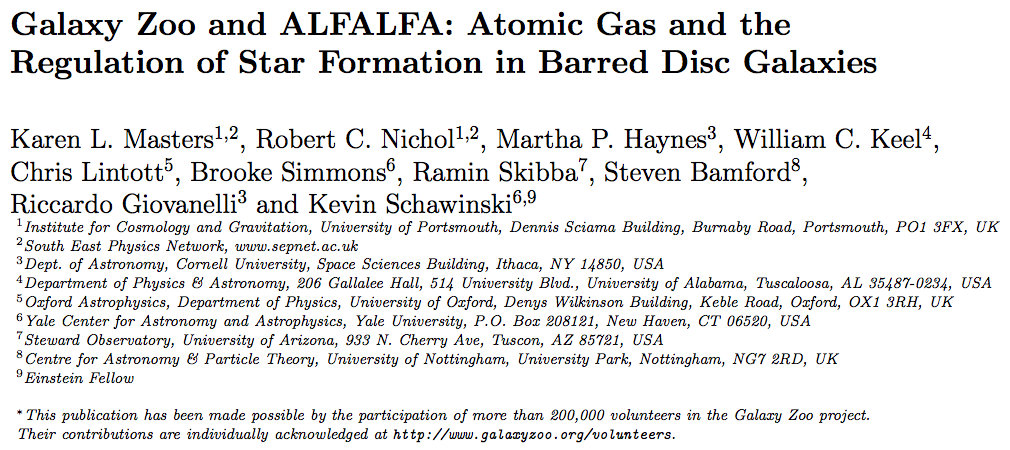
So what was new about this paper was that we combined information on the morphologies (whether or not the spiral galaxies had bars) with information on the amount of atomic hydrogen gas the galaxies contained and and our main result was that galaxies with more atomic gas in them, are less likely to have a bar.
But I want to back up a bit first and tell you about where we get this information on the atomic gas content, and why it might be interesting. As you might guess from the title of the paper it’s from something called the ALFALFA survey (and the new names in the author list for a Galaxy Zoo paper – Martha Haynes and Riccardo Giovanelli – are from Cornell University who are running this survey). Atomic hydrogen emits radio waves at a frequency of 1.4 GHz (or 21cm). This is detectable by a classic radio telescope (in what we call the “L”-band which makes up the second L of ALFALFA). In the case of ALFALFA, we use the Arecibo radio telescope (two of the “A”s in the acronym stand for Arecibo, the third is for array), which is the worlds biggest single dish radio telescope deep in the jungle of Puerto Rico.
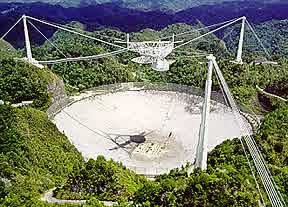
Aerial shot of Arecibo. Credit: NAIC.
ALFALFA is a massive survey which will map the location of atomic hydrogen over basically the whole sky visible to the Arecibo radio telescope. What’s neat about a survey for something which emits as a specific frequency is that you actually get a 3D map of where the hydrogen is – both redshift and sky position! Anyway, we made use of about 40% of the survey which is already complete, and which covers about 25% of the area of the sky in which the Galaxy Zoo galaxies are found (the Sloan Digital Sky Survey Legacy Area). Adding some cuts on how face-on the galaxies are so that the bars can be identified, and to make sure the sample contains the same size galaxies right through it’s volume we ended up with 2090 galaxies with both atomic hydrogen detections and bar classifications from you guys. This is an order of magnitude larger than any similar sample! So thanks. 🙂
Atomic hydrogen is the basic building block of galaxies (after dark matter). It represents the fuel for future star formation in a galaxy – a galaxy with a lot of atomic hydrogen could in principle make a lot of new stars. Many spiral galaxies have a lot of atomic hydrogen (with perhaps as much as 10 times as much mass in hydrogen as in stars!), while a typical elliptical galaxy has very little atomic gas, and so cannot form lots of new stars.
So our observation that bars are more likely to be found in spiral galaxies with less atomic gas supports our earlier ideas about bars possibly “killing” spirals (ie. helping to stop them form stars).
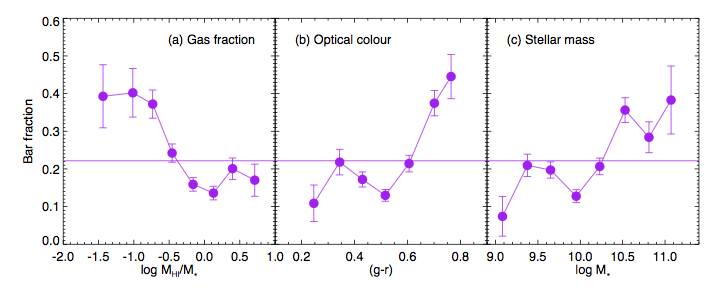
Trends of bar fraction with atomic gas content, galaxy colour and how many stars are in a galaxy.
Of course it’s never quite that straightforward with galaxies. To start with correlation is not the same as causation, and to that we add that lots of things are correlated. We show some of that in the figure above. Bars are more likely in redder spirals which have more stars (“log Mstar” represents stellar mass in units relative to the mass of our Sun) and which also have less atomic gas. So the skeptical astronomer could say this has nothing to do with the gas content at all, just that the types/sizes of galaxies with less bars have more gas. To test that idea we measured the typical gas content of a spiral galaxy with a given number of stars, and from that we calculated how “deficient” or rich in atomic hydrogen any given galaxy was. Then we plotted the bar fraction against that. The convention in astronomy is to call how much less atomic hydrogen a galaxy has than normal it’s “HI deficiency” which gets bigger the less atomic hydrogen there is (from the people who brought you the magnitude scale!).

Bar fraction against how much more or less atomic gas a galaxy has than is typical for the number of stars it has. Bigger HI deficiency = less atomic gas than is normal for a galaxy’s size.
Anyway you can see we still see a clear trend, which demonstrates that it’s likely to be the atomic gas driving the correlation. Where a galaxy is richer in atomic hydrogen than normal it’s less likely to host a bar, and vice versa. Very atomic hydrogen rich galaxies which are massive and have bars are really quite rare!
Here are some examples of low and high mass galaxies which are gas rich or poor and with or without bars. 🙂

Example images.
I made images of the whole sample we use available here.
At the end of the paper we put forward three possible explanations for the correlation, all of which fit in with the observations we presented. It’s possible that the bars are causing the atomic gas in galaxies to be used up faster – “killing” the galaxy. The bar does this by driving the gas to the centre of the galaxy where it gets denser, turns into molecular hydrogen and from that stars (but only in the centre). It’s also possible (based on dynamical studies of galaxies) that gas slows down the formation of a bar in a spiral galaxy, and/or destroys the bar. Finally it’s possible that as a galaxy interacts with its neighbours, a bar gets triggered and its gas gets stripped (ie. the correlation between the two is caused by an external process). We’ll need to do more work to figure out which of these (or which combination of them) is the most important.
To my mind the most interesting result was a hint that if a gas rich galaxy does (rarely) host a bar, it’s optically redder than similar galaxies without bars. It’s just possible that bars hold back infall of gas from the outer regions of a spiral galaxy and slow down star formation over all in that galaxy. That idea needs testing, but if it’s true it’s saying that an internal structure like a bar plays an important role in the global star formation history of a galaxy.
Anyway thanks again for the classifications, and I hope the above made at least some sense! 😉
Curiouser and curiouser – Hubble and Mkn 1498
Fresh off the telescope, here’s a first view of the “Voorwerpje” gas clouds around the Seyfert galaxy Markarian 1498. Its nucleus, shown in our Lick and Kitt Peak spectra, is a type 1 Seyfert, meaning that we see the broad-line region of gas very close to the central black hole, moving at high velocity. Those data showed highly-ionized gas to a radius of at least 20 kiloparsecs (65,000 light-years). Its nucleus is too dim to account for the ionization of the extended gas clouds, which landed it a spot in our list of seven objects for the Hubble proposal. Getting these data now was an unexpected treat – they were originally scheduled to be taken next November. As another bonus, the good people at the Space Telescope Science Institute just last week implemented the software to deal with charge-transfer problems in the Advanced Camera CCDs, right in the pipeline, improving the image quality a lot (it took months to get to this point with the Hanny’s Voorwerp data). And here it is, Markarian 1498 in a combination of [O III] emission (green) and Hα (red):

This is… interesting. From the few of these galaxies where we have data so far, loops of ionized gas near the nucleus may be a recurring theme. I could add speculations on what we’re seeing in Mkn 1498 – but for now, I’ll just let everyone enjoy the spectacle.
My Galaxies – Write in Starlight
Long time Zookeeper Steven Bamford has made a new website on which you can easilly write any words you like from the galaxy alphabet.He’s called the website: My Galaxies – Write in Starlight!


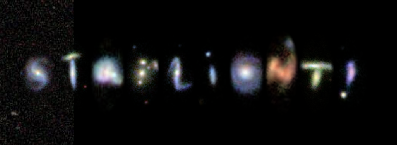
Enjoy!
My favourite colour magnitude diagram
I was embarrassed to discover today that I never got around to writing a full blog post explaining our work studying the properties of the red spirals, as I promised way back in October 2009. Chris wrote a lovely post about it “Red Spirals at Night, Astronomers Delight“, and in my defense new science results from Zoo2, and a few other small (tiny people) things distracted me.
I won’t go back to explaining the whole thing again now, but one thing missing on the blog is the colour magnitude diagram which demonstrates how we shifted through thousands of galaxies (with your help) to find just 294 truly red, disc dominated and face-on spirals.
A colour magnitude diagram is one of the favourite plots of extragalactic astronomers these days. That’s because galaxies fall into two distinct regions on it which are linked to their evolution. You can see that in the grey scale contours below which is illustrating the location of all of the galaxies we started with from Galaxy Zoo. The plot shows astronomical colour up the y-axis (in this case (g-r) colour), with what astronomers call red being up and blue dow. Along the x-axis is absolute magnitude – or astronomers version of how luminous (how many stars effectively) the galaxy is. Bigger and brighter is to the right.
So you see the greyscale indicating a “red sequence” at the top, and a “blue cloud” at the bottom. In both cases brighter galaxies are redder.
The standard picture before Galaxy Zoo (ie. with small numbers of galaxies with morphological types) was that red sequence galaxies are ellipticals (or at least early-types) and you find spirals in the blue cloud. The coloured dots on this picture show the face-on spirals in the red sequence (above the line which we decided was a lower limit to be considered definitely on the red sequence). The different colours indicate how but the bulge is in the spiral galaxy – in the end we only included in the study the green and blue points which had small bulges, since we know the bulges of spiral galaxies are red. These 294 galaxies represented just 6% of spiral galaxies of their kind.

So this is one of my favourite versions of the colour magnitude diagram.
 Galaxy Zoo